Type C Nimbus
Years produced: 1934-1959
Total production: 12,500 (est.)
Claimed power: 18-22hp @ 4,500rpm
Top speed: 70mph (no sidecar)
Engine type: 746cc overhead cam, air-cooled inline four
Weight (dry): 185kg (408lb)
Price then: $1,200 (std. model, approx.)
Price now: $6,500-$11,000
MPG: 55

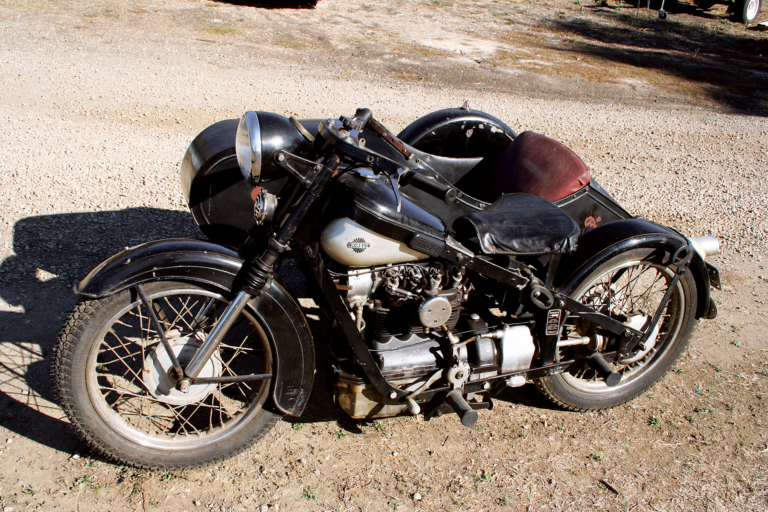
A slow run down a country road. Stopping to smell the roses, having a picnic, or maybe working in a California vineyard, the sidecar holding baskets full of grapes and bags full of fertilizer — or just going to check that the irrigation is working right — that’s the purpose of this Type C Nimbus motorcycle sidecar rig.
And that is the workaday reality of the fine machine portrayed here, still in its original 50-year-old livery, not all spruced up with flashy paint and polished chrome. After all, when was the last time you saw a real farmer detailing his elderly John Deere tractor?
Read Jamie Spitzley’s review of owning and riding the 1957 Type C Nimbus
No, this Nimbus motorcycle is not one of those shiny restorations, nor is it the machine you want for running along the Interstate at 80mph or ripping past Porsches while going over 12,000ft Independence Pass. This was intended to be a utilitarian workhorse, a back-woods hauler; run it slow, and it would run nigh on forever.

This makes sense when you appreciate that this machine was originally conceived in the small, flat nation of Denmark back in 1915, when roads were unpaved and motor vehicles still made way for horse-drawn wagons.
This 1957 Type C Nimbus, the third rendition of the Nimbus, is powered by an inline 750cc four, with a single overhead camshaft, three-speed transmission and shaft drive. The engine and gearbox are bolted into a strap-steel frame, rigid-style with no rear suspension and telescoping front forks.
With a modest 5.4:1 compression ratio, the engine starts first kick, will cheerfully idle all day long, and will last for many years if the external valve mechanism is occasionally lubricated. In line with the Danish thinking on sensible environmental policies, the crankcase breather runs straight into the body of the slide carburetor, ensuring maximum combustion of all petroleum by-products and minimal contamination of the air.
The sidecar has a tubular frame with four points of attachment and a pair of leaf springs, one on each side of the car, to absorb the bumps. The third wheel has no brake, a good indication that the manufacturer thought of this rig as a practical, rather than a sporting, vehicle.
Back to the Beginning
In 1903, a Dane named Peder Fisker left his homeland to go off and see the New World. After two years in the United States and other countries, he returned home to make his fortune. In 1906, he teamed up with a fellow named Hans Marius Nielsen, and they were soon producing small electric motors for use in household appliances. Fisker & Nielsen, Ltd., had an electric vacuum cleaner on the market in 1910 and did great business. Fisker bought out Nielsen that same year, but kept the company name intact.

Time marched on, and Denmark watched as larger nations tried to destroy each other in World War I, as the Danish government remained neutral. It was the war that prompted Fisker to realize that the horse was on its way out, and that auto-motion, on two wheels and four, was the way of the future.
In 1916, Fisker decided to build a motorcycle and to incorporate modern automotive knowledge in its design. Inline, four-cylinder engines mounted lengthwise in the frame were popular at the time, and Fisker decided the four-cylinder arrangement was desirable, as it could provide a good deal of torque at low rpm, meaning that neither high revs nor high horsepower were essential.
On the first Nimbus motorcycle the four cylinders were cast separately, with lots of finning to carry away engine heat. An inlet-over-exhaust valve design was used, and the carburetor was designed in-house with an eye for economy rather than power. Ignition was by a Bosch magneto and the engine, with a compression ratio of 5:1, reputedly put out some 9hp, quite respectable for that day and age and good for about 45mph. A Fisker-designed generator and electric lighting was available.

Power transferred from the crankshaft via a wet, multi-plate clutch to the three-speed transmission. The shift lever was on the right side of the gas tank, and the clutch had both foot and hand operation. Final drive was by shaft, but the Nimbus motorcycle was more sophisticated than its competitors in that it had a flexible shaft to accommodate its swingarm rear suspension, a rather new notion 90 years ago. A set of “triple-stem” forks, meaning three girders on each side of the wheel, was at the front, with the springs contained in the middle tubes.
The frame was most unconventional. A large top frame tube doubling as the gas tank provided the main strength, and the engine was held in a welded cradle below this backbone. There was no front brake, but the expanding/contracting rear-wheel brake could be operated by both a hand lever and foot pedal. Late in 1918 the first Nimbus rolled out onto Danish roads, and knowledgeable riders greeted it for the well-thought-out and well-made machine it was.
In 1924 a new leading-link girder fork design was used, and this model was referred to as the Nimbus Type B, its predecessor known retroactively as the Type A. However, Fisker soon realized the problem of building his motorcycle up to a very high standard. With cheaper units coming out of factories all over Europe, Fisker decided to halt production in 1927. Fewer than 1,300 Nimbuses had been built and sold by then.
A Second Try
After this, Fisker & Nielson concentrated on Nilfisk vacuum cleaners and other household appliances until the Great Depression descended on Europe. When country after country imposed protectionist legislation to limit imports, Peder’s son, Anders, decided to have a go at building a motorcycle. He had in mind a more practical machine for use by the army. And this time it would be built with price in mind; he looked at the old Nimbus and sat down with a sheet of paper around 1932 to start contemplating changes.
The first thing to go was the rear suspension. Danish roads had improved considerably over the years, and a well-sprung saddle would make up the difference. The front suspension would be a pair of telescoping tubes, which was cheaper to build than a complicated girder fork.

There was one small problem here, in that the tubes held only springs and had no provision for damping. Riders would learn to live with the occasional boing-boing operation, although dealers recommended bending the inner fork tubes a little bit in order to create some “stiction.” Those “low” forks could be considered an early version of the upside-down design so popular today, as the gaiters covering the moving sliders were down by the axle.
The frame was unconventional, as it was riveted together from pieces of strap steel, giving the bike a very industrial look, but it was easy to fix in case the rider bent a part of it. Braking was by single-leading-shoe drums, fore and aft.
The engine’s inline four-cylinder arrangement remained, but this time the cylinders were cast as a unit. The compression ratio was kept low to avoid overheating problems. Two large ball bearings supported the crankshaft, rather than the previous three bearings, and lubrication was by full pressure, which kept all the bearings well oiled, including those in the gear box. The clutch was changed to a dry, single-plate system, but shifting was still done by hand. The shaft drive had no seals or internal lubrication, serving quite happily with an occasional shot of grease to the fitting on the hub, despite the manuals’ recommendation of repacking the grease each year.

Anders settled on a then-modern overhead camshaft engine design. Drive was via a bevel-driven vertical shaft at the front of the engine, which also spun the dynamo. The combustion chambers were hemispherical in shape, the valves angling in with rocker arms and valve stems quite exposed. For whatever reason, the factory did not see the need to enclose the valves, nor lubricate them. The presumption being, one supposes, that the practical fellow who purchased such a machine would have the good sense to lube the valve stems on occasion. As the manual notes: “If the valves should stick they may be squirted with kerosene (paraffin) or a light cylinder oil.”

The handlebars were not “bars”, but a stout steel pressing, with very short round bars fitted into each end, the right one operating the throttle, the left the headlight.
Birth of the Type C
The Type C was introduced in 1934. With a compression ratio of 5:1, the engine was rated at 18 horses. The factory didn’t mind the cheerful banter proclaiming it was built so it could be completely stripped down to the crankshaft with just a couple of wrenches and a screwdriver.
This was an immensely practical vehicle, especially with the car on the side; the factory built the chassis, but the sidecar bodies were actually made by other companies. The young dandy could get a passenger body and take his girlfriend for a ride, while the postman could mount a large box and do his rounds. A plumber could order up a container specifically built to hold all the tools of his trade, along with the pipes and such that he would need.
The Type C met with modest success. A Sport model was built, with the compression ratio upped to a heady 5.7:1, and improvements were made to the Sport’s telescopic forks, giving a measurable amount of damping later incorporated in the Standard model. A foot-operated gear change was also introduced by 1939.
After World War II the company incorporated several small changes. The power output of the engine, now with a 5.4:1 compression ratio, was put at 22hp at 4,500 rpm. The new oil-damped forks were called the “tall” forks, the rubber gaiters protecting the sliders now above the front fender; four grease fittings kept the tubes sliding smoothly. And instead of springs under the saddles, there were now hefty rubber bands doing the job.
A solo rig weighed in at a little over 400lb, with a sidecar adding another 150lb. In terms of performance, the solo model, with 4:1 gearing, was good for 70mph, while the sidecar outfit with lower, optional 4.9:1 gearing would top out at 50mph.
In the late 1950s designers thought about several other minor changes. One was to cover the valves, another to use Earles-type triangulated forks since most of the machines were being used with sidecars. However, the handwriting was on the wall when the Ariel Square Four and two-cylinder Zundapp KS-601 came on the Danish market.
The Nimbus assembly plant was closed in 1959, although a few machines were built from supplies over the next year. Figures are imprecise, but it is calculated that about 12,500 Type C models were built. Many of them are still running today, still in used as the workhorses they were designed to be. MC
Nimbus Timeline
1906: Peder Fisker joins with friend Hans Marius Nielsen to produce small electric motors.
1910: First Nilfisk vacuum cleaner introduced.
1918: First Nimbus is produced.
1924: New trailing-link forks put on Nimbus, which led to the Type B designation.
1927: Nimbus production ceases, due to the high cost of the motorcycle.
1934: First Type C produced.
1938: Sport model, with slight increase in horsepower, is introduced.
1959: End of the Nimbus era, but Nilfisk vacuum cleaners are still being made.
Nimbus Resources
• Danish Nimbus Club
• US Nimbus Club
• Danish Nimbus Site
Read more about this motorcycle:
• Jamie Spitzley’s review of owning and riding a 1957 Type C Nimbus Motorcycle