1921 Indian Powerplus
Claimed Power: 8hp
Engine: 1,189cc (72.59ci) air-cooled side valve 42-degree V-twin, 82.5mm x 111mm (3-1/4in x 4-3/8in) bore and stroke
Weight (wet): 430lb (195kg)
Fuel capacity: 2.5gal (9.5ltr) gas/2.5qt (2.4ltr) oil
Price then/now: $510 (1921)/$15,000-$25,000
Modern motorcyclists have it easy. Suit up in comfortable riding gear constructed of space-age materials, swing a leg over the saddle, insert key, turn ignition on, thumb the starter button. Hey, presto, it’s running. Shift into first gear with a snick of the foot change lever, and away you go.
It’s not quite as easy for an enthusiast riding a machine of the veteran era. Controls abound, with levers, knobs and twist grips working everything from exhaust valve releases to ignition timing.
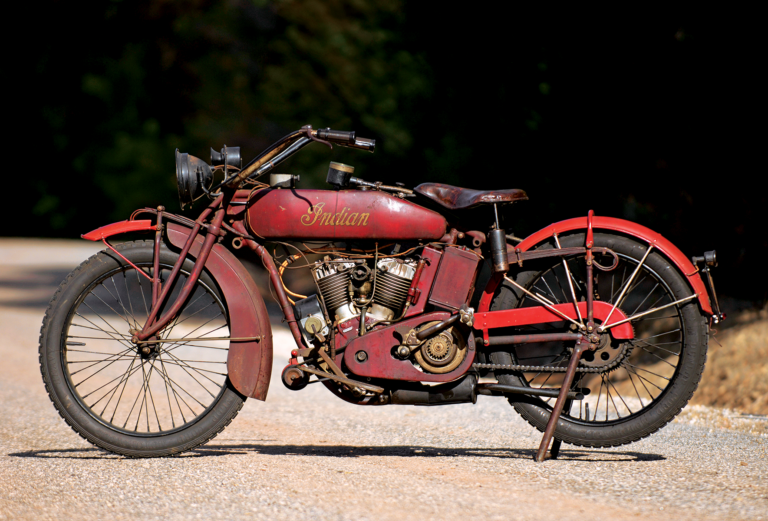
Such is the case with a machine like this 1921 Indian Powerplus, a uniquely rare machine (more on that later) that is fairly representative of other motorcycles of the era. On the handlebar are a right-hand twist grip spark control, a left-hand twist grip throttle and a left-hand lever actuating an external rear brake. A foot pedal for the clutch is on the left, while a foot pedal working an internal rear brake drum is on the right.

On the right side of the gas tank is a hand clutch lever, together with a shifter moving in a vertical plane and an exhaust valve lifter. Such a motorcycle is a busy yet charming machine to ride; at least it has a kickstarter, clutch and a 3-speed gearbox. Earlier models were more primitive, retaining bicycle pedal cranks for starting.
A truly modern motorcycle … in 1916
Motorcyclists and policemen of the day would have been overjoyed at the prospect of having a “modern” Indian Powerplus. Introduced in 1916, the Powerplus featured a new 61ci side-valve L-head engine, replacing the F-head (inlet-over-exhaust) layout first designed in 1901 by Indian Motocycle co-founder Oscar Hedstrom. It was Hedstrom’s V-twin engine that brought the company success at the 1911 Isle of Man TT races, where Oliver Godfrey was the first to ride a non-English machine to a TT win; Indian took the top three positions. By the time of the Powerplus in 1916, Indian founders Hedstrom and George Hendee had taken their not-insignificant earnings, purchased country estates and retired from the fledgling motorcycle industry they had helped create.

Charles Gustafson, Sr., who had early ties to the Reading Standard Co. of Pennsylvania, was the man behind Indian’s side-valve engine. According to Jerry Hatfield’s Illustrated Indian Motorcycle Buyer’s Guide, the Indian Powerplus engine initially met with resistance from Hedstrom loyalists, who preferred the F-head design. However, Hatfield writes, “a Powerplus test ride was sufficient enough to convert them because of the extra punch of the new side-valve engine.”
A 1916 Indian sales brochure claims the company had been working on the Powerplus for some three years prior to its introduction. “This new power unit is designed on very neat and practical lines,” Indian’s copywriters exclaimed. “The cam mechanism and timing gears are placed on the outside of the crankcase, the whole (including the mechanical oil pump, which on this new engine is placed horizontally, and driven direct from the mainshaft) being covered by one neat oil-proof plate.”
The Indian Powerplus featured a 3-1/8-inch bore and 3-31/32-inch stroke (a smaller bore and longer stroke than the F-head). Indian assured customers this arrangement offered greater power and flexibility at higher speeds, and would provide ample torque for sidecar work.

Cylinders and heads were cast in one piece, with telescoping covers protecting the four valve stems and their springs on the right-hand side of the engine. Large threaded caps in the heads unscrewed to allow valve removal. Lubrication was no longer total-loss; Indian was now recirculating surplus oil rather than forcing it out of the engine. Heavier construction connecting rods rotated on larger big-end bearings, with the crankshaft supported by roller bearings on the timing side and a plain bearing on the drive side. Although rated at 7 horsepower, Indian claimed the 61ci Powerplus developed between 15 to 18 horsepower when tested on a dynamometer.
The new Powerplus engine was installed into the older F-head’s frame, with many of that machine’s other components, including gearbox, clutch, fenders, gas and oil tanks, and handlebar, also used.
According to Hatfield, in 1917 Indian modified the Powerplus engine by lengthening the barrels and pistons a quarter-inch and relocating the piston wrist pin to below piston center. These changes helped cure piston slap, while new valve caps featured integral cooling fins to aide heat dissipation.

A 1918 Indian brochure proclaimed the company’s confidence in the Powerplus, noting small changes to the fork and its leaf spring, handlebar, muffler and gearbox adjuster. “For the third consecutive year the Powerplus Motor remains the swiftest, most powerful, simplest, strongest, cleanest, most accessible stock motor ever put into a motorcycle frame — the same motor that has, for over two years, most decisively demonstrated its ability to far outmatch, in long or short demonstrations, even its closest competitor.”
A larger, 72ci twin (actually 72.59ci or 1,189cc, but period literature refers to it as a 72ci unit) was introduced in 1920, and was sold alongside the 61ci version. The 72ci engine was only built for a few years, and machines fitted with the larger engine included a “P” designation in the engine serial number.
Sprung frame
Indian was far ahead of the competition in one particular area: rear suspension. In 1913, the company introduced what it dubbed the Cradle Spring Frame. “Riding on the Indian is like riding on air, so smooth is its running,” crowed Indian sales literature. “There’s no strain on the nervous system and no unnecessary jarring of the machine and fittings.” With the exception of some economy rigid frame 1916 models, almost every Indian Powerplus produced between 1916 and 1922 featured the Indian Cradle Spring Frame.
By 1921, the year of the Powerplus featured here and owned by photographer Gary Phelps of Ventura, Calif., the model had been in production for six years. It was close to the end of the line, thanks in part to Indian designer Charles B. Franklin’s introduction of the 37ci Scout in 1920 and the new 61ci Chief in 1922. For 1923, the Powerplus was renamed the Standard, and production of the model ceased in 1924.

Surprisingly, the new Scout and Chief motorcycles were fitted with a rigid frame, Indian having decided that a swingarm rear suspension was too advanced for riders of the day. That and, according to author Hatfield, “Excelsior and Harley-Davidson had done a good job of convincing riders that the Cradle Spring Frame caused broken chains.”
The Phelps’ Indian Powerplus
Gary’s dad, Bud, purchased this Powerplus in 1991 as part of a package deal that included a 1933 Indian Four (1933 Indian Four, September/October 2011). The Powerplus was sold as a 1918 model, and while Gary was always suspicious that dating was incorrect, he couldn’t find anything to prove it. Yet whenever possible, Gary would compare his Powerplus to others he saw at motorcycle shows, searching for clues from its serial number, SP-893. Eventually, he discovered a reference to the SP designation in a 1916-1923 Indian Powerplus parts book, and the fact that the P, as earlier mentioned, denotes a Powerplus 72ci engine.

Here’s where that uniquely rare part comes into play, because it turns out that Gary’s Powerplus is a model NEP-21; N for Powerplus, E for Electrical, and P for the 72ci engine. The 21 stands for the year, 1921. Although Indian aficionados are familiar with the famous 1,206cc, 74ci engine used in the Big Chief starting in 1923, many are unaware of the 1,189cc, 72ci Powerplus engine, which was only built from 1920-1922. There was also an NP model, a 72ci Powerplus without electrical.
The 61ci variants were NE, the N again for Powerplus and the E for Electrical, and finally the N for the base Powerplus, sans electrical gear.
As purchased, the Phelps’ Indian wore most of its original patina. However, at some point in its life someone, whether to hide rust or in a failed attempt at customization, painted the hinged front fender tip, chain guard, generator mount, rear fender and top loop of the cradle spring system a brighter shade of red. These bits were sprayed in place, as evidenced by red overspray on the rear tire and several nuts and bolts.
Every other piece of the machine is original Indian red, including the Powerplus crankcases. Most of the engine nuts and bolt heads are free of wrench marks, and Gary wonders if the engine has ever been apart.

Over the years, Gary has replaced a torn saddle with a very good, correct for 1921, original condition seat, installed new spark plug wires and inner tubes, and soldered a seam on the oil tank. Not surprisingly, there’s always something to attend to on a motorcycle this old.
Getting the Powerplus ready for our photo shoot, Gary went through his maintenance checklist, which includes changing the gearbox lubricant. After removing the drain plug, there wasn’t a dribble of fluid.
“I filled it up and it started seeping out at the bottom of the transmission side cover,” Gary says. “I went to tighten the bottom bolt, and I could move it with my fingers and, of course, it wouldn’t tighten up.” That bolt is actually a stud threaded at both ends, with a slot in one end for a screwdriver. Gary was concerned the threads in the case were stripped, but he discovered the problem was the threads on the stud. He found a used stud at David Hansen’s The Shop in Ventura, Calif., cleaned it up, and threaded it home with blue Loctite to keep it in place. “It tightened up and stopped the leak,” Gary says, adding, “I got lucky.”
While the Indian Powerplus is fitted with a Splitdorf 6-volt generator and electric horn and lights, Gary doesn’t use the system and says he has no intention of riding the Powerplus at night. He does ride the Powerplus occasionally, however, firing it up for a tool around the neighborhood several times a year.

“There’s not much for brakes,” Gary says about riding the Powerplus. “You have to plan your stops and just hope you don’t have to perform a panic stop. It’s a back roads kind of bike. You’ve really got to keep concentrating while you’re riding it — there’s a lot going on. I’m not sure how much springing the cradle frame actually provides; I’m thinking about so many other things, my comfort is the last thing I’m concerned about.”

So the next time you casually thumb the starter button and ride off into the sunset, consider what it was like going for a simple ride 90 years ago. After owning his Powerplus, Gary has tremendous respect for riders who, back in the day, used bikes like this on a regular basis. “I can’t imagine how someone like a motorcycle cop would have managed on something like the Powerplus. They’re very busy to ride,” Gary says. Busy, yes, but highly entertaining, as Gary will also attest. MC
Editor’s note: Videographer Jeremy Mazur was with Gary Phelps while photographing the Indian Powerplus. Click here then scroll down the page until you see “Magazine Shoot” to view the short video Jeremy took of Gary and the Indian Powerplus.