Bridgestone 350 GTR
Years produced: 1967-1971
Total production: 9,000 (est.)
Claimed power: 37hp @ 7,500rpm
Top speed: 95mph
Engine type: 345cc two-stroke, air-cooled parallel twin
Weight (dry): 160.6kg (354lb)
Price then: $695 (1970)
Price now: $1,800-$4,000
MPG: 45 (est.)
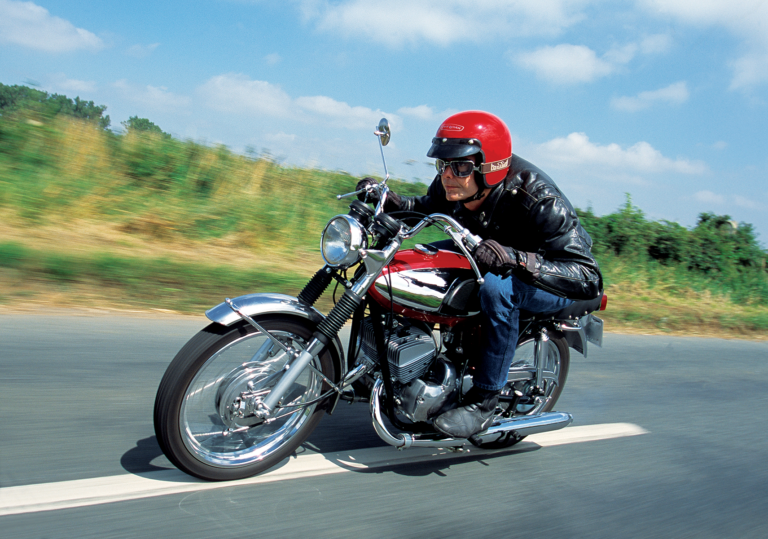
Accelerating out of a curve with the two-stroke engine revving hard, sun gleaming off the chromed tank and a high-pitched exhaust note providing a vivid soundtrack, it’s easy to understand why the 1967 Bridgestone 350 GTR was widely regarded as one of the best Sixties middleweights around. It’s also a bit sad to think that this model was the high point for a firm that abandoned motorcycle production shortly after it was built.

The Bridgestone 350 GTR was one of the most sophisticated Japanese motorcycles of the Sixties, featuring a disc-valve induction parallel twin engine as well as generally high quality construction. Almost three decades after it was built, this immaculate GTR impresses with its neat looks, crisp performance and reliable handling. Yet only a few years after this bike rolled out of the factory in 1967, Bridgestone not only ceased production of the GTR but gave up making motorcycles altogether to concentrate on the Bridgestone tires for which the Japanese company is still well known.
After riding the twin, that decision seems strange, although it makes more sense when you realize that the little two-stroke was expensive, costing as much as a Triumph Bonneville in some markets. The GTR was good all right, but in most people’s minds it wasn’t that good. Most motorcyclists were unconvinced about the appeal of the relatively little-known Japanese company and its flagship two-stroke twin, with the result that relatively small numbers of GTRs were sold before production ended in 1971.
Induction production
The most notable aspect of the 350 GTR’s 345cc parallel twin engine was its rotary disc-valve induction system, which allowed much more precise control of gasses than the more simple piston-ported design being used by rival two-stroke roadsters. Ironically, Bridgestone’s Japanese rival Suzuki had considerable experience racing disc-valve two-strokes, but the firm’s 250cc Super Six roadster, also a two-stroke twin, was piston-ported. Suzuki’s experience dated back to 1961, when MZ factory racer and engineer Ernst Degner defected from East Germany, bringing his team’s secrets with him and passing them on.

Bridgestone’s twin used a disc valve (one for each cylinder) on each end of its crankshaft, with a 26mm Mikuni carburetor bolted outside each valve. Another neat feature was the “piggy-back” alternator, situated above the engine rather than at the end of the crankshaft, making the GTR unit quite slim despite its side-mounted carbs. Peak output was normally claimed to be 37hp at 7,500rpm, although a figure of 40hp was also quoted in some materials. (Most manufacturers were optimistic with power and speed claims, and Bridgestone played that game enthusiastically.)
The GTR’s advanced engine features did not end with its induction. Lubrication was by a Yamaha-style pump-operated system, to which Bridgestone added the refinement of inspection windows for both engine and gearbox oil. The GTR impressed with its six-speed gearbox, and with its facility to swap the gear lever and rear brake pedals to give a left- or right-foot gearchange, both of which were commonly used at the time.
But the Bridgestone 350 GTR also annoyed because neutral was placed at the top of the six-speed gearbox, instead of between first and second as on most bikes. Similarly, although the GTR was unusual in allowing the rider the start the engine in any gear provided the clutch was pulled in, the kick-starter was inconveniently placed on the left of the bike. More thoughtful details included a stainless-steel front fender and lubrication points on the control cables.

The rest of the GTR was relatively conventional. Its twin-cradle steel frame, gaitered front forks, chromed twin shocks, and 19in wheels with drum brakes front and rear were standard fare when the GTR was first introduced to the U.S. market in 1966. Visually, it was similar to its 90cc and 175cc siblings, and there were also models with offroad styling, notably the 350 GTO, which was built in even smaller numbers than the GTR.
Riding the GTR
Few Bridgestones have survived in better condition than this 1967 GTR. The bike looks superb and feels light, slim and quite tall as I stand alongside it, firing the two-stroke engine into life with a gentle swing on the kickstarter. The disc-valve engine immediately settles into a steady idle, and feels just as well sorted as I set off, although I’m mildly disappointed that the dry clutch displays none of the wheelie-provoking sharpness reported in some contemporary press coverage. That unusual gearbox arrangement did cause a few hiccups when I went to pull away and found myself in neutral.
But generally the GTR is very easy to ride, and responsive through the rev range, with no evidence of the two-stroke power step that I’d expected. With 40hp on tap (assuming you accept the higher of Bridgestone’s claimed figures for the GTR) the twin is hardly powerful by modern standards. But it is still lively enough to be fun, and to make me understand why the model impressed most people who rode one in the late Sixties.
Back in the day, the Bridgestone’s revvy engine and light weight of just over 350lb made the two-stroke a match for almost any bike off the line: Bridgestone quoted a standing quarter-mile time of 13.7 seconds. And even though it wasn’t really as quick as that, the GTR provided plenty of acceleration away from the lights — and if the front wheel did come up occasionally to produce that Sixties rarity of a wheelie, I can’t imagine many wide-eyed owners would have complained.

Top speed is about 95mph, rather than the 100-110mph quoted by some Bridgestone sources. More to the point, the GTR is happy to cruise at a steady 60mph or so, feeling very smooth thanks to its rubber-mounted engine. Making the most of its performance means sticking to fifth gear on the straights rather than using the overdrive sixth ratio, which cuts speed unless the bike has the benefit of running downhill or with a tail wind.
Inevitably the upright riding position dictated by the Bridgestone’s fairly high and wide handlebars would make high-speed riding tiring, although this was hardly a criticism in the days when fairings were rarely fitted as accessories, let alone as standard equipment. On my ride the bike was comfortable enough, thanks to a reasonably well padded seat, plus suspension that is reasonably firm without being too stiff.
Handling is good by contemporary standards, thanks in part to a twin-cradle steel frame that is rigid enough to prevent the notorious head-shaking suffered by some rival two-strokes. (Who mentioned Kawasaki?) Neither the front forks nor the rear shocks have any adjustment, even for preload, but the shocks can be tuned by moving the top mounting point fore and aft (think Velocette), which changes the shock angle with the ride getting firmer with the units set vertically. This bike’s angled-forward units weren’t too far out for my 200lb.
Similarly, the GTR’s drum brakes work quite well, with even the twin-leading-shoe front unit that was borrowed from the firm’s 175cc model providing reasonable stopping power. I also had no problem with the 350’s tires (Bridgestones, of course), which gripped well despite their narrow size (though it would probably have been a different story in the wet).
From tires to bikes to tires
Unfortunately for Bridgestone, the GTR’s quality came at a high price, for in most markets the bike cost considerably more than rival Japanese two-strokes, and it was competing directly with larger-engined four-strokes. It also faced resistance from riders who were dubious about a high-performance two-stroke’s reliability. This concern was not unreasonable, given the problems that early engines had with oil seals, and with broken air filter parts being sucked into the engine.
Relatively small numbers were sold following the model’s U.S. introduction in 1966, and the GTR also failed to trouble the sales charts in Europe when it was released there in the following year. By 1968 Bridgestone was coming under pressure from rival Japanese companies, which were also customers for its tires, Bridgestone’s most important product; bikes were really only a sideline. The story goes that Honda applied pressure, suggesting that if Bridgestone wanted to continue supplying the huge numbers of tires Honda purchased, it should consider its priorities. Shortly afterwards, Bridgestone quit bike manufacture to concentrate on tires.

And so the GTR was gone, but not without leaving a lasting impression on anyone who had ridden one. Given Bridgestone’s success in the tire world over the last few decades, it’s hard to argue with the decision to quit motorcycle production. But after riding this quick and classy machine, I can’t help wondering how good modern Bridgestones might have been, if the firm that created the 350 GTR all those years ago was still building bikes. MC
Reviews
“But if the brakes are good, the engine/transmission unit is fantastic. Never before have so many advanced features been incorporated into a single package. It is so good, in fact, that only a real technician can fully appreciate all of the details.” — Cycle, August 1967
“The Bridgestone is a big motorcycle. The 33-inch seat height has a lot of people tippy-toeing to retain balance at a stop sign. And once you’re rolling, you’re very aware that it is indeed a long way to the ground. The wheelbase, at 54 inches, is longer than that of many 650s.” — Cycle, December 1970
“The styling of the Bridgestone 350 is cetainly not going to hurt sales for this new model. We consider it to be one of the handsomest roadsters in all of motorcycling, with a superbly successful blending of Japanese smoothness and English cobbiness. Further, it’s, as we’ve said before, a full-size motorcycle, as big and as fast as any 500 — and considerably faster than most. The seating and control layout are exceptionally comfortable for the average or larger rider.” — Cycle World, August 1967
“Bridgestone built the motorcycle line up gradually, and in the summer of 1967 tossed a major player into the booming middleweight sweepstakes — the GTR. Grand Touring Roadster? Great Track Racer? Nobody ever really explained the initials, but that was ok. It was a 350, and this was a hot item in that long-ago era.” — Rider, July 1997