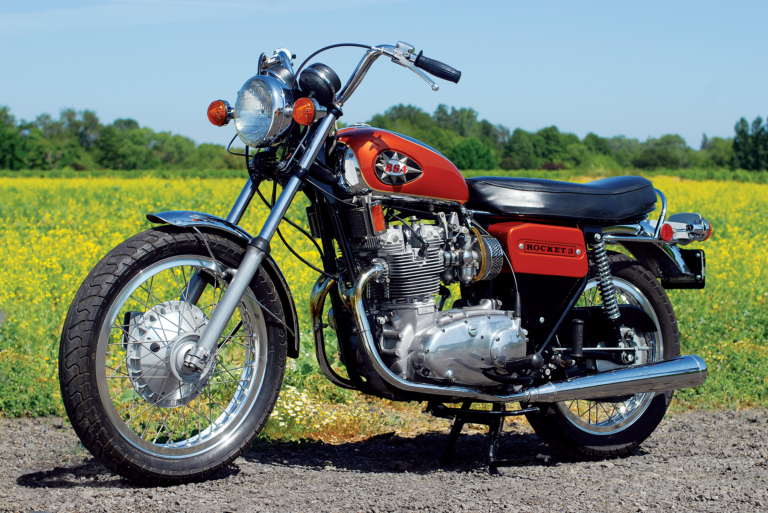
1971 BSA Rocket 3
Claimed power: 58hp @ 7,250rpm
Top speed: 115mph (period test)
Engine: 741cc OHV air-cooled inline triple
Weight (dry): 444lb (977kg)
Fuel capacity/MPG: 3gal (11.3ltr) / 40-45mpg
Price then/now: $1,678 / $6,000 – $8,500

“I’ve owned new bikes,” Bill Whalen says, “but I still prefer my 1971 BSA Rocket 3. Once you have a properly sorted triple, they are great bikes, especially if you plan to cover any distance.”
Bill has lots of experience with the 3-cylindered bikes from Britain — he now owns six, and one, a 1969 Rocket 3, has over 100,000 miles on it. Bill’s favorite ride was, in fact, the first Superbike of the Sixties — and it was also BSA’s last hurrah. Powered by a 741cc, air-cooled 3-cylinder engine, it was, for a brief period, the fastest production motorcycle available.
Rocket to nowhere
The history of the BSA Rocket 3 is an excellent example of how the British motorcycle industry put itself out of business. It was designed at the Triumph works at Meriden by Doug Hele, Bert Hopwood and Jack Wicks, as BSA owned Triumph by this time. Hopwood had the idea in late 1961, and Hele had drawings by October 1962, but the idea was not officially shown to Triumph management until 1964, when rumors of a 4-cylinder street bike from Honda began to surface.
The triple could have been in showrooms by 1967, two years ahead of the Honda CB750, but management slowed the bike’s development when it handed the job of styling the new triple to Ogle Design, an outside styling house with no motorcycle experience, which spent more than a year on the job. The first triples looked unappetizingly bizarre (Ogle was famous for styling avant-garde toasters, which goes a long way toward explaining the styling on the first Rocket 3), and needed extensive re-styling following the America-only launch in 1968. England and Europe got their first Rocket 3/Trident shipments in 1969. The 1969 Trident was released at the same time, and though not identical, the Triumph Trident is very similar to the BSA Rocket 3.

Unfortunately, Honda introduced the revolutionary CB750 shortly after the launch of the Rocket 3 and Trident. Although its handling wasn’t the best, it was oil tight and featured an electric starter, an overhead camshaft and a front disc brake. Honda sold an estimated 30,000 CB750s in 1969, against some 7,000 Rocket 3s and Tridents.
Yet the big BSA was still a contender. In March of 1970, Cycle Magazine organized a comparison between seven Superbikes of the era: a Norton Commando, a Kawasaki H1, a 750 Honda, a Suzuki Titan, a Harley Sportster, a BSA Rocket 3 and a Triumph Trident. The Rocket 3 came out well, tying with the Honda for best lap times on the track. Its double-leading-shoe front brake performed well for the time (the only bike in the comparison with a front disc was the Honda), and testers called the Rocket 3 an easy bike to ride fast, its good weight distribution making it easy to fling into corners.

But these were bad times for BSA, which was losing roughly $6 million annually during 1970-1972, due largely to gross mismanagement, even though its Triumph subsidiary was actually showing a profit. Despite (or possibly because of) the financial squeeze, BSA decided to go road racing.
Three BSA Rocket 3s and three Tridents awaited the green flag at the 1970 Daytona 200. Dick Mann won on a Honda, but Gene Romero took second on a Triumph Trident. Dave Aldana took 12th on a BSA Rocket 3 and came back two months later to win the Talladega race at a record-setting speed of 104.5mph. In June, Gary Nixon won Laconia on a Trident. The racing triple came back in 1971, improved with a Rob North frame and twin discs up front. Dick Mann switched to a Rocket 3 and again won Daytona, with Romero second on a Trident and Don Emde third on a Rocket 3.
Despite the good publicity from racing, BSA continued to hemorrhage money. Parliament stepped in, and the decision was made to sell what was left to Dennis Poore of Norton Villiers. The BSA brand was discarded in the fallout of this move, and so BSA, and the Rocket 3, came to an end.
Bill’s triples
Bill remembers seeing his first BSA Rocket 3 when the bikes appeared in the U.S. in late 1968. It was in the window of a strange store that was part plumbing emporium, part dive shop and part BSA dealership. “That is what motorcycle dealerships were like in those days,” Bill explains. “The styling of the Trident and the Rocket 3 was quite different and not what you would call an immediate success. The Trident suffered more than the Rocket 3, due to its green coloring, which was referred to by one of the motorcycle magazines as ‘sea bottom green.’ At least the Rocket 3 was a nice red color. I liked the Rocket 3, but like many other Triumph riders at the time, I was perfectly happy with my Triumph twin.”
In 1972, Bill and his wife, Linda, decided to vacation in Europe. “I kept seeing these ads, go to Europe and buy a bike, and I decided to buy a Trident to ride on the trip,” he recalls. “We bought a black and white 1971 Trident from a dealer in Coventry, England. We got three miles from the dealership and oil was pouring out all over the engine. We went back, and the dealer was very apologetic. It turned out the factory had left the gaskets out of the pushrod tubes. He fixed the bike and we left for a 3,000-mile tour of England and the Continent. We had no more major trouble, but it was all these little things — the bike was completely unsorted. We brought the Trident back with us, but I went back to riding the single-carb twin.”
Bill sold the Trident, which ended up at a dealership. It was still gathering dust in a corner when Bill, who wanted a new Bonneville, walked in. It was 1976, and the Trident was not a sought after item. The dealer threw it in with the deal.

Fast forward to the 1990s. Bill heard about a woman who had a Trident for sale. “I went to see it. She was mad at her boyfriend, who had left her with it. She insisted I take it. She kept yelling, ‘Just get that thing out of here!’ and wouldn’t take any money.” Not long after, Bill spotted a red 1969 BSA Rocket 3 at Britalia Motors in Santa Cruz, Calif. The owner said it didn’t run and he didn’t really want to work on it. Bill traded the Trident for it, and that Rocket 3 is now his daily rider.
Bill found our feature bike at Raber’s Parts Mart in San Jose, Calif., a few years ago. “It wasn’t running, but it was all there, all the original stuff. Also, it was a 5-speed — BSA had to make 200 Rocket 3s with the 5-speed transmission to homologate the race bike for AMA racing. It’s rare, but I eventually found another, so I now have two,” he says with some satisfaction.
As the previous owner had abandoned the Rocket 3 in a storage locker, registering the bike took blood, sweat, tears and multiple trips to the DMV. Restoring it was comparatively easy. Bill had the original exhaust rechromed, replaced the rings, valves and guides, cleaned and reassembled the carburetors and added a Tri-Spark digital electronic ignition. Bill, who is also handy with a spray gun, repainted the tank and bodywork with paint matched to the original.
Keeping it on the road
When Bill Whalen gets a new-to-him triple home, he spends considerable time “getting it sorted” — taking it apart and putting it back together. Dr. Bill’s prescription for the ills of the typical triple works: He’s put over 100,000 miles on his daily rider BSA Rocket 3, and it is still running strong. “Once set up, a Rocket 3 is as reliable as anything else,” he says. “I’ve ridden this triple coast to coast several times, and had no problems whatsoever.”
Bill continues: “At the time these were built, it was rather difficult to keep them from leaking oil. Now you can do it. Copper base gaskets, rocker box and head gaskets are available now — they weren’t at the time. You used to have to torque the head 10 or 12 times to get it to seal properly, but with copper gaskets, you torque once at 500 miles and you are done. Today, you can get hardened mushroom valve adjusters, better valves, valve guides and hardened lash caps, which all help the top end longevity.

“Amal carburetors will work properly if assembled and adjusted properly. I drill and tap all three intakes so I can set them up with vacuum gauges, which guarantee all three carbs are in sync. The float levels are often not correct — poor English quality control — and I check them before assembly. Once set up, Amals will work well and will not go out of tune.
“As far as Lucas electronics, the main problems are caused by the people who work on them. The owners are as bad as the dealers and the factory. The problem is often poor wiring. Ignition timing was always a problem with three sets of points. Tri-Spark electronic ignition for triples is excellent — it draws less current than a Boyer or a Lucas Rita, so I can run a halogen headlight.”

When it comes to riding, Bill tends to compare our feature bike to his trusty 1969 Rocket 3: “The front end is longer and lighter, due to the different bodywork and the smaller tank. It’s a little more nimble. I take the ’71 on club rides, which tend to be 100 miles or so over twisty roads, and the ’71 does better on little roads in the mountains than the ’69. A friend of mine rode the ’69 for a bit, and pronounced, ‘It handles like a Buick.’ It has a big cushioned seat and soft suspension and I sometimes ride 500 or 600 miles a day on it. The ’71 has a harder seat and suspension — I don’t think I could do the same mileage on the ’71. On curves, the limiting factors are the rigid pegs, the low mufflers and the lack of crankcase clearance. The ’71 would do very well on a racetrack. It likes smooth roads and big sweepers.”
So if you see a red Rocket 3 rolling down a Nebraska highway or an Idaho mountain road, there’s a good chance it might be Bill, out enjoying himself. Go ahead, give him a wave — he’s a friendly guy. And don’t worry about the Rocket 3. It’s getting Bill where he wants to go, and putting a smile on his face while doing it. MC