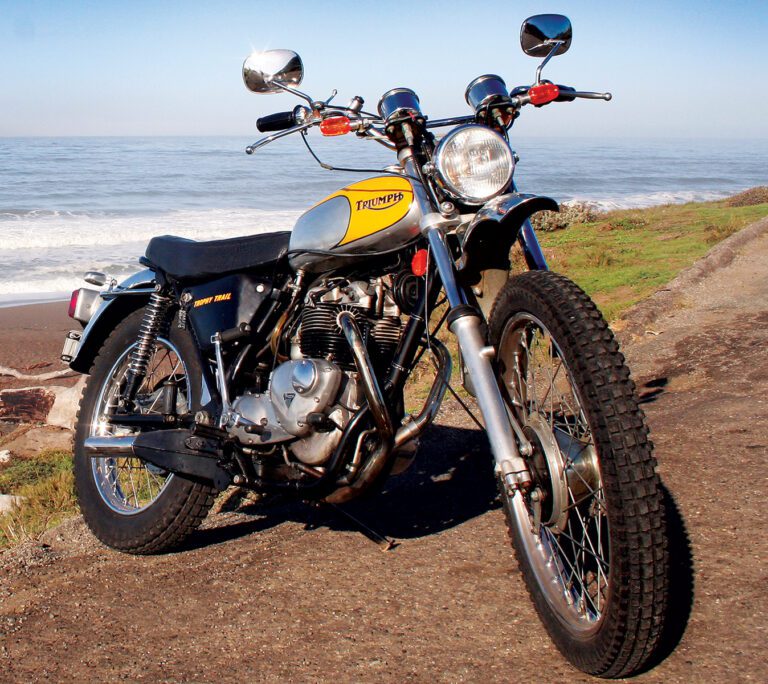
- Claimed power: 34hp @ 7,000rpm (18 rear-wheel hp @ 7,000rpm, period test)
- Top speed: 82mph (period test)
- Engine: 490cc air-cooled OHV 4-stroke parallel twin, 69mm x 65.5mm bore and stroke, 9:1 compression ratio
- Weight: (curb, half tank) 344lb (156kg)
- Fuel capacity/MPG: 2.2gal(8.3ltr)/37mpg
- Price then/now: $1,649 (1974)/$4,000-$10,000
Though Triumph joined the BSA Group in 1951, each brand essentially operated as a different company, with production in two separate factories. Each jealously guarded its designs and developments, and it was only in the 1960s (after Triumph boss Edward Turner retired) that they began sharing components and techniques.
At its peak, BSA employed more than 13,000 workers at its Small Heath, Birmingham, plant. By the Spring of 1972 the workforce was down to 202, and the factory shipped the last motorcycles produced there — 11 Rocket 3s and seven B50SS Gold Stars — on April 14. Small Heath was shuttered, and production focused on Triumph’s Meriden factory. From BSA-Triumph’s 1971 range of 250cc and 500cc singles, 650 twins and 750 triples, only the Bonneville and Trident would survive the takeover by Norton-Villiers. Except, that is, for an unlikely, oddball trail bike blended from BSA and Triumph parts.
In his book, A Penguin in a Sparrow’s Nest, journalist and former BSA motocross rider Frank Melling explains. On a visit to the Triumph Meriden factory, Melling was carrying an experimental BSA B50 motocross frame in the back of his car. Legendary Triumph development engineer Doug Hele happened to see the frame and demanded to borrow it for a half day. It took a couple of years, but Triumph’s 1973 range included a 500cc trail bike using the peppy Triumph T100 twin in a lightweight oil-bearing frame almost identical to the BSA B50 chassis.
Triumph engine …
It is likely Triumph always intended a 500cc version of its first unit construction twin, the 350cc 3TA of 1957; and the 5TA Speed Twin duly arrived in 1959. Both shared a stroke of 65.5mm, with the 350’s bore of 58.3mm increased to 69mm for the 500. The air-cooled OHV engine followed standard Triumph practice with two camshafts, external pushrod tubes, duplex chain primary drive to a multiplate clutch and 4-speed transmission. With performance upgrades, the engine survived until 1974 in the T100R Daytona and TR5T. As used in the Trophy Trail, the specification was essential as the single-carb Tiger 100 street bike with a single 28mm Amal Concentric carburetor.
… BSA Frame
The Trophy Trail’s frame came from the 1971 BSA B50T and was modified to accept the Triumph engine. The lightweight welded frame carried engine oil; a Ceriani-style fork and a 21-inch front wheel helped overcome off-road obstacles; a steel bash plate protected the engine’s underside; wide, cross-braced bars made for quick steering; and the chain was easily adjustable with the swingarm mounted on snail cams — an idea borrowed from the Rickman brothers. The 6-inch front brake was hardly adequate for the street, though, and the 7-inch rear meant easy back-end lock-ups; but they worked fine off-highway. The alloy gas tank held just 2.2 gallons, but that was good enough for 100 miles.
Contemporary reports indicated a top speed of around 80mph. And while aesthetically challenging, the square matte black muffler (with California-spec. spark arrestor) mounted underneath the transmission meant no more seared shins. The result was a bike better suited to back-country trails in the Berkshires than blasting across the Mojave from Barstow to Vegas.
In 1973, BSA-Triumph’s east coast distributors modified some Trophy Trails for the International Six Days Trial, held in Dalton, Massachusetts — the first time the ISDT had been run outside Europe. Team USA finished second to Czechoslovakia, winning the Silver Vase. Though lightweight 2-strokes dominated the event, Dave Mungenast and John Greenrose both won silver awards on their TR5Ts for finishing within 25% of the best time in class.
Summing up the TR5T, Melling wrote, “One of the best bikes ever produced by the British motorcycle industry … if only it had arrived seven years earlier.” MC
Contenders: Two more street scramblers
1971-1972 BSA B50T Victor
- Claimed power: 34hp @ 6,200rpmTop speed: 83mph (period test)
- Engine: 499cc air-cooled OHV 4-stroke single, 84mm x 90mm bore and stroke, 10:1 compression
- Weight (curb, half tank): 327lb (149kg)
- Fuel capacity/MPG: 2.5gal/53mpg
- Price then/now: $1,300 (est.)/ $2,000-$7,50

Meanwhile, over at BSA, the 441cc Victor Special street-scrambler had sold reasonably well through the second half of the Sixties and got a complete makeover in 1970 to create the B50T Victor. The motor was punched out to 499cc and matched to a stronger bottom end. This used a bigger diameter crankpin and dual roller/ball main bearings on the drive side. The transmission was also beefed up to cope with the extra torque, though the clutch was always prone to slipping.
The revised drivetrain went into the same oil-bearing frame as the TR5T combined with similar cycle parts, like the fork and brakes. Styling was somewhat outlandish including a bulky upswept flat-black muffler behind a chrome heat shield with the frame painted dove gray (to emulate, it was said, the titanium frame used on some experimental Victor scramblers). With 10:1 compression, the kickstart procedure was to be carefully followed — and even that sometimes failed when the engine was hot. Once started, though, the B50T “handles well, looks good and has a modicum of docility … torque is abundant,” wrote Cycle World. However, “Pleasant the B50T is, especially if you’re biased toward big thumpers … a mass-market dual-purpose bike it ain’t.”
Replacement 20-inch front tires are almost impossible to find. The front brake is useless on the street, though fine for off road (and easily upgradable to the Group 7-inch TLS). But BSA’s 1972 collapse meant the B50T lasted just 18 months anyway.
1968-1971 Yamaha DT-1
- Claimed power: 21hp @ 7,000rpm • Top speed: 71mph (period test)
- Engine: 246cc air-cooled 2-stroke single, 70mm x 64mm bore and stroke, 6.7:1 compression
- Weight (curb, half tank): 235lb (107kg)
- Fuel capacity/MPG: 2.5gal/35- 55mpg
- Price then/now: $580 (1968)/ $3,000-$9,000

If the B50 and TR5T closed out one era, the DT-1 ushered in the next, sweeping away the British 4-stroke dirt dinosaurs. Power came from an air-cooled 2-stroke single with five ports, tuned to provide adequate power while preserving low speed torque, and harnessed to a 5-speed transmission. The drivetrain was housed in a chrome-moly dual cradle spine frame with a Ceriani-style fork offering six inches of travel and a stout rear swingarm mounted in widely-spaced pivots. Wheels/tires were 4 x 18 inches rear and 3.25 x 19 inches front, though a 21-inch front was available as an option. Brakes were 6-inch SLS drums front and rear.
In its test, Cycle World praised the “unusually wide power-band” and well-spaced 5-speed transmission, allowing “60mph at a modest 6,000rpm, while bottom is low enough for plonking through the woods.”
Finding no indication of fork bottoming or topping over 200 miles in the rough, “Damping is excellent,” wrote their tester, while noting the rear suspension was “soft, but well-damped, never bottoming … Lack of frame flexure and good suspension make the DT-1 one of the finest tracking machines in mud and soft sand, especially at rather high speeds.”
User-friendly features on the DT-1 included: brake/shift levers that could be swapped side-to side depending on rider preference; Yamaha’s Autolube system, which eliminated premixing oil and gas; and removable lighting with quick-disconnects. A battery powered the lights per California law, though the DT-1 would start and run fine without one. Available also was an off-road only Genuine Yamaha Tuning (GYT) kit that added 1,500rpm and 8 horse-power.