One of history’s rarest and most coveted motorcycles will take to the Mecum Vegas auction stage this February.
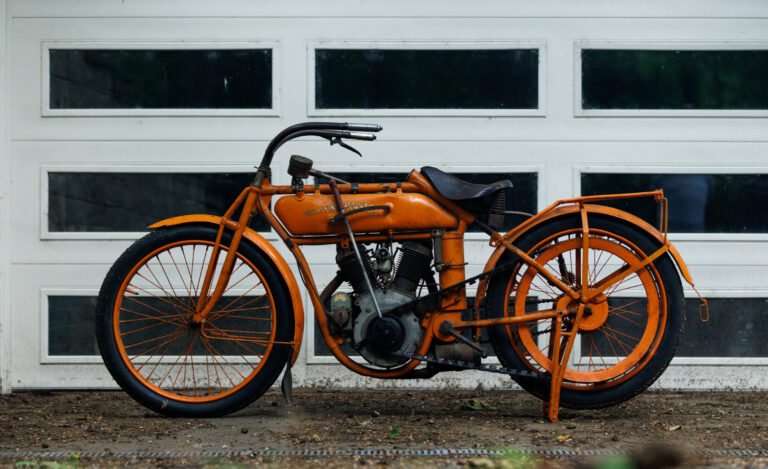
The Flying Merkel remains one of the most elusive machines in American motorcycle history, but that rarity doesn’t equate to anonymity. As evidenced by this immaculate, unrestored example from 1914 heading to Mecum’s renowned motorcycle auction in Las Vegas this February 3-6, the signature orange paint, slender yet sophisticated geometry, and trailblazing features are instantly recognizable, but they’re only a small part of what places the Flying Merkel atop the list of history’s most coveted machines.

Merkel, The Man
The marque’s story begins with founder and namesake Joseph Frederic Merkel, born in Manistee, Michigan, in 1872. The son of a logger, Merkel entered the mechanical trades remarkably young, working on logging railroad machinery and machine shops before studying mechanical engineering at Michigan Agricultural College. By the dawn of the 20th century, he had moved to Milwaukee, Wisconsin, a city rapidly becoming one of America’s great manufacturing hubs. There, he established the Merkel Manufacturing Company in 1899, initially producing bicycle components before experimenting with powered machines, purported to be the state’s first motorized vehicles. By 1900, Merkel began road-testing a two-wheeler with a small engine mounted within a bicycle chassis.
Over the next two years, Merkel tinkered, raised capital, displayed his machines at national trade shows, and sold several of his first motorcycles to enthusiasts across America, making the Merkel marque one of the earliest established motorcycle manufacturers in the country.
Forced to “Fly”
Motorcycle roads in the first decade of the 20th century were rarely what a modern rider would consider roads at all, and most motorcycles relied almost entirely on their saddle and tires to isolate the rider from ruts and rocks. Merkel’s machines pursued a different approach, becoming among the first in history to employ both a spring-loaded telescoping front fork and an ingenious rear suspension system using a pivoting rear section controlled by a spring beneath the saddle. Decades before rear suspension became universal, and long before the modern monoshock, the Merkel offered genuine full-suspension motorcycles. His advertising would eventually summarize the advantage neatly: “All roads are smooth to The Flying Merkel.”
His engines were similarly focused on refinement, and as the years progressed, Merkel motorcycles gained a reputation as some of the most well-engineered, advanced, and reliable motorcycles on the market.

From Road to Track
Like most other pioneering motorcycle men in America, Merkel found that the budding sport of racing provided an excellent venue in which to test his latest designs, and he went elbow to elbow with fellow engineers/owners/racers like Glenn Curtiss, Oscar Hedstrom and Walter Davidson. Beginning around 1905, Merkel increasingly turned to racing to prove his machinery, develop it further, and drum up publicity.
Looking to expand production, Merkel sold his operation to the Light Manufacturing and Foundry Company and moved from Milwaukee to Pottstown, Pennsylvania. The machines became known first as Merkel-Light and increasingly by the name that would define the company’s legacy: The Flying Merkel. Racing pushed the new identity into the national consciousness, while improved manufacturing facilities increased production.
Another sale followed in 1911, when the Miami Cycle and Manufacturing Company acquired the brand and shifted production to Middletown, Ohio. There, the Flying Merkel name and vivid orange finish became fixtures. Among the men working inside the factory was Maldwyn Jones, a brilliant young racer from Ohio. Mechanically gifted and ferociously competitive, Jones became inseparable from the Flying Merkel legend.
Without the massive competition budget enjoyed by some rivals, Jones and fellow Merkel employees developed their own racing machines with limited factory support and took them wherever they could win prize money. At Savannah’s grueling 300-mile road race in December 1913, Jones rode a Flying Merkel with remarkable consistency against factory stars from Excelsior, Indian, Thor, Yale and Pope. A scoring mistake cost him what was later acknowledged as the actual victory; officials determined that Jones had been sent around for an unnecessary extra lap, during which his drive chain broke. Though the official result stood, Merkel wasted little time claiming the win.
A Bike Ahead of Its Time
In 1914, the year this exceptionally rare, unrestored motorcycle was manufactured, Flying Merkel was arguably at the height of its public reputation. Slated to cross the block at Mecum’s 2027 auction in Las Vegas, this unrestored Flying Merkel offers a remarkable glimpse into the company’s brief but influential moment in American motorcycling. Its 61 CI IOE V-twin is fed by a Schebler carburetor and Bosch magneto ignition, coupled to a single-speed, belt drive with an Eclipse clutch. Up front is Merkel’s distinctive telescopic fork, while a cantilever arrangement provides rear suspension–a remarkably sophisticated combination for a motorcycle built more than 110 years ago.

More evocative still, the passage of time has not been erased by a restoration. The machine retains the appearance of something used rather than recreated, with original Wisconsin registration cards documenting its use in the 1910s and ’20s. Rather than simply representing the Flying Merkel story, this motorcycle appears to have lived through it, even beyond the lifespan of its maker. Within a couple years of this gorgeous machine rolling off the line in Middletown, Flying Merkel production had ended. A marque responsible for some of the most forward-thinking machines of the pioneer period had effectively vanished after barely 15 years.
More than a century later, this unrestored 1914 Flying Merkel remains an unusually tangible connection to that brief, inventive period, still wearing the evidence of both the roads it traveled and the engineering ideas that placed Merkel ahead of its time. Though the company itself didn’t survive, this exceptional 1914 Flying Merkel makes clear just how much of the motorcycle’s future it had already figured out.