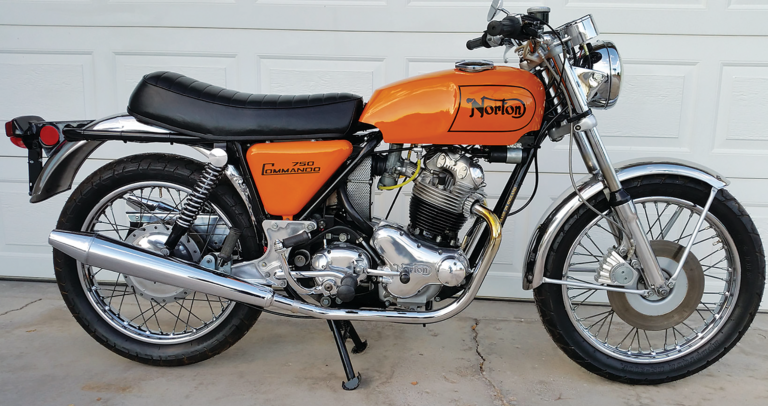
Claimed power: 56hp (1972 Combat 65hp) @ 6,500rpm
Top speed: 116mph
Engine: 745cc air-cooled OHV twin, 73mm x 89mm bore and stroke, 8:1 compression (Combat 10:1)
Weight: (dry) 398lb
Fuel capacity/MPG: 3.2gal steel tank (2.6gal fiberglass tank)/45-50mpg
Price then/now: $1,479 (1970)/$4,000-$13,000
The 750 Roadster enjoyed a production run longer than any other variety of Norton’s Seventies superbike, with production running from March 1970 to October 1973. It’s also the most commonly found variety — though easy interchangeability also means that many Roadsters became Interstates, Fastbacks and other models. The Commando was introduced in April 1968. Styling was eccentric, featuring a swooping fiberglass gas tank, wraparound dual seat (orange on early bikes) and “boat-tail” rear bodywork.
Within a year, two offspring, the Models R and S had joined the Fastback (as it was now called). The more conservative R model continued the Fastback’s exposed oil tank and low-level Atlas-type mufflers, but with a new shaped gas tank and more conventional dual seat. The S was the wild child, with buckets of chrome, high exhaust pipes on the left side with chrome heat shields and “peashooter” mufflers. These begat the Roadster, which was essentially the S model fitted with a low-level exhaust and upswept peashooters.
These numerous styling options highlighted the versatility of the Commando’s architecture. From the beginning, all Commandos were built using the same flexible drivetrain mounting system, separating the engine from the frame to subdue its hammering vibration. Detail adjustments aside, any Commando could become any other variant by changing the seat, gas tank and side panels. So a Fastback could become an Interstate with the right bits. Relatively small run models like the Street Scrambler and Hi-Rider were thus easily accommodated on the production line.
So like all other Commando models, the Roadster featured the time-served 750cc OHV Atlas air-cooled parallel twin with its built-up crankshaft, ball and roller main bearings and single camshaft driven by chain and gears. A triplex primary chain drove the separate AMC 4-speed gearbox through a diaphragm spring clutch. The complete drive train was mounted to the frame with Isolastic rubber “bungs” inside steel bushings. Lateral movement was contained by shims between the bushings and the frame. So the drivetrain could move in two dimensions (up-down and back-front) but not side-to-side. With the shims properly set, the Commando was remarkably free of engine vibration at speed without compromising handling.
Over its 3-1/2 year production run, the 750 Roadster saw a number of changes. A steel gas tank of increased capacity replaced the fiberglass item. Contact breaker points moved from behind the cylinders to the timing case. 1972 saw the introduction of the Combat engine making a claimed 65 horsepower from higher compression, hot cams and larger carburetors. This quickly showed a tendency to disintegrate if the full power was used. The cause was identified as rapid wear in the roller main bearings caused by crankshaft flexing, combined with suspect lubrication and breathing changes. The solution was to replace the mains with “Superblend” bearings, which employed barrel-shaped rollers. If you’re buying a Combat, make sure the mains have been replaced. 1972 also brought turn signals, and a single disc brake replaced the eight-inch TLS drum. For 1973, the Combat engine was dropped, replaced by a re-tuned 750 with strengthened crankcases, an inline oil filter and revised breathing. It’s reckoned to be the best of the 750s. This lasted just until October 1973, when the even sturdier 828cc engine replaced it. And in 1975, electric start arrived …
Commandos are well capable of mixing it with modern traffic. The aftermarket is loaded with upgrades: electronic ignition, electric start kits, uprated charging systems, new carbs and more. Just two things to remember: The 750 was always kickstart only from the factory; and shifting is on the right — one up, three down. More resources: Norton Owners Club (U.K.) Commando Service Notes and the U.S. International Norton Owners Association Technical Digest. MC
1970-1973 BMW R75/5
• Claimed power: 50hp @ 6,200rpm
• Top speed: 110mph
• Engine: 745cc air-cooled OHV twin, 82mm x 70.6mm bore and stroke, 9:1 compression
• Weight: 462lb (full tank)
• Fuel capacity/MPG: 6.2gal (4.5gal Toaster)/52mpg
• Price then/now: $1,848 (1970) $4,000-$10,000

Difficult to believe, but in the late 1960s BMW almost abandoned motorcycle production. Sales were slow, and the aging /2 series was obsolete. Fortunately, they decided instead to design a new engine and chassis with assembly at a new factory in Spandau, Berlin.
The /5 borrowed technology from the company’s automobile engines, with a forged crank running on plain bearings and chain drive to the camshaft (now below the crank). A dry single-plate clutch connected the engine to a 4-speed gearbox with shaft final drive. Electrics were 12 volt with battery/coil ignition replacing the /2’s magneto, and Bing CV carbs were fitted. The drivetrain was mounted in a new lighter welded frame with the driveshaft comprising the right-side swinging arm. A Sachs front fork and dual Boge rear shocks connected to 19-inch and 18-inch wheels with aluminum rims and 7.9-inch (200mm) drum brakes (TLS front, single rear). Styling was conservative except for the 1972 season which featured the chrome-sided “toaster” gas tank. A longer rear swingarm was fitted from January 1973.
Over a quarter century, the “airhead” boxers established an outstanding reputation for endurance and durability.
1973-1982 Triumph T140 Bonneville
• Claimed power: 54hp @ 6,200rpm
• Top speed: 118mph
• Engine: 744cc air-cooled OHV twin, 76mm x 82mm bore and stroke, 8.6:1 compression
• Weight: 441lb (dry)
• Fuel capacity/MPG: 4.8gal/42mpg
• Price then/now: $1,599 (1973)/$3,000-$10,000

The T140 was a simple extrapolation of the preceding T120 Bonneville 650 using the oil-carrying frame introduced in 1971. Into the frame went a 750cc OHV air-cooled parallel twin that traced its roots directly to the 1938 Speed Twin, but with a 5-speed transmission, and (from 1973) a front disc brake.
After the Meriden workers’ cooperative resumed production in 1975, the Bonneville gained a rear disc brake and left side shifter/right brake pedal. Mark II Amal carburetors arrived in 1978, and electronic ignition in 1979. That year also brought the T140D Special with alloy wheels and custom styling. Electric start finally arrived in 1980 together with the Executive model wearing hard luggage. The final Meriden Bonnevilles, the TSX and TSS featured a 4-valve head and rubber engine mounting respectively.
Though increasingly obsolete, the Bonneville traded on nostalgia — and its relative simplicity of construction and easy maintenance, together with decent handling and good brakes. Vibration was effectively damped by the sturdy frame and soft engine tune. Once considered second-rate to the earlier Bonnies, T140s are increasingly collectible, especially the 1977 Silver Jubilee and 1981 Royal Wedding editions.