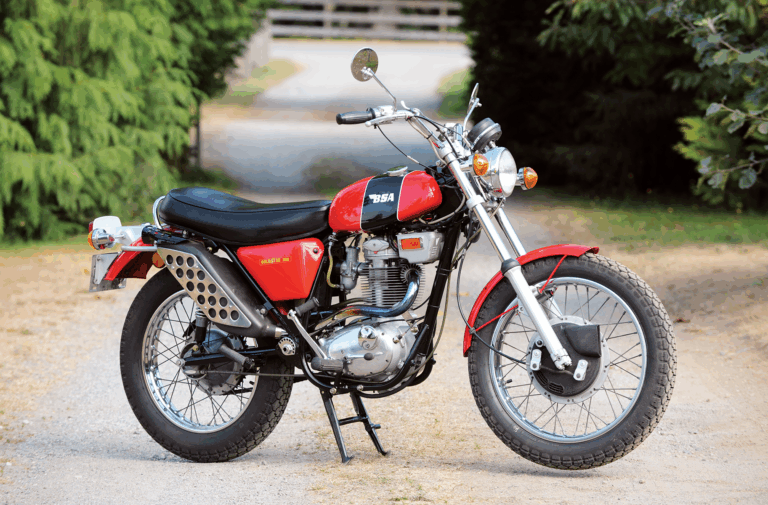
1971 BSA B50SS
Claimed power: 34hp @ 6,200rpm
Engine: 499cc air-cooled OHV single, 84mm x 90mm bore and stroke, 10:1 compression ratio
Top speed: 80mph (est.)
Weight (dry): 310lb (141kg)
Fuel capacity/MPG: 2.5gal (9.5ltr)/45-55mpg
Price then/now: $1,300 (approx.)/$2,500-$4,500

When BSA announced that its 1971 range would include a new 500cc unit-construction single called the “Gold Star,” it provoked outrage among traditional British motorcyclists. How could they sully the name of the mighty Goldie — the most successful British clubman’s race bike and favorite of the café racer crowd — by attaching it to an overgrown commuter bike?
Of course, BSA wanted to capitalize on the first Goldie’s reputation on racetracks in the U.K. and on the Grand National circuit in the U.S. But the association was in name only. The original Gold Star was developed from the 1930s Empire Star into a potent AMA Class C racing package, with the street versions sporting much of the race bike’s performance potential. The 1971 bike had grown out of BSA’s prosaic 250cc Star, itself a development of the Triumph Tiger Cub. But perhaps the older Goldie’s fans were being a little unfair. Jeff Smith won two world motocross championships (in 1964 and 1965) with the B50’s immediate predecessor, the BSA 441cc Victor, and John Banks narrowly missed giving BSA two more world motocross titles in 1968 and 1969 with the factory prepared 500cc B50MX. So why was so much scorn heaped on the unit-construction bike? Was it the humble origins? Or BSA’s hubris in usurping the famous Gold Star name?
BSA Origins
All BSA unit-construction singles can trace their roots to Edward Turner’s 150cc Triumph Terrier of 1953. The Terrier grew into the 200cc Tiger Cub, and the basic design, albeit with an upright cylinder instead of the Triumph’s forward tilt, was developed into the BSA C15 Star of 1959 with cylinder dimensions of 67mm x 70mm. Taking the bore out to 79mm, the C15 begat the 340cc B40 in 1961. Meanwhile, in BSA’s competition shop experiments began with stretching the B40’s stroke, first to 85mm for 420cc and finally to 90mm for 441cc, with the intention that it would replace the heavier and bulkier DBD34 Gold Star engine in the factory motocrossers. It was the unit-construction 441 engine, when installed in a lightweight oil-bearing frame, that powered Jeff Smith’s two 500cc FIM Motocross World Championships.

A difficult 1966 season with a titanium-framed Victor (the frames were prone to cracking, and the works team lacked the equipment to repair them in the field) saw Smith finish third in the Championship, with a second place finish in 1967. New team member John Banks took over the mantle in 1968 and 1969, placing second both years. But the main title went to the new lightweight 2-stroke CZs in 1966-1968 and Husqvarna in 1969. It’s not clear exactly when, but during this time BSA recognized that the “stretched” Victor engine had reached the end of its development. They needed a full 500cc engine if they were to remain competitive.
The Victor clearly exceeded the design limits of the B40 bottom end (big end failures were common), so the engine was completely redesigned with a new built-up crankshaft, larger crankpin diameter and heftier needle roller connecting rod big end. The crank was supported on no fewer than three main bearings — a roller on the timing side, and roller and ball bearings on the drive side — in beefed-up cases. A new iron-lined alloy cylinder took the bore out to 84mm, which, combined with the 90mm stroke, gave 499cc. The distortion-prone alloy-bodied oil pump was ditched in favor of a steel-bodied item from the unit-construction twins. Engine breathing was completely revised, the crankcase now breathing into the primary case with a half-inch diameter vent to air. The crankshaft drove a wet multiplate clutch and strengthened 4-speed gearbox through a duplex chain.

The drivetrain was now capable of handling the 38 horsepower that a stock B50MX produced. (For comparison, a stock DBD34 Gold Star Clubman made around 40 horsepower in 1961.) However, by 1970 2-strokes were totally dominant in the FIM Championship, and BSA — now running out of money — closed its motocross shop in 1971. But the development work was not for nothing, and a trio of 499cc B50-based bikes was announced for general sale in 1971. These were the offroad B50MX, the “dual sport” B50T Victor Trail and the B50SS Gold Star street scrambler.
The B50SS and B50T both used an oil-bearing frame derived from the factory motocross bikes, featuring a tubular swingarm with a cam adjuster at the front needle-bearing pivot — ideas that BSA borrowed from the Rickman brothers, famous for their custom motocross frames. Both 500s got the new BSA Group alloy front fork and “conical hub” drum brakes — an 8-inch diameter twin-leading-shoe front on the B50SS, a 6-inch single-leading-shoe on the B50T. Frames and painted ancillaries got 1971’s unpopular Dove Grey paint scheme, though there’s some evidence this reverted to black during the model year. It’s been said Dove Grey was meant to replicate the fragile titanium frame of the 1966 factory motocross bikes — in spite of the damage it did to Jeff Smith’s attempt at a third title.
A completely new electrical system contained major components in an alloy case under the front of the fuel tank, and also featured a quick-connect socket allowing the headlight to be removed. Lucas turn signals were operated by a switch on the right handlebar. Many cycle parts were common with other 1971 BSA/Triumph bikes, like the Thunderbolt, Lightning and Bonneville. Most distinctive, though, was the massive black muffler covered with a perforated stainless steel heat shield. The styling was bold and aggressive, even if the bikes perhaps weren’t!
Was it any good?
Well, yes and no. Mechanical reliability was certainly an improvement over the B44 (my 1969 Victor Special destroyed two big-end bearings and suffered a bent gearbox mainshaft during my tenure), thanks to the larger crankpin and three-bearing bottom end. It was also lighter than the last B44 Victor by 10 pounds or so, and power was up from the Victor’s claimed 29 horsepower at 5,750rpm to 34 horsepower at 6,200rpm. The engine was tunable, too. Simply fitting the B50MX cam and 32mm carburetor raised output to 38 horsepower, and more was available with cylinder head work. B50s were competitive in endurance events at the time, and continue to be raced on the track today in AHRMA events.
Author Steve Wilson owned a B50 back in the day, and describes his experience in BSA Motor Cycles Since 1950: “… for short haul, stop-and-go motoring, the engine’s punchy power characteristics made for an inspiring, pant-kicking, arm-wrenching ride … the B50’s engine clatter, plus the vibration from such a powerful engine in a comparatively light frame did make long-distance riding a bit of an ordeal.”

That said, Wilson found the B50 to be a “more satisfying compromise” than the later, similarly positioned Yamaha XT500. But it was a “bitch to start,” not helped by the 10:1 compression ratio and awkwardly placed decompressor lever. Accurate ignition timing was critical in this regard — a condition exacerbated by incorrect placement of the timing marks on some early bikes. The situation was compounded by the absence of a choke, and the tendency of the 30mm Amal Concentric carburetor to flood the intake. However, some owners have also noted that there are specific techniques that, if followed meticulously, can make starting easier — though they don’t always agree on what they are!
Keith Barnett’s Gold Star
Keith Barnett found his B50SS in a neighbor’s barn. “I saw these two wheels sticking out from under a pile of hay,” he says. “They were rusty looking, so I asked him, ‘What’s that?’ and he told me. I said, ‘Well, I’ve been looking for a project — is everything there?'”
It turned out Keith’s British-born neighbor had bought the B50 when it was almost new, and while he had partly dismantled it, he claimed it to be pretty much complete. “He showed me a box with the tank in it — which was all rusty — and a few other bits that had obviously been taken off the bike. It turned out the only thing that was missing was the left footpeg,” Keith says. “He said if he looked around he’d probably find it. But it’s been seven years now …”

In the end, Keith modified a Norton footpeg so that it now looks and works like the original. The only other non-stock parts fitted are a Boyer Bransden electronic ignition system. “The previous owner said that you’d be at a stop sign, and it would just suddenly die. Then you’d have to kick and kick. The electronic ignition really solved the issue.”
Keith credits much of his mechanical success to input from local specialist Art Vanderstar, who helped with freeing up the seized piston — the spark plug had been missing for 27 years, and the rings had rusted to the cylinder liner. Keith got the piston loose after more than 20 repeated cycles of adding oil, then heating and cooling the cylinder. “I took a block of wood and a rubber mallet, and I whacked the piston,” Keith says, “and finally it broke loose.”
Unfortunately, while easing the cylinder over the piston, the piston rings, swollen with corrosion, cracked the cylinder liner. A direct replacement proved impossible to find, so Alec’s Automotive in Vancouver bored out the existing cylinder to accept a modern off-the-shelf sleeve, pinned it to the old cylinder, then bored it to suit the old piston, which had survived intact. New +0.020-inch rings were sourced and ground to fit the standard bore. Alec’s also sourced and installed new valves, guides, seats and springs.

Just about everything else Keith needed was supplied by Vancouver, British Columbia’s, British Import Motorcycles, who he also cites as being helpful in identifying parts that were common to other British bikes of that era. Keith also bought a set of custom silicone gaskets from Steve Dales at Britgaskets. “I don’t think I waited more than two weeks for anything,” Keith says, marveling at how quickly he was able to source parts.
Living with a BSA B50SS
“BSA had a few of their really good ideas in it,” Keith says. ‘The needle bearing swingarm — it leans into corners, and the thing does not wobble on the back end at all. I put the Dunlop K70 replicas on there, and they were quite a good tire in their time. Nice soft rubber and very sticky. The bike is very light, it’s very maneuverable and I quite enjoy riding it — as long as you don’t have to go over 60mph. Getting up to 60mph, it does it no problem. It pulls really well, it’s got so much torque. The only problem is other vehicles. Above 60, you get blown all over the place. If I try to do 70mph, it’ll do it. But my mirrors are vibrating all over the place, my hands are jingling. Everything is jumping around: You’re seeing three cars coming up behind you.”

The only major problem still bugging Keith is that the B50 is almost impossible to restart when hot. Keith suspects a vapor lock in the carburetor and plans to try altering the carburetor intake angle. Another niggling issue he expects to deal with soon is the pivot for the compression release in the rocker covers. “There’s no bearing in there, no bushing,” Keith says. “They just drilled a hole. Well this thing has worn elliptical … and it just pukes oil out of there.” Keith thinks he’ll need another trip to Alec’s to get the hole over bored and fitted with an oil-impregnated bushing.
“I enjoy riding it,” Keith says. “Whenever I park it anywhere for any amount of time, there’s always somebody who comes up to me … I’ve had a few people say, ‘Hey, when did BSA start making bikes again? It looks like brand new.’ Well, it kinda is. But it’s a 1971 …” MC