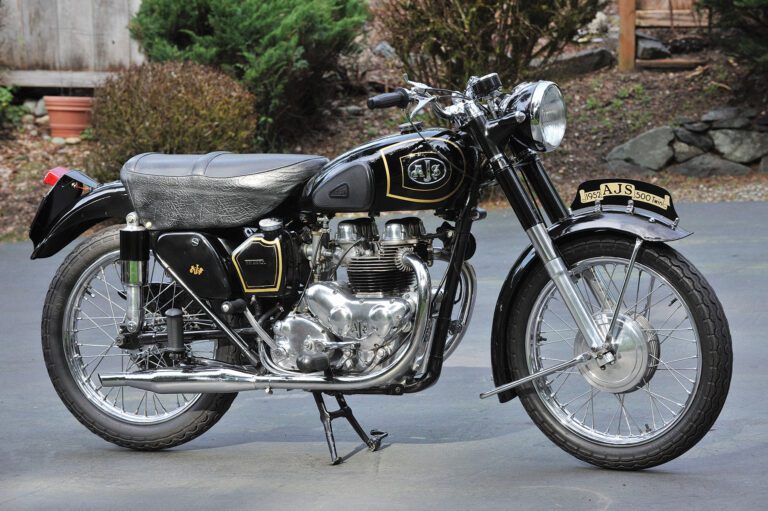
1952 AJS Model 20 Spring Twin
- Engine: 498cc air-cooled OHV parallel twin, 66mm x 72.8mm bore and stroke, 7:1 compression ratio, 29hp @ 6,800rpm
- Top speed: 87mph
- Carburetion: Single 1in Amal 76
- Transmission: 4-speed Burman gearbox, chain final drive
- Electrics: 6v, Lucas K2F magneto ignition
- Frame/wheelbase: Steel tube cradle frame/55.25in (1,403mm)
- Suspension: AMC Teledraulic fork front, dual shocks rear
- Brakes: 7in (178mm) SLS drum front and rear
- Tires: 3.25 x 19in front, 3.5in x 19in rear
- Weight (dry): 394lb (179kg)
- Fuel capacity/MPG: 4.5gal (17ltr)
When Chief Designer Phil Walker started work on a parallel twin for Britain’s Associated Motor Cycles, he seemed determined to better the competition.
By 1949, every major British motorcycle manufacturer had announced a parallel twin, including BSA, Ariel, Norton and Royal Enfield. (Velocette and Vincent, as usual, went their own way.) Edward Turner’s Big Idea had become ubiquitous in the industry, and represented modern thinking and sporting performance. Suddenly, singles and V-twins looked stodgy and dated.

Compared with a single-cylinder 4-stroke of the same capacity, power delivery was smoother, thanks to twice the power strokes for the same revs. That also allowed for lighter flywheels, so pickup was faster. Compared with a V-twin, parallel twins were more compact and typically lighter, too.
Stylishly late
Associated Motor Cycles (AMC), AJS and Matchless’ parent company, had been focused on producing 350cc and 500cc singles, and arrived a few months late to the twin-cylinder party. No doubt AMC designer Phil Walker was aware of what the competition was doing, but his design for what would become the Matchless G9 and AJS Model 20 incorporated many unique features into the 2-cylinder format.

In addition to roller bearings at each end of the crankshaft, Walker added a center main shell bearing. All the other parallel twin makers followed Turner’s lead, using only two mains. The third bearing gave extra support to the crankshaft and helped to prevent flexing. It also allowed feeding oil through the crankshaft to the two big-end bearings, providing an even supply for each. All other contemporary parallel twins fed oil from one end of the crank, creating the potential for the farther big-end bearing to be starved of oil — with the inevitable result. Another bonus: the center main bearing located the crank laterally, allowing it to “float” on the two outer roller main bearings during expansion and contraction.
Like Royal Enfield’s designer Tony Wilson-Jones, Walker chose a massive one-piece iron crankshaft with integral counter weights rather than the bolt-up arrangement BSA, Triumph and Norton used. And like Enfield, Walker also opted for separate (interchangeable) iron cylinder barrels topped with light alloy cylinder heads. Under the alloy rocker covers were four eccentric rocker shafts: Adjusting the valve clearance required only a screwdriver once the pinch bolt was slackened. Walker also chose two separate oil pumps driven from the ends of the two camshafts — the exhaust operating the oil feed pump and the intake cam the return. Walker’s engine was, as a British worker would say, a “proper job.”
Well appointed
Other features that made the AMC twin stand out from the crowd included a bypass fabric filter in the return line to the oil tank (only Royal Enfield did likewise) and the absence of external oil lines, all the oilways being internal. Drive to the 4-speed Burman gearbox was by single-row chain and wet clutch housed inside AMC’s pressed-steel “oil bath” chaincase.

The AMC twin used an all-new steel tube frame with a rear swingarm and AMC-made telescopic spring/shock units. These quickly gained the nickname “candlesticks” for their slender profile. Front suspension was by telescopic fork of AMC’s own design, known as the Teledraulic.
The new twin was launched in 1949 as the Matchless G9 Super Clubman and the AJS Model 20 Spring Twin. The two motorcycles were identical except for the shape of the timing case, the fuel tank (the AJS tank held 4.5 U.S. gallons vs. 3.5 for the Matchless), seating (single seat and pillion pad for the AJS, “Dunlopillo” dual seat for the Matchless), and mufflers (megaphone style on the Matchless), as well as logos and paint. Power was quoted at 29 horsepower with a weight of around 400 pounds, although the AJS version was marginally lighter — and 3 British pounds cheaper at £209.

Like most new British cars and motorcycles at the time, initial production of the new twins was for export only. The U.K.’s economic situation in the immediate post-war years was dire, and the slogan “export or die” was widely quoted. The Model 20 wasn’t generally available to British buyers until the 1951 model year, which saw the introduction of new squatter, fatter shocks, which became known as “Jampots.” Though only fitted for six years, the Jampots became synonymous with AMC’s motorcycles, and even lent their name to the AJS/Matchless Owners Club newsletter. They were replaced with conventional Girling units in 1957.
In 1951, a new alloy front brake hub was fitted, and the front fork internals were revised. A new Burman gearbox arrived in 1952, while a new dual seat arrived for both AJS and Matchless models in 1953. For 1954, a new full-width alloy single-leading-shoe front hub with cast iron brake drum arrived, with a similar unit fitted to the rear for 1955. Dual pilot lights were fitted to the headlight shell in the same year.

One of the major failings of the British motorcycle industry in general, and AMC in particular, was to underestimate the importance of the U.S. market. By the mid-1950s, it was already noticeable that home sales of full-size machines were falling, and U.S. sales were booming. Triumph’s Edward Turner and James Leek, CEO of BSA, understood this: They had both produced 650cc parallel twins in the late 1940s with eyes on the American market and its hunger for more power and more speed. Royal Enfield upped the ante with its 700cc twin (sold in the U.S. as the Indian Trailblazer) in 1953. AMC was being left behind.
The 20B
In the early 1950s, offroad racing legend Frank Cooper was the U.S. Matchless/AJS distributor. His customers loved the lighter weight and compact size of British bikes, but were persistent in their demands for more capacity and more power. Cooper went as far as to create his own “big bore” Matchless G9 engine, increasing the bore by 3mm to 69mm for 545cc. He improved the oiling system to cope with the extra power (33 horsepower), then took the engine to London to try to persuade AMC to make it.

They declined, so Cooper went ahead on his own. New 1953 G9s and Model 20s were dismantled in Cooper’s shop, bored to 550cc, and sold as the Cooper Sport Twin. The next year, the factory adopted Cooper’s approach, using modified engine cases for better lubrication and offering the bikes as the Matchless G9B and AJS Model 20B. The 550 was apparently offered through 1955, but by 1956 AMC had a bigger twin of its own: the 600cc G11/Model 30.
With the introduction of the 600cc and the arrival of the 650cc Model 31 in 1959, sales of the Model 20 declined, and it disappeared from the AMC catalog after 1960. Cooper was dropped as distributor in 1960, when AMC bought the Indian brand from Brockhouse Engineering. Norton distributor Berliner Corporation added Matchless and AJS to its portfolio in 1963, with the Indian brand being picked up by Floyd Clymer.
Chuck Thompson’s 1952 AJS Model 20
It was the memory of riding a Model 20 as a teenager that made Chuck Thompson of Gig Harbor, Washington, want to find another one.

The Ajay Chuck rode back then lived in the Thompson family tool shed for three years, the arrangement being that Chuck could ride it as long as he did the maintenance. “It was sort of inherited through a group of friends who basically didn’t want their parents to know that they had purchased it,” Chuck says. But the owners’ visits became fewer. “At the end of the day, I was getting more use out of it than they were. My owner friend finally decided to pick the bike up and soon after he sold it.”
Chuck had owned some smaller 2-stroke Harleys before, but says “to me, they weren’t what cycling was all about.” But the AJS was something else. “That was my dream bike. It had a tandem seat, so once you got on the bike it felt like you were sitting on a horse saddle. The throaty mufflers provided a sound all its own, and the sound of the Amal carb sucking air and feeling the torque of this ‘little beast’ as you shifted through the gears.”

The Ajay also taught Chuck a lot about working on British motorcycles. “If you’re an English bike owner, you know what this means!” Chuck says. He also searched out books and manuals for the AJS, many of which he still owns today.
“Those are all a part of the history of the bike… everything that would be needed in conjunction with repair work, and it’s been used quite extensively.” Chuck found his present Model 20 on eBay in Australia around 2002, bought it, and had it shipped to the U.S. “It has been in restoration ever since it hit dry land,” Chuck says, even though it had undergone renovation in Australia.
The Lucas K2F magneto had to be replaced, along with the voltage regulator. The dynamo was rebuilt, a blown head gasket replaced, and a new carburetor fitted. Chuck kept meticulous notes of the work he did, and even devised a novel method of sealing the notoriously leaky “oil bath” primary cover. The rear wheel was out of alignment and the wiring harness needed a lot of repair, as well as the main headlight switch, which had to be rebuilt. “You don’t just go out and buy another switch,” Chuck says.

A replacement dual seat came from Walridge Motors, as did a set of running lights for each side of the headlamp. Shrouds were missing from the Jampot rear shocks, so new items were sourced from a local maker. And although the gas tank was dent free, Chuck decided to have it repainted and pinstriped. The front fender was in “bad shape,” and was powder coated. Chuck says his restoration was aided by several local enthusiasts, who helped out with parts and services.
Since getting the Model 20 up to his standard of finish, Chuck sticks to a fastidious detailing routine that can have him spend two or three hours just on the front of the bike, including cleaning spokes and rims. The Ajay gets started at least once a week in winter, and has to pass a checklist of all its functions before being put away! “It gets manicured pretty thoroughly at least once a month,” Chuck says.
Saddle up
So what’s the Model 20 like to ride? “It feels like you just got on the saddle of a horse,” Chuck says, “particularly with that tandem seat. You don’t just get on and ride. It’s not a lightweight in the sense that you’ve got to watch when you start it. You’ve got to pay attention.

“These bikes were never designed for interstate highways; 45 or 50 miles per hour, that’s about how fast you wanted to go because the bike would vibrate too much. I try to protect the bike in keeping it away from traffic as much as possible.” Chuck also finds the period brakes reluctant to stop the bike. “You have to downshift in most instances and plan to stop — as opposed to just stopping!”
Chuck notes with pride that the Barber Museum, the largest vintage motorcycle museum in the U.S., does not have a Model 20. “This is something that is scarce,” he says. “There are very few left out there.” He’s offered to loan it to the museum, but Barber doesn’t borrow bikes, preferring to own them outright. Chuck is reluctant to part with the Model 20 right now, intending eventually to pass it along to his son.

One story Chuck likes to tell: Riding back from his local hardware store one time, he realized he was being followed by a truck. After several maneuvers to try to get the truck to pass him, Chuck pulled into a subdivision and stopped. The truck did the same. The driver admitted he just wanted to listen to the Ajay: “I didn’t see the bike but I heard it.” The driver claimed he could tell it was a Model 20 by the exhaust note. “This particular bike has somewhat of a personality,” Chuck says. “It sounds different from a BSA, a Triumph. It has a sound all of its own.” MC
AJ Stevens and Co. Ltd.
The family firm of Albert John Stevens & Company was founded in 1909 to build and sell complete motorcycles, and to compete in motorcycle racing. With multiple wins including back-to-back victories in the 1921 and 1922 Isle of Man TTs on the famous 350cc “big port” OHV single, AJS motorcycles sold well. But by the end of the 1920s they had, like many other bike makers, overstretched themselves with a wide motorcycle model range and interests in automobile and bus production. And they suffered a common fate in 1931: bankruptcy.
In stepped the more cautious Collier Brothers, Harry and Charlie of Matchless Motorcycles, acquiring the AJS company and its assets. But they respected AJS’ racing reputation and cannily preserved the name for racing motorcycles they developed, like the 1935 supercharged AJS V4 racer, the post-World War II 500cc E90/ E95 Porcupine and the 350cc OHC 7R “Boy Racer.”
Matchless also acquired Sunbeam motorcycles in 1938, becoming Associated Motor Cycles (AMC) at the same time. Post-WWII, AMC also picked up Francis-Barnett and James (makers of 2-stroke commuter bikes) and Norton. After going bust in 1966, AMC and its assets were sold to engineering conglomerate Manganese Bronze, which relaunched the company as Norton-Villiers in 1967. That same year, the last AJS (until the name was revived in recent years), a Norton Atlas-powered 750cc Model 33CSR left the Matchless factory in Plumstead, London.