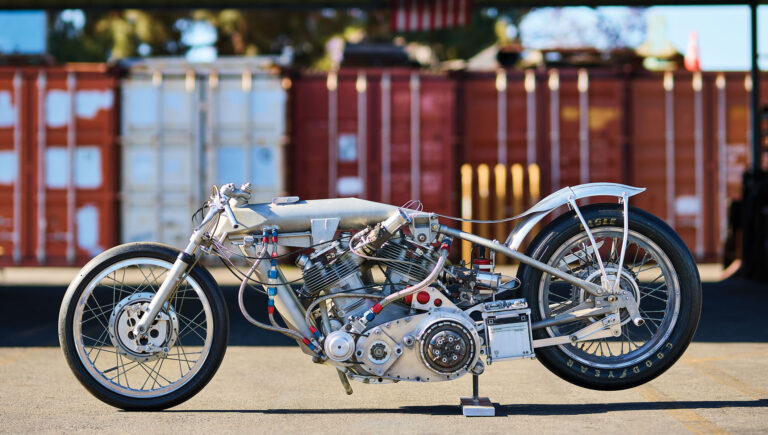
1980 Vincent “Barn Job” Drag Bike
- Engine: 1600cc/96cu in, OHV, 50-degree V-twin with offset cylinders and male connecting rods, compression ratio: 11:1
- Best E.T./top speed: 8.40sec/187mph
- Bore & stroke: 4.00in x 3-11/16in
- Carburetion: Hilborn fuel injectors (one per cylinder)
- Transmission: Chain primary, third and fourth gears only with modified Harley-Davidson clutch using additional plates and stronger springs
- Electrics: 12v, electronic ignition
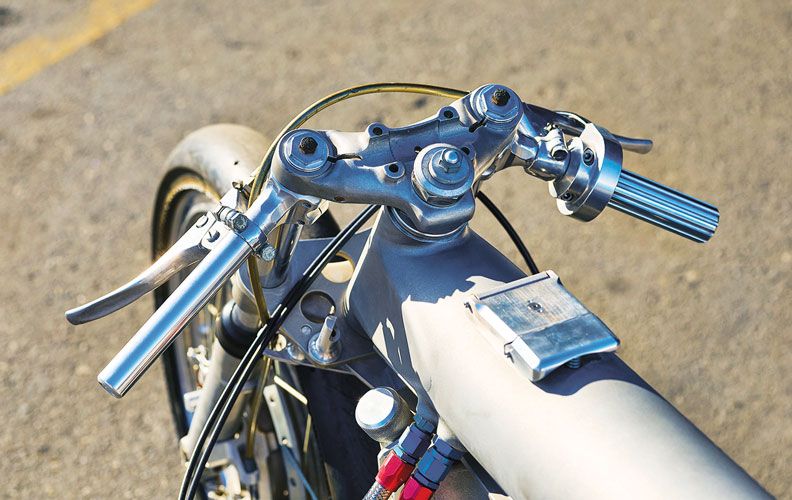
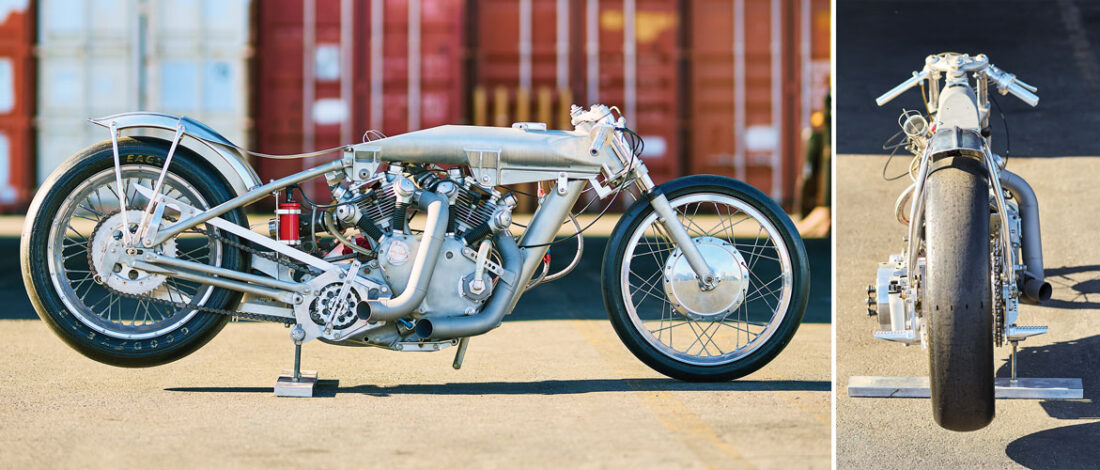
- Chassis: Custom designed, tubular aluminum, 63 inch wheelbase
- Suspension: Ceriani fork, rigid rear
- Brakes: Double-leading shoe front, SLS drum rear
- Wheels/tires: 2.50/2.75in. x 18in. front, 7.00in x 18in. rear
- Weight: Approx. 260lbs
It’s been said that drag racing was one of the first forms of motorcycle racing — and that’s probably true. All that was needed, after all, was a stoplight and a pair of motorcyclists waiting for it to turn green. Whoever got to the finish line first was the winner. And when it became a sanctioned American motorsport in the Fifties — and for many years to follow — the motorcycle that got there first most often was Barn Job.
How it came to be
In 1964, in Buffalo, New York, native Clem Johnson purchased Vincent Rapide VIN F10AB11209 and began modifying it almost immediately. In the early days of drag racing, there were few, if any, performance parts available. Racers had to make their own, and being a master tool and die maker, Clem was well-equipped to do so. By the time he was done with Barn Job, virtually the only original parts remaining were the crankcases and timing cover. Or as Hot Rod magazine put it, “To call it a Vincent today is merely a courtesy to the manufacturer, so radical is the metamorphosis that leaves only an engine shell to hint of its heritage.”
Much of the inspiration for that metamorphosis came from hot rodders. Since car guys back then were a lot further along in terms of knowing how to increase their machines’ performance, Clem borrowed much of his thinking from them. One of his first steps was to increase displacement, which he did by lengthening the stroke from three-and-a-half to four inches, while also increasing the bore from three-and-five-sixteenths to three-and-eleven-sixteenths inches — in the process, ending up with 85 (and later 96) cubic inches. He then machined a set of 11:1 pistons from forged aluminum billets and added larger intake valves, modified Mack truck parts, along with valve springs from a Chevy V-8.
Problems solved
The camshafts proved particularly challenging. Not only were the stock ones too mild, but the lever-type valve lifters of a Vincent required an unusual profile, which local cam grinders wanted nothing to do with. Clem — true to form — built his own cam grinding machine and ground a set of half-inch, billet steel cams with 300 degrees of duration.
The ignition system also proved challenging. Since a twin-cylinder magneto has its greatest spark only at every 180-degree rotation, the irregular firing order of a V-twin makes it impossible to obtain maximum efficiency. Clem tried using a separate magneto for each cylinder, which proved overly complicated. At that point, he developed a dual-point, battery ignition system, and the problem was solved.
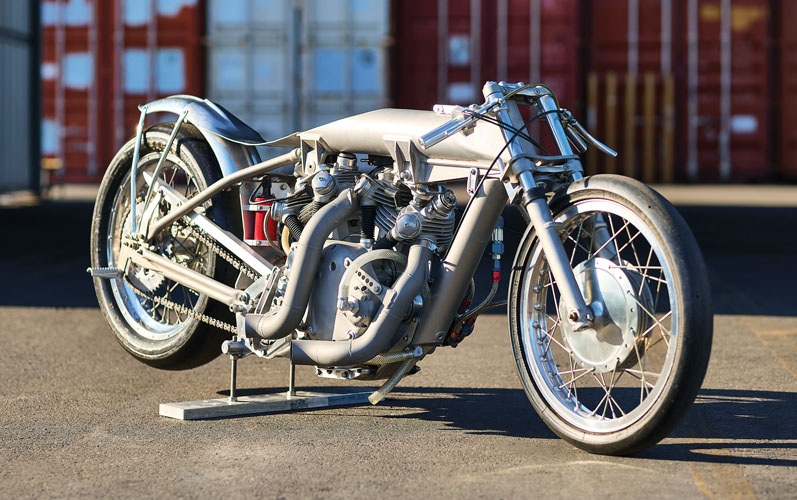
And then there were the inadequacies with the dry sump oiling system, which he first solved by eliminating the oil tank and external lines, and carrying the engine oil in the transmission case, to be fed to the cams and rod bearings before being returned by gravity through holes drilled in the “wall” separating the crankcase and transmission. When this system no longer proved satisfactory, he used the front frame down tube as the oil tank.
Chassis and running gear
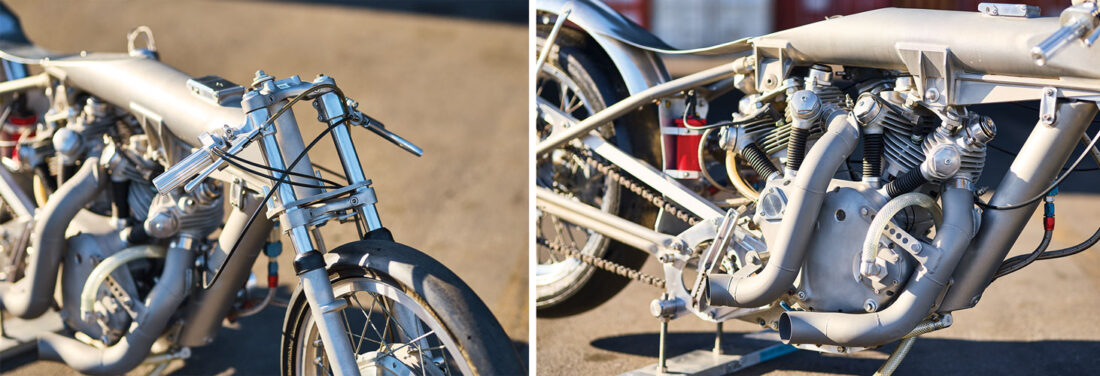
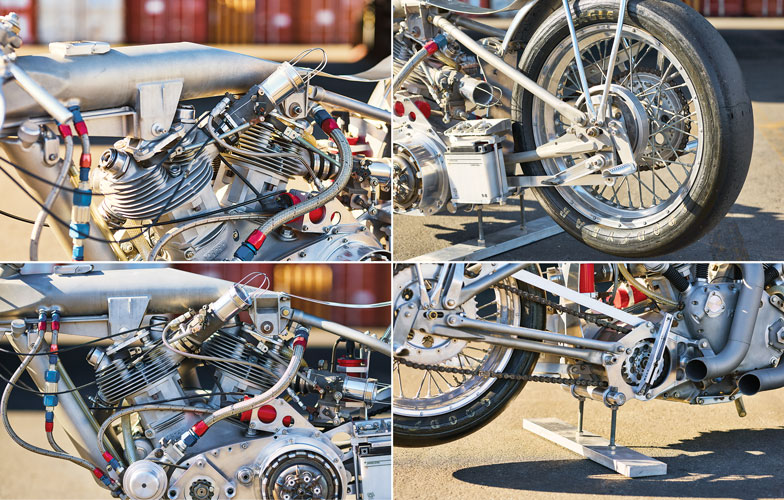
As the horsepower in Barn Job increased, so did the need to ensure that the chassis could take advantage of it. The first order of business was to replace the stock steel frame with an aluminum one Clem designed and fabricated using one-inch diameter, eighth-inch wall thickness, 6061 ST aluminum tubing that was heli-arc welded and shot-peened. As for the fuel tank, the earliest versions of the bike used either the stock Vincent gas tank or a cylindrical tank fastened to the upper frame tube. On later versions, the upper frame tube itself also serves as a gas tank. Initially, a four-inch street tire was used at the rear, later to be replaced by a proper four-inch wide slick and still later by a six-inch road racing tire. The front forks are Ceriani road racing units. Typical for the era, there’s no rear suspension.
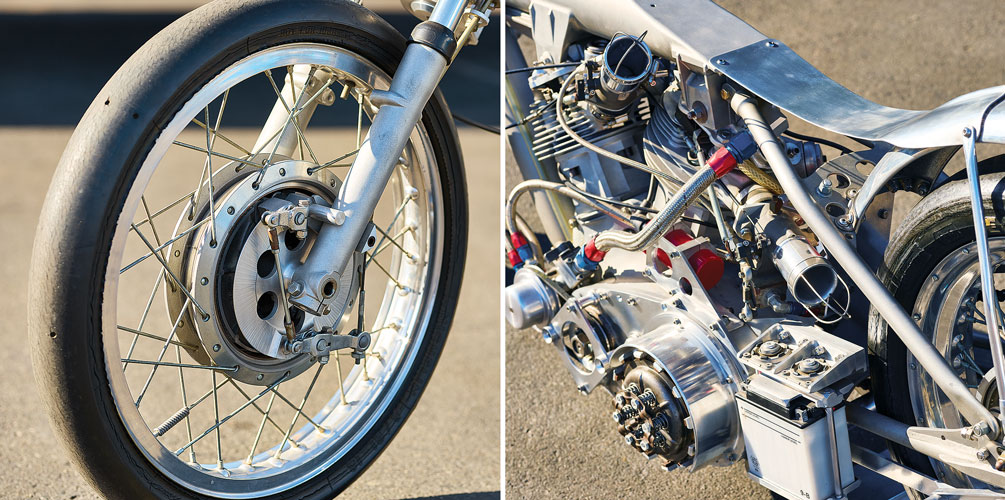
For whatever reason, the machine used drum brakes at both ends, even though almost everyone else at the time took advantage of the more efficient disc brakes. The front brake on Barn Job is a heavily modified, Suzuki street bike part, while the rear is an aluminum drum machined by Clem.
The evolution of Barn Job
As with any machine raced over the course of 25 or so years, there were several versions of Barn Job. And because it was based on a street machine running on pump gasoline that later became a Top Fuel Motorcycle running nitromethane, the evolution was dramatic.
The first iteration of Barn Job was as a stripped-down street bike with a 1000cc displacement, or 61 cubic inches. It used a four-inch, Dunlop Universal street tire at the rear and 19-inch Avon at the front. The frame and forks were mostly stock.
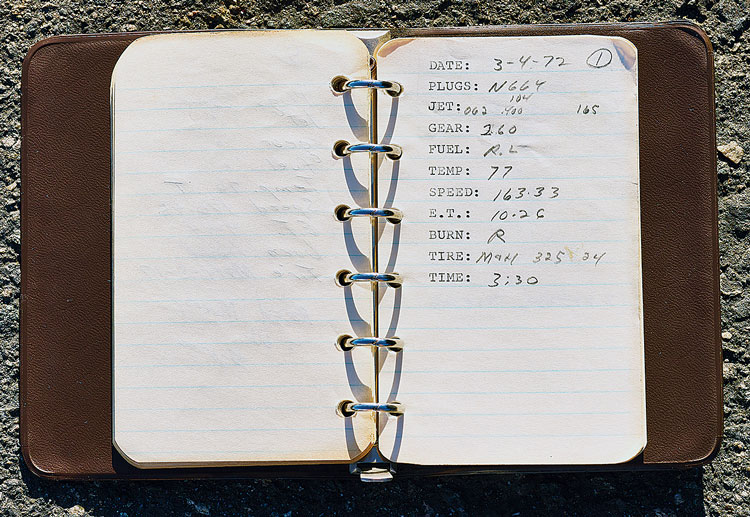
The second iteration was dramatically different from the first, with a rigid aluminum frame having replaced the stock steel Vincent frame and swingarm components that use the engine as a stressed member. Massive 42mm Dell’Orto carburetors were used with a mixture of 50 percent nitro and a blend of benzol and methanol. Best time was 9.70 seconds at 151.51mph — easily enough to beat any other drag bike and many of the cars.
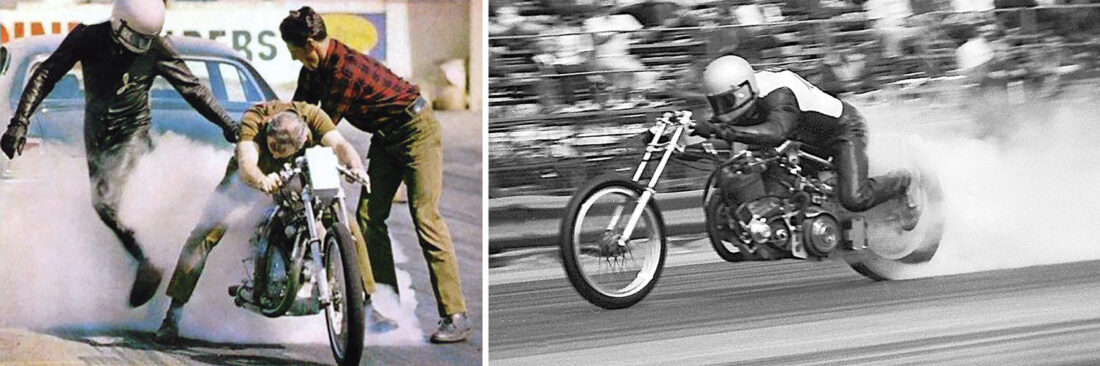
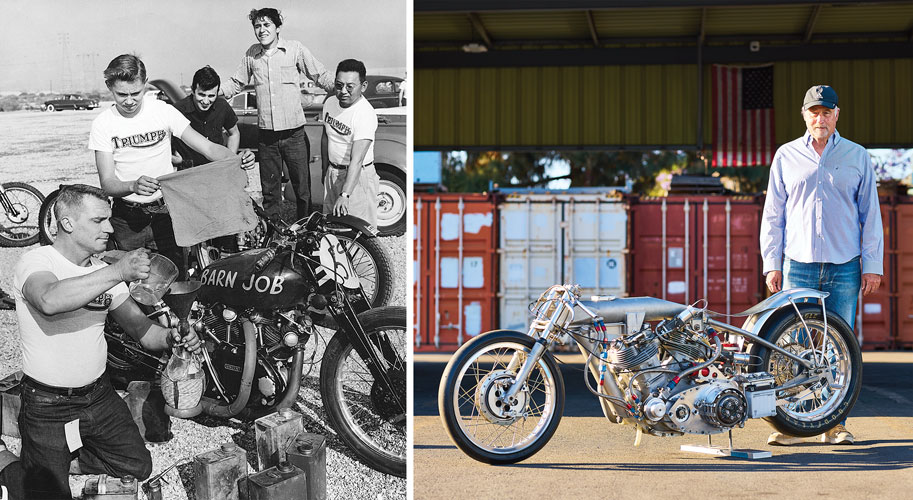
Arguably the most beautiful version of Barn Job, the third, was notable for its sleek, aluminum, Clem Johnson-designed frame. The engine now displaced 1,600cc (96 cubic inches) and used a pair of Hilborn fuel injectors with the injector pump running off the crankshaft on the left side of the engine. Only third and fourth gears were used since the engine provided enough torque to make first and second unnecessary.
In time, Japanese in-line Fours and twin-engine Triumphs, Nortons, and Harley-Davidsons began dominating. Johnson needed something dramatic to be competitive, and he found it with a Jerry Magnuson-designed supercharger. Because of the additional power it provided, a set of wheelie bars was added to keep the machine from flipping over backwards. Now with Jim Leineweber riding, Barn Job had a best time of 8:40 seconds at 187mph.
How it came to be mine
Although I never saw Barn Job run, when I was 13, I did have the good fortune to see a story about it for which I’m forever thankful. I can still remember that day in May of 1964 when the new issue of Hot Rod magazine arrived in our mailbox. Although primarily car-focused, it did have the occasional article on motorcycles when the editors considered them worthy. And Barn Job, for reasons immediately apparent, was one of them. The photos in the article were forever etched into my mind. But just to make sure they would stay that way, I placed the magazine — which I still have — in a heavy-duty plastic sleeve and bought a couple of back-up issues for insurance.
From that point on, I dreamed of owning Barn Job but knew the odds of that happening were slim at best. And then, some 40 years after the article appeared and me now living in Los Angeles, I went to a dinner of car and bike enthusiasts where I had the good fortune to sit across the table from Clem Johnson. After mustering enough courage to introduce myself, I told him how much I admired what he had done and that I’d be interested in buying the machine should he ever decide to sell it. He didn’t say “yes,” nor did he say “no”. In hindsight, he didn’t say much at all. Although the builder — and for a time rider — of arguably the most dominating drag bike of all time, he was quiet and reserved, more shy than aloof. I’d bump into Clem every few years, each time reminding him of my desire to own the machine, but not wanting to come on too strong and risk alienating him. I knew that I couldn’t be the only one expressing interest — and far from the wealthiest — but I hoped that I’d be the right one.
Background checks
And then one morning several months later, my cell phone rang. Although I didn’t recognize the number, I had a sense that the call was an important one. I answered and it was Clem who asked if I still wanted to buy Barn Job. “Absolutely,” I told him. But before he would agree to sell it to me, he needed to “check me out” to be sure I’d be a good “caretaker.” Some weeks later, he’d gotten his answer, and it was what I hoped it would be. He threw out a price and I accepted it without hesitation. I didn’t know if it was a fair one, but I thought it unwise to try to negotiate a better price and risk losing the deal altogether. Clem insisted that I pay him in full even though he wouldn’t allow me to take possession until he felt the machine was perfect. Although I told him that I had no intention of starting it (not wanting to take chances with something almost entirely handmade and running on volatile nitromethane, no less), he was steadfast.
It was fully a year and many sleepless nights before Clem told me I could pick up Barn Job. The next morning, my son and I headed to his house in a rented van and loaded up the machine, securing it with at least twice as many tie-downs as necessary. I expected to feel ecstatic and somehow triumphant with my good fortune, but I didn’t. It was actually sobering: a realization that as its new caretaker, the responsibility for doing the right thing was now mine. And never having owned anything particularly iconic, I wasn’t sure what the right thing was.
What kind of Harley is it?
Rather than keeping Barn Job hidden away in my garage, I assured Clem that as with any work of art, it would be shared with others. It’s been older, more knowledgeable enthusiasts who have asked, “Is that what I think it is?” to younger, less knowledgeable ones asking, “A V-twin, huh? What kind of Harley is it?” A few weeks after buying Barn Job, I drove out to Clem’s house to check in on him, only to find that he’d had a stroke and was unable to talk. I was reminded of when a young Bob Dylan went to visit an ill Woody Guthrie before his passing. Heroes are heroes no matter what shape they’re in. When Clem passed away in December of 2013, I was asked to bring Barn Job to the funeral service, which I was happy to do. I was also asked to be a pallbearer, which I also did. For so many years, he was part of my life. On that day, I was part of his. MC
Genius in the camshaft
The camshafts in Barn Job have been a particular source of interest. One day, I got a call from a friend who mentioned that one of the most knowledgeable Vincent people in the world, Australian Terry Prince, would be in town and wanted to see Barn Job. I told him that while the machine was on loan to a museum, he was certainly welcome to go through the many spares I’d received with the bike.
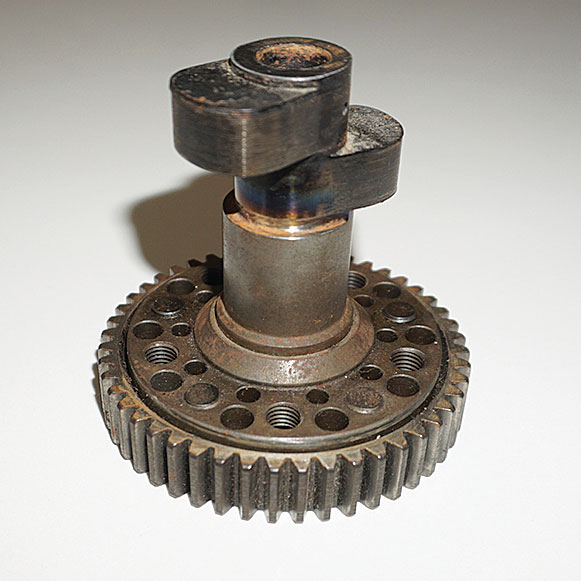
After handing Terry a cam to look at, he held it in his hand for a couple of minutes without uttering a word, staring at it as if it were the Hope Diamond. “Genius,” he said, “absolutely brilliant. Just amazing what Clem’s done.” I, on the other hand, never “saw” it, and probably wouldn’t have understood it if Terry had tried to explain it to me.