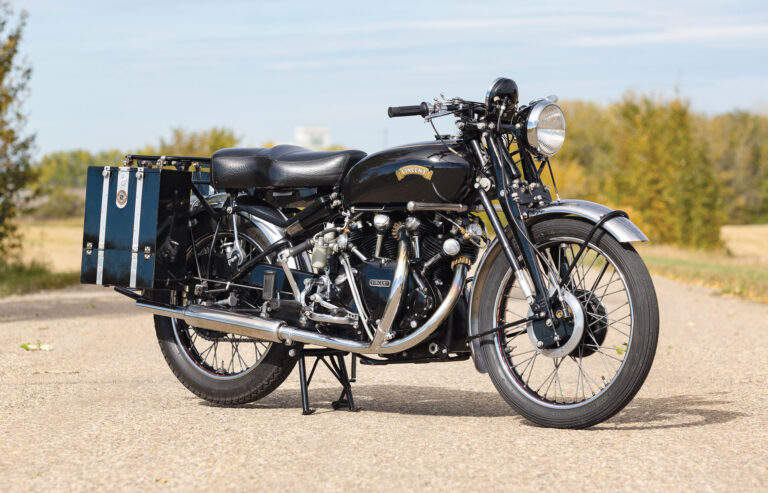
1951 Series C Black Shadow
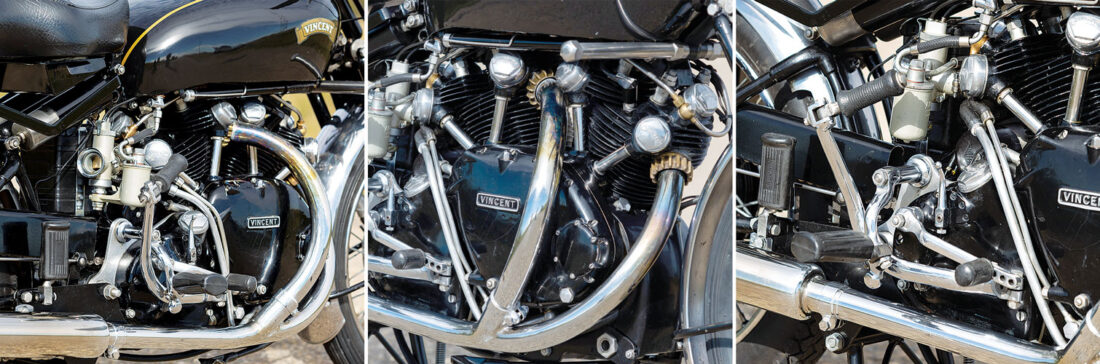
- Engine: 998cc OHV air-cooled V-twin, 84mm x 90mm bore/stroke, 55hp @ 5,700rpm stock, w/7.3:1 compression ratio. (Horsepower now unknown w/8.5:1 compression ratio)
- Top Speed: 125mph (est.)
- Carburetion: 2 Amal 1.125in 289 Pre-Monobloc
- Transmission: 4-speed, triplex chain primary drive
- Electrics: Lucas KVF magneto, Miller 6V dynamo
- Frame/wheelbase: Single upper frame member, stressed engine, 56.5in (1435mm)
- Suspension: Girdraulic front, dual spring/single shock triangulated swingarm rear
- Brakes: Dual drum 7in (178mm) front, drum 7in (178mm) rear
- Tires: Avon Speedmaster MKII 3.00 x 20in front, Avon SM MKII 3.50 x 19in rear
- Weight: 458lb (207.75kg) dry
- Seat height: 32.5in (825.5mm)
- Fuel capacity: 4.2gal U.S. (15.9ltr)
After cleaning up some wiring to the headlight of his 1951 Series C Vincent Black Shadow, Howard Smith headed out for a quick test ride on a nearby country road. He hadn’t owned the bike, which he had purchased in 1993, for very long.
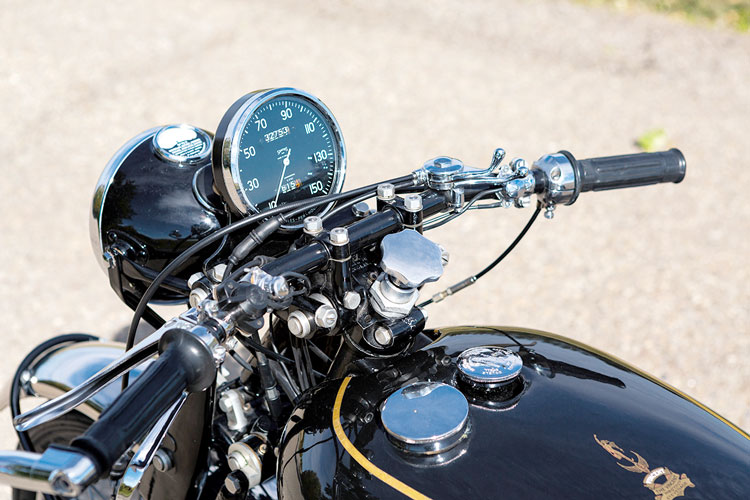
“Things seemed to be working right,” he explains. “But I was riding along with one hand on the throttle and with the other, I was messing with the headlight switch to see what kind of readings I was getting on the amp gauge. Of course, I was wearing jeans and a T-shirt, and I hit a deep dip in the road, and the front (Girdraulic fork) totally unloaded. I was going about 60 or 65mph, and it went into a lock-to-lock tank slapper that lasted all of two seconds. The front tire got enough grip to somersault the bike, launching me in a wide arc onto the road where I flailed along like a rag doll.”
He continues, “I wound up sliding on my back into the grass of the opposite ditch while the bike gyrated end over end beside me. I was hoping it wouldn’t land on me, and it came to rest in the middle of the road, still running, with fuel pouring out of the tank.”
Not only did Howard lose skin from his back, arms, and one leg, but he also broke his collarbone and a wrist. The shield to his full-face helmet was missing and his glasses were lost, but he managed to kill the Vincent’s engine, right the motorcycle, and get it on its stand at the side of the road where he’d been riding near his Calgary, Alberta, home. A couple of young men in a truck stopped to help and called an ambulance.
It was a few weeks before Howard could assess the damage to his prized 998cc V-twin Vincent, a machine he’d aspired to own since he was an 18-year-old riding a Triumph Tiger 110 while living in Kenya — a year and a half before he moved to Canada.
Where it all began
“The first Vincent I ever saw was stripped down for racing, and it was on a Kenyan track being raced by a fellow called Gordie Crowe,” Howard says. “His dad owned the bike, and Gordie raced it, but that did it for me. I was enthralled by the sight and the sound of that stripped-down Black Shadow, and I said, ‘One day, I’m going to have one.'”
It took 25 years and a bank loan before Howard acquired his Vincent. The first one he found for sale locally was a Series C Black Shadow for $10,000. At the time, he had to pass, but he got to know a few western Canadian Vincent enthusiasts, including Art Cartwright and Phil Mahood. Originally from Ontario, Phil lived in Calgary for seven years and then Castlegar, B.C., but eventually moved back east. Phil’s advice to Howard was to join the Vincent H.R.D. Owners Club, which he did.
“Phil had purchased this Black Shadow, the one I’ve got, from his friend John Andrews in Toronto,” Howard recalls. “It was running, but always had a problem oiling plugs, with the front one getting so bad it would whisker and cut out.”
John Andrews and Vincent
John Andrews was a well-known name in the Vincent Owners Club. He was the section organizer of the Toronto Section of the VOC and organized an International Vincent Owners Club rally held at Shadow Lake in 1977. With participants from around the world attending, this initial event set the mold for subsequent International Vincent rallies, now held every four years somewhere in the world. North American VOC rallies are held annually in a variety of U.S. and Canadian locations.
Born in 1935, John left England during World War II with his family to move to New Brunswick. As a teenager, he served in the Royal Canadian Navy but went on to become a respected journalist. He was also a road racer, buying a new 500cc Manx Norton aboard which he competed for a single season and won the Eastern Canadian Championship. In the 1960s, he returned to England and, while working as a daily columnist and features writer, he began searching for a Vincent.
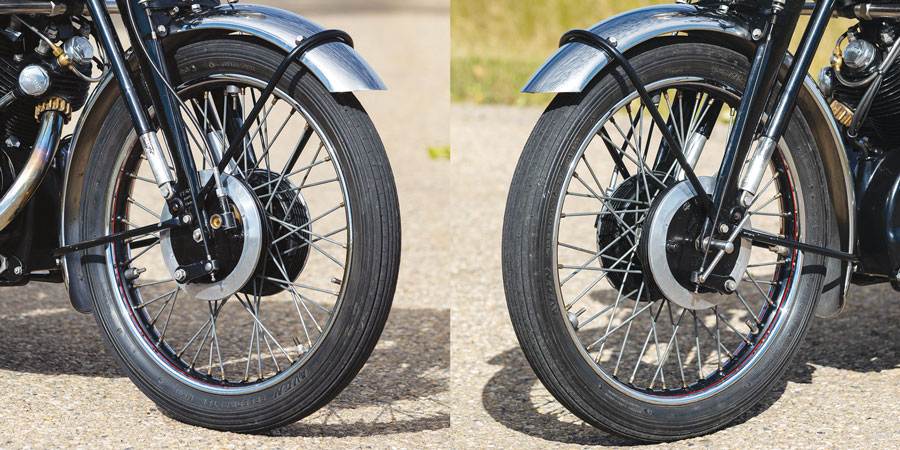
In 1967, he found a complete but tatty 1951 Series C Vincent Black Shadow. He bought it and took it directly to Harper Engines Ltd. in Stevenage, a town some 28 miles north of London and home of the original Vincent works. In 1959, Harper Engines acquired the manufacturing rights and all spare parts of the bankrupt Vincent H.R.D. company. There, John’s Black Shadow underwent a complete overhaul. A six-page invoice dated April 18, 1968, indicated labor included dismantling, machining, and checking all parts, as well as refinishing and fitting of new pieces as itemized. Finally, “Retiming valves and ignition, tuning carbs, rebuilding both wheels, and restoring to as-new condition,” the invoice stated, ending with, “Road testing and adjusting.”
Items on the invoice include new main bearings, pistons, bushes, push rods, cam followers, chains, sprockets, seals, screws, and rivets — and much more. Notably, a new gas tank, front hub, rims, and front and rear fenders are on the list. The gas tank was £8, the front fender £2/12, the rear £2/15. Adjusted for inflation, that £8 gas tank is equivalent to £122.60 today, or about $167 U.S. The total on the invoice was £403/4. Adjusted for inflation, that’s £6,175.94, or about $9,275 U.S. today.
John moved back to Canada shortly after buying the Black Shadow and having commissioned Harper Engines to undertake the rebuild. When the job was done, the rebuilt Vincent was crated and shipped to Halifax, Nova Scotia, on February 12, 1969. Apparently, John didn’t ride the machine often, and it made its longest journey when he rode it some 1,000 miles from Nova Scotia to Toronto, where he’d taken up residence. He then seldom rode the Black Shadow, occasionally displaying it at Vincent rallies, and in 1989, sold it to Phil Mahood.
Its path to the present
According to a letter from the Vincent H.R.D. Owners Club to John Andrews, this Series C Black Shadow was ordered by English dealer Blacknell Motors on June 18, 1951. The Vincent factory in Stevenage had the machine assembled and road tested by a Mr. Peach for 50 miles before forwarding it to Blacknell Motors on July 16, 1951. Its history from that point isn’t clear until it was purchased by John in 1967, then sold to Phil. Under Phil’s ownership, the bike was shown at the North American Vincent Rally in 1992 in Calgary at Canada Olympic Park.
“Phil had bought the bike and had it there, but he wasn’t riding it much because it was giving him some grief,” Howard recalls. “And that’s the first time I saw it. I was riding my 1975 Norton Commando Mk3 at the time, and I was following the Vincent market. I passed on a Series D Rapide out of Pennsylvania because I just couldn’t bring myself to buy a bike sight unseen, and a short time later, Phil decided to sell this one and offered it to me for $20,000.”
Prices for Vincent motorcycles have never been inexpensive, even when new, but Howard has also never thought himself to be well-heeled. “I was certainly not in that category when I bought mine,” he says, and continues, “I normally consider myself to be a fairly conservative person, but in this case, I wanted the bike so badly that I got a bank loan to buy it. Then I subsequently sold five Nortons to mitigate about two-thirds of the loan. They were a ’47 Model 18, a ’50 Model 18, and a ’62 650SS. They were all basically complete but needed to be restored. Then a nice ’73 Dunstall 850 Commando, and lastly, my mint ’75 Mk3 Commando.”
Part of the deal for $20,000 included Phil helping to sort out the oiling issue. The barrels were removed, and there was evidence that oil was making its way up between the liner and the wall of the barrel. New liners were installed with a tighter interference fit, and the heads were modified to accept valve guide seals. Machining was undertaken near the front head’s exhaust valve so oil wouldn’t pool and would better drain down the pushrod tube. “And that sorted it,” Howard says. “I took delivery of it in the spring of ’93.”
Living with the Vincent
Although the oiling problem was solved, Howard says the machine was a recalcitrant starter when hot and suspected the Lucas KVF magneto was slowly failing. And it had been fitted from Harper Motors with early Amal Mk1 Concentric carburetors, which he never really liked, but lived with them for a long time.
His first real highway venture in June of 1993, just weeks after taking delivery of the Black Shadow, started with the bike on a trailer. “There was a combined Alberta and British Columbia Vincent rally every summer at Mara Lake, in B.C.,” Howard says. “The first time I was so nervous, I put it on Art Cartwright’s trailer with his Vincent. About halfway there, though, I said, ‘This is nonsense, stop and let me off.'” At the next gas stop, the Black Shadow was unloaded, and Howard rode it the rest of the way without issue, and rode it back home.
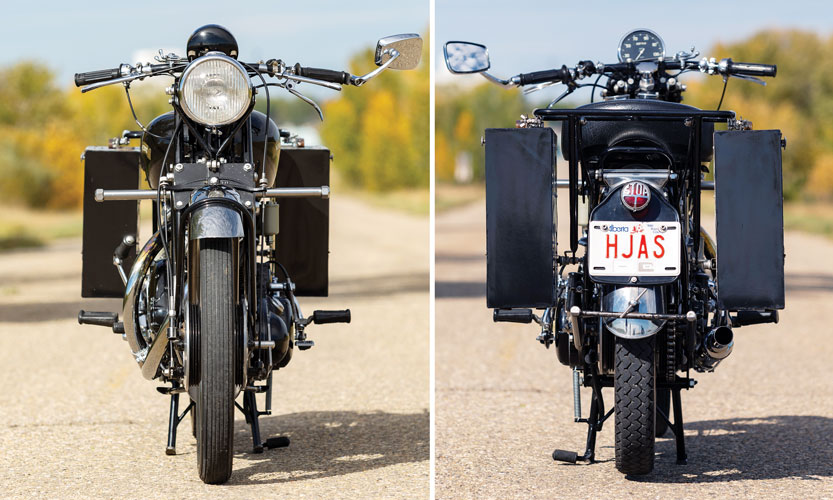
Not long after, Howard had his accident with the Black Shadow. He says that while he was in rough shape, the Vincent survived remarkably well. “It wrecked the light unit and the rim, but the shell was okay,” Howard says. “The handlebars and levers were wrecked, and the tank took a licking from the bars. The seat, taillight, rear stand, and muffler were also damaged.”
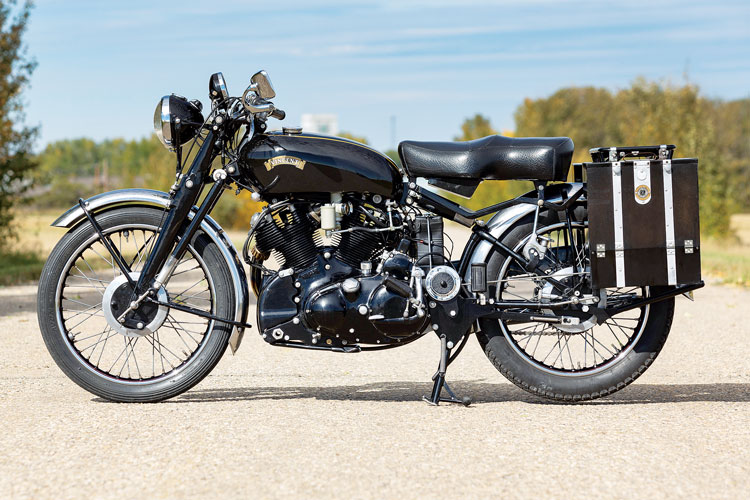
He had the tank, which was a Series B tank, restored. While it was a beautiful job, the tunnel became slightly narrower in the process as it wasn’t trued on a jig. That made the tank difficult to remove and replace. He traded the Series B tank for a correct Series C tank. All other components, built to original specifications, were available from the VOC.
There was never any question he’d return the bike to the road. It gives him a story to tell, and the accident never stopped him from using the Vincent after it was back together. What he’s learned to do is crank down tight on the steering damper when riding fast on the highway, and to keep lower pressures in the tires, per the Vincent owner’s manual.
Howard suffered with the KVF mag for several years before he removed it in 1999 and sent it to “Vintage Car & Motorcycle Electrical Specialist” Dave Lindsley in England. It was treated to a complete overhaul with a rewound armature, new condenser, slip ring, and bearings. The fresh mag turned the Vincent into a one-kick starter when hot. Howard also bought a second KVF magneto, which he had rebuilt by The Magneto Guys. This second mag is a spare, carried on longer journeys. “As to my mind, that’s one of the main things that could really just leave you at the side of the road,” Howard says.
“I bought the bike to ride, and it’s fun, but I never had much of a plan to tour long-distance on it,” Howard says. “I never really had a burning desire to own a modern touring bike, and the Vincent allowed me to ride something classic but still go long distances if I wanted to. That is the beauty of it — it has the power to keep up with modern traffic, and I did ride it in 2001 into Oregon to attend a North American Vincent rally in the Columbia River Gorge.”
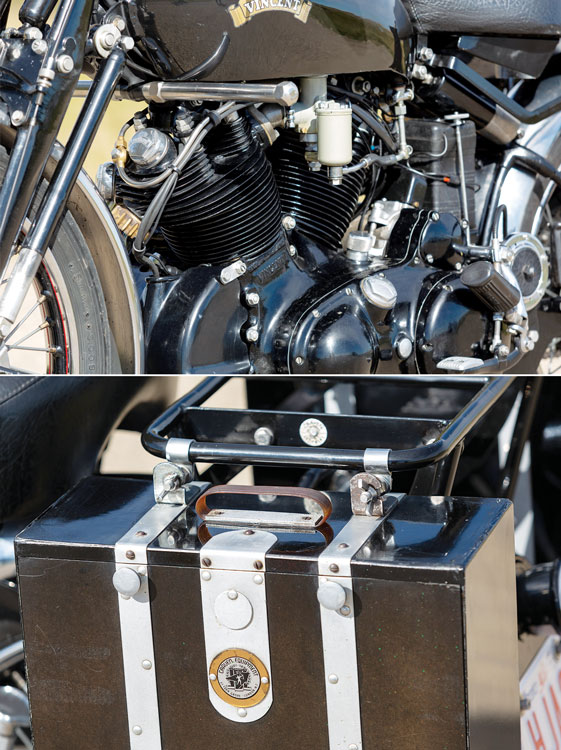
During the ride back from Oregon, Howard said fuel was vaporizing in the rear Amal Concentric, and during a long climb up a steep grade, the rear cylinder cut out. “I had that happen a couple of times, and the slides also sometimes stuck,” Howard says. “So, I began searching for what would originally have been fitted, and those are Amal pre-Monobloc 289s.” Howard checked with Burlen Ltd. in England and was told at the time that they would not be reproducing the Amal 289 carbs suitable for the front and rear cylinders.
Howard then spent a good three years on eBay tracking down new old-stock Amal components to build himself a set of handed 289s. Handed simply means the separate float bowls and the mixture and air screws on the carb bodies are correctly oriented when installed on the machine. “That transformed the bike, and it’s closer to original, which is how I like to keep my bikes,” he says.
He also had issues with the push rods, which he assumes were the ones fitted by Harper Motors. They were soft, and one once jumped off a rocker. With a replacement push rod and rocker acquired from the VOC, the Vincent was back together when the next year, on a ride to Missoula, Montana, there was something about the feel of the exhaust valve lifter that didn’t feel right. Checking the tappets, he found the front cylinder exhaust tappet was loose. He adjusted it and then adjusted it every time he stopped. By the time Howard made Missoula, about a quarter of an inch had been chewed off the push rod. He carried new spare push rods and had it changed in five minutes in the hotel parking lot.
Engine overhaul
“The last time the engine had been looked at was when Harpers went through it,” Howard says. “So, in 2004, I had John McDougall in Vancouver, B.C., go through the motor. I pulled it out and got it to him, and there were some issues internally. He did a lot of work, with new pistons and rings, and he redid the crankshaft, put Honda valves in it with new valve springs, and looked after the cam plate spindle.”
One of the only other serious issues Howard faced with the Black Shadow was a dragging clutch, which he discovered while riding back from overnight camping at a local vintage motorcycle rally. “Luckily, I didn’t have to stop at any lights, and when I pulled up behind the garage and pulled in the clutch and put on the brakes, the clutch didn’t disengage, and it killed the engine, the drag was so bad,” Howard says.
Unique to the Vincent, the dry clutch is like a brake drum with shoes that expand and contract, with a single disc primary clutch that engages the links to push the shoes out, rather than separate multiple friction and steel discs. He dug into the Vincent books to try and determine what might be going on, and he suspected the clutch springs and sleeves. He replaced these components, and it was just as bad.
All apart once again, on a whim, Howard pushed down on the kickstart lever. It was stiff. “I know I don’t have a gearbox issue,” he says he thought to himself, “so why is the kickstart stiff without the clutch even in the bike? It turned out to be a dry bush on the clutch sprocket that was binding on the clutch shoe carrier, which rotates on the mainshaft. This bush had been made of brass, instead of Oilite, which is self-lubricating. Another legacy of a past rebuild. While it was all apart, I had the shoes refurbished by the VOC, and I replaced the clutch shoe carrier and bushes, properly reamed to size. Now, that clutch is beautiful, just lovely.”
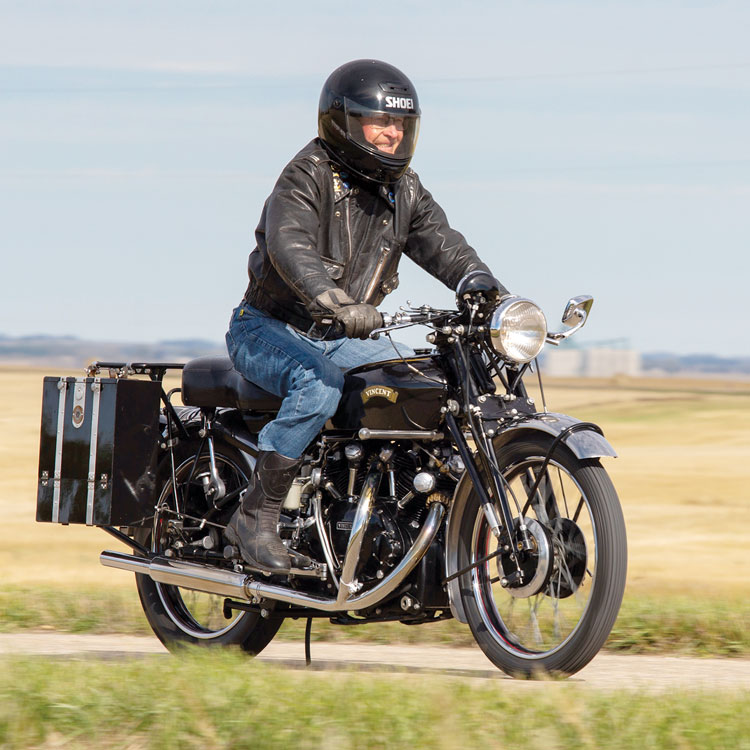
At the Vincent H.R.D. Owners Club 2023 International Rally held in California, Howard’s Black Shadow won best Series C during the Cobble Beach Concours. It’s not the shiniest example, Howard says, but he was told by Vincent specialist Somer Hooker that the award recognizes his Black Shadow as being one that best represents how a Vincent would have left the Stevenage factory.
Over 33 years of ownership, Howard figures he’s added 20,000 miles to the Black Shadow. “My 20,000 miles is really pathetically low when compared to many others in the VOC, partly because I never had a schedule when working, and partly due to family commitments. Some of the West Coast guys in California and Vancouver put on huge mileage on their Vincents.
“But it’s an awesome motorcycle; it handles well and there’s so much power with tons of torque. It’s very comfortable to ride, as pretty near everything is adjustable to tailor the riding position to suit your needs.”
He concludes, “I have a BMW R100S, and it’s a beautiful bike, but it doesn’t light my fire like the Vincent does. The Vincent lights a fire, that’s what it does.” MC
Hard lessons in riding gear and safety
Given Howard Smith’s get-off with his Vincent Black Shadow, the experience changed his thoughts about riding gear. He says, “When I came off, I was wearing running shoes. Since then, I’ve always worn high leather riding boots. And I always wore leather after that, too, no matter how hot the weather, or how far I was going. Later, I purchased a Joe Rocket jacket, and a few years ago, I bought Draggin Jeans, which I wear quite often if it’s hot and I’m not going too far or fast like at vintage bike rallies. The other thing I wear religiously these days is a high-visibility vest — I almost got taken out by a Mercedes when I was riding in Chicago seven years ago.” At the time of his accident, Howard was wearing a full-face helmet and was glad for the protection it provided over a half or open-face helmet. Many riding enthusiasts have adopted the “All The Gear, All The Time,” or ATGATT philosophy. Howard agrees. Had he been suitably attired for his test ride, he’d have not lost as much of his hide. As for what caused the initial Vincent headshake, Howard adds, “There have been a lot of Vincent riders who experienced ‘tank slappers’ over the years, and some guys in the club have devoted considerable effort into determining why. It seems to be only with the Girdraulic forks when they become totally unloaded. The earlier Bramptons are not affected.”