Norton Mercury 650
Years produced: 1969-1970
Power: 47hp @ 6,800rpm
Top Speed: 110 mph est.
Engine: 646cc (68mm x 89mm) air-cooled, OHV parallel twin
Transmission: Chain primary, wet multiplate clutch, 4-speed, chain final drive
Weight/MPG: 408lb dry/NA
Price now: $4,000-$12,000
When the 750 Commando was launched at London’s Earls Court motorcycle show in 1967, cynics were quick to point out that Norton had ditched the best feature of its heavyweight motorcycle range — the sweet-handling Featherbed frame — and retained its main liability — the 20-year-old parallel-twin engine. But the Commando, with its vibe-killing Isolastic frame, was such a success that by 1969 the remaindered items in the company’s parts inventory included Featherbed frames and a quantity of 650cc engines from the Manxman and 650SS. What to do?
The result was the Norton you’ve never heard of — the 1969-1970 Mercury 650. Although no doubt intended to clear out Norton-Villiers’ stock of pre-Commando parts, the company created what is sometimes described as the nicest Norton ever. The long-stroke 650cc engine was considered the best development of Bert Hopwood’s 1949 parallel-twin. The largest capacity version, the 750 Atlas, produced such teeth-loosening vibration in the Featherbed that it was first sold as a mild-tune, low-compression tourer. The 750’s tuning potential had to wait for the Commando’s Isolastic frame. But the 650 worked beautifully in the Featherbed chassis, either in standard 650 Manxman form or as the dual-carb 650SS.
The Featherbed famously started out as a race chassis for the Norton Manx. It was a full duplex cradle frame made from chrome-moly tubing, strengthened with cross braces, triangulated around the headstock, and bronze welded. A rear subframe was welded on to support the swingarm suspension and dual shocks. The Featherbed was more expensive to manufacture than traditional lug-and-braze frames, so its introduction to Norton’s production twins wasn’t completed until the late 1950s. The production-bike frames adopted mild steel tubing rather than chrome-moly, and (after 1960) featured top tubes that swept inward behind the gas tank for more comfortable seating. The earlier frames were known as “wideline,” and the later as “slimline.”
The 650cc engine fitted to the Mercury’s “slimline” Featherbed frame was a development of the 1949 Model 7 Dominator 500cc OHV parallel twin. Unlike Triumph’s 500 twin, the Norton engine used a single camshaft driven by chain from a half-time pinion, making it mechanically quieter. Pushrods were fully enclosed in the cylinder casting, and the cylinder head incorporated the rocker boxes, reducing the opportunity for oil leaks. The 500 became the Dominator 88 in 1953 (in the Featherbed frame) and was joined in 1956 by a 600cc Dominator 99 with an alloy cylinder head. The first 650 was the cruiser-style 1960 Manxman, intended for the U.S. market, though a “home” market 650SS with lower bars and twin carburetors followed in 1961.
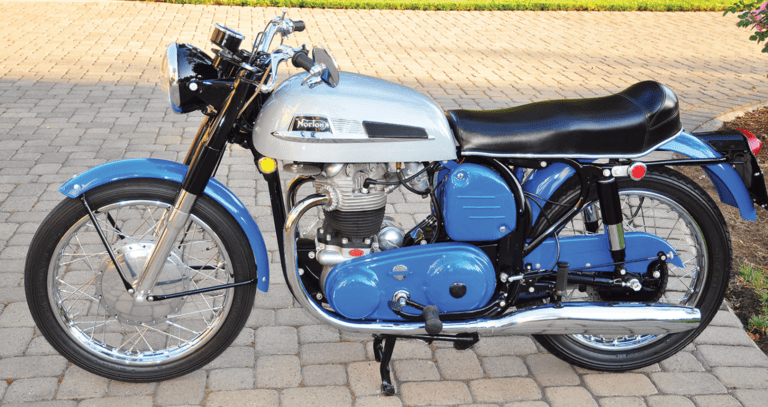
Why it took Norton so long to build a full 650cc bike is bewildering when the company must have been losing sales to 650cc BSAs and Triumphs. AMC, Norton’s parent company after 1952, also stuck to 600cc for their Matchless and AJS twins until the 650cc G12 and Model 31 of 1958 — even though 650cc had been the class benchmark since Triumph’s Thunderbird and BSA’s A10 Golden Flash of 1949. The Mercury appeared in 1969 in a striking Atlantic blue paint scheme (oil tank, toolbox, fenders, primary chain case and chain guard) with a silver gas tank and chrome badges. A black finish with red or silver gas tank also seems to have been available, and stainless steel fenders were an option. The rest of the chassis and running gear were traditional Norton including the Roadholder front fork — though the Mercury was fitted with an 8-inch single-leading-shoe front brake (not the twin-leading-shoe brake from the Commando) and a tachometer was optional. However, there are many Mercuries around with the TLS brake, though whether retrofitted (a straightforward modification) or from the factory isn’t clear. A tachometer could also be added but required fitting a drive gear from the camshaft behind the timing cover blanking plate.
Though superficially similar to the earlier Manxman and 650SS engines, the Mercury benefited from many of the Commando’s internal upgrades, and featured 12-volt electrics with capacitor ignition for battery-less emergency starting. A single Amal Concentric carburetor was fitted. Unfortunately, the Mercury retained the leak-prone sheet metal primary cover: the Commando’s alloy primary case worked much better in that respect.
But the result was a well-balanced motorcycle with superior handling, enough power for spirited touring, and improved reliability. That, and the fact that only around 750 copies of the Mercury were built, means they’ve now become desirable and collectible. MC
Contenders: Parallel-Twin Alternatives to the Norton Mercury

1966-1970 Kawasaki W1/W2
Years Produced: 1966-1970
Power: 50hp @ 6,500rpm (claimed)
Top Speed: 101mph (w1, period test)
Engine: 624cc (74mmx72.6) air-cooled, OHV parallel twin
Transmission: Chain primary, wet multiplate clutch, 4-speed, chain final drive
Weight/MPG: 476lb (curb, w/half tank of fuel)
Price: $1,195 (1966)/$4,000-$14,000
Though U.S. and European manufacturers often accused the Japanese of copying their products, in the case of the 1966 Kawasaki W1, they had a point! When Kawasaki acquired Meguro in 1964, they also got the K1, a 500cc air-cooled OHV parallel twin that was essentially a reverse-engineered BSA pre-unit A7 twin. Stretched to 624cc, the K1 became Kawasaki’s W1 of 1966. But like many “copied” Japanese products, the W1 was in many ways better than the original. For example, the W1 replaced BSA’s suspect plain bush bottom end with a built-up crankshaft, ball and roller bearings and improved oil feed. Breathing was also revised to reduce the potential for oil leaks. The separate transmission had four gears in an N-1-2-3-4 pattern with the shifter on the right. The drivetrain went into a sturdy duplex cradle frame with a telescopic fork, a dual spring/shock rear, and a TLS front drum and SLS rear drum brakes. The W1SS of 1968 got dual 28mm Mikunis, and the restyled W2SS of 1969-1970 had more compression and three more horsepower. Cycle liked the overall finish of the W1, “… being made with more than the usual care,” and concluded: “On balance, a very good motorcycle.”

1967-1970 BSA 650 Thunderbolt
Years Produced: 1967-1970
Power: 46hp @ 7,000rpm
Top Speed: 104mph
Engine: 654cc (75mmx74mm) air-cooled, OHV parallel twin
Transmission: Chain primary, wet multiplate clutch, 4-speed, chain final drive
Weight: 385lb (dry)
Price: 1,199/$3,500-$9,500
Ironically, BSA had been building its successor to the pre-unit 650cc A10 Golden Flash for five years before the W1 appeared in the U.S. More of a makeover than a completely new machine, the A65R Rocket arrived in 1962 with “over-square” bore and stroke dimensions (compared with the long-stroke A10). The combined engine and transmission unit featured smooth, rounded lines, and quickly became known as the “power egg.”
The Rocket morphed into the single-carb Thunderbolt and twin-carb Lightning, both with more power and more vibration. To fully exploit its considerable performance, the short-stroke engine had to be revved. And with the revs came enough vibration to destroy headlight bulbs and defeat testers’ attempts to determine top speed! By 1969, the Thunderbolt had gained the excellent BSA/Triumph TLS front brake, and also featured a reasonably sound engine, solid handling, ever improving reliability and strong performance up to around 75mph — above which the vibration became debilitating. 1970 was the last year before the Thunderbolt acquired BSA’s controversial oil-bearing frame.