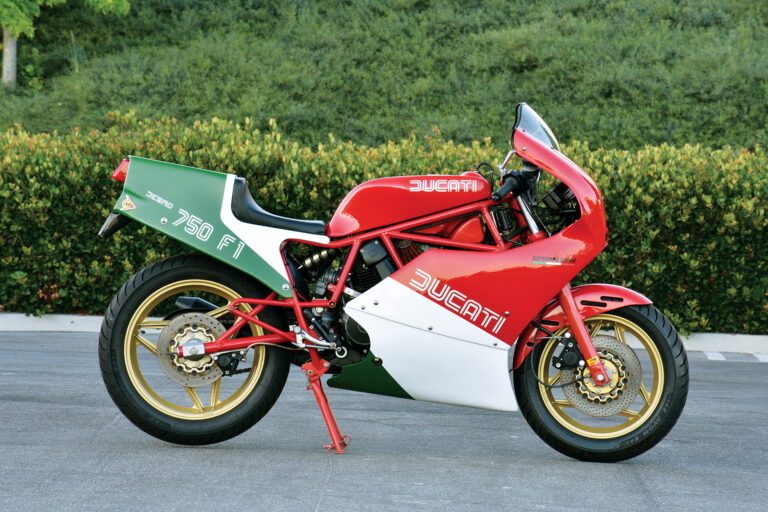
1985 Ducati F1
Engine: 748cc air-cooled SOHC desmodromic 90-degree V-twin, 2 valves per cylinder, 88mm x 61.5mm bore and stroke, 9.3:1 compression ratio, 75hp @ 9,000rpm (claimed)
Top speed: 137mph (period test)
Carburetion: Two 36mm Dell’Orto PHF
Transmission: 5-speed, chain final drive
Electrics: 12v, Kokusan electronic ignition
Frame/wheelbase: Chrome moly trellis frame w/engine as a stressed member/55.1in (1,400mm)
Suspension: 38mm Marzocchi telescopic fork front, single Marzocchi cantilever shock w/adjustable pre-load and damping rear
Brakes: Dual 11in (280mm) full-floating Brembo discs front, single 10.2in (260mm) full-floating Brembo disc rear
Tires: Michelin MN48/M48 (OE; Avon Roadrider replacement on feature bike), 120/80 x 16in front, 130/80 x 18in rear
Weight (dry): 386lb (175kg)
Seat height: 29.5in (750mm)
Fuel capacity/MPG: 4.8gal (18ltr)/47-49mpg (period tests)
Price then/now: $6,995 (1985)/$15,000-$25,000
In reality, the Ducati 750 F1 is a 1980s motorcycle, the first examples rolling out of the Borgo Panigale factory in Northern Italy in 1985. But in truth, the F1 is a child of the 1970s, its DNA traceable to blueprints originally penned by famed engineer Fabio Taglioni (aka Dr. T) for a 499cc air-cooled L-twin using a belt-drive desmodromic valve train.

That engine eventually powered Ducati’s 1980 Pantah 500SL, a bike touted by Cycle magazine in its May 1981 issue as “the first genuinely new European bike in a long time.” Of more historical consequence, though, Taglioni’s design served, in various displacements, as Ducati’s bread-and-butter engine platform during the coming years. As Cycle‘s editors pointed out in their road test, the Pantah’s half-liter engine “has room for further development.” Their prophecy would prove to be an understatement, as we shall see.
Soon enough the little engine that could evolved beyond its original half-liter displacement, stretching like Gumby to 583cc, its combustion chambers later ballooning to 649cc of Italian power. Shortly after that, and with an eye on international endurance road racing’s 750cc class, Ducati created a 748cc version of Taglioni’s 90-degree twin. That engine found a home in essentially the same remarkably taut and lightweight tubular trellis frame used for Ducati’s earlier Formula Two racer that dutifully etched its mark in moto history on road race tracks the world over. Before the millennium played out the unassuming Pantah-based engine continued contorting, morphing and growing, much like the Incredible Hulk, ultimately resulting in engines for subsequent Ducati sport bike models displacing more than 900cc.

It was in road racing where Ducati originally established itself as a major player in the approaching modern era of motorcycling that would be dominated by sporty bikes boasting big-bore engines. The saga gained traction in 1972 when a British road racer, the remarkable Paul Smart, raced the stunning Ducati 750 Imola, powered by a twin-cylinder 748cc engine masterfully engineered by Dr. T, to win the Imola 200, Europe’s short-lived response to America’s long-established Daytona 200. Smart’s win elevated Ducati into motorcycle racing’s big league of players.
A few years later a couple of motorcycle magazine scribes — Cycle magazine’s charismatic editor, Cook Neilson, and his ever-so-capable colleague and the magazine’s then-managing editor, the late Phil Schilling — ever so patiently and painstakingly modified their own Ducati 750SS — a bike they humbly christened Old Blue — to win the 1977 Daytona Superbike race. That dynamic duo’s performance, with Cook twisting the throttle and Shilling spinning the wrenches, proved that, yes, you too can become a rockin’ road racing star if you race a Ducati. Their win is epic lore among Superbike aficionados.

The following year Ducati completed its 1970s trifecta of landmark wins when Mike “The Bike” Hailwood, whose name was synonymous with motorcycle road racing, made a stunning comeback following a seven-year hiatus from the sport. Competing in his first major motorcycle event since the 1971 Daytona 200, Hailwood rode a privately entered Ducati 900SS prepared by Steve Wynne’s British-based shop to win — nay, conquer — the 1978 Isle of Man’s Formula 1 TT race. Ironically, at about that same time, the Good Doctor of Bologna was putting the finishing touches to an engine that was soon to be the Pantah project.
Enter the 750 F1
It was practically by default that Dr. T’s cam-belt L-twin engine even made it into production. Following a string of masterfully engineered small-bore single-cylinder engines designed primarily by Taglioni, Ducati management felt it was time to forge onward and upward, choosing parallel twin-cylinder engines displacing 350cc and 500cc to do so. Taglioni, feeling those engines lacking in many ways, abstained from participating wholeheartedly as he had in past projects. He felt his own L-twin design with desmodromic cam/valve drive for a 500cc engine made more sense — and probably more horsepower.
History has proven Taglioni right. The parallel twins, shoehorned into quirky chassis sporting unorthodox bodywork styled by Giorgio Giugiaro, tanked in terms of sales. Mamma mia and what to do? Quick, somebody call a doctor, and fortunately, one was already in the house. To stop the bleeding, Dr. T quietly presented management a set of plans for an L-twin 500 sporting belt-driven camshafts for 2-valve heads. The move from triage to production came about in 1979 when the first Pantah was launched. Ducati was saved… for the time being.

Of course, Italians being Italians, someone in management almost immediately got the notion to place one of Dr. T’s new L-twin engines — in race-ready trim, no less — into a racing chassis, a project that was dubbed the TT2. Trusted into the capable hands of English road racer Tony Rutter, the 600cc racer captured four Formula Two world championships, from 1981-1984.
Empowered with such success, the TT2 project begat the 750cc TT1 program that eventually carried local Grand Prix hero Virginio Ferrari to the Italian Formula One championship in 1985, along with various wins in endurance racing on the world championship theater.

About this same time another player emerged as a leader in the motorcycle industry scene. Cagiva, a privately owned motorcycle company in Northern Italy and a relatively unknown commodity on the international front, but a thriving marque in Italy, was interested in producing models powered by big-bore engines. Their solution was to contract an outside source for their engines, and that source happened to be Ducati. Cagiva ordered a variant of the Pantah 650 to fill about 6,000 frames for two new models, the Allazzura and Elefant. That order alone essentially doubled the number of engines that Ducati normally produced for its own models.
Bad moon rising
Flush with lira, the kind folks in Bologna looked at each other and, in so many words, said, “What the heck, let’s build another racer!” That model, in prototype form for what would become the 750 F1, appeared in several endurance races during the 1983 season, with ultimate success coming at Ferrari’s hands with his Formula One title in 1985. That same year, Ducati produced one of the sexiest, sweetest, sharpest-looking sport bikes ever, the 750 F1 Replica. Mamma mia, indeed, but trouble still loomed over the horizon for Ducati. Even though Cagiva’s engine orders helped buoy Ducati’s financial woes, the Bologna-based company continued to hemorrhage money. Rumors of a takeover persisted. Cagiva, based in Varese, Italy, and known for its rather cartoonish elephant logo, was prepared to solve Ducat’s economic woes through a financial bailout. Was the new 750 F1 Replica to be Ducati’s swan song?

Cycle magazine thought so. A brief article featuring the new F1 Replica appeared in the magazine’s October 1985 issue, stating, “… you’re likely seeing the last pure Ducati motorcycle there will be. And arguably the best.” “If it is,” reasoned Cycle‘s editorial crew, “Ducati certainly hasn’t bowed out meekly, but rather has left us with the machine we always hoped they would build.”
Nearer and dearer to readers, though, Cycle‘s review gave Ducatistas an idea of what the F1 production model was like to ride. But first the not-so-good news; the hydraulic clutch: “The clutch lever pull is European (read stiff),” stated the report. Now for the F1’s good points that Cycle‘s report revealed. Referencing the transmission, the editors opined, “Lever throw is short with minimal linkage slop; those raised on Japanese bikes will find that the gearbox performs precisely over the engine’s wide, flat power band.” Ah, now that’s Italian!
Then the editors cut directly to the chase, addressing the most vital piece of information that every Ducati-phile on the planet was curious about, and that pertained to how the bike handled at speed: “The Ducati invites spirited riding, forgiving of the novice’s fluttering inputs yet responsive to the commands of an expert.” Now we’re talking, and who really cares about that clutch-lever pull thingy that was pointed out elsewhere in the report anyway?

And there was more good news to report from that October 1985 issue. As brilliant as the F1 Replica was on public roads, it proved even more sensational on the racetrack. After a brief session aboard the F1 Replica around the original nine-turn Laguna Seca track, Cycle‘s editors concluded: “Good handling manners on public roads frequently turn to ungainliness on the racetrack. Not so with this Ducati.” They ended their on-track session stating, “A study in excess? Indeed. First, the F1 is an excessive street bike that performs on the track. Second, it’s a true racer that’s street legal.” Despite Ducati engineers having to slightly alter the production model’s steering geometry to accommodate a wider front tire, the street F1 offered steady handling and predictable steering at all speeds. It was practically poetic justice that a bike with only 75 horsepower could perform so brilliantly. But then, the F1 with its taut trellis frame weighed less than 400 pounds, so its power-to-weight ratio favored such sporting behavior.
The lads at Cycle also pointed out that Massimo Bordi, the Good Doctor’s right-hand man, noted that the Pantah engine platform still had potential for more growth, i.e., bigger jugs. According to Bordi, claimed the report, Dr. T’s aging engine could carry the weight of pistons displacing as much as 850cc, “but no farther.”
Confusing as an Italian family reunion
By the time original 750 F1s made it into owners’ garages, Cagiva had successfully bailed out Ducati from financial ruin. The resulting company was, in essence, a sweet blend of the two Italian bike makers, and fortunately the contingent from Varese was comfortable about leaving the iconic Ducati logo on the engine cases of most models, the F1 included.
That didn’t stop the original Ducati crew in the Borgo Panigale factory from clinging to their old ways of mix-matching various components as the parts supply dictated. One American motorcycle magazine referred to this as building a bike in “cost-effective ‘parts-bin’ fashion.” That dumpster-diving technique of gathering leftover parts also creates a little confusion when trying to pinpoint each bike made during the F1’s multi-year run. Welcome to a typical Italian extended-family gathering, and believe me, having an Italian surname I know just how confusing this can be.

The first F1 race replica was officially marketed in America as the F1A, and it was a true racer replica that celebrated Ducati’s participation on the racetrack. It was the first Cagiva-owned Ducati to wear the famous tricolor paint scheme, and subsequent variations included Cagiva’s infamous elephant logo as part of the paint graphics. About 300 were initially offered. Fittingly, the 1986 version was touted as the F1B, and the same year Ducati added a variation called the Montjuich to celebrate the F1’s win at that legendary Spanish racetrack. The Montjuich didn’t have the famous tricolor livery as the F1, and it sported an aluminum swingarm, plus the engine had larger valves to accommodate slightly hotter cams. Its popularity led to two more special “win models,” the Laguna Seca (1987) and Santamonica (1988). But by 1988 the effects of Cagiva’s acquisition of Ducati were beginning to show when the Ducati 750 Sport showed up. It was perhaps the most subdued version of all the 750-based bikes using the fabulous F1 trellis frame, by now modified to accept the Paso-based engine with its single downdraft, 2-barrel Weber carburetor. Gone was the sexy, race-proven twin Dell’Orto arrangement of original F1 models. Indeed, the 750 Sport was such a diluted interpretation of the F1 that it really didn’t deserve to be included in the same discussions as those first Replica-based models.
Jeff Case’s 1985 F1
When the F1A’s rubber first hit the road in 1985, a young Jeff Case cast his gaze on the red, white and green bike, deciding then and there that it was time to belly up to the bar and buy one. Just before he laid down his hard-earned cash, though, his father interceded, suggesting that as a young man, Jeff should instead invest that money into California real estate, which then as now was sure to appreciate in value. Had Jeff’s surname been something like Caselli, his emotions probably would have overruled his father’s sound financial advice, but alas, his name is Case. He elected to forego the bike and go for the house. “He [Jeff’s dad] suggested it might be wiser for me to put that money towards a down payment for a house,” says a wiser Jeff Case today. Financially speaking, it proved to be a good decision, and through that and a few other sound investments, not to mention hard work, years later Jeff navigated himself into a position to buy not only this F1A, but various other motorcycles that interest him.
Jeff purchased the F1A in 2012, its odometer reading more than 25,000 miles on the tumbler. That’s pretty high mileage for a specialty bike such as this; the old tricolor Duck needed a tuneup. He brought the bike to Superbike Corse in Laguna Hills, California, where Drew Immiti and James Henderson’s crew went to work sorting through the L-twin’s rough spots. Nothing major was wrong, and in no time the 748cc engine was purring.
The bike sports some interesting components. The OSCAM wheels are magnesium, although Marvic wheels were the notable wheel of choice by Ducati back in 1985. And as with all F1As, the front 16-inch wheel supports a 38mm Marzocchi fork. The Brembo brakes are the full-floater type, and there’s no sidestand to support the bike at rest, only the centerstand. The sleek fairing clings to the chassis using lightweight race-only hardware, and the pair of Dell’Orto carburetors wear tiny aftermarket filters to sift the air before the combustion chambers swirl the precious fuel/air mixture around for power.
For years Jeff displayed the rare Ducati in his living room, but the bike currently resides in Superbike Corse’s showroom (accounting for the decals on the fairing), which is where I spotted it. Jeff indicated that he’s considering selling the bike, but Immiti privately suggests that Jeff’s F1A is destined for something else, what some collectors might deem shrine status. “Jeff’s remodeling his house right now,” Immiti says, taking a moment to look over his shoulder to make sure Jeff doesn’t hear, “I think the bike’s going back into the living room when the house is finished.”
And that would be a pretty good choice, but with this caveat for Jeff: Keep the engine fluids fresh and topped up, because you never know when you’ll get the itch to ride it again. After all, we’re talking about one of the best sport bikes ever presented to the world. MC