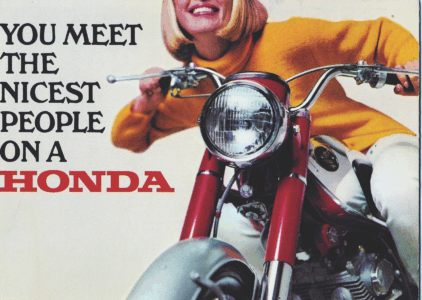
Back in college in the late 1960s, conversation often wrapped around the proper way to live. Were you environmentally conscious, politically astute, and thoughtful toward the best way into the future, or were you a self-serving materialist? Well, I think I straddled such criteria as I lusted after the next great motorcycle; I was a confirmed moto-materialist, and I think I’ve always been — especially when motorcycles as fine as the Honda VF750F Interceptor or the Ducati 916 were previewed at shows or in the pages of a multitude of magazines. When the Honda Interceptor hit in late 1982, and the 916 in late 1994, I quickly ran down to dealerships with deposit checks. I was completely nuts for these two bikes, and decades later, I still own both of them.
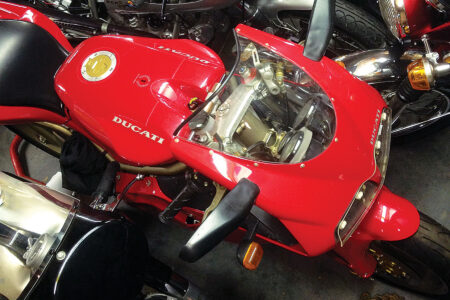
But what was the root of the grip these machines had on me — the Duc driving me to proudly hang a Turn One “Gotta Have One” T-shirt in my garage to focus on raising the money, and eventually to cash in a life insurance policy and sell seven “collector” bikes? Having studied industrial design in school, I found the 916 particularly captivating visually — so much so that it drew me past my long-held belief that Italian bikes were not only unreliable, but also expensive and difficult to find parts for. But what I thought was common sense was completely run over by a machine that seemed to rethink motorcycle engineering, design, and styling. Without the guidance of motorcycle magazines, I could see the single-sided swingarm, the understated three-spoke wheels, the dual high-level exhaust, the dual headlights in a cast aluminum housing, all complemented by an Ã-hlins rear shock and a seating position that has you wrapped into the machine. Service? Yes, belt drive Desmos are service-intensive. But I found that, through the use of Dzus fasteners, all of the well-designed bodywork and fuel tank could be stripped off in under five minutes with a bit of practice. (30 years of development later, this convenience is lost on Ducati’s newest V4S Panigale Superbike; three hours’ labor is a dealer’s charge to remove and replace the stylish yet complex, non-intuitive fairing.)
After a three-month wait for Ducati to make my 916, I doubled with my buddy Kevin about 75 miles on his 1993 Ducati 900SS to Holt BMW Ducati in Athens, Ohio. I’d brought along a bottle of Italian red to celebrate with Kent, Nancy, and Marvin. Then, Kevin and I headed north, took the back way on Ohio Route 56, and made some break-in miles. But we stopped a couple of times to stare at our then-new Ducati sport bikes, and we must have grinned. At 12 years its senior, the Interceptor still seems sleek, and the then-unique vee four kicked butt in AMA Superbike immediately. But the six years it took Tamburini to complete the 916 shows, by comparison. Let your eyes drill in on any portion of the Duc. You’ll see hundreds of places where his effort to perfect is evidenced. After factory test riders, Alan Cathcart was the first to ride the prototype decades ago, and thoroughly covers the origins of the landmark motorcycle beginning in “Birth of a Legend.”