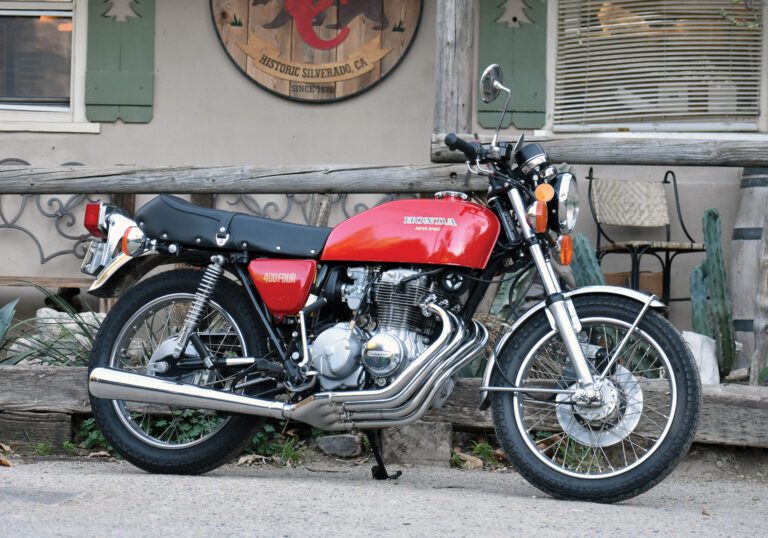
- Engine: 408cc OHC air-cooled inline four-cylinder, 51mm x 50mm bore and stroke, 9.4:1 compression ratio, 32hp @ 8,000rpm, 20.21 ft/lb @ 8,000rpm
- Top speed: 100mph
- Carburetion: Four 20mm Keihin carburetors
- Ignition: 12v battery and coil, electric and kick start
- Transmission: 6-speed
- Frame/wheelbase: Tube frame/54in (1,372mm)
- Suspension: Telescopic front fork, dual coilover shocks rear
- Tires: 3 x 18in front, 3.5 x 18in rear
- Brakes: Single 10.25in (260mm) front disc, 6.3in (160mm) rear drum
- Weight (curb): 403lb (183kg)
- Seat height: 30in (762mm)
- Price (then/now): $1,433/$6,000-$20,000

Honda’s CB400F Super Sport, a model that enjoyed a three-year run from 1975-1977, is probably one of the most underappreciated motorcycles from Japan.
Powered by a spunky inline 408cc four-cylinder engine, the 400F was actually a replacement for the CB350 Four, a bike that Soichiro Honda himself declared at the time to be “the finest, smoothest Honda ever built.” Cycle magazine was less generous, labeling the inline 350 as the “reply to a query never raised — unless someone wanted to know how few cubic centimeters Honda could split by four.” In short, the 350 Four, offered from 1972 through 1974, was exceedingly slow … and dull. Even Honda’s hot-selling twin-cylinder 350 — sold during those same years — was quicker and faster … and more fun to ride.
Honda quickly realized the 350 Four’s plight, assigning a development team headed by LPL (Large Project Leader) Masahiro Sato to stop the bleeding, and the only way to do that was to create a faster, more exciting model. Enter the CB400F Super Sport, and years later in a rare video about the CB400F, Mr. Sato didn’t hide the fact that the 350 Four never sold well and was slow, also revealing the 350 as a “failure.”
350 gets you 400
The 350 Four’s replacement had to offer more. Improved speed and performance topped the build sheet, plus the replacement model needed new and exciting styling, without increasing production costs. Consequently, several features in particular evolved as the design team moved forward. Foremost, the engineers bumped engine displacement that made use of an all-new exhaust. Honda’s original inline-four models, the CB750 and CB500/550 (plus the retired 350 Four), routed four individual header pipes into four separate, and rather cumbersome, mufflers. Sato’s squad elected to take a different approach by following a growing trend among tuners of the time that funneled four individual header pipes into a single collector box that, in turn, fed exhaust gases into a common muffler. The new “tuned” exhaust not only became the CB400F’s visual trademark, it also positioned Honda as the first large-scale motorcycle manufacturer to include a collector exhaust system as an OEM item. Sato-san said that the 400F’s groundbreaking exhaust design actually helped keep manufacturing costs low (i.e. one rather than four mufflers), while also upping the 408cc engine’s performance.

As for the engine itself, Honda based it on the existing 350, enlarging the lower cases to accommodate a close-ratio 6-speed transmission, clearly an improvement over the 350’s 5-speed cluster. Second through fourth gear ratios differed from the 350’s, while first and fifth remained the same as those found in the older box. Sixth was an all-new overdrive.
Up top the design team bumped compression ratio from 9.3:1 to 9.4:1, and cylinder bore and stroke specs jumped from 47mm x 50mm to 51mm x 50mm. Camshaft grind remained pretty much the same, and the 350’s quartet of 20mm Keihin carburetors retained their rightful place on the 400F’s intake side. Ditto for valves, and the net result was an engine more eager to reach its 10,000rpm redline, which matched that of the 350’s redline. However, magazine road tests of the 400 indicated that while searching for higher speeds, test bike tachometer needles easily swung past 10,500 without profound consequences to the revamped engine.
Tanks a lot

The new Super Sport’s other landmark feature was its gas tank, a marvel of styling that incorporated a few new production techniques intended to keep costs down. Again, Mr. Sato tells the story best: “Look at the tank,” he says in the video. “There are no bright spots on it. And there is not a single bit of molding anywhere,” two frequently used manufacturing tricks that, while eye catching, generally required pieces that were chrome plated, or otherwise fashioned in a costly manner. The new styling also led to improved manufacturing trends that, again, helped lower production costs for other future models. Sato continues: “Normally with a tank you’d have three pieces joined at the middle. We made two of them (pieces) into one so we could get by with fewer molds,” he explained. The final product was — and is — a gas tank that’s straightforward and pleasing in design, yet timeless in its simplicity and beauty. And, as Mr. Sato pointed out, there’s no chrome, and only minimal model-name decals to clutter the lines.
Noted Cycle Guide in its January 1975 road test, “The steel tank is styled like the rest of the bike: simply, with little of (the) ornamentation and glitter of the other Honda road bikes,” emphasizing elsewhere in their report of the manner in which the header pipes seductively cascaded down the engine’s front to create the bike’s most “striking feature.” They also noted that the exhaust system itself was “the quietest motorcycle (exhaust) ever sound-tested” by the magazine’s staff.
In terms of power, all of the major American motorcycle magazines waxed eloquent about the 408cc engine’s performance. Cycle Guide reminded its readers that the new 408 produced 4.5 horsepower more than what they experienced with the 350 Four in their December 1973 road test, and all the magazines posted quarter-mile times that were about a second quicker than that of the stogy CB350 Four. The 400F was good for a quarter-mile time of about 14.8 seconds versus the 350’s yawning 15.9 seconds.
Interestingly, though, a wild card in mix came from Cycle World. Their 1976 road test showed a 14.1-second time, even though there had been no further upgrades to the engine (from 1975 to 1976). I contacted D. Randy Riggs, who did most of Cycle World’s quarter-mile runs in those days, and he didn’t recall the big difference in the magazine’s drag strip times, although he pointed out that in 1976 he weighed a featherlight 130 pounds, so power-to-weight might have played a role. Regardless, the CB400F was much faster than its predecessor.
Café Racer!
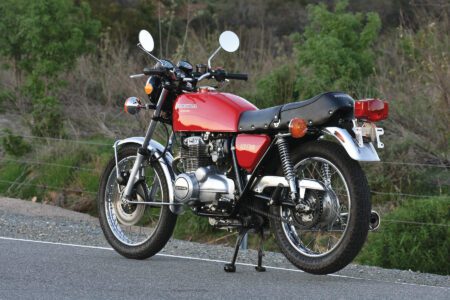
All of the magazines agreed on one thing, though: The CB400F Super Sport shared the ergonomics of a bona fide cafe racer, a styling trend making inroads with American riders during the Seventies. The 400F’s handlebar bend was only about an inch high, and foot pegs were positioned further back than most conventional bikes of the time, plus the 400F’s cornering clearance was as good as could be expected for any model.
The sum total was a bike that Cycle described as playing “its best tune on winding roads where the 10,000rpm engine and 6-speed gearbox can drive the bike along at a splendid pace. The 408 inspired confidence by providing a stable platform for carving on a winding road. The bike feels as though the rider could get off the machine in the middle of a corner, shake hands with the handlebar, and step back aboard without disrupting the bike.”
Return to sender
Our particular feature bike has its own unique history. In 1975 it served as a field bike for American Honda, issued to Gary Christopher, a district sales manager in the Midwest states at the time. He instantly developed a strong affection for the bike, purchasing the little Honda at the end of the sales year. Christopher continued with American Honda, eventually earning a position at corporate headquarters in Southern California where he worked his way to senior manager of the company’s media relations department and American Honda’s racing programs until he retired in 2006 to return to his home state of Texas.
Christopher also owned a small collection of Hondas that, besides this CB400F, included a 1970 CB750 that he purchased new, a CX650 Turbo that served as his 1983 DSM bike, and a first-year Valkyrie that he purchased used in Texas. All the bikes were in excellent condition when he retired in 2006. In 2020, Gary graciously gifted his bikes to American Honda’s private collection for future service. Thank you, Gary.

Most recently Jon Seidel, another former American Honda employee and retiree, volunteered to get the CB400F roadworthy again. As the Super Sport’s temporary ward, Jon exercised his new role by delivering the bike to Owen Bishop at Moto 41 Restorations in nearby Costa Mesa for a thorough tune up and prep session. The visit also included replacing the aging Kerker 4-into-1 collector system that Gary had installed years ago with a new David Silver Spares system, considered to be an exact replica of the Super Sport’s original, and very stylish exhaust.
You might note, too, that this CB400F has aftermarket hand levers. Simply, Gary preferred them to the original cast alloy levers that came with the bike. In gratitude for Gary’s efforts in preserving this red tanker, Owen and Jon have left the classic levers for the time being. The bike has 2,800-plus miles on it, and looks new, although as you’ll read elsewhere, we managed to roll the odometer’s numbers like tumbling dice before our photo session later in the day.
Having said that, at the end of the day, is the Honda CB400F Super Sport considered a landmark model? In certain ways, yes, because it ushered in new design and manufacturing techniques, plus it represents Honda’s willingness to offer enthusiasts narrow-focused models — in this case a café racer– compared to what was typically offered prior by the Big Four Japanese manufacturers. Within a few years of the CB400F introduction, Japan began offering new and specialized platforms such as the customs that mimicked Harleys, and later sport bikes that wore aerodynamic fairings and sleek body panels, plus full-on touring models, and so on. The result of this narrow-focused marketing: the motorcycle markets have expanded, becoming more specialized in products offered. And over time, the industry as a whole has benefitted greatly from it all. Thank you, Sato-san and your design team, not only for the CB400F but a whole new tomorrow in how the motorcycle industry approaches the future. MC

47-Year Itch
I’ve ridden some interesting, even exotic, motorcycles during my 50 years as a motojournalist. The list includes Bimotas, Ducatis and the like, plus laps at race tracks aboard Eddie Lawson’s 1984 world championship Yamaha YZR500, and several Superbikes, among them “Fast” Freddie Spencer’s 1980 Honda CB1000 raging bull.
But one model in particular escaped my grasp, Honda’s 1975 CB400F Super Sport. How could that be? Well, in 1975 I was a young freelance writer chasing down two seasonal championships in AFM and CMC club racing with my Yamaha RD250. Little else mattered.
Fast forward to the 2021 IMS Motorcycle Show in Southern California where long-time American Honda employee Jon Seidel (now retired) was manning the Vintage Japanese Motorcycle Club’s booth that contained a bevy of landmark bikes, among them the 400F featured here. Midstream in our conversation Jon asked if I’d be interested in doing a “look back” riding impression of the bike. “Absolutely,” I replied. A few weeks later we met at Orange County, California’s, popular biker roadhouse, Cook’s Corner, in Santiago Canyon, for my ride. This canyon, and its tributary canyons, are where, as a teenager, I discovered the art of carving apexes through serpentine corners. That education began with my 1965 Honda S90 before graduating in 1967 to my brand-new Honda CB77 Superhawk. Post-graduate studies occurred in later years with various magazine road test bikes.
It was an unseasonably hot February day when Jon unloaded the 400F, and after a brief warmup he followed me aboard his Honda scooter (!) onto Live Oak Canyon Road. Diving into the very first corner affirmed that the little Honda was both lithe and responsive to steering input, as if it were developed specifically for me and this particular ride. Below 3,000rpm the 408cc four-cylinder engine’s power band felt lethargic and lazy in a friendly manner, but as revs increased, so did the fun factor. By 8,000rpm those four jewel-like header pipes feeding a single megaphone-style muffler emitted an exhaust note that, although subdued, brought to mind those halcyon days when the world experienced the dawning of a new era in motorcycling — the age of the inline four-cylinder sport bike. Thank you, CB750, et al.

I crouched closer to the 400’s sculpted gas tank, tucked my elbows in and reveled with glee about connecting one turn after another, streaking quickly beneath the canopy of live oak trees above. The bike was doing all that I asked of it … until it was time to brake hard for a turn, and as I squeezed the little Honda’s front brake lever our spiritual connection began to unravel. What gives? That single front disc brake wasn’t nearly as responsive as I recalled of those early inline-four motorcycles. As the bend in the road approached at a menacing pace, I found myself lost in the Seventies … and futilely grabbing the right-hand lever, my eyes glued to the upcoming corner. The crisis avoided, and the bike once again stable, I sheepishly exited the corner, making a mental note to use earlier braking markers for future corners. Brake technology, I reminded myself, has come a long way since 1975.
We doubled back, heading for Modjeska Canyon, our route taking us to the uphill left-hand hairpin turn where we took some ride-action photos before venturing back to our primary route, Santiago Canyon Road. Ordinarily this road connects the cities of Mission Viejo and Orange, but Jon and I detoured toward Silverado Canyon, then quickly deviating left into Black Star Canyon’s short stretch that terminates at a perpetually-closed metal gate controlled by the Cleveland National Forest rangers. This canyon offers some scenic backgrounds where I’ve photographed many road test and feature bikes.
We circled back to Silverado Canyon, stopping for lunch at the Silverado Cafe (I love their burgers). After that, it was back onto Santiago Canyon Road where on a reasonably long straight section of pavement, I spun the little Honda’s tach needle to redline in top gear; I now shared the ride with 10,000 oh-my-god rpm! What a lovely sound, and a glance at the speedometer confirmed about 95mph. The bike, I’m convinced, would take me to the “Ton” had I asked it to, but I didn’t want to be “that guy” who returned an otherwise pristine CB400F, now powered by an engine displacing 306cc (or less), to American Honda’s unique private collection in Torrance, California.
My heartfelt thanks to American Honda and Jon (and Gary Christopher!) for allowing me this trip back in time. After the ride, I paused to reflect on the day. And as I soaked in the bike’s timeless beauty I pondered: If I could own just one vintage motorcycle, would I be happy with a red CB400F Super Sport? Most assuredly, and even though a Canary Yellow edition sold on auction this past winter for an eye-boggling $21,000-plus, I realize more than ever that money and value aren’t everything. Instead, what’s truly cherished are worthy memories that remain with us long after we can no longer ride. And that, above all else, makes motorcycles like the CB400F Super Sport priceless jewels that serendipitously help us get through this crazy little thing called life. — Dain Gingerelli