Honda CA95 Benly Touring
Claimed power: 16.5hp @ 10,500rpm
Top speed: 63mph (period test)
Engine: 154.6cc air-cooled SOHC 4-stroke parallel twin
Weight (dry): 246lb (wet)
Price then/now: $460 (1960)/$800-$3,500
Although pop culture folklore says it was Honda’s little
50cc step-through that inspired Brian Wilson and Mike Love to write the hit
song “Little Honda” featured on the Beach Boys 1964 Album “All Summer Long,” it
could just as easily have been the little 155cc Honda CA95 Benly. The CA95
certainly fits as “just a groovy little motorbike,” complete with royal blue or
magenta paint and a red seat.
Often called the “Baby Dream” for its obvious and
intentional styling similarities to Honda’s own 250cc CA72 and 305cc CA77
Dreams, the CA95 Benly (which means “convenient” in Japanese) Touring used a
pressed-steel backbone frame similar to the 124cc CA92 introduced in 1959 but
fitted with a 154.6cc single overhead cam 360-degree parallel twin. Inside the
engine was a small but sturdy three-main-bearing “anti-friction” crankshaft
with a chain on the left side driving an overhead camshaft, which in turn
actuated the two valves per cylinder by screw-adjustable rockers.
Drive to the 4-speed transmission was by gear through a wet
multiplate clutch with chain final drive. The unit construction engine and
transmission were housed in a horizontally split case that held the
engine/transmission oil. An advanced combustion chamber design allowed an 8:1
compression ratio, which in turn meant Honda’s engineers could squeeze a
claimed 16.5 horsepower out of the 155cc engine, or more than 100 horsepower
per liter — a figure usually only reached by race bikes at that time.
The engine/transmission unit was suspended from a welded
one-piece pressed-steel spine. A leading-link front fork was fitted at the
front while a swingarm with twin shocks featuring square shrouds took care of
the rear. The Honda CA95 rolled on 16-inch wheels front and rear (3-inch
section front and 3.25-inch rear) with white walls as standard on later models.
Although not exactly light at 246 pounds, the Honda CA95
returned pretty lively performance as long as the engine was kept spinning
quickly, reaching 20mph in first gear, 35mph in second and 50mph in third to a
maximum of 63mph in fourth in Cycle magazine’s 1960 test. Cycle
also found the engine to be “almost vibrationless,” while the dual mufflers
produced a “whisper exhaust note.”
Cycle also praised the CA95’s leading-link front fork
and swingarm rear suspension, saying it gave a “comfortable ride” while “shock
is almost completely eliminated.” And while Cycle found the suspension
somewhat soft, they were unable to make the springs bottom out. The brakes were
also pronounced good, with Cycle‘s editors saying the twin-leading-shoe
front and single-leading-shoe drum rear “held firmly … even during panic-stop
tests.” Also noted was the attractive styling (compared with other small bikes
of the era) and high-quality finish of the Benly, with lots of chrome and a
well-padded seat.
The Honda CA95 was also well-equipped, including a
comprehensive tool kit and an item still unheard of on many larger motorcycles — an electric starter. That was an important feature and one appreciated early
by Honda, a simple piece of equipment that made Hondas easy bikes for
non-traditional motorcyclists entering the market to warm up to.
With their generous fenders, reliable running, electric
start, easy low-speed handling and clean appearance, it’s not surprising that
CA95s were popular with Americans from all walks of life, including members of
the Ancient Arabic Order of the Nobles of the Mystic Shrine, or Shriners as
they’re more commonly called; many ex-parade bikes are still in circulation.
As early as 1960, Honda was building 180,000 bikes a year.
Although the company was a new player in North America,
its production output was already exceeding that of most of its European
competition. By 1963, Honda commanded an estimated 60 percent (90,000
motorcycles) of total U.S.
motorcycle sales!
Together with its bigger brothers, the 250cc CA72 and 305cc
CA77 Dreams, the Honda CA95 established a solid footing in the U.S.
market. It also created a template for the CB160/250/350s that followed, while
at the same time bolstering Honda’s brilliant and growing reputation for
quality and performance. That so many CA95s have survived — and generally in
spite of careless or even no maintenance — speaks to the soundness of their
design.
Although you can still dig up most parts, some items
(especially body and exhaust system parts) are getting hard to find. Small
Hondas from the 1960s are appreciating rapidly, and there are still many old
CA95s out there waiting to be found and restored. Get yours now!
Contenders: Small-bore rivals to Honda’s CA95
Ducati 160 Monza Junior
Claimed Power: 16hp @ 8,000rpm
Top Speed: 63mph
Engine: 156cc(61mm x 52mm)
Weight: 233lb(dry)
Price then/now: $529 (1964)/$800-$3,000
At the request of East Coast motorcycle importers Berliner
Corporation, Ducati produced a smaller-capacity version of its successful 250 Monza for the U.S. market. To do this, Ducati
simply dropped a smaller, 156cc engine into essentially a 250 Monza
frame, fitted 16-inch wheels instead of 18-inchers (although with the same
front fender), together with a standard Monza
gas tank and side panels. Over a four-year production run, the Monza and Monza Junior
were mildly restyled with more angular gas tank and headlight, but the basic
specifications remained unchanged.
In its 1967 review, MotorCycle magazine said the
Junior “handles beautifully … with well-damped suspension and precise
steering … it’s easy to see why the Ducati 160 Monza Junior is such a ride-able bike.”
The British magazine also applauded the Junior’s “excellent” brakes, “useful”
acceleration and “lively” throttle response. All this combined with light
controls, comfort and economy made it “an ideal commuter” in their book.
It may have been ideal in London,
but it seems the Junior didn’t work so well in the U.S. market that spawned it. By
1967, Berliner’s unsold inventory was so big they refused a shipment of 1,800
160 Monza Juniors, most of which ended up in the U.K., where they took years to
sell. Today, all Ducati singles are collectible — even the ones that were
unloved in their time.
Harley-Davidson Scat 175
Claimed Power: 10hp @ 5,000rpm
Top Speed: 65mph (est.)
Engine: 175cc air-cooled 2-stroke single
Weight: 220lb
Price then/now: $475 (1962)/$700-$3,500
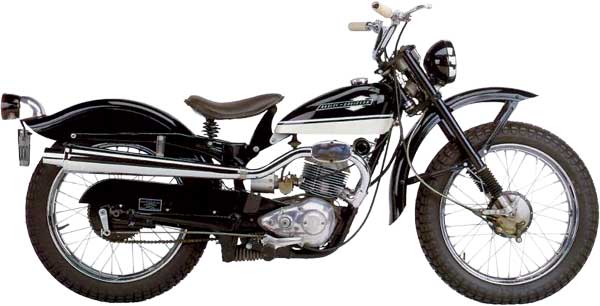
The penultimate model in a line of Harley 2-strokes that
dated back to the Model 125 of 1948, the Scat was essentially a dual-sport
version of the 175cc Pacer introduced in 1962. Intended as a road bike that
could also be used offroad, the Scat added a sprung, high-mounted front fender,
high-level exhaust, buckhorn bars and single saddle to the basic specification
of the street Pacer. It was in many ways a precursor to the small offroad bikes
that proliferated from Japan
years later. Like the contemporary BSA D7 Bantam, the Scat used a 2-stroke
engine based on the prewar DKW RT125 but now stretched to 175cc.
1962 was the only year for the model’s hardtail frame and
from 1963 the Scat and the Pacer were fitted with Harley’s Glide-Ride rear
suspension, a cantilever design that located the spring under the frame. The
front end sported Harley’s Tele-Glide hydraulic front fork, which replaced the
rubber band girder fork used on Harley’s 2-strokes from 1948-1951. It was in
fact an early “upside down” design.
Neither the Pacer nor the Scat were successful in
stemming the tide of Japanese and European imports. They were offered up
through 1965, and the last gasp for the range was the street focused,
fiberglass-bodied, Scat/Pacer-based 1966 Bobcat, the only 2-stroke offered by
Harley-Davidson that year. MC