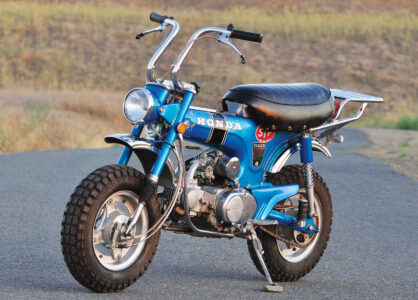
1972 Honda CL350 Flying Dragon
Claimed power: 33hp @ 8,500rpm
Top speed: 90.63mph (period test)
Engine: 325cc air-cooled OHC parallel twin, 60mm x 50.6mm bore and stroke, 9.5:1 compression ratio
Weight (dry): 351lb (159.5kg)
Fuel capacity/MPG: 2.4gal (9ltr)/45-55mpg
Price then/now: $775 (est.)/$1,500-$3,500
Believe it or not, once upon a time, Honda offered its customers a tie-dyed motorcycle. Available in at least four different combinations, the paint flowed across the body panels like psychedelic rivers of color, fluid and eerily formless.
To explain Honda’s Flying Dragon, we have to revisit the era that produced it. Starting in the mid-1960s, America and Europe experienced an upwelling of creative energy, much of which went into the visual arts. Advanced artistic thinking became part of everyday culture and advances in technology were harnessed into creative expression, such as the light shows that were a part of many musical events. Visual artists such as Peter Max, Andy Warhol, Diane Arbus and Roy Lichtenstein became household names.
At the same time, clothing and textiles became modes of self-expression. Tie-dying, a traditional fabric decorating technique used in Japan and India, as well as other places, became the hallmark of the counterculture. Restrained traditional tie-dye effects became loud, exuberant and psychedelic in the hands of young experimenters dancing to a new beat.
The changing styles must have been difficult for the Japanese manufacturers to comprehend. Although celebrations of individuality were foreign to their culture, their motorcycles were as popular in Sixties and Seventies America as sex, drugs and rock n’ roll, and it was important for them to understand their customer base in the U.S. Honda and the other factories worked hard to please their American customers, and someone in the paint department decided that a tie-dyed tank option might make some customers happy. Enter the Flying Dragon paint set.
The Flying Dragon
Don Stockett, the owner of this 1972 Honda CL350 K4, has spent considerable time tracking down the history of paint sets that pop up for sale under the name Flying Dragon. The sets consist of a gas tank and side covers to fit either a CL350 or a CL450 Honda twin, model years 1972 or 1973. The sets come in a box marked “Honda Japan,” with a graphic depiction of the tank, but in a standard scheme with horizontal striping. A part number (06171-456-810 for the CL350 version followed by a two-letter color code) is stamped on the box, which is lucky, because no one would believe that the Honda factory would come out with something like these paint sets without a part number to trace back.
So far, Don has been able to confirm that sets came in four colors: gold/purple, silver/purple, green/purple and blue/dark blue. Don only recently verified the blue/dark blue set after locating one in Florida. According to Bob Kelly, writing in the Vintage Japanese Motorcycle Magazine, the official publication of the Vintage Japanese Motorcycle Club, American dealers were notified of the availability of the paint sets in a parts bulletin. The sets were also supposedly mentioned in a Honda accessories catalog. Bob has been looking for the parts bulletin and the accessories catalog for some time, but has not located either item yet.
Don has also invested considerable time and effort trying to uncover the details of how the paint sets came to be produced. Despite having contacts with many retired American Honda employees, he has come up largely empty. The only sure things he has confirmed are that the parts numbers are genuine Honda Japan numbers, not American Honda numbers, and that the sets were probably the work of a special project team in the paint department. At the time, Honda had special project teams within each department. The projects these teams worked on were authorized, but the existence of the project would not be widely known outside the team’s department.
It is also unknown how Honda created the paint swirls, but period customizers created similar effects by spraying a base color on the part to be painted, then floating a second color on liquid and dipping the part into the mix. So far, the green and purple sets have been the more common sets to surface, and Don thinks the reason they’re most likely to appear for sale is that they were the least popular, and thus the most likely to be put back on the shelf, to be found in a back storeroom years later.
Rising coverage
The special paint sets were only made for CL350 and CL450 Hondas. Although the CB750 Four grabbed most of the spotlight for Honda in the late Sixties and early Seventies, the 350 twins were actually some of Honda’s best-selling motorcycles. About one third of Honda production in the late Sixties and early Seventies was 350 twins, with an estimated 650,000 of all variants sold in the U.S. during the 1968 through 1973 model run.
The 350’s popularity is easy to understand. At the time, small motorcycles were traditionally simple devices, typically single-cylinder jobs with overhead valves. Honda broke with tradition and gave the 350 twin cylinders, an overhead cam and two Keihin diaphragm constant velocity carburetors. And all but the SL version had electric start. For the first five years, front stopping power was provided by a twin-leading-shoe drum brake. In 1973, the drum was swapped for a disc, but only on the CB model.
The 350 twin came in three styles. Most people bought the CB roadster, but about 20 percent of production was the CL high-pipe version, which looked mildly offroad capable but was best suited to street use. There was also a real offroad 350, the kickstart-only SL, with a dual-downtube cradle frame and metal headlight case.
The first 350s could rev up to 10,500rpm, but for reasons unstated (Don thinks it was due to emissions issues), Honda degraded the performance each year; by 1972, max revs were down to 9,200. The 350s were discontinued in 1974 in favor of the CB 360. In the last few years, Honda 350s have become something of a cult bike, popular for turning into café racers or as a platform for artistic customization. However, a significant number of 350s are being restored to stock — which is where Don comes in.
The find
Don’s first Honda was a CL350, bought new when he was 18. He was making $2 an hour at the time, but was able to finance the purchase and was soon out on the local roads, humiliating owners of Corvettes. “I was taking on all the muscle cars and winning races — I was quicker off the line and stopped shorter. 350s are nimble bikes and a joy to ride,” Don says.
Unfortunately, Don was going to college, and a hard lesson in personal economics led to the sale of the Honda. “I never forgot that bike,” he says. “I retired from the practice of law and wanted my bike back. There weren’t any Honda 350s around that weren’t pieces of junk. Finally, I bought a bike on eBay and had it shipped to me. Everything was rusted and corroded, but it was orange, like my old bike, and it ran.”
Wanting his “new” Honda to look and run like the bike he had when he was 18, Don started looking for parts. It took him four years. The most difficult pieces to find were the fork ears and headlight case. He wanted to use stock rear shocks, but just about all of the originals (sprung with nitrogen) had long ago given up the ghost. “I bought a lot of shocks to find some with gas in them,” Don says. “As a result of my experience, I’m working with Hagon to produce reproduction Honda 350 shocks.”
Along the way, Don met up with Honda expert Geoff Sprague, who was named after Fifties British racing champion Geoff Duke. “Geoff is a superb mechanic. He can make a carburetor sing!” Don says. The pair are now working together as Vintage Motorcycle Rescue, specializing in vintage Honda restorations. Don buys new-old-stock and used parts, and paints to original finishes, while Geoff puts the bikes together. Awhile back, Don saw a Flying Dragon tank and side cover set offered for sale on eBay and showed the page to Geoff. Geoff was convinced the paint set must be the work of some addled customizer and discouraged Don from buying it. Four months later, a second set turned up, in the Honda Japan box, with the seller asking twice as much. Don bought the set and went looking for a CL Honda to install it on. In one of those great coincidences that occasionally pops up in life, a 1972 CL350 shortly turned up on eBay in good condition with only 1,400 miles on it. To top things off, the tank and side covers were Candy Panther Gold, Don’s least favorite stock color.
Geoff and Don took the bike apart and found it to be quite original. Don painted the engine with high temperature silver paint, covered with high temperature clear coat. His aim was to produce a finish that mimics the original factory aluminum metal color, but with stain-resistant paint. He also sanded the frame, then recoated it with rustproof primer (a step Honda left out) followed by high gloss enamel. “Powder coat chips easily and you can’t repair the chips. We never powder coat.”
Not surprisingly, the carburetors were gummed up and in need of a rebuild. Fortunately, that’s not a problem as Canada-based Sirius Consolidated sells diaphragms and a lot of other carburetor parts. “The 350s had very complicated three-stage carburetors — Honda did not skimp,” Don says. Don managed to locate a new-old-stock seat for this restoration.
The wiring harness was, fortunately, in excellent condition. “The bike must have spent winters in a warm basement,” Don concludes. In fact, the original tires still held air, although Don warns that original tires should not be installed on a bike that travels farther than around the display area at a show. “All the bikes we restore have new Dunlops or Heidenaus.”
CB350s are generally reliable, with one weak link — the cam chain tensioner rollers. Don explains that, with time, the black rubber tensioner rollers become hard, and pieces start chipping off. “Check whether the rollers have started to disintegrate by taking the centrifugal oil filter cover off. You get it out by carefully prying all the way around the cover — there is a half inch sleeve inside so be careful. That is where the pieces end up. Little fragments will get into the motor, and the cam chain tensioner may completely disintegrate, causing disaster. If you don’t see any large chunks, clean the filter, replace the two O-rings and put the cover back on. If you do see chunks, get the top end done — you only have to do this once.”
Don says that, once restored, a 350 Honda is great for everyday commuting and fun riding on weekends with just a little extra care. “Only use oil with a high zinc content, such as Red Line or Motul motorcycle oil. It’s important to get oil into the valve train as soon as possible on cold starting. To do this, turn the stop switch off and crank with the electric starter for several seconds to get oil into the valve train. Stop, turn the stop switch to ON and then start. Don’t rev it for the first minute. Let it idle for one minute and then take off.”
With the restoration finished and the paint set installed, Don has been taking the Flying Dragon on the show circuit. With the original Bridgestone Safety tires installed, he isn’t taking it on any long rides, but that’s OK. For now, this is a bike to show, a unique piece of Honda history that highlights some of the curious paths manufacturers will follow trying to entice customers. MC
Honda Flying Dragon: Making sense of the numbers
Don Stockett’s pretty serious about nailing down all the variations on the Flying Dragon theme. So far, his research has yielded four confirmed color combinations for the CL350, and four confirmed sets for the CL450. The Flying Dragon option (there’s no record of why the name Flying Dragon was chosen) was apparently only made for those two models, and only for the 1972-1973 years.
The part numbers follow Honda convention, with each set of digits having specific meaning. For example, the 1973 CL350 sets all utilize the same base part code, 06171-456-810. The first five digits represent the “function area” of the bike, in this case the fuel tank. The second three digits represent the model fitment, 1973 CL350 K5. The final three digits represent the Flying Dragon option. For a 1973 CL450, the second three digits are 347 (the official Honda model code for a 1973 CL450 K5), with the rest the same. Finally, each color combination has its own unique two-letter designation: SM (gold metal flake base), SN (silver metal flake base), SP (green base) and ST (blue base). Confirmed set part numbers are as follows:
1972-1973 CL350:
06171-456-810SM: Gold/purple
06171-456-810SN: Silver/purple
06171-456-810SP: Green/purple
06171-456-810ST: Blue/dark blue
1972-1973 CL450:
06171-347-810SM: Gold/purple
06171-347-810SN: Silver/purple
06171-347-810SP: Green/purple
06171-347-810ST: Blue/dark blue