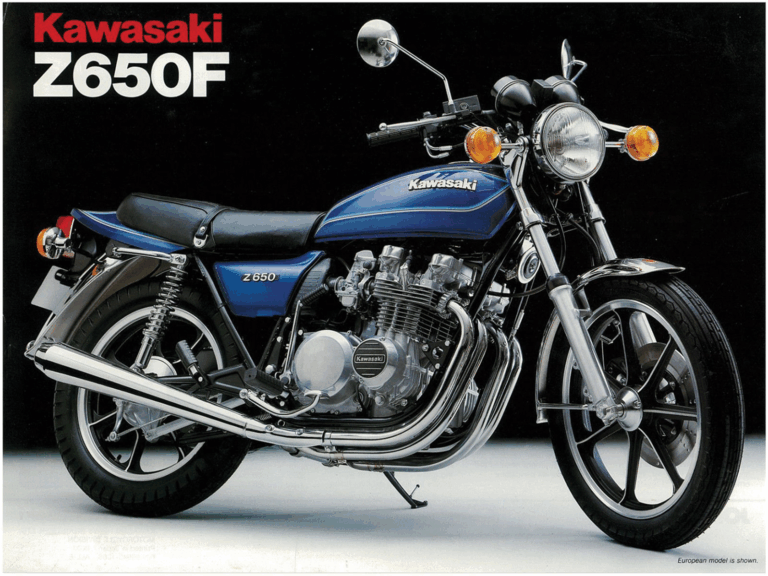
Kawasaki KZ650
Years produced: 1977-1980
Power: 49hp @ 8,000rpm (at rear wheel/period test)
Top speed: 108mph (period test)
Engine: 652cc air-cooled, DOHC inline four
Transmission: 5-speed, chain final drive
Weight (wet)/MPG: 498lb/44mpg (avg./period test)
Price then/now: $1,995 (1977)/$700-$2,200
In marketing-speak it’s called a “unique selling proposition,” or USP. It’s the feature or benefit that makes your product stand out from the rest. In the era of the ubiquitous Universal Japanese Motorcycle – across the frame, air-cooled, overhead cam 4-stroke multi – each of the Big Four knew they had to be in this market: But how to give their UJM a USP?
Honda set the stage with the single overhead cam CB750. Kawasaki fired back with the dual overhead cam 900cc Z1. Honda tried the undercut with 350, 400, 500 and 550 fours. Suzuki made the first dual overhead cam 750, the GS. Yamaha tried a triple. Kawasaki responded with a new capacity: 650cc (40ci).
Kawi asked Z1 designer Ben Inamura to develop the KZ650. And while the Z1 inherited some engine design features from Kawi’s strokers (like the built-up crank), Inamura started with a clean slate for the KZ650. The goal: a 650 that could run with the 750s, while making the engine mechanically quieter and easier to mass produce than the Z1.
The 650 used a one-piece crank with five shell main bearings and split connecting rod big ends (whereas the Z1 had roller bearings and one-piece connecting rods on a built-up crankshaft). A chain and central sprocket drove the two overhead camshafts, running directly in the cylinder head (they ran in shell bearings in the Z1). The cams operated the valves directly, with adjustment by shim under bucket (Z1: shim over bucket). A 24mm Mikuni fed gas to each iron-lined alloy cylinder and the spark plugs were fired by two coils via mechanical contact breakers. A car-type, controlled-field, crankshaft-mounted alternator (Z1: permanent magnet) and regulator/rectifier generated 12 volts. Starting was electric with kickstarter backup. Primary drive was by HyVo chain to a jackshaft (Z1: direct geared) with integral cush drive, carrying the starter and oil pump, then by straight-cut gears to a multiplate clutch and 5-speed gearbox.
Wire-spoked 19-inch front and 18-inch rear wheels attached to the frame via a telescopic front fork and 5-way adjustable spring/shock units at the rear. A single 10.75-inch front disc and a 7-inch rear drum provided braking. The frame itself was sturdier than the Z1, with larger diameter tubes, triangulating gussets and beefier engine mounts, although the swingarm – a known Z1 weakness – was similar to the 900.
How did the 650 stack up on the strip? A standing quarter of 13.5 seconds at 98mph handily dispensed with Honda’s closest competitor, the 550, but couldn’t stay with any of the 750 UJMs, which ran in the high-12s. In weight terms, the Kawi split the CB550 and Suzuki’s GS750 at 498, 455 and 532 pounds, respectively; and at $2,000 it split the price, too (roughly $1,800 and $2,200.) On the street, the KZ performed and handled at least as well as the competition, though Cycle World gave the “smallest possible vote in favor of the overall handling of the GS (750), mostly because the swinging arm and rear shocks feel as though they do just that much better work.”
Cycle Guide‘s tester acknowledged the stiffer frame gave “less of the flexi-flyer action that bothers the Z in hard, fast corners. The KZ650 responds and maneuvers delightfully.” They described the ride as “pleasant by current standards,” adding, “The biggest gripe with the shocks, though, is their apparent lack of damping, especially in rebound,” to which the tester attributed a high-speed wallow. That said, the KZ was “sprung tautly enough to prevent premature grounding on hard corners.” The brakes were “decent … never in danger of running out of stopping power.”
So did the KZ650 deliver a USP? Cycle magazine’s praise was faint: “Staffers liked Kawasaki’s new 650. It’s far too competent a motorcycle not to like … At the same time, no one was wildly enthusiastic … it was bigger and bulkier and heavier than expected.” Cycle Guide was more enthusiastic: “For most riders, it will be a whole bunch easier and more fun to ride than a Z1. And it gives the rider the impression of being almost as fast.” Summing up, Cycle World said: “The KZ650 does offer 750 performance in a more sporting package, and for a few less bucks.” MC
Contenders: 650cc 4-cylinder alternatives to Kawasaki’s KZ650
1979-1982 Honda CB650
Years produced: 1979-1982
Power: 49.5rwph @ 8,500rpm (period test)/113mph (est.)
Engine: 627cc air-cooled SOHC inline four
Transmission: 5-speed, chain final drive
Weight/MPG: 467lb (wet)/48mpg (avg./period test)
Price then/now: $2,498 (1979)/$800-$2,500

While the KZ650 was intended to be a 40-incher from the start, the CB650 snuck in the back way. Although it shared few parts with the CB550, it used the same production machinery and tooling, meaning some dimensions were retained. “Its roots lie in the past,” Cycle Guide said. “It’s a remanufactured CB550 with assorted detail improvements to make it both more appealing and economical.”
Honda’s goal for the 650 was 60 horsepower. That meant a bore and stroke increase giving 627cc, revised combustion chambers and pistons, bigger valves and 26mm Keihin carburetors. Oil capacity and cooling were increased to dissipate the extra heat.
With screw-adjustable valve clearances, easy access to spark plugs and maintenance-free electronic ignition, it was, Cycle World noted, “… the sort of engine a dedicated owner could care for himself.” With performance comparable to the KZ650, an excellent front brake (though the rear drum could be grabby) and street handling that was good “as it comes out of the box,” CW concluded that Honda had “built a motorcycle which works overall as well as or better than its competitors, costs less for the features delivered and is easier to maintain.”
1981-1983 Suzuki GS650E
Years produced: 1981-1983
Power: 59.8rwhp @ 9,000rpm (period test)/120mph (est.)
Engine: 673cc air-cooled DOHC inline four
Transmission: 5-speed, chain final drive
Weight/MPG:480lb (wet)/43.6mpg (avg./period test)
Price then/now: $2,569 (1981)/$900-$2,900

We’ve come full circle. The GS750 inspired Kawi to build a 650 four, but it took Suzuki five years to launch a direct competitor, the GS650E. Like the CB650, the chain-drive GS650E was a grown-up 550 rather than 750 lite. So the E inherited the roller-bearing bottom end, shim-over-bucket 8-valve DOHC top end, and 55.8mm stroke from the GS550. (The shaft-drive GS650G used a new plain bearing crank.)
Larger 32mm Mikuni CVs, revised “swirl” combustion chambers and a compression boost to 9.4:1 meant straight-line performance of the E echoed the GS750 Cycle World tested five years before, running the quarter-mile in 12.8 seconds at 102mph. Though the suspension was relatively soft, it was “compliant and controlled,” CW said. They also praised the brakes: “powerful and controllable and require just the right amount of lever effort.” CW‘s only gripe about the GS650 was its appearance, which they said “lacks visual excitement.” That aside, the GS650E was “the fastest 650 tested to date. It has no handling quirks. It’s fun to ride on a variety of roads. It is a well thought out design that has proven to be dependable and long lasting.”