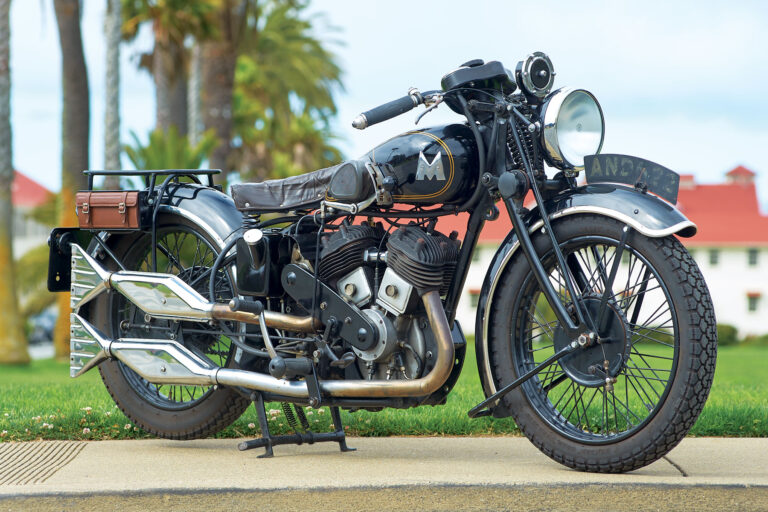
1934 Matchless Model X
- Engine: Air-cooled four-stroke side-valve V-twin, two valves/cylinder, 85.5mm x 85.5mm, 990cc, compression ratio: 5:1, 30hp @ 4000rpm (est.)
- Top speed: 80mph (period test)
- Carburetion: Amal remote float carburetor
- Transmission: 4-speed, hand shift, chain final drive
- Electrics: 6-volt Lucas Magdyno, 30-watt three-brush generator
- Lubrication: dry sump, recirculating oil
- Clutch: multi-plate, oil bath
- Miles per gallon: 48.5 miles to the Imperial gallon
- Frame/wheelbase: single downtube cradle, wheelbase: 57in (1,448mm)
- Suspension: Front: girder fork, rear: rigid
- Brakes: Front: 8in x 3/4in single leading shoe drum; Rear: 8in x 3/4in single leading shoe drum
- Tires: 3.25 x 19 front, 4.00 x 19 rear
- Weight: 400lbs (181kg) (est.)
- Fuel capacity: 3.5 Imperial gallon (4.2gal U.S.) gas tank
- Oil capacity: 4 Imperial pints (2.4qt U.S.)
- Current value: ~$26,000, depending on condition
“I’ve had it out in summer heat — it doesn’t seem to care. Once, I stopped under a tree for a break. When I got going again, it ran rough for a bit, then smoothed out. Turned out the gasoline sitting in the float bowl during the stop got so hot it was boiling.” –Owner Charlie Taylor
Few people buy a 90-year-old motorcycle because they want to ride it. One of these few is Charlie Taylor, who has put more miles on his elderly beast than many riders of modern bikes have on theirs. When Charlie Taylor bought this bike, it had 41,000 miles on the clock. The odometer now shows 70,000 miles. On the road, the only issue Charlie has had with this V-twin was a flat tire. “It’s really rugged — massive rods and flywheel, a triple row of roller bearings on the drive side.”
Built for work and transportation
This Matchless was built in England in a bygone era, when people bought motorcycles for transportation and valued reliability and hauling power. It was also a time when British factories built heavyweight V-twins. Despite the intervening 90 years, this Model X is still impressively reliable, although having an owner who is a long-time British bike mechanic might have something to do with it.
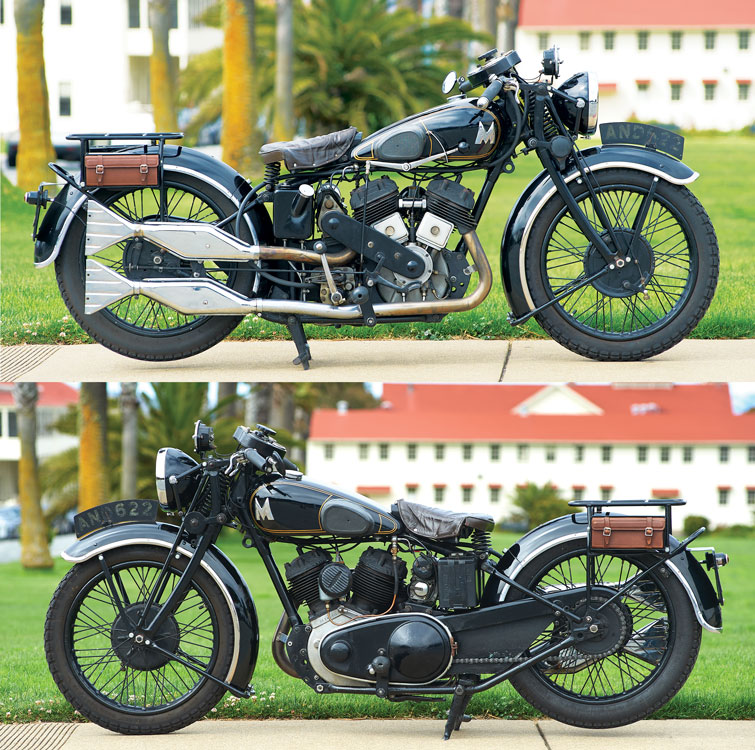
Few people on this side of the Atlantic have seen a Matchless V-twin. They were built to cater to the needs of consumers in Great Britain in the Twenties and early Thirties, a time when automobiles were expensive and most English people couldn’t afford them. Motorcycles with a sidecar were much cheaper, so that is what working people used for year-round transportation. There were thousands of sidecar outfits traveling on British roads through the 1950s, and many motorcycle manufacturers produced bikes specifically designed to pull a sidecar. One of these motorcycles was the Matchless Model X. Owners soon learned that the Model X, one of the few English motorcycles over 500cc built during the 1930s, could be a lot more fun without the sidecar. Its V-twin motor was pretty much the same motor that powered the Brough Superior SS80, a fast, luxurious, and pricey touring motorcycle, although the motors Matchless sold to Brough were a little more carefully put together and had a small number of different components.
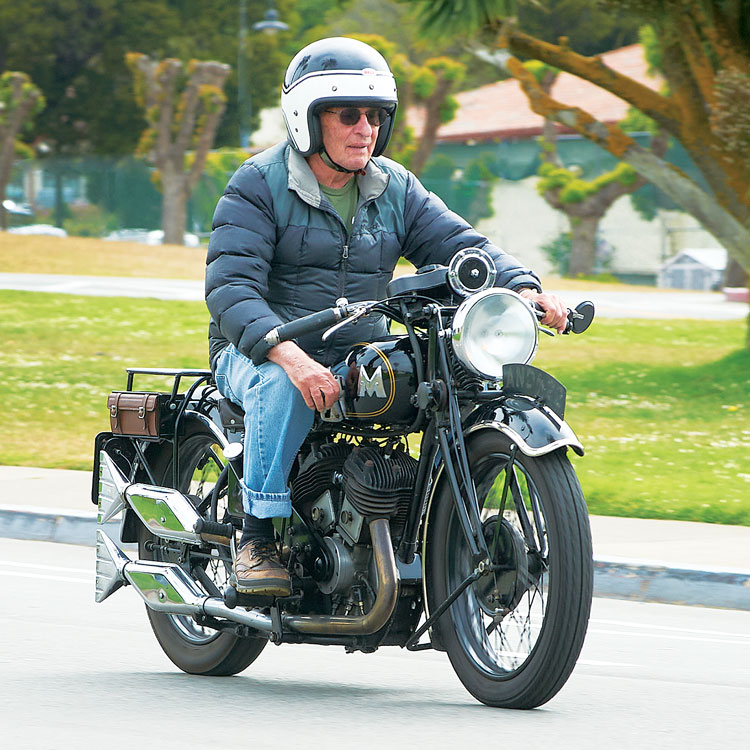
The Model X V-twin was designed with a sidevalve top-end configuration, with both intake and exhaust valves coming up from the timing chest. In the late 1920s, both oil and metal casting technology were in development. Overhead cam motorcycles of the time were mostly racing machines, and overhead valve motorcycles were not yet reliable enough to function as daily riders. Sidevalve engines generally made less horsepower than overhead valve or overhead cam engines of the same displacement, but being less reliant on top-end lubrication, they were less likely to either leak or break down. It took several more years before overhead valve machines could compete with sidevalve engines in the clean-running or reliability department.
Evolving with the times
Matchless was one of the first English motorcycle makers. Bicycle manufacturers Henry Herbert Collier and his sons Charlie and Harry Collier built their first motorcycle in 1899. When they put it into production in 1901, they named it the Matchless. In 1905, the Colliers advertised a motorcycle with swingarm rear suspension, which was quite advanced for its time. Charlie won the inaugural Isle of Man TT race for single-cylinder motorcycles on a Matchless, while a Norton won the twin-cylinder race. Like many early motorcycle factories, Matchless started by buying its engines from an engine manufacturer, but starting in 1912, it produced its own. Matchless quickly gained a reputation for good engineering and reliability — important qualities for English customers whose motorcycle was their sole means of transportation. After a hiatus during World War I, production resumed in 1919. The first bikes out the door were V-twins built for hauling sidecars.
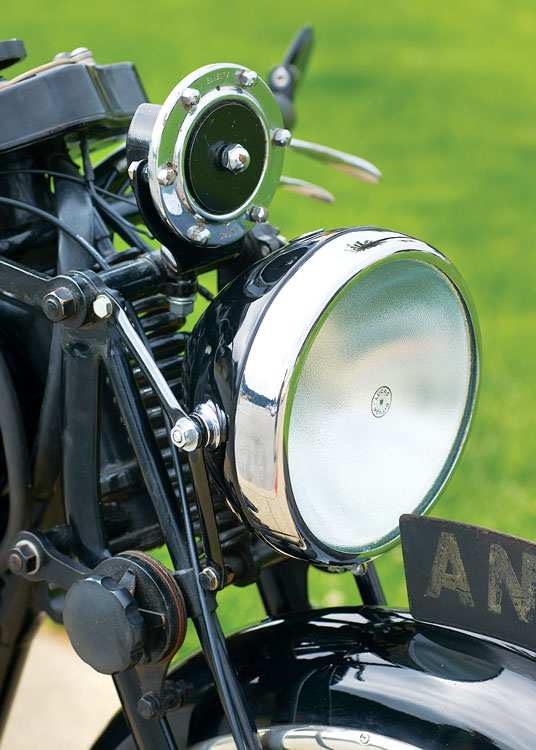
The Model X (possibly designed by Bert Collier, a younger brother of Charlie and Harry) was launched in 1929 and treated to yearly upgrades. The 1934 version, powered by a sidevalve motor with 85.5mm x 85.5mm bore and stroke and a 5:1 compression ratio, had fully enclosed valve gear and a four-speed Sturmey-Archer transmission. The rear had no sprung suspension, but a sprung seat smoothed the ride.
Such was the popularity of the motorcycle in Great Britain for most of the 20th century that there were two weekly publications devoted to two-wheelers. They were known to most riders as the “Blue ‘Un” and the “Green ‘Un,” from the color of their covers. These magazines did road tests of most motorcycles sold in England and wrote them up in standard British literary language — no slang or off-color asides allowed. The December 20, 1934, edition of The Motor Cycle included a review of the 1935 version of the Model X. Starting was “delightfully easy” once one performed the starting ritual of advancing the ignition using a lever on the handlebars, though Charlie says that you don’t need to do this. Then you set the choke and crack the throttle a hair. Given the low compression ratio, a heavy boot was not needed to get the motor running. The author praised the “good tick-over” (meaning easy idle), quiet motor, and lack of vibration. “A run of several hundred miles could be tackled without any tiring effects.”
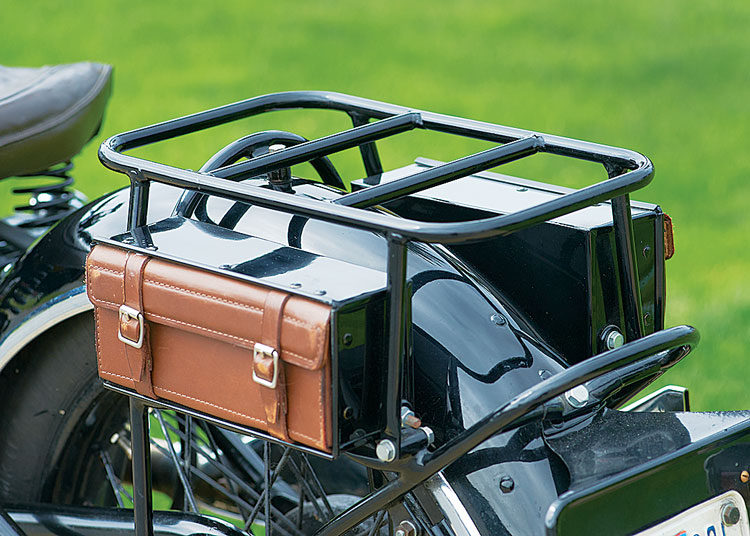
The traditional British motorcyclist wore rubber boots over thick socks cuffed over the top of the boots. The one complaint against the Model X registered by The Motor Cycle‘s tester was that the hand shifter tended to get caught in the boot tops. But potential purchasers were assured that, with the wide power band, frequent shifting was not necessary.
In 1935, the Model X went from using a Sturmey-Archer gearbox to one made by Burman. The next year, the Model X was revamped to be a solo cruiser instead of a sidecar hauler. Relatively inexpensive automobiles were beginning to appear on the market, which cut into the sales of big sidecar haulers like the Model X. Seeing a market for fast sport motorcycles like the Brough, Matchless decided that people who wanted a Brough but did not have the necessary pounds sterling to purchase an expensive Brough Superior would be interested in a motorcycle that had similar performance, but a lower price tag. The frame was shortened, and the gearbox probably went to foot shift at this point.
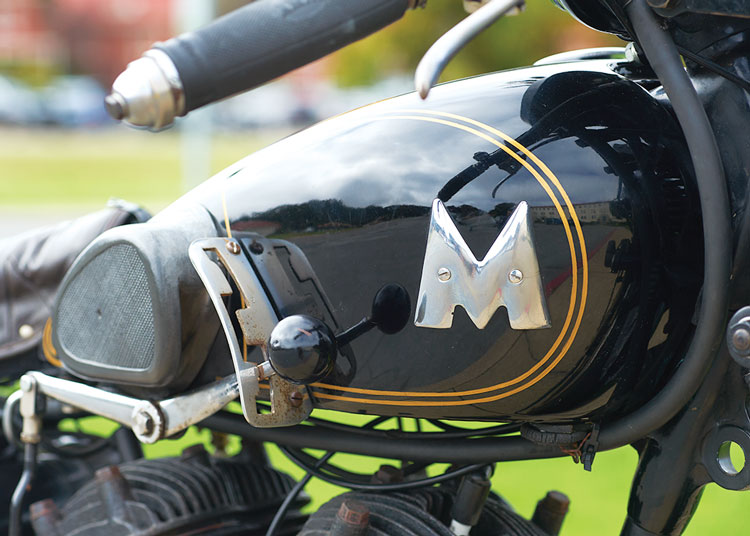
England entered World War II in 1939, and Matchless stopped making civilian motorcycles in 1940 and concentrated on military production. After the war, England was focused on paying off huge war debts, and economizing was the name of the game. Motorcycle manufacturers, including Matchless, dropped large-displacement bikes like the Model X from the lineup in favor of smaller, lighter machines. Shortly before the war, the Matchless company, which had started buying up other brands, renamed itself Associated Motor Cycles, or AMC. AMC lasted until 1966, when it went defunct, in large part for failing to revamp the product line to make bikes that would sell in the new sport-oriented market that had sprung up after 1960.
A lifetime in the saddle
Charlie Taylor has had a long history of owning and working on motorcycles. “I went to Europe in 1963 looking for a car. I couldn’t find a car, and I decided to look for a motorcycle. I ended up at a dealer in the center of London and struck a deal on a 125cc Honda Dream. It had an electric start. I studied the controls — I had never ridden a motorcycle before — and rode down an alleyway into a humongous traffic circle. I rode around the circle for a while, then rode back to the fleabag hotel I was staying at. I went off touring Europe, and the Honda broke down in France. No one there knew how to work on Hondas, so I had to abandon it. I ended up in Pamplona and traded a small portable typewriter to someone for a 50cc Motobecane moped. I rode all over Spain at 30mph.”
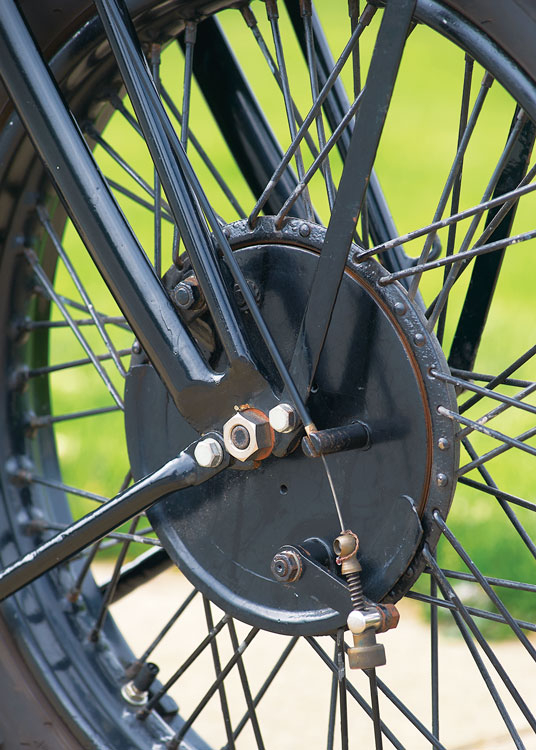
“I came back to the U.S. and was going to college. I walked past a 1951 or ’52 BMW every evening. One night, it had a “for sale” sign on it. I rode it all over the East Coast.” Eventually, Taylor ended up with a 1938 BMW, “brought over to the U.S. by a German Hitler hater.” He got married, had two children, and kept riding. He commuted to work on the old BMW in all kinds of weather. “My knees still remember.” In the 1960s, Taylor went to work for Coburn Benson, at the time the premier East Coast Vincent repair shop. He acquired a basket case 1950 ‘C’ Black Shadow from his employer. “I went straight from old BMWs to Vincents, with no experience on any other English bikes in between. The C Shadow would run ‘like the hammers of hell,’ and then something major or minor would break, and I would have to fix it. It was like a rolling apprenticeship. It taught me a lot.”
The family ended up on the West Coast in the early 1970s, and Charlie met up with a group of diehard British motorcycle enthusiasts. He found a job as a Triumph and BMW mechanic. A little later, he started his own Vincent restoration shop. The Taylor family moved back to the East Coast, and so did the restoration service. Eventually, Taylor decided to close the shop. “The clientele was changing — instead of regular folks who wanted to ride their bikes, it was rich people who were worried about insurance.” During this period, Charlie briefly owned a Brough Superior from the 1920s. “The power was incredible, but it had no brakes. You had to make an appointment to stop.”
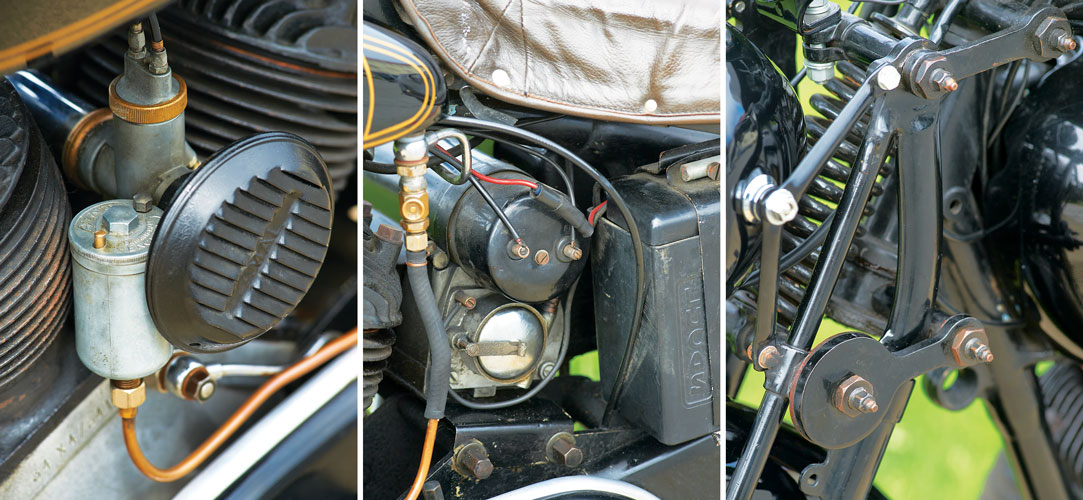
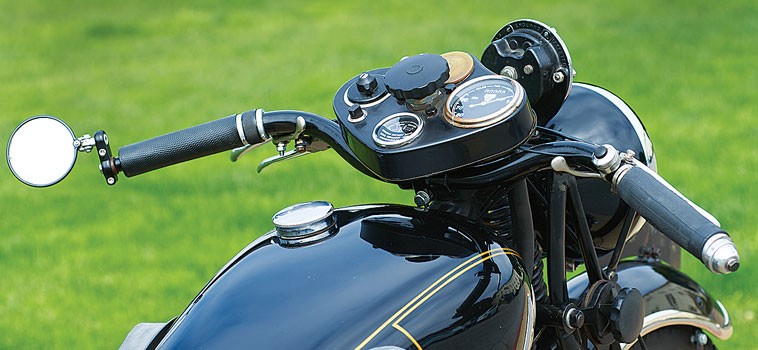
Taylor moved back to the West Coast in 1999 and continued to earn a living working on British motorcycles until he retired about 15 years ago. A few years back, he decided he wanted a Model X, “the cheap Brough,” and started looking for one. A friend pointed him to Australian eBay, where this 1934 machine was being advertised by a dealer. “I wouldn’t have bought it if it weren’t being sold by a dealer.” It arrived in an open crate, in running condition, and very original. Charles surmises that the Matchless had been overhauled by the dealer before he bought it. This Model X4 is a ‘Deluxe’ model, meaning it came with an eight-inch headlight, an instrument panel, a horn, and an air filter. It could be ordered stripped down, or with the owner’s choice of parts: a six-inch headlight, no instrument panel, and no air filter, for example. This Model X4 had the original Lucas Magdyno, a three-brush generator, and all of the original controls. 1930s English motorcycles sprouted a small forest of levers from each handlebar end, with levers controlling the choke and ignition advance and retard.
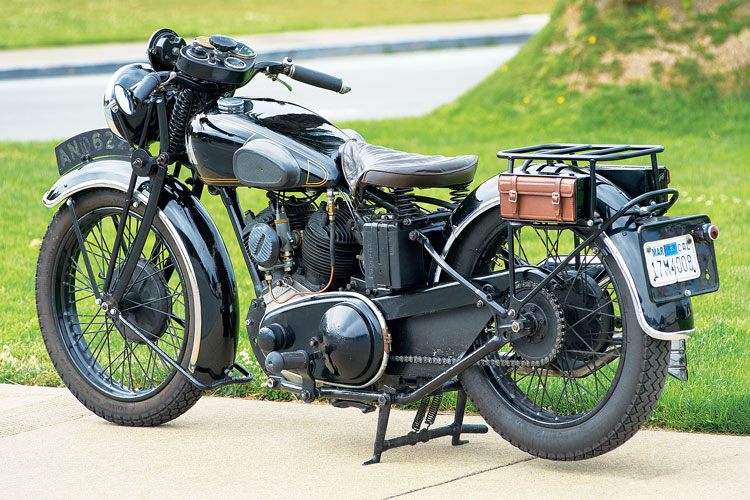
The first thing Charlie did with the X4 was take the top end apart. He decided he didn’t like the valves that were in the bike and replaced them with Toyota Land Cruiser valves. He had parts powder coated and the tank repainted, put it back together, and started riding it. “It’s a relaxing, comfortable ride, and really rugged — massive rods and flywheel, triple rows of drive side bearings. It runs on regular gas, and at 60mph, it is turning 2800rpm. The brakes were good by 1934 standards, but they are not so good by today’s standards. They are ¾ inch wide, eight inches in diameter, single leading shoe — so you have to plan stops. The frame is really long, so you can’t flip it into corners, but it has massive torque — this Matchless can haul 700 pounds at 65mph. It likes to bang along at 55-60, but it will cruise at 70.” The only time something went wrong on this bike on the road was when it had a flat tire. “It’s very reliable.”
Charlie has overhauled the magneto once and thinks it is getting a little tired, so another magneto rebuild is on the to-do list. He replaced the crankpin at the 50,000-mile mark. “The rods are offset so both can run on a single pin.”
Riding the Matchless, Charlie got into an accident on a club ride several years ago. “There was a four-inch drop in the pavement and I didn’t see it in time.” He sprained his ankle, the throttle side of the handlebar was damaged, and the rear fender was mangled. Luckily, one of the members of the club that was sponsoring the ride is a sheet metal wizard who was able to straighten it out. Charlie put the Matchless back together and kept riding it. It now has 29,000 more miles on the clock than when he bought it.
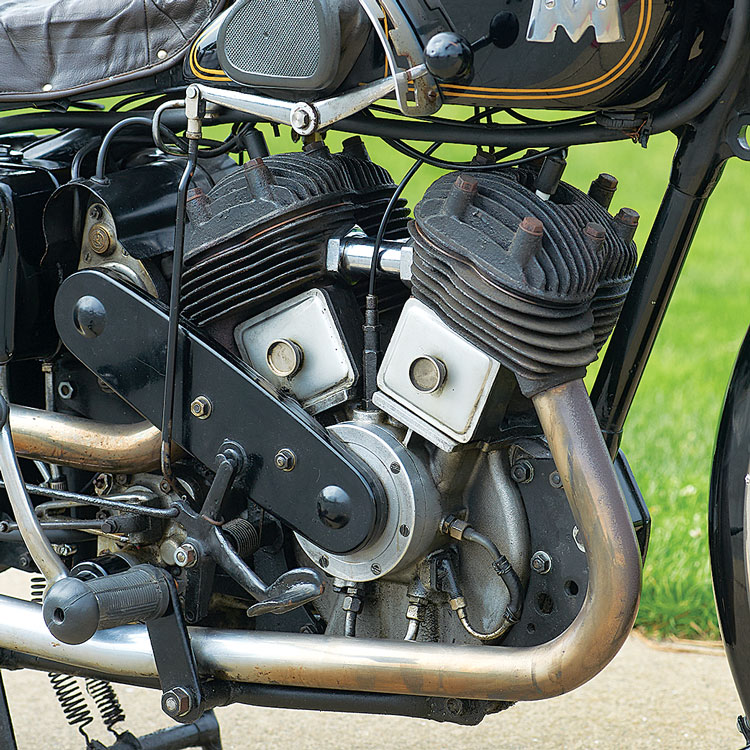
Matchless maintenance is somewhat more involved than for a modern bike. Taylor changes oil every 1,000 miles. He uses Valvoline 50 weight. “It’s getting harder to find.” The most annoying maintenance is adjusting the primary chain, an infrequent task. “It’s a pain. You have to remove the exhaust pipe to do it.” Aside from that, keeping the points clean and adjusted, and an occasional check of the carburetor is about it. “It doesn’t use a lot of oil, and nothing wears out.” This is a good thing, since almost all parts are unavailable, although the Brough Superior Club does have pistons and a few other bits and pieces.
Starting the Model X is also somewhat more involved than starting a modern bike. Taylor does not use The Motor Cycle‘s starting procedure. He tickles the carburetor, gives it two priming kicks, turns on the ignition, and gives it one good kick. It almost always starts on the first kick.
The Motor Cycle summed up the Model X by calling it “an efficient and lively big-twin machine,” and “an attractive proposition for the person who requires quiet, effortless power.” After all those miles, Charlie Taylor continues to enjoy his very English big twin. MC