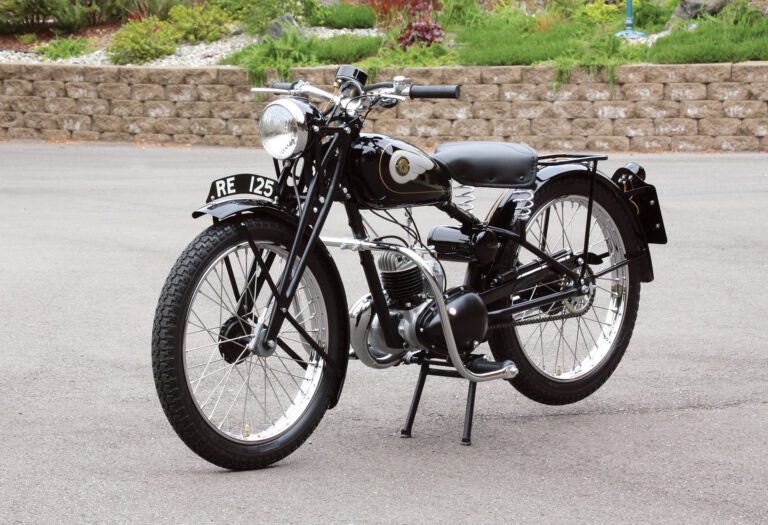
1948 Royal Enfield RE125
Claimed power: 3.5hp @ 4,500rpm
Top speed: 45mph
Engine: 125cc air-cooled 2-stroke single, 54mm x 55mm bore and stroke, 5.75:1 compression ratio
Weight (wet): 130lb (59kg)
Fuel capacity/MPG: 1.75gal (8ltr)/130mpg
Price then/now: $325 (1948)/$2,500-$7,500

It all started innocently enough after dinner one Wednesday evening when I sat down at my computer and logged onto eBay. For some unknown reason I typed in “Royal Enfield motorcycles.” The first bike that appeared was a 1948 Royal Enfield RE125.
The seller’s description was short and to the point. He had purchased it from a garage sale near his home in Pennsylvania. He went on to describe the motorcycle as best he could and admitted that he knew very little about it. Never having seen an RE125 before I was curious, so I Googled the make and model, only to discover these little machines were very important to the British military during World War II, when they were nicknamed the Flying Flea.
Flying Flea background
The original design of this motorcycle was by DKW in 1935, a 98cc 2-stroke known as the DKW RT100, which went on to become the hugely successful and much copied RT125.
In early 1938, the Germans instructed DKW to cancel its relationship with its Dutch concessionaire, RS Stokvis en Zonen, after the Dutch company refused to force out its Jewish owners. Instead, the Dutch simply took an example of the DKW RT100 to Royal Enfield, asking them to make the same machine but with an engine displacement of 125cc. Royal Enfield’s chief designer, Ted Pardoe, was responsible for the faithful reproduction of the DKW RT with the increased 125cc engine size.

According to information I found, two prototype versions of the RE125 were displayed in Rotterdam in April 1939 under the name “Royal Baby.” World War II interrupted plans for civilian production after only a few were made, and the RE125 was instead manufactured for military use. The early version of the RE125 was nicknamed the “Flying Flea” by the British Army Red Berets parachute regiment in 1942 when it was released for service duty, where it was used extensively in airborne drops. The Flying Flea name fit perfectly, reflecting its light 130-pound weight and small overall dimensions; a mere 26 inches wide and 75 inches long.
The frame was constructed from steel tubing. Front forks were pressed steel girders linked top and bottom to the steering head by three rubber bands, a system designed by DKW in the mid-1930s for their racing machines. A 1950 revision of the front forks used a more modern telescopic style with internal springs for damping. A foot-operated gear change lever was also added at that time. Then, in 1951, the model was completely redesigned with a new frame and engine. Known as the RE2 to distinguish it from the earlier version, it was not enough to compete with the likes of the 1952 BSA D1 Bantam. With its plunger rear suspension and other modern amenities, the BSA was a more popular machine than the rigid frame RE125. In 1953 the Royal Enfield Ensign was launched, signaling the end of the RE125.
Getting familiar with the Royal Enfield RE125
The 125cc unit-construction engine has a 54mm x 55mm bore and stroke with a handshift 3-speed gearbox. With its lightweight aluminum cylinder head, flat-top piston and a compression ratio of 5.75:1, the machine would run on any grade fuel. The timing chain ran in an oil bath, as did the cork clutch. A Miller magneto supplied electrical power for the 6-volt ignition and the 27-watt lighting system. Horsepower was a claimed 3.5 at 4,500rpm. Fuel economy was excellent, as the bike returned an impressive 130 miles per gallon, a welcome feature during — and after — the war years when every drop of fuel counted.
The British military’s interest in the Flying Flea was that its small size and lightness meant it could be parachuted along with airborne troops. The Flying Flea was placed into a round tubular birdcage crate with a parachute attached to the top and dropped by aircraft to the ground troops.

The machine proved to be invaluable to the British troops, especially during the Normandy D-Day invasion, where its riders were able to direct operations as required and cover miles quickly. Its lightweight structure, low seat height, luggage rack, front and rear fenders, and Miller six-pole flywheel magneto ignition and lighting allowed troops to use this machine in almost every conceivable situation. If a soldier got stuck in the mud, he simply lifted it out and got going again. He could also carry the machine across rivers or over logs and other debris.
The early Flying Fleas were equipped with the military-issue top headlamp brow and restricted lens opening to help hide the beam from enemy aircraft, along with a very small oval tail lamp. The built-in toolbox offered ample storage for the basic tool set wrapped in a leather pouch. To keep things easy, the fuel tank cap had a built-in measuring tube to ensure riders mixed the oil and fuel at the recommended 24:1 ratio.

A unique three-rubber-band front suspension system was incorporated in the girder-style pressed steel front forks, making the front suspension capable of absorbing the worst terrain. Drum brakes — a 4-inch front and 5-inch rear — were amply capable of hauling the flyweight machine down from its top speed of 45mph.
After the war ended, Royal Enfield offered the Flying Flea to the public as the RE125, making some changes along the way, such as a redesigned exhaust system. To gain more power, Royal Enfield engineers designed an expansion chamber head pipe finished off with a fishtail muffler, the former significantly aiding low- and mid-range performance.
The eBay auction
On the Wednesday evening of my eBay discovery, I noticed the Royal Enfield RE125 on offer had only 24 minutes remaining, with a current bid price of $252. “What the heck,” I thought, figuring the headlamp or gas tank had to be worth that much. I put in a bid and waited.
I never realized how long 24 minutes could take to pass, and when the auction closed, I was the winning bidder at $295. The 1948 advertised price for an RE125 was $325, making this one example where inflation has almost stood still over the past 64 years.

After taking possession of my RE, I embarked upon a lengthy research assignment because I wanted to restore this machine accurately. I contacted various sources in England who deal with both the Flying Flea and post-war RE125 models and started my search for parts.
I also contacted the Royal Enfield Owners Club in England, which still has the original records for all Royal Enfield motorcycles, to obtain the original build information for this RE125. Apparently, the rolling chassis was shipped to the U.S. in 1948. The engine, however, was sent first to Brussels and then to the U.S. How these two significant parts found their way back together is still a mystery.

Tackling the engine rebuild first seemed the correct thing to do, and it ended up taking a spare engine and a few other oddball engine parts to complete one good engine. Items like cables, grips, footpeg rubbers, tires and a seat were sourced from suppliers around the globe. These little machines have quite a following, although relatively few of the 55,000 units Royal Enfield produced during the war period (a good portion of which were military Flying Fleas) still exist.

Once the necessary parts were gathered and readied the restoration took only 38 days. However, as with most restoration projects the planning and preparation time usually accounts for the majority of the hours spent doing the project, and makes all the difference for the ultimate outcome.

Aboard and underway
Seated on the RE125, you instantly notice the small stature of the machine. It’s sort of like a BMX bicycle, or maybe think of it as a 5/8-scale modern 250cc street machine. The handlebars are in close proximity to the rider’s knees, yet the seat height provides adequate leg room even for my 6-foot build, allowing the overall ergonomics to be quite comfortable.

The controls are mounted just right for operating the clutch and front brake levers. The angled Miller speedometer is easily readable and the accessory bulb horn is but a finger-grab away from your left hand. The gear shift lever falls conveniently to hand; as long as you are headed straight ahead. The headlamp and dip switches are also within easy reach, as are the rear brake pedal and kickstart lever.
The engine runs like most 2-strokes in that the more revs it builds the happier it is. As with any vintage motorcycle, at least low horsepower examples, you have to continually keep in mind the bike’s lack of accessible power. Taking this into account, riding is easy as long as you plan each move on the road a little more carefully than you normally would on a modern motorcycle.

I showed the Royald Enfield RE125 at the 2012 Meet at the Ace Vintage Motorcycle Festival at the LeMay museum in Tacoma, Wash. I plan to display it more and share with other enthusiasts the important history of this little motorcycle. And then? Maybe some Wednesday evening I’ll see what other interesting motorcycles are listed on eBay that I know nothing about, and receive yet another history lesson. I should be so lucky. MC