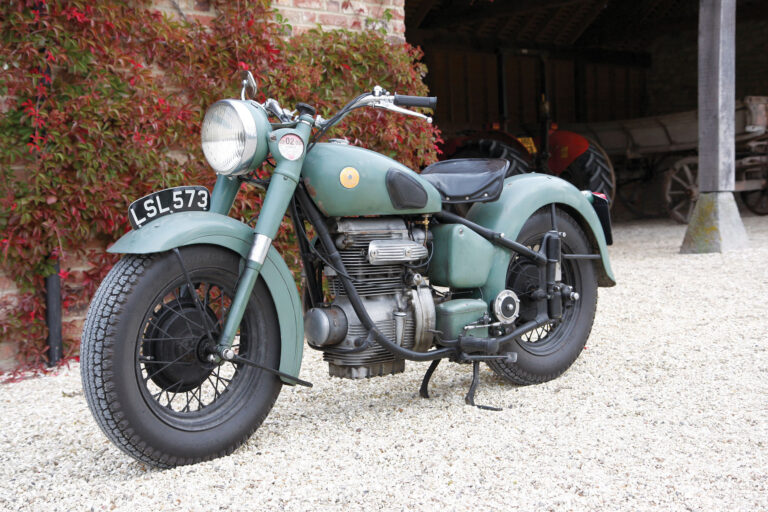
1951 Sunbeam S7

- Engine: 487cc OHC in-line twin-cylinder, wet sump, four-stroke, 70mm x 63.5mm, 26 bhp @ 5800 rpm,6:1 compression ratio
- Top speed: 70mph, approx.
- Carburation: One Amal 276 D0/3A
- Ignition: 6v, points, distributor, single coil
- Gearbox: 4-speed, foot shift, direct primary drive, shaft to worm gear final drive
- Clutch: 7in single plate, dry
- Frame/Wheelbase: Duplex tubular steel cradle frame, 57in/1410mm
- Suspension: Front: telescopic fork, rear: sprung plunger
- Brakes: Front: 8″ SLS, rear: 8″ SLS drum to final drive housing
- Fuel capacity: 3.5 Imperial gallons
- Wheels/tires: Front: 4.50 x 16in, rear: 4.50 x 16in
- Seat height: 30.5in
- Weight: 430lb dry
It was along a dark side street in North London in 1984 where I first looked a Sunbeam S7 over properly and realized it was a fine-looking motorcycle. Parked outside the rockabilly club I’d just left, the Sunbeam was covered in a sweat of light rain, and its paint and chrome shimmered under the sodium streetlamps. I didn’t really know much about them and preferred the Triumphs and BSAs that were more commonly seen, but I was intrigued by the big balloon tires and single sprung seat.
Then the owner — whose name I knew was Ashley — came out dressed in perfect ’50s gear, put the key in, kicked it over, and rode off into the night looking as cool as hell. To me, and this probably partly explains its attraction to owners like Ashley, the Sunbeam seemed like a British Indian Chief — big all over, with those large mudguards, big headlamp, big tires, and plenty of presence. So, when I recently saw Jon Huson astride his 1951 S7 Deluxe at a local meet, I had to have a chat once he’d parked. First, Jon’s bike is a beautifully original example in Mist Green, and with its solo cantilever seat that’s specific to the S7, it does have that “Chief” thing going on. Second, Jon looked the part in period gear, especially when thrashing the Sunbeam up the Kop Hill climb, and he reminded me of Ashley, who had impressed me so many years previously.
An ambitious machine
Jon’s a head gardener for an impressive country estate in the Oxfordshire, U.K., countryside, so when we met up, I arrived to find the old Sunbeam sitting amongst the old stone walls, gravel, and character barns. Jon tells me of his ownership of this particular bike: “I bought this 11 years ago, and it came from the North of England. It was on eBay, and the seller had set the starting price but had no bids. The photos weren’t at all very clear, but the seller, who had owned it for some time, assured me it was all original, which it turned out to be when I bought it. Traces of yellow undercoat under the green paint and the documentation that came with the S7 suggest it is untouched, and it certainly looks it. It’s been well looked after over the years, and it would be wrong to restore it now.” I wonder what drew Jon to an S7. “Well, it’s a bloke’s bike for a start, and I like heavy-looking motorcycles, full of engine. I owned a Suzuki Hayabusa before this but got bored of going fast everywhere. I had a friend who had a Sunbeam sat in his back garden, and I’d always liked it, though his was ropy, so I decided to look for another one.”

This S7 Deluxe that Jon ended up with was, according to copious notes in the folder that came with it, first registered on January 16, 1951, and was one of the approximately 5,500 S7 Deluxes to have been produced between early 1949 and 1956. Manufactured at Small Heath by BSA, then owner of the Sunbeam marque, the first S7 was loosely inspired by a BMW R75 design offered up for inspection as part of German war reparations. It was heralded and welcomed as a super-deluxe grand sports tourer for a public starved of motorcycling inspiration after too many years of war. Designers were the Austrian-born but U.K.-raised Erling Poppe and Gerry Bayliss, and the 500cc straight twin-cylinder configuration, with an advanced design chain-driven overhead camshaft, all light alloy construction, and the convenient shaft drive, was seen as modern, high-tech, and expected to be capable of smooth running and easy power.

Well, it would have been, but underdevelopment led to various design flaws that would, over time, tarnish the S7’s reputation for potential buyers. With a motor initially bolted directly into the frame, vibration killed the ride completely, as willing police escort riders in South Africa discovered on their shiny new S7s — the Sunbeams were sent back, with a message saying “unusable.” BSA’s chief engineer David Munro (Erling Poppe had moved on by then…) rectified the issue to an extent by rapidly adding dampers and rubber engine mountings, but the inherent vibration of a typical 360-degree crankshaft motor was there to stay. Then the shaft drive, being an intelligent and convenient choice for owners, was marred by early problems with the worm gear final drive that panicked BSA into reducing the power output of the OHC motor to 25bhp.

Today, Sunbeam experts say that the use of the correct half pint of the correct AG140 mineral-based oil means the rear drive should be reliable. The fact that the sleeker, slightly faster-intended “sports” model, the S8, was also on sale in showrooms at the same time as the S7 meant that sales of the S7 were limited. But it went from a bravely designed breath of fresh air from a technical point of view to an expensive-to-produce, underperforming anachronism, so the BSA group pulled its support plug on it in 1956. Interestingly, the S7 was supposedly a motorcycle whose design and conception were influenced by readers of The Motor Cycle magazine being asked for opinions by the makers, or perhaps read “clever advance PR scheme.” One enthusiastic reader’s opinion was, “I should say the new ‘Beam is very definitely a step in the right direction, but why too big a stride? Surely, we should progress with the times and support a manufacturer who has ideas and the ability to execute them.” The S7 still turned out pretty well once some issues were addressed.
Quirky but enduring
Of course, fast forward five decades or so, and none of that seems to matter, because what you have now is an interesting example of British motorcycling production history that has a style and quirkiness all its own, appealing to owners like Ashley back in the ’80s, and Jon today. And of course, with the internet and dedicated Sunbeam specialists like Stewart Engineering (established 1960!) and support groups like the Sunbeam Fellowship, it’s easier than ever to have the resources to hand to keep the S7 running, even more so for an unrestored example like Jon’s.
It has a fantastic patina — the Mist Green paintwork is dulled and chipped here and there, and the black frame paint has suffered over the years. The unshining chrome has spots of corrosion here and there, and oil has made its mark where it’s been able. What’s even better about Jon’s bike is the amount of paperwork that came with it, including a handwritten list of many of its owners. The original supplying dealer was Claude Rye, Fulham Road, SW6, according to the very nice metallic badge on the rear lamp holder (Claude Rye being an eminent interwar speedway rider for Wimbledon, but that’s another story).

The bike is then noted as belonging to a motorcycle shop called Phillips Bloomfield Ltd. of South Street, Reading, assigned on to another owner in Wokingham in 1952. The ‘Beam then travels down to Teignmouth, Devon, in February 1953, back up to Buckhurst Hill, Essex, in September 1959, then back down to Bideford, Devon, (again) in 1969. It stayed around the Barnstaple and Bideford area for the next 20 years, passing through the hands of another three owners. A change of registration came around 1997 as the original old FDP 370 number was sadly sold off; then the S7 ended up in Keighley, North Yorkshire, via another owner in Kent. This S7 has certainly traveled! Many past MOTs and receipts, mostly from the aforementioned and longstanding Sunbeam specialists Stewart Engineering, show the bike has been consistently maintained over a long period of time, and there is nothing to suggest that it has been restored or rebuilt.

Jon still wanted to check the Sunbeam over once he’d purchased it. “I went through it thoroughly, not least because I wanted it to be as reliable as possible. It started well enough, but I took the head off first to have a look inside, and the motor looked to be in very good condition. I change the oil once a year, using straight 50 oil, and I clean out the gauze filter in the sump. I’ve heard of these Sunbeam motors being prone to overheating, but I’ve never had a problem with this one; I just check the oil level often.” Jon then turned his attention to the electrics. “It looked like the original wiring loom. Parts of it were starting to break down, so I decided to strip it out completely. I bought a new complete harness from Stewart Engineering and fitted it, and I think it has made a big difference in terms of its reliability. I also decided to rebuild the distributor because it was pretty worn out, and it is a straightforward job to carry out. I then timed the ignition manually and continue to do so when required. The only occasion it really let me down is when the choke cable plunger broke, and another time the clutch cable snapped as I was wheeling it out of the shed — so I’ve had it pretty easy until now,” laughs Jon. Ironically, Sunbeam themselves used the words “Long Lasting Luxury” on many of their brochures and ads for the S7 and S8 bikes, and that doesn’t look like just an empty marketing boast fifty years on.
Riding the ‘Beam
We take the Sunbeam out into the nearby countryside for photos and riding. Jon follows me on my Guzzi, and I ride the S7 Deluxe. I really like the riding position — the bars are just the right height, and not too high, and the cantilevered seat is, well, not too uncomfortable! But like the Indians I have ridden, the Sunbeam just feels good to ride. The motor is seriously smooth, Japanese-engine smooth, and though with just 25bhp on tap from the 500cc motor, acceleration is not particularly swift, it is consistent and strong. Before long, I’ve gone through the particularly light one up, three down gear changes, and we’re bowling along the lanes nicely at a sedate 55mph. I can’t feel much of a hint of vibration at any speeds, maybe occasionally through the foot pegs and bars, but nothing to spoil the ride. And the ride is good. The big tires, plunger rear suspension, sprung seat, rubber knee pads, and telescopic hydraulic forks all combine well to provide the gentleman touring experience. Although, the forks prove themselves to be the harsh link in the chain over potholes and ruts, and bends have to be taken with a certain amount of anticipation. Though I don’t feel the S7 wallows at all, I suspect it would handle sharper with smaller 4.50/4.75 tires as fitted to the S8, but simply wouldn’t have that same look. There’s no real disturbance from the exposed shaft drive universal joint or drive box, and though a little heavy on the lever, the single plate clutch works precisely. The brakes are adequate, too, for a bike that must weigh in at around 500 pounds. For a bike that doesn’t seem to have seen any major restoration, this S7 is fun to ride, and it’s a credit to Jon’s skills that he’s set it up so well. “I like it a lot,” he says, “and especially having gone from a sports bike, I’ve noticed how much more of the countryside I take in on the Sunbeam! I like to use my bikes, and the S7 is fast enough to keep up with modern traffic, and comfy enough to take out for a long ride on a nice day. I took it to Chepstow recently, and it went very well for a heavy machine, and returned around 40mpg, so it isn’t particularly thirsty either.”

So as a usable classic, the S7 Deluxe has a lot going for it. But it really is its design lines and details that capture the attention, as it had mine all those years before. The heavy finning on the engine’s crankcases, in the desire to aid cooling the inline cylinders as much as possible, is actually very attractive on this tall OHC motor, and it’s repeated on the polished aluminum cover that serves to protect the spark plugs and high-tension leads. The round protruding pancake-type dynamo has its spherical shape repeated in the casting for the oil filler and access cover on the left side of the motor, and the exposed distributor at the back of the motor. The corners of the crankcases are curved and smooth, as are the toolboxes, so not sharp or angular. There are hints of classic aero design here. There’s even something about the flexible exhaust connecting pipe that makes me think of Maserati, Italian design, Rumi, that sort of thing. Though maybe not the most convenient place to access them, I like the ignition switch and ammeter and the ignition coil being mounted in the right-hand box. This arrangement also leaves a clean-looking headlamp for the rider, with just the classic black face Smiths speedo and oil and ignition lights to consider. The air cleaner sitting on the Amal carburetor also has a pleasing “swept-back” shape and is picked out in the green of the rest of the bike, and the two exhaust pipes on either side of it swoop down from the head and back to the silencer in a very graceful arc. The big, flared mudguards, expanse of space behind the solo seat, big hubs and wheels, and balloon tires complete the S7’s individuality. Even the tax disc holder built into the headlamp bracket is a clever, though nowadays redundant, idea. Everything has its place, and as overall design, it is balanced, considered, and unique.

All this is emphasized as we return through the door of Jon’s house, and I’m greeted by the sight of a shining, immaculate Sunbeam S7 Deluxe parked up in one room, surrounded by framed shots of its restoration, and period Sunbeam paraphernalia. “It’s a 1952 S7 Deluxe, and I paid £800 for it. I bought this one several years ago as a project already in pieces,” he explains, “and luckily all the bits were there. It’s vital to have all the tinware, especially as the originals are extremely difficult to find nowadays, though many of the other parts are now readily available. Having already owned an original example, I wanted to try and restore one too, and of course it was a big bonus to already own one to look at and compare. I got help with the motor when I needed it, but all the paintwork I did myself. The whole restoration took about a year, and I’m very proud of how it ended up. It has got me thinking, I’d quite like a Sunbeam S8 now,” he laughs. With one kept original, and one restored and saved from the scrap man, Jon’s passion for these interesting 1950s British twins obviously runs deep. I’ll wait and see where he steps next in the land of the ‘Beam. MC