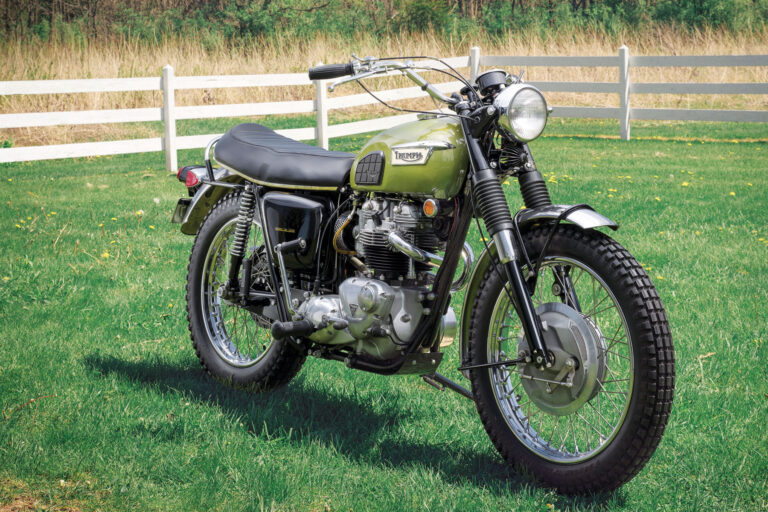
1970 Triumph TR6C Trophy
- Engine: 649cc OHV air-cooled parallel twin, 71mm x 82mm bore/stroke. Two valves/cylinder, 9:1 compression ratio. 45hp @ 6500rpm (claimed)
- Carburetion: one Amal 930 Concentric
- Transmission: 4-speed, twin-row chain primary drive
- Final Drive ratio: 5.11:1
- Electrics: 12V Lucas battery/coil, dual-contact-breaker ignition
- Chassis: Cradle-type lugged steel tube, furnace brazed; bolt-on rear section
- Suspension: Triumph-BSA 35mm telescopic fork with compression and rebound damping; twin Girling shocks
- Seat height: 30.5in (775mm)
- Brakes: Triumph-BSA 8-in TLS ventilated drum front; 7in SLS rear
- Tires: Dunlop K70 3.50 x 19in front; 4.00 x 18in rear. Optional Dunlop Trials Universal front/rear.
- Wheelbase: 55.5in (1410mm)
- Weight: 384lb (174kg) dry
- Fuel capacity: 2.5gal U.S. (9.5ltr)
- Price then/now: $1,380/$15,000-$17,000 (restored)
Offer the word “Triumph” in a word-association game, and the answer will likely be “Bonneville.” Few motorcycle brands are as intertwined with a single model as Triumph is with the iconic Bonnie. The twin-carb 650cc twin was a lust object during the 1960s — beautiful to behold, a confident handler, and one of the few stock machines able to smoke an 883-cc Harley Sportster. Triumph Bonnevilles were, in racing form, the bikes Americans saw winning the Ascot TT on Saturday TV’s popular “Wide World of Sports.” The name was indelibly linked to the Utah salt flats where Triumph held the ultimate motorcycle speed record.
The T120 Bonnie was the stud machine, but its TR6 cousins enjoyed a broader and equally devoted customer base. Introduced in late 1955 as the Trophy 650, the TR6 married the 40-hp Tiger 110 engine with the new TR5 Trophy 500 chassis — Triumph’s first with swinging-arm rear suspension. The stout “40-incher” (its cubic-inch displacement) was a do-it-all model, designed to be equally at home on and off road. It was endowed with a fat spread of torque and the right hardware. Triumph’s new aluminum “Delta” cylinder head and sports camshafts were standard, along with a siamesed high-level exhaust, Lucas K2FC “wader” (somewhat waterproof) magneto and Dunlop Trials Universal semi-knobby tires.

Off-road competitors appreciated the Trophy’s quick-detachable (QD) 7-inch headlamp, 20-inch front wheel, sump guard, sports seat and 3¼-gallon fuel tank. A QD rear wheel enabled speedy tire changes. The Tiger parts bins contributed a ventilated 8-inch front brake part-way into 1956 production. And the Trophy’s single Amal carburetor made it simple to tune and easy to twist.
The Trophy 650 arrived in the U.S. just as the aftermarket for Triumph hop-up parts was taking off. Useful goodies from Bates (racing seats), MCM (exhaust and sprockets), Flanders (handlebars), Webco (various), and others combined with owner ingenuity to create the classic Triumph “desert sled”– the grandaddy of today’s Adventure bikes. In the hands of Bud “Desert Fox” Ekins, Buck Smith, Eddie “Squirrel” Mulder, Al Rogers, Dusty Coppage, and many others, modified TR6s ruled southern California’s popular AMA District 37 Hare & Hound races and epic long-distance events through the late ’60s.
Triumph’s western-states distributor Johnson Motors capitalized on TR6 wins at the 150-mile Big Bear Run, the two-day 500-mile Greenhorn Enduro and the AMA Cross Country Championship. For members of SoCal’s many desert racing clubs — among them the Checkers, Shamrocks, Prospectors, Rams, Dirt Diggers, and Four Aces — the Trophy 650 was the winning ticket.

Old-timers agree that the basic high-pipe TR6 as engineered in Britain was a fairly rugged machine for its era. “But it wasn’t made for doing what we were doing — beating the hell out of it in the desert!” said Gene Smith, Jr., son of the late, great Buck Smith and a veteran Triumph 650 desert racer himself.
“We broke just about everything you could break on a Triumph and still make ’em work,” Smith told Motorcycle Classics. The machines survived the worst abuse the Mojave Desert could dish out. To improve handling on the rough terrain, Trophy 650 owners raked their bikes’ steering head, lengthened swing arms, and fitted beefy 4.00-19 tires on front. Final-drive gearing was changed; on the long desert courses a TR6 sled could top 100mph. Excess stock parts were shed to save weight and boost reliability — the first 10 finishers in the Heavyweight class at the 1965 Greenhorn were all aboard high-pipe Triumphs. Eventually the big sleds’ dominance came to an end when the two-stroke tide led by Bultaco and Husqvarna arrived. Still, for many Triumph buyers across the U.S., it was the desert-proven Trophy, not the Bonneville, that attracted them to the brand.
Steady refinement
Triumph followed the Trophy 650’s blockbuster debut by spinning off variants on the TR6 platform. A low-pipe roadster, the TR6A, launched in 1957. It became the template for subsequent Triumph single-carb 650 street bikes, rebadged TR6R, offered through 1972. These featured a standard tachometer and Dunlop street tires. The TR6B basically carried over the 1956 dual-purpose theme with high pipe and Trials Universal rubber. It evolved into the TR6C (the C indicating a competition focus) in 1961.

Triumph steadily refined its multi-use 650 through 1963, when the unit-construction engine (with integral gearbox) and new frame debuted. From 1957 to 1962, there were many significant upgrades among the annual changes. Stronger and more efficient cylinder head and pistons. A one-piece forged crankshaft. Alternator electrics replaced the old generators. The fork was revamped, and the TR6 adopted a lightweight aluminum full-width front brake hub and alloy front fender. A one-gallon oil tank, heavier, butted wheel spokes, and a more robust chain guard arrived.
Other changes were problematic. Triumph’s new Slick-Shift gearbox (1958) promised clutchless shifting — something that didn’t quite work as advertised and that buyers didn’t ask for. And the infamous duplex frame (1960) suffered a number of catastrophic failures in U.S. off-road racing. Used only on the 650cc models, the twin-downtube frame debacle prompted the Meriden factory to add a lower tank rail (after engine D1563) to stiffen the structure. Triumph then offered dealers a modified front frame section to swap out on customer machines. Meanwhile, an all-new single-downtube frame was being readied for ’63.

A major riff on the high-pipe 650 theme was the TR6SC, built for the 1963 to 1966 model years. There were two catalogued SC variants. The Trophy Special was the lean, stripped-down desert racer with straight pipes and lacking any road gear — not even a tach. The Trophy Competition Sports came with full street equipment and is the rarer version. Shared specs included a standard TR6R motor with 8.5:1 compression, ET (energy transfer) ignition and 17-tooth gearbox sprocket, soon changed to 18-tooth sprocket with a wide-ratio gearbox. Both SCs were fitted with weight-saving aluminum fenders, skid plate, Trials Universal tires, folding footpegs (on 1965 models) and a centerstand — good for maintenance, bad for weight and ground clearance, but easily removed.
Cycle World published the only magazine road test of a Trophy Special, in October 1965. The $1,145 TR6SC was described as “a real off-the-shelf fire breather” and “a born slider” whose street-bike fork geometry compromised it as a pure racer. But the test concluded that the SC “will serve nicely as a dual-purpose racing/fun motorcycle.”
Thinking man’s street scrambler
Triumph’s model development during the 1960s favored refinement, with most changes (other than the move to 12-volt electrics in 1966) being incremental. By 1970 the TR6C still retained the ‘Trophy 650’ badge while the TR6R was now Tiger 650. Both TR6s were still known as Trophies in the U.K., however. The ‘R’ was marketed as a “tourer” with a 3.5-gallon fuel tank, standard tachometer and Dunlop K70 street tires. The ‘C’ model had evolved from its off-road-biased origin to a big-bore street scrambler. Its visual signature was a pair of chromed pipes stacked high on the left side, with large roadster mufflers replacing the small sports silencers used in 1967-’68. Rider and passenger legs were kept from frying by a chromed, fabricated heat shield that “looked like it had been clipped from a shopping cart,” opined Triumph historian and author David Gaylin.
Many other details that are valuable to restorers delineate the ’69 and ’70 TR6C from their roadster-R brother. The ‘C’ shares its 2.5-gallon tank with the Bonnie. The slimline vessel was finished in Spring Gold, a very “late-Sixties” shade of metallic green with black center stripe outlined in gold coach lines. Polished stainless-steel fenders as on the Trophy 500 mount on black-painted stays rather than chrome. All fenders sport a rolled edge.

Engine spec is shared between the single-carb 650s, as is the 8-inch twin-leading-shoe front brake — a heavy road-bike item that journalist and veteran desert racer Bob Greene argued was excessive for off-road use. The Trophy 650 came standard with an 18-tooth countershaft sprocket versus the 19-tooth cog on the roadster. The main footrests fold and a steel skid plate protects the front cradle. The fork’s upper triple clamp has a solid, cast-in handlebar mount and includes a steering damper through the stem.
The high-pipe 650 was fitted only with a Smiths magnetic-type speedometer, center-mounted between the fork tubes. A Smiths tach was optional, mounted on a dual-gauge plate. Optional too were a center stand (standard on TR6R) and Dunlop K70 tires. The Trophy 650’s 5.75in chrome headlamp has a toggle switch and a green hi-beam indicator light and red oil pressure light, and the push-button hi/low beam on the left side. Unlike the TR6R’s 7-in headlamp, there is no ammeter.
“The TR6 was the thinking-man’s Triumph twin,” notes Bob Leppan, the Salt Flats speed legend whose Triumph-Detroit dealership was among the British brand’s highest-volume U.S. stores during the era. He explained that by 1967, the TR6 had evolved into “a single-carb Bonneville.” The two models shared the same E3134 ‘Q’ camshafts, racing tappets, and the same valve diameters, 9:1 compression and gearbox ratios.

“Performance of the single-carb vs. twin-carb 650s was virtually identical in every measure except peak velocity,” Leppan observed. “Frankly, TR6 owners were more about practicality and riding, and less about image and ego, than the typical Bonnie customer,” he quipped.
Triumph’s U.S. regional customer base determined how the Tiger and Trophy 650 mix was apportioned to dealers. For example, Leppan ordered more TR6Rs in a typical year because his store, in metropolitan Detroit, served mainly road riders and drag racers. About 100 miles northwest of Detroit, Sam Hawley’s Saginaw Cycle was in the heart of Jack Pine Enduro country, with ample wide-open space for the big TR6C to roam. Many shops, however, like Triumph of Wellesley, Massachusetts, sold both TR6 models in roughly equal numbers, according to owner John Healy.
A joy to ride
“The TR6C has a simplicity to it, a perfect proportion. There is nothing excessive on the Triumph,” observed Matt Jonas, as he admires his stock 1970 model shown on these pages. Jonas cut his teeth on a Cushman scooter and later raced Bultaco Astros on Midwest short tracks. He admits an affinity for Norton Commandos, but the Chicago area enthusiast is brand-diverse when it comes to riding and collecting. His stable includes a Ducati F1 Montjuich; Harley-Davidson XLCR; Honda CBX, RC30 and CX650 Turbo; a Yamaha XS750E shaft-drive triple, and a yellow Laverda SFC 1000.
On a Yamaha 900 Seca, Jonas racked up over 140,000 miles, including trips into western Canada and Alaska. Close to home, however, he was bitten by the Triumph charm. “I love the Trophy 650’s high pipes,” he says, with a passion first ignited long ago by one of his first bikes, a CL450 Honda.

He bought the TR6C in the 1990s, with 3,800 original miles on it, from a friend’s friend who worked at Windy City Triumph-Yamaha. “It had an original-paint tank, original seat, headlamp, and fenders,” Jonas recalls. He had the stainless mudguards polished at a local buffing shop. The rims were slightly rusty on the bottom, replaced by new ones found at Baxter Cycle in Iowa and in Arizona.
Frame paint was good and mostly original, requiring a minor touch-up in places. Jonas swapped out a high-rise handlebar for the standard Triumph “western” bar fitted to U.S. models. As the rocker boxes had been leaking down onto the top fin of the cylinder head, Jonas pulled the head to fit new gaskets. He cleaned up the combustion chambers and found the valves to be in good shape, so left them untouched. “The motor’s on standard bore and I believe the barrel’s never been removed,” he noted.

Jonas had the header pipes rechromed and fitted reproduction mufflers purchased from Bob Goodpaster at Expert Cycle Works in Hobart, Indiana, a shop that’s been in continuous business since 1950. NOS Dunlop Trials Universal tires made in the U.K. are rare as hen’s teeth, but Jonas found a pair made by Dunlop in Japan.
“Parts for classic Triumphs are readily available, with a great aftermarket in England and now in India,” he explains, “because Triumph evolved its motorcycles over the years rather than completely changing them, it makes finding parts and restoring the bikes easier than with, say, a Yamaha XS750E.”
Jonas appreciates the 650cc twin’s punchy power delivery and rock-solid handling. He hasn’t had the bike off road but on pavement “it’s a joy to ride. Light and flickable,” he says, and an easy starter. “The TR6C is the only classic-era Triumph twin I’ve got. And those high pipes still grab my attention whenever I see the bike.” MC
Ekins’ 1962 ISDT Gold Medal Winner
Attendees of this year’s National Triumph Rally in Oley, Pennsylvania, were treated to a special surprise motorcycle on display: the factory Trophy 650 ridden by Bud Ekins in the 1962 International Six-Days Trials, held in southern Germany. Ekins won his first ISDT Gold medal on the bike (and earned his second Gold in 1963, on another works TR6). He’d won a Silver medal in 1961.

The ’62 machine — TR6SS D17866 — is a stunning time capsule, unaltered since being retired following the September ’62 event. Ekins brought the machine home to his Triumph dealership in Hollywood, where it remained in his motorcycle collection for more than 25 years. The bike’s engine still wears unbroken scrutineers’ wire, fitted by FIM inspectors at key interfaces (such as the cylinder head-to-barrel joint) of each motorcycle. The wires, each attached to a tiny lead disc stamped “FIM,” served as evidence against any tampering by the teams during off hours during the grueling enduro, dubbed “the Olympics of Motorcycling.”

D17866 is basically a standard TR6SS, the regular U.K. and general export 650cc model of the day. It was prepped by Harry Woolridge in the Meriden factory’s Competition Department along with other works-supported 350cc, 500cc and 650cc twins entered in the trials. Ekins’ machine’s patina is spectacular, and the bike brims with period equipment aimed at surviving the six-day blitz. There are tommy bars on each axle for rapid wheel removal. A pressurized air bottle for filling punctured tires. Doubled-up duplicate cables. A “tire scrubber” hung from the front fender to ward off nails. Girling competition shocks, and Dunlop Trials tires mounted in 1962.

The ISDT bike and extensive documentation were acquired by a U.S. collector specializing in British classics. The owner trusted his friends Scott and Sid Chantland, themselves longtime Triumph collectors, with the bike’s transport and display at the Triumph rally. “It’s an honor for us to bring this great piece of Triumph and ISDT history,” Sid told Motorcycle Classics.