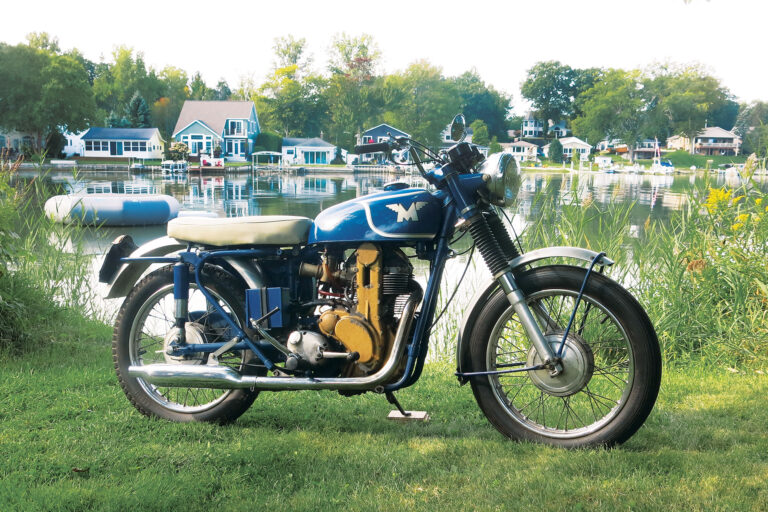
1962 Matchless G50CSR “Golden Eagle”

- Engine: Air-cooled 496cc SOHC two-valve single. 90mm x 78mm bore/stroke. Aluminum head and barrel, magnesium crankcase. 10.5:1 compression ratio. 48.5hp @ 7000rpm (est.)
- Top speed: 121mph*
- Carburetion: 1 3/8in Amal GP2
- Transmission: AMC 4-speed
- Final drive: Roller chain, 4.78:1
- Electrics: 6V battery/dynamo; Lucas magneto ignition
- Chassis: Duplex steel cradle, brazed lugs
- Suspension: AMC “extended” Teledraulic fork; swingarm, Girling dampers
- Seat height: 32.5 in (826mm)
- Brakes: 7in (178mm) SLS drum front and rear
- Tires: 3.25-19in front, 3.50-19in rear
- Wheels: Steel rims, wire-spokes
- Wheelbase: 55in (1,397mm)
- Curb weight: 385lb (175kg)
- Fuel capacity: 2.0gal (7.6ltr)
- 1/4-mile acceleration: 14.1sec @ 98mph*
- Price then/now: $1,500/$35,000+ (est.)
*Cycle World, April 1962
Few collector motorcycles are more desirable than the rare breed of production-based race bikes known as Homologation Specials. Built in limited numbers, these machines must meet a race series’ technical rules, with a minimum number of units required for sale to the public. Essentially race bikes with full street kit — lights, horn, mirrors, sidestand — they allow their lucky owners to enjoy the occasional head-clearing run on public roads.
Honda’s iconic RC30 (aka VFR750R) is perhaps the best-known example. Based on the factory’s RVF World Endurance racers, the 100hp 750cc V4 is highly coveted by vintage superbike and Honda collectors. But it’s hardly a low-volume rarity. Honda is estimated to have produced at least 3,000 RC30s — some sources quote upwards of 5,000 units — from 1988-1990. U.S. retail price: $15,000.

Then came the RC45, Honda’s next homologation riff on the RVF750. Roughly 600 units were made between 1994 and 1999. Each example retailed for twice the price of an RC30. Competitors’ specials include Yamaha’s FZR 750RR (500 units made 1989-1991) and YZF-R7 (500 examples, 1999), the Ducati 916 SPS Fogarty Replica (202 units made in 1998), and Harley-Davidson’s VR1000 (50 bikes, 1994).
Far rarer than those modern exotics, however, is the granddaddy of Homologation Specials: the Matchless G50CSR. Just 25 examples were assembled in early 1962 in the Associated Motor Cycles factory race shop in London, England. The bike is an odd amalgam: a 496cc SOHC single-cylinder motor designed for European Grand Prix racing, slightly detuned and stuffed into Matchless’ humble G80CS street scrambler chassis. The G50CSR was a clever strategic play by AMC’s U.S. distributor, the Indian Sales Corporation, aimed at breaking the Harley-Triumph-BSA hammerlock on the AMA Grand National Championship. That it did, indirectly by Dick Mann, but not without being the center of an historic AMA racing controversy.

Some 12 complete machines have survived today, according to John Posthuma, the owner of our feature bike, and the late Robert Iannucci, founder of the New York-based Team Obsolete historic racing group. An authority on AJS and Matchless works racers, Iannucci bought his first G50CSR in 1974 while still in college. Through the years, he owned many more and compiled a registry of the known G50CSRs based on their matching engine/frame serial numbers.
Born from the “Boys’ Racer”
Built in small numbers from 1959 to 1962, the G50 road racer was an evolution of its 350cc cousin, the AJS 7R. The “cammy” Ajay was the perfect racing motorcycle for speed-starved postwar Britain and Europe when it debuted in 1948. Design engineer Phillip Walker retained the SOHC 2-valve architecture, with chain-driven camshaft, proven on AJS’s prewar 350cc R7. He rejected the more expensive towershaft-and-bevel gears cam drives employed by Norton and Velocette. The chain-driven setup allowed compression ratios to be raised or lowered by swapping out different-thickness spacers under the cylinder barrel — a task not easily done on a towershaft engine.

The new lightweight AJS engine used a deeply finned aluminum-alloy cylinder head and barrel, the latter with a shrunk-in iron liner spigoted into the crankcase. The robust I-section connecting rod was an EN-series high-tensile steel forging. Lubrication was by two separate gear-driven oil pumps, for the feed and scavenge sides, respectively. Walker’s development budget included magnesium castings — 38% lighter than aluminum — for the 7R’s crankcases, cam box, timing-and-magneto drive housing, hubs, and brake backing plates. All were given a special gold paint to prevent oxidation, creating a 7R visual hallmark that carried over to the G50 ten years later.
Through the 1950s, steady development by engineers Ike Hatch then Jack Williams raised 7R output to 41hp at 7,800rpm. Bore and stroke were altered and breathing was vastly improved. The 7R endeared itself to professional and privateer racers alike. Nicknamed the “Boy’s Racer,” it was easier to tune and maintain in the field than a Manx Norton. The cam box could be removed without first removing the engine from the frame. Rocker spindles were mounted on eccentric bushings, making valve lash adjustments and checks simpler than with shims or screw-type adjusters. And the 7R’s valve gear was fully enclosed, keeping the engine cleaner than the oily Nortons. A slender and strong duplex chassis in Reynolds 531 steel tubing and beefy 8-inch brakes made the 7R nimble and responsive.

The motorcycle itself was a thing of beauty. Its long list of successes in British and international races belatedly prompted AMC management (which owned AJS and Matchless) to replicate the 350’s design in a 500cc machine, under the Matchless brand. In 1958, the G50 was launched with oversquare 90 x 78-mm engine dimensions. It used the 7R chassis and enjoyed all of the 350’s technical and aesthetic goodness. Rated output was 50-52hp, with 1.5-inch Amal GP carburetor and reverse-cone megaphone exhaust.
Mann and Matchless vs. the AMA
In the U.S., meanwhile, AMA Class C racing was restricted to modified production motorcycles. Thoroughbred racers like the 7R and G50 weren’t permitted. The AMA had banned Norton’s Featherbed-framed Manx in the early 1950s, and its rulemaking Competition Committee was composed of partisan reps from Harley-Davidson, Triumph, and BSA — the influential “iron triangle” clique of American bikesport. Indian, defunct as a manufacturer since 1953, had been spun into a sales outlet for British brands and was the U.S. Matchless importer. The company hatched a plan to get its Grand Prix-proven racer approved for the 1962 AMA Grand National season: Install a slightly detuned G50 motor into the heavy G80CS street-scrambler chassis favored by U.S. desert racers.
The hybrid machine was submitted for homologation, and the scheme worked. Fitted with a smaller 1 3/8-inch GP carb, a stifling muffler, puny seven-inch SLS brakes, and full street-legal equipment, the bike was approved by the AMA Competition Committee for 1962. Matchless catalogued it as the “G50CSR Golden Eagle,” a reference to the engine’s gold-painted castings. (The name was decided in a mail-in contest.) The factory hurriedly dispatched to the U.S. 25 machines required by the AMA for homologation. Each unit wore the standard Matchless scrambles/trials fuel tank. A belt-driven generator on the primary side was concealed under a specially fabricated sheet metal cover. Various brackets were unique to the model. All bikes except one were in blue and silver livery. A red-tank machine was shipped first, for promotions. It became Cycle World‘s April 1962 cover feature (see sidebar below).

The G50CSR was “created to market the Matchless brand and get the AMA Number 1 plate away from the Harley-Triumph monopoly,” asserted Brian Slark, recently retired from the Barber Museum. Slark worked in the AJS-Matchless competition department during the period. He observed that the scrambler chassis “basically served as a ‘shipping crate’ for the G50 motor.” A Trojan Horse! The CSR project was “a way to get G50 overhead-cam motors approved by the AMA so that Dick Mann, whom we supported, could race it here.
“As soon as Dick got one, he could slot it into any chassis,” Slark noted. Indian’s former racing champ Jimmy Hill, the company’s rep on the Comp Committee, had separately submitted the 7R road-race frame, fork, big brakes and fuel tank for AMA approval. A racer could therefore purchase the AMA-legal G50CSR, remove the motor, and install it in the AMA-approved 7R chassis. Voilà — a Grand Prix-spec G50 to compete against the “iron triangle” KRs, Tiger 100s and Gold Stars.
“While the G50CSR was approved for the 1962 season, Dick Mann rode a 7R-framed G50 in half-mile, mile, TT and road race events,” noted U.S. racing historian Bill Milburn. Mann proved the Matchless’s potency by finishing a close second at Daytona then won the Laconia National, lapping the field. Rod Coates, Triumph’s strident race boss on the AMA Comp Committee, became concerned. When Mann slotted the G50 motor into a BSA Goldstar dirt track frame, Coates and the committee declared the bike illegal, Milburn said. This led to the AMA ruling the 7R road race frame illegal, causing Mann to be disqualified at Daytona 200 tech inspection in 1963. He was told he could run a G50CSR, which would have been uncompetitive. He considered suing the AMA and sat out the race.

As former AMA official Ed Youngblood noted in his insightful Dick Mann biography, “After the Daytona decision, the Matchless fiasco became even crazier. Mann was allowed to use the outlawed 7R frame for TT racing but not road racing. Even more incredibly, the AMA reversed itself and let him run the G50 engine in the Gold Star-based rigid frame on dirt. In regard to the G50, both the letter and the spirit of Class C racing became totally obscured in a bizarre morass of contradictory rulings and counter rulings by the Competition Committee.”
Despite the controversy, the G50CSR had enabled Mann to earn the Number 1 plate for 1963. Defying further comprehension, in 1964 the AMA allowed the 7R-framed G50 to compete in full racing trim. Mann won four Nationals on his Matchless that year, including the Ascot TT. However, as Youngblood reported, “no record exists of the Competition Committee reversing its earlier decision to ban the bike.” Racing politics!
“You’ll never find one”
By the time feature-bike owner John Posthuma was 22, he’d become a hardcore Matchless Guy. “Big four-stroke singles were on the way out by then, but I was picking up G80CSs for $400,” he said. “I had a rule about buying bikes: Never pay more than $1 per cc.” Then he saw the April 1962 issue of Cycle World. “The red G50CSR on the cover was the coolest-looking bike I’d ever seen!” he exclaimed. Posthuma became obsessed with owning one of the 25 specials. “Everybody told me, ‘You’ll never find one of those’ and ‘You’re nuts riding that old stuff! You can’t find parts!’ But I knew you could.”
His search in those pre-internet “snail mail” days led him to vintage motorcycle experts across the U.S. He placed ads in magazines and hunted down former Matchless dealers. Finally, in 1974, his search led him to Robert Iannucci, who had just acquired his first G50CSR. The young New York City attorney had already amassed a mountain of data on the bikes. Not long after, he found another G50CSR in Texas. Iannucci bought that bike and sold it to Posthuma for $1,650. Paperwork shows it was originally sold by Stoval’s Texaco Station, a Matchless dealer, in Dallas, Texas.
The bike had been set up for TT scrambles and was missing all of its street-legal equipment. John did some painting and replaced various parts — it had a 1.5inch GP carb, a straight exhaust and a TT seat — but was in good shape overall. The race-bred single wasn’t designed for a kickstarter but it fired easily. John’s research discovered that the G50CSR motors were built to 1961 spec; in their final year G50s featured larger valves and a one-inch crankpin, versus the CSR’s 7/8-inch pin. Over the years more G50CSR treasures were found as John brought his dream bike back to original condition.
Riding the G50CSR in Gotham City
How does riding the Matchless compare with the immortal British sporting singles such as BSA’s DBD34 Gold Star and the Velocette Thruxton?
“As a homologation special, it’s hard to compare the Matchless to contemporary 500cc singles that were built as road bikes,” explained classic-racing legend and Isle of Man TT winner Dave Roper, who may have more track miles on Matchless G50s than anyone else. “I reckon not many road miles were done on the G50CSRs when they were new,” he said. “During the bike’s heyday, motors were typically pulled out and installed in 7R chassis, which also was the proper G50 road-race chassis.”
Roper has ridden a couple trick G50CSRs with bored-and-stroked 650cc motors built at Team Obsolete over the years. Finding people with seat time on a stock G50CSR is as rare as the motorcycles themselves. Steve Zabaro was working in the parts department at Indian Sales Corp.’s California operation when the West Coast shipment of 13 G50CSRs arrived. Zabaro’s boss ordered him to a U.S. Customs bonded warehouse in the Port of Los Angeles to meet legendary AMA referee Earl Flanders to certify that the Matchlesses existed.

“I knocked the side off of five or six wooden crates so Earl could see the bikes inside. When I first saw the crated motorcycles, I wasn’t too excited,” Zabaro told Motorcycle Classics. He knew what the bike was for, and that it wouldn’t be raced seriously in that configuration. He also noted that all engines left the factory stamped G50CS (no R).
Soon after, Zabaro rode the red machine that was first to arrive. “It was pretty fast, equivalent to a 40-inch [650cc] Triumph,” he recalls. “But I don’t think it would have touched a Harley KR or DBD Gold Star.”
Veteran U.K. moto journalist Mick Duckworth is another of the lucky few who have ridden the rare “cammy” single on open roads. He has sampled both the National Motorcycle Museum’s restored G50CSR as well as one of Team Obsolete’s stock bikes. He rode the latter over the course of two nights, in dense urban traffic. New York City, to be exact.
“The TO guys invited me out to dinner, all of us riding as a group into Manhattan. They offered me the G50CSR” — a privilege, he acknowledges.
As the two-wheeled herd thundered across 12 miles of Gotham streetscape, Duckworth found the Matchless tractable, easy to manage, and “smoother than expected — certainly smoother than a Goldie.” His only issue was keeping up with the other guys, all hard riders, on a bike he wasn’t familiar with. “The G80 front brake was not up to the bike’s performance,” he recalled. “And funnily enough, I had no issues with it stalling at red lights.”

Iannucci recalled that he and his wife Sonia rode off on their honeymoon aboard his G50CSR–an unconventional use for one of motorcycling’s most famous competition engines. “The frame is a bit tall, but it’s a nice bike to ride,” Iannucci told Motorcycle Classics in early 2025. “It vibrates less than a Velo, which itself is smoother than a Gold Star. It’s a friendly motor with a pretty broad powerband,” he claimed.
Opening up the CSR’s street exhaust system, with its extremely restrictive muffler, “makes a huge difference” in performance, Iannucci said. In the 1962 Cycle World article’s track test, swapping the muffler for a G50 megaphone and a jetting change yielded significantly more peak power.
Matchless man Posthuma owns a dozen Flying-M models. He fires up the G50CSR only occasionally these days, as he prefers to run the engine on vegetable-based Castrol R with its famously fragrant exhaust scent. The factory-spec “bean oil” tends to gum up the internals unless drained soon after each outing. On the road, the overhead-cam single is “much smoother than a G80CS and mechanically much quieter,” Posthuma asserts, “with none of the valve gear clatter of a pushrod single or twin.”
And as its original AJS engine design intended, the G50CSR is relatively easy to live with. “There’s not much to do to maintain these simple motors,” he explains. AMC did not print an owner’s manual, but each machine came with an oversized pamphlet showing how to set up and adjust the bike. “The engine will idle with the 1 3/8-inch GP2 carb if you turn up the adjustment screw,” Posthuma noted. “But these engines weren’t meant to sit and idle!” MC
Sidebar: Cycle World‘s Exclusive Test
Cycle World magazine was in its first year of publication when it landed an exclusive road test of Matchless’s equally exclusive G50CSR. The April 1962 cover story also included a detailed analysis of the G50 engine by respected technical editor Gordon Jennings. Some quotes from that historic report:
“The fact is, this Matchless does not really come to life until you get up to about 40mph. After that it really begins to move. It will lift its front wheel completely clear of the ground in the shift into second, and then just pip it into the air on the shift into third. It has so much steam that it is hard to believe it all comes from only 500cc of displacement and one cylinder.”

“Initially, we had rather wished that Matchless had either put lights on the G50 racing bike or put the G50 engine in a real, 100-percent dirt-flinging scrambler. What they have done is much wiser; the man who buys a G50CSR will certainly have competition in mind…and Matchless has provided a machine that stands at the center of things.”
“The things that make the G50 engine design good are its flexibility and reliability, and the fact that it is easy to keep in good repair. These things are essential for the private owner.”