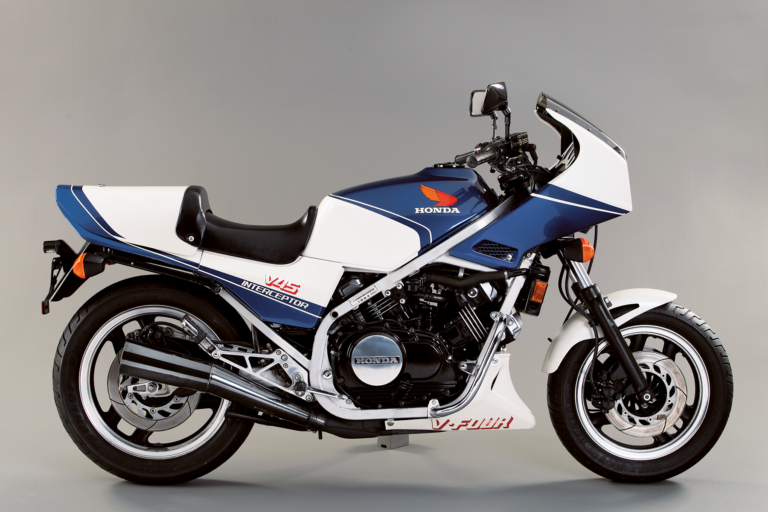
Honda VF750F Interceptor
Claimed power: 86hp @ 10,000rpm
Top speed: 132mph (period test)
Engine: 748cc liquid-cooled 16-valve DOHC 90-degree V4, 70mm x 48.6mm bore and stroke, 10.5:1 compression ratio
Weight (wet): 551lb (250.5kg)
Fuel capacity/MPG: 5.8gal (22ltr)/37.3mpg (period test)
Price then/now: $3,498/$3,000-$5,500
An Interceptor is a fighter aircraft specifically designed to repel enemy missions. Relying on high speed and powerful armament, they were once seen as the first line of air defense. So did Honda’s first Interceptor, the 1983 VF750F, have the fleetness and firepower necessary to beat the competition?

It’s been said that Honda rushed its V4s to market after the launch of the Suzuki Katana, and in anticipation of a new world-beater from Yamaha that became the FJ1100. As the Eighties dawned, Kawasaki, Suzuki and Yamaha seemed bent on deposing Big Red as the default Japanese brand. Honda appeared to have taken its eye off the ball, perhaps because of its new range of four-wheelers. Its mainstream bikes were seen as sturdy and reliable, but stodgy and dated. While Honda relied too long on its single overhead cam design from 1969, Yamaha, Suzuki and Kawasaki, formerly 2-stroke dependent, had all developed dual overhead cam inline 4-stroke fours. Though technological tours de force, neither the Honda Gold Wing, nor the CBX — not to mention the CX twin — were considered mainstream: Honda’s volume marketplace lead was slipping.
Then the V4s arrived, like a squadron of F-22s to intercept and scatter the intruders, creating a sensation along the way. In 1982, Honda introduced the V45 Sabre and Magna for the U.S. market, and the VF750S for Europe. All had liquid-cooled, hugely over-square 70mm x 43mm bore and stroke engines, 6-speed transmissions and shaft drive. The short stroke, 4-valve V4 was state of the art, and buyers anticipated high-revving, high-power performance.

The VF750F joined the U.S. range a year later, in 1983. Aping Suzuki’s 1981 Katana, the VF sported a frame-mounted headlight fairing. But while the Katana was in many ways a dressed-up late-Seventies GS1100, the Honda was just about all new. Though based on the V45 Sabre, the VF featured an all-new GP-derived frame, a revamped power train and several other race bike goodies.
Race on Sunday . . .
The Honda VF750F Interceptor was the offspring of a metaphorical marriage between the revolutionary 996cc V4 FWS1000 U.S. Formula 1 Championship Superbike racer Honda introduced in 1982 and a change in AMA Superbike rules. For the 1983 season, 4-cylinder bikes were limited to 750cc and were required to be production based. Honda management decided to build a new street bike around the Sabre engine, but with the right stuff to form the basis of a Superbike contender. The 1983 Honda VF750F Interceptor was the result.
The innovations were immediately apparent. An all-new perimeter frame made from square-section steel tubes enveloped a strengthened version of the 750cc V4, which was tilted back to allow for a shorter wheelbase and better weight distribution. The VF750F engine shared most components with the Sabre, though detail changes to cam timing and combustion chambers resulted in extra horsepower. A more race-suitable chain final drive replaced the Sabre’s shaft, while the number of cogs in the transmission went, curiously, from six to five. Apparently, reconfiguring the tranny for chain drive meant less room for gears, and rather than make the gears narrower, which would increase their loading to an unacceptable level, Honda chose to drop one.

The transmission also included a new slipper clutch, with half of the clutch plates driving the clutch hub through sprags, so the clutch was only 50 percent effective on the overrun. This provided for some slippage if rear wheel traction was compromised under heavy braking. And here you thought slipper clutches were something new …
Using similar engine internals to the Sabre meant the Interceptor retained the Sabre’s chain drive to the four overhead cams, carrying forward tensioner and cam wear problems that were just showing up on the 1982 bikes. Though Honda had developed a multi-gear camshaft drive for their V4s, it was reserved at that time for the European-market VF1000R. But in 1983, the issue of cam wear had yet to make the front page.

Completing the racer-on-the-road formula was a 16-inch front wheel attached to fully adjustable, air-assist Showa forks fitted with Honda’s TRAC anti-dive system. Sixteen-inchers were all the rage on the track, though whether the faster-turning characteristics were a result of reduced rolling mass and radius or a shorter steering angle was open to argument. Rear suspension was Honda’s own Pro-Link system with a fully adjustable air-assist Showa shock. Comcast alloy wheels (the demise of the sketchy composite Comstar wheels from the CBX era disappointed no one) carried floating discs, two at the front and one at the rear, each gripped by twin-pot calipers.
As well as the prodigious thrust provided by 77 rear-wheel horsepower (Honda claimed 86 at the crank), testers noted that the Honda VF750F Interceptor was a Japanese Superbike with a chassis that really and truly handled. Unlike the rubber-mounted Sabre engine, the Honda Interceptor engine bolted directly to the wide perimeter frame, providing very effective cross-bracing. The well-triangulated steering head, rigid cast alloy swingarm and cross-braced front fork also helped resist twisting loads. The inclusion of 4-stop, adjustable preload for the rear suspension and adjustable air assist at both ends provided dial-in settings to optimize springing and damping for the weight of the rider and for the type of surface — including the racetrack.
. . . sell on Monday
So was the VF750F just a repli-racer on the street like today’s screaming 600s — peaky power, nervous steering and a 20-minute riding position? Not according to period reports: An “incredibly docile powerplant” combined with “a fine balance in the location of seat, bars and pegs” to produce “a supremely versatile motorcycle, one that’s neither a posturing dandy with delusions of trackside grandeur nor a surly, petulant racer-cum-roadster,” said Cycle Guide of May 1983. “Steering response is textbook neutral,” it went on, making the Honda VF750F Interceptor “as useful to the Monday-through-Friday commuter as it is to the Sunday morning racer.”

But there was trouble in paradise. Issues with rapid camshaft wear and disintegrating cam chain tensioners started surfacing regularly, and Honda’s belated response was a series of service advisories that attempted band-aid solutions under warranty rather than a full recall. Unfortunately, the damage to the VF’s image was done, and within two years the VF750F was replaced by the VFR750 with gear-driven cams and a twin-spar alloy frame.
The original Honda Interceptor had itself been intercepted.
Jeff Barger’s Honda VF750F Interceptor
In 1983, Jeff Barger was riding his 1974 Honda CB750 through his home city of Milwaukee when he tangled with a drunk driver. Though the bike was badly damaged, Jeff made a speedy recovery.
“I was getting interested in watching motorcycle racing at about that point,” he says, “and getting pretty hyped up about it. I’d taken Keith Code’s California Superbike school at Road America.” And the new Honda VF750F Interceptor had just arrived in dealerships.
“A lot of the good motorcycles, the more racing-oriented motorcycles, only went to Europe,” Jeff says. “This was one of the first bikes that the Japanese companies said, ‘OK, we’re gonna send them a bike we wouldn’t typically have sold in America in the past.’ It was the first bike with a 16-inch front tire. Everyone said it was the closest thing to a race bike out there. I had to have one.”

So with the insurance money from his crash, Jeff bought one. And amazingly, he’s managed to hang on to it, even after starting a family. “When I bought the bike, I was dating the gal who became my wife. Jane always knew I loved bikes. At that time, used Japanese motorcycles weren’t worth a lot of money. And my wife knew if I sold it, I was just going to buy another,” Jeff says.
That may be true, but you don’t keep a bike like this if you don’t actually like riding it, and Jeff says the VF is an entertaining bike to ride, even if he hasn’t exactly piled the miles on. “It steers aggressively because of the 16-inch front tire,” Jeff says. “When I bought the bike, the dealer told me a guy had bought a similar bike the week before, left the parking lot and threw it right down. He didn’t even get across the road. It steers a lot faster [than other bikes] with much less effort. I just had to learn the style of riding that it demanded.”

Not only has he kept it all these years, he’s also kept the Honda Interceptor completely stock. “Everybody that bought those bikes had been modifying the hell out of them and racing them, and I thought, ‘I’m going to keep mine really clean,'” Jeff says.
Although common engine parts are readily available, one thing that’s getting harder to find is that 16-inch front tire. “It’s a little trickier,” Jeff admits. “There aren’t as many options now. I’ve got a really good parts guy at our local Ducati dealership, and they’ve been finding me tires.” Jeff is also a devout Ducati fan.
And has Jeff run into any of the cam wear issues that many Honda V4s suffered? “The cams do wear faster,” he says. “The last time it was in for a service, I took some pictures of the top of the cam lobes when they had the heads off. They replaced the cams with ones with a harder metal.”

In fact, it was that reputation for cam wear that kept Jeff from piling too many miles on the VF. Although he’s put more than half a million miles on various motorcycles, Jeff’s Honda VF750F Interceptor shows just 13,077 miles on the odometer. He’s looking forward to riding it again this year, though his focus has been on fixing up a Honda 550 Four for his son, who’s back from serving in Afghanistan, so they can ride together.
“It was with me at special points in my life,” Jeff says of the Honda VF750F Interceptor and why he still has it. “It was there when I got engaged, it was there when I was raising my kids. I have pictures of my kids on it when they were little. It’s just meant a lot to me. A motorcycle is much more special to you than a car, especially if you have a long history with it. It’s almost like it’s a family member. It’s the bike I’ll always own. I’ve decided I’m never going to sell a motorcycle again; I’m just going to acquire more!” MC
Press Reports on the Honda VF750F Interceptor
“The handling is a treat, the power more than adequate and the appearance, the Interceptor’s primary thrust, spells out its job: To boldly go where only racebikes have gone before.”
– Cycle World, December 1982
“On tight, twisty mountain roads the Honda does everything you ask of it; flick it from side to side, up hills or down, with the brakes on or off, and it responds willingly, instantly and precisely.”
– Cycle, May 1983
“Beneath the single-purpose, one-dimensional trappings … lies a supremely versatile motorcycle, one that’s neither a posturing dandy with delusions of trackside grandeur nor a surly, petulant racer-cum-roadster.”
– Cycle Guide, May 1983
“This is truly a motorcycle for the expert rider. I have reservations about seeing an inexperienced rider try to cope with the bike’s highly sensitive brakes, powerful engine and virtually unlimited ground clearance as he searches to prove to his riding buddies that the fastest machine makes the fastest rider.”
– Rider, July 1983
“We count this motorcycle as a landmark, one that in years to come will be remembered for playing as important a role in moto-history as the transverse-four CB750 of 1969.”
– Cycle Guide, August 1983