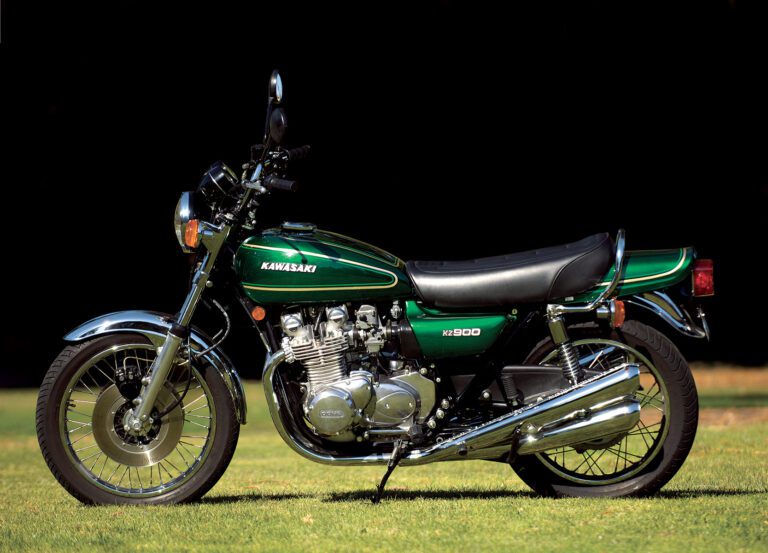
1976 Kawasaki KZ900
Claimed power: 82hp @ 8,500rpm
Top speed: 120mph (est.)
Engine: 903cc air-cooled DOHC transverse mounted inline four, 66mm x 66mm bore and stroke, 8.5:1 compression ratio
Weight (dry): 511lbs (232kg)
Fuel capacity: 4.7gal (17.8ltr)
Price then/now: $2,475/$2,000-$6,500
In 1976, Kawasaki was putting the final touches on its next big-bore challenger, the soon-to-be-released KZ1000. Until then, the top of the line was the KZ900, essentially a dressed up Z1, only better.

In the late 1960s Kawasaki was in the kitchen, cooking up what it dubbed their New York Steak project. They couldn’t have known, however, that their featured dish — a 4-stroke, 4-cylinder big-bore motorcycle — was about to be upstaged by the Honda CB750.
Starting in 1967 and working into 1968, Kawasaki was designing “a Super-cruiser, a machine to replace the legendary Vincent HRD of yesteryear.” At least, that’s how Ivan J. Wagar, writing in the October 1972 issue of Cycle World, described the unlikely code-named New York Steak project. Kawasaki’s research indicated the market was hungry for a reliable, large-capacity motorcycle capable of high performance that, when asked, could also be a decent touring machine.

Kawasaki engineers were well underway with a mocked-up machine equipped with a 750cc 4-stroke engine when Honda burst their bubble with the CB750. Work stopped on the project, but Kawasaki picked it up again in 1970 and decided to go ahead with its original plan, which was, Wagar wrote, a big bore bike with “good handling and brakes.” It was to be fast and comfortable “along with low noise and emissions as design criteria.” According to Wagar, Kawasaki engineers were still aiming for a 1972 production target.
Bigger and better
Although Kawasaki’s forte was mostly 2-stroke engine development, 4-stroke technology wasn’t new to the company. Kawasaki produced its first 4-stroke, a single-cylinder 148cc motorcycle engine, in 1953. Ten years later, in 1963, Kawasaki absorbed Meguro Works, Japan’s oldest motorcycle maker and manufacturer of a number of 4-stroke engines, and became the Kawasaki Motor Sales Co.

Ben Inamura, an engineer Kawasaki inherited with its acquisition of Meguro, was responsible for engine development. Contemporary press reports indicate he was simply instructed to build an engine “that works,” whatever the engine capacity. Honda’s introduction of the CB750 helped underscore the fact Kawasaki’s new 4-cylinder engine would have to be larger than 750cc. In this case, it was 903cc.
North American testing began in February 1972, and by mid-year Kawasaki finally delivered the code-named New York Steak as the Z1 900. The Z1 became a 1973 model-year machine, and when it was introduced it was the largest and most powerful 4-cylinder 4-stroke Japanese motorcycle ever built.
Inamura’s 903cc engine featured chain-driven twin overhead cams actuating shim-over-bucket valves. The head had shallow, hemispherical combustion chambers and the flat-top pistons gave a reasonable 8.5:1 compression ratio. With special sintered-alloy exhaust valve seats, the engine could run on lead-free gasoline. The Z1’s crank was pressed together and turned on roller bearings, while the connecting rods used caged needle bearings. Fuel and air mixed in a bank of four 28mm Mikuni carburetors. The finished engine produced a claimed 82 horsepower at 8,500rpm, delivered to the pavement through a gear primary drive turning a 5-speed gearbox and chain final drive.

The mill went into a double-cradle, single backbone tube frame with a stocky rear swingarm. Up front was a 19-inch spoked wheel with an 11.5-inch disc brake, while an 18-inch spoked wheel with a large 7.9-inch drum brake was at the rear. Not many bikes on the road had the distinctive style of the Z1, with its streamlined front fender and slim gas tank and saddle. The paint was a distinctive Candy Brown and orange or a green and Candy Yellow.
Lifting the seat revealed the battery, a tool kit and the paper element air cleaner. Beneath the left side cover Kawasaki placed a small oil tank to dole out lubricant to the massive 0.75-inch pitch endless (no master link) final drive chain, larger than what Harley-Davidson fit to their Electra Glide. Overall, the Z1 weighed in at 544.5 pounds wet.
A good ride
“The steering was very stable and deliberate and the front brake functioned perfectly for the whole session,” said testers in the “Superbike 1973” article that ran in the December 1972 issue of Cycle. At the Orange County International Raceway in California, riders Jess Thomas, Dale Boller and Cook Neilson pitted the Z1 against the Harley-Davidson Sportster, Triumph Trident 750, Honda CB750, Kawasaki 750 Mach IV, Ducati 750 and Norton Commando 750. “You can lean the Z1 way over before the pegs and stands begin to drag,” Cycle said. “With better rear shocks and disc rear brake, the 903cc mind-stopper would circulate incredibly quickly, even on our tight test course. As it was the Z1 tied for the fastest lap with a time of 44.5 seconds.” The machine it tied was Kawasaki’s own 750 Mach IV.

As groundbreaking as the Z1 was, Kawasaki only included it in their line for two more years as the 1974 Z1A and the 1975 Z1B. The formula, though, was right from the get-go. There weren’t many changes across the three years, but Kawasaki did clear up some carburetion issues that saw the bike stumble when making the transition from idle. It wasn’t just the carbs that caused trouble, but also the automatic ignition advance mechanism, which retarded the spark too much, making the Z1’s off-idle throttle response suffer. The 1975 Z1B received upgraded rear shocks and forks with more dampening and slightly softer springing. The engine was no longer all-black, and the chain oil tank had been deleted. Color changed to Candy Super Blue or Candy Super Red.
From the Z1 to the Kawasaki KZ900
By the time 1976 rolled around, the Z1 became the KZ900A4, the four indicating the fourth year of 903cc production. Essentially the same machine as the Z1, the KZ900’s most notable change was its bank of carburetors. These were reduced in size from 28mm to 26mm, and were different in design from the earlier instruments. The new 26mm Mikunis had no visible individual synchronized adjusters; these were concealed beneath the top covers, and according to Cycle Guide, the carburetors were tricky to synchronize.

The frame of the KZ was made with thicker-walled tubing, and the gas tank now featured a locking cap. On the side panels, the legendary “Double Overhead Camshaft” script had been removed, and the tail section was redesigned to accommodate a square-shaped taillight. For the KZ, colors became Diamond Dark Green and Diamond Brown.
Kawasaki expert Jim Goebel, manager of Redline Cycle Service, Inc. in Skokie, Ill., claims the 1976 KZ900A4 was something of a transitional model. Kawasaki already had plans for the KZ1000, a model that was introduced for 1977. However, the venerable 900 platform carried on in different iterations, including the 1976 KZ900-B1 LTD, and later as a turbo-charged café racer and shaft drive touring model before eventually being dropped in 1984. 1977 was the last year for the KZ900 model in the U.S.
Jim figures prominently in this story as the builder of our featured 1976 Kawasaki KZ900, which was commissioned by California-based motorcycle journalist Arthur Coldwells. The publisher of Ultimate Motorcycling and a passionate motorcycle enthusiast, Arthur sits as a director of the Lehmann Motorcycle Foundation, an active motorcycle museum in California that has noted collector Daniel Schoenewald as the main director.

When he was a 19-year-old living in England, Arthur owned a Diamond Dark Green (or bottle green, as he describes the color) 1976 Z900. In Europe, the KZ was known simply as a Z.
“I’d bought my 1976 Z900 in 1977 or 1978, and for some reason I’d gotten rid of it,” Arthur recalls. “It was one I always wanted to get back.” In 2006, he started researching the KZ900, and was pondering buying a used one and restoring it. “I didn’t have the time or the skill,” he says he realized.
When he discovered Redline’s website, he contacted Jim to discuss a build. Arthur was going to buy a KZ and ship it to Redline, but Jim said he had everything at hand necessary to custom-build his Kawasaki, including an engine, frame and all ancillaries.
Building a better Kawasaki KZ900 today
Arthur notes that although the badge on the side cover reads KZ900, his instructions to Jim were specific: It had to be a Euro-spec Z900 motorcycle. The most noticeable difference between the two is the dual front disc brake setup. Australian and European Z900s were fitted with dual discs, while the U.S. model KZ had a single binder up front. Jim, however, notes that Kawasaki offered a dual-disc conversion kit as an option for U.S.-spec bikes.
Jim used a combination of new-old-stock (NOS) Kawasaki parts, new aftermarket reproduction parts and reconditioned used parts to put the special KZ900 together. He started the project by disassembling the engine and glass-beading the cases. When assembling the bottom end, he used high-strength bolts to hold the crankshaft in place, as stock bolts are prone to snapping. Also, an undercut second and fifth gear set was installed to replace the stock gears, which Jim says are prone to failure. Standard NOS pistons went into standard bore cylinders, and the head was treated to a hand-cut valve job finished with NOS valves.
On the chassis, Jim cleaned and powder-coated the frame black and installed reproduction rear shocks, which he says have a much nicer chrome finish than stock and are also slightly stiffer. Reproduction fork tubes were matched with polished lower fork legs, and the triple trees were fitted to the frame with tapered roller bearings.
Used rims from a KZ900 were chromed and laced with stainless steel spokes to bead-blasted hubs, then fitted with Bridgestone BT45V tires.

The front fender is NOS Kawasaki, while the rear is a reproduction blade. The handlebar is slightly lower than the stock U.S. unit, and the KPH speedometer is a reproduction while the tachometer is a restored instrument. The exhaust is reproduction Z1, with the baffles modified to make them look like KZ mufflers from the rear.
Arthur says the paint is faithful to the original, only better. “The paint on the side panels of the old bikes never matched the tank and tail section. On this one, it’s a more vibrant green than the original, and to a purist, it’s not the original paint,” he says.
“Jim did a fantastic job with the build,” Arthur says, adding, “I rode it some 2,000km on short journeys. It sure brought back a lot of memories.” However, he soon found he wasn’t using the Kawasaki as much as he’d have liked.
Arthur rides plenty of motorcycles for work, but rarely his own. That lack of use translated to dead batteries and stale gas, so he decided to sell the Kawasaki KZ900 to the Lehmann Motorcycle Foundation. There, it is properly attended to, and even though it’s no longer technically his, he can ride his á la carte version of the New York Steak any time he chooses. MC
Want more information about Kawasaki motorcycles? Check out the articles below: