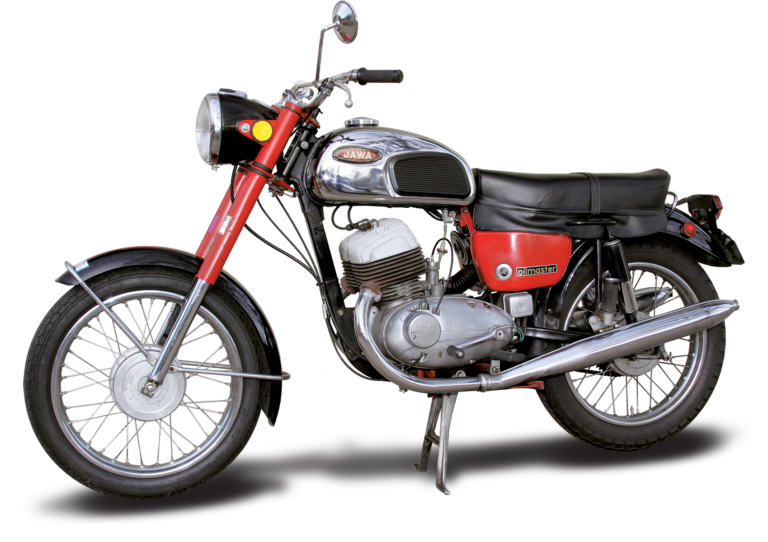
Jawa Californian 350
Years produced: 1967-1974
Engine type: 343cc air-cooled two-stroke parallel twin
Claimed power: 28hp @ 5,250rpm
Top speed: 69mph
Transmission: 4-speed
Weight: 337lbs (wet)
MPG: 50-70mpg (est.)
Price then/now: $720 (1972)/$350-$1,250
Though Japan’s two-stroke triumvirate of Kawasaki, Suzuki and Yamaha popularized the air-cooled two-stroke twin in the 1960s, its origins lie elsewhere. Yamaha famously “researched” the 1953 Adler MB250 to create the YD1 (even borrowing the Adler’s dimensions), but it was Jawa that fashioned the mold, which eventually led to development of the Jawa Californian 350.
Frantisek Janecek built his first motorcycle in Bohemia in 1929 using a German Wanderer 500cc four-stroke engine (hence Ja-Wa), and quickly earned the company a reputation for quality engineering. After WWII, with Bohemia then part of communist Czechoslovakia, the company produced utilitarian two-stroke singles, introducing a 350cc twin in 1948, the same year the nationalized company was merged with its former rival, CZ. With CZ building motocross and trials bikes, and Jawa focusing on road racing and speedway, Jawa-CZ quickly earned its competition chops.
Unlike its competition machines, Jawa’s two-stroke road bikes emphasized reliability and longevity, but less so performance. In 1966, Jawa’s aging, long-stroke 350cc twin got a makeover intended to help it keep up with the all-conquering Yamakawazuki twins. The engine got oil injection, a compression boost for more thrust, a new name — Californian — and up-to-date styling. So how did it stack up with its Japanese competition?
Although its engine displacement suggests comparison to, say, the 39hp Yamaha RD350, it’s probably fairer to compare the 28hp Jawa Californian with smaller bikes of the era. In 1972, Yamaha’s RD250 claimed 30hp and the 32hp Suzuki T250 Hustler. Both were smaller and lighter than the Jawa, so they were faster, too. A more fitting comparison might be Yamaha’s earlier 1965-1969 YM-1 (see Contenders below). But flat-out speed wasn’t what the Jawa was about. While the Japanese pretenders needed lots of revs to perform, the Jawa would still be burbling along well after the screaming strokers had been sidelined with a holed piston — a frequent occurrence if you used all their power. It was sort of the hare and the tortoise, if you will.
Though relatively sluggish, the Jawa was up to speed in other ways. The Californian introduced the “Oilmaster” system, which, like Yamaha’s Autolube, metered oil into the carburetors by a throttle-controlled pump. The fail-safe system used two cables — one from the twist grip to the pump control, and one from the pump to the carb — so if one cable failed, the engine wouldn’t run above idle, thus avoiding catastrophic damage from oil starvation.
Another innovation was Jawa’s combined kick starter/shift lever with automatic clutch, whereby you swung the lever back to kick start the engine, then moved it forward into the shift position to ride. Shifting could be achieved with or without the clutch lever, as the clutch disengaged when pressure was applied to the shift lever — just like a Honda Cub.
Quirkiness carried through to the styling, too. Upswept mufflers and a motocross-style handlebar followed the period scrambles fashion. Also trendy was the red-painted frame, though offset with traditional black and chrome, and finished with gold pinstriping.
Period tests praised the Jawa’s solid, stable handling and ability to cope with rough surfaces, but while the brakes were considered adequate when cold, testers found they faded noticeably with repeated hard use. The engine was smooth up to 4,600rpm, but produced noticeable vibration above that. Just as well, because the Californian was all done at around 69mph — 4,600rpm in top gear. Significantly, piston speed at peak power output (5,250rpm) was less than 2,200ft/min at a time when the Japanese street screamers were doing twice that. Low piston speeds and lazy power mean long life and low maintenance — just what the Jawa twin was designed for.
The Californian was somewhat anachronistic in other ways, too. It had iron cylinder barrels, a four-speed transmission, a single-leading-shoe front drum brake and six-volt electrics when its contemporaries boasted aluminum cylinders, five or six speeds, twin-leading-shoe drums — or even disc brakes — and 12-volt electrics.
You wouldn’t buy the Californian for its performance, but if you wanted a steady, reliable, ride-to-work mount that would still be putting down the road long after its competitors had seized, the Czech bike was the way to go. Not surprisingly, Jawa 350s were popular in poorer countries like India, where durability and ease of repair were more valued than speed.
Cycle World perhaps summed it up best in their February 1972 review: “In spite of some small flaws (in the finish), the Jawa is well executed for its intended purpose — transportation … it will outlast the Rock of Gibraltar, and the price is low. But there are many low-priced, reliable machines that excite us more.” Nice survivors are getting hard to find, but a smaller pool of fans compared to comparable bikes from Japan has kept prices in — pun intended — Czech. MC
Contenders: Two-stroke twin rivals to the Jawa Californian 350
1965 Yamaha YM-1

– 29hp @ 7,000rpm (claimed)
– 305cc air-cooled parallel twin two-stroke
– 5-speed
– TLS drum brake front/SLS drum rear
– 343lbs (wet)
– 35-40mpg
– Price now: $1,000-$5,000
In 1957, Yamaha introduced the 250cc twin YD1. This evolved into the 19hp 1962 YD3 roadster with electric start, joined in 1963 by the sporty kick start-only 25hp YDS2. The big development came in 1964 with the YDS3. Until then, almost all two-strokes were lubricated by mixing oil with fuel. Yamaha’s innovation was to carry engine oil in a separate tank and inject it into the engine. Eventually, most two-stroke Japanese road bikes adopted a similar system.
In 1965, Yamaha introduced its first bigger banger, the 305cc Yamaha YM1 with Autolube. It claimed 29hp and a curb weight of just 343 pounds. Testers liked the YM1, noting a lack of the usual vices like frame flex and wobble, though they did make use of the friction steering damper. The transmission featured five speeds, the electrics were 12 volts, and the whole package was halted with a twin-leading-shoe front brake capable of squealing the front tire.
Advances in two-stroke engine design meant more power from a smaller package; while the Jawa was the evolution of a 1950s bike, the Yamaha was a fresh take on the plot using modern materials and production methods. Within two years, the full 350cc R5 arrived, followed by the six-speed RD350 in 1972, by which time it was pretty much game over for Jawa.
1972 Suzuki T250 Hustler

– 32hp @ 8,000rpm
– 246cc air-cooled parallel twin two-stroke
– 6-speed
– TLS drum brake front/SLS drum rear
– 322lbs (wet)
– 40-50mpg
– Price now: $1,000-$2,000
Based on the Suzuki T20 X6 of 1966, the Suzuki T250 Hustler took the same 246cc two-stroke twin and added more fire for a claimed 32hp, treated it to a stronger six-speed tranny and gave it modern cosmetics. The result was a package that weighed a shade over 320 pounds, was wickedly quick (an indicated 100mph), shifted smoothly, stopped reliably, handled capably thanks to a strong frame, and would embarrass many bikes with twice its cubes on the boulevard.
The downside was a peaky power band that needed to see 5,000rpm for real giddy-up, and a typical for the time Japanese suspension that managed to be dive prone at the front and both over firm and under-damped at the rear. Even so, the Hustler was sedate in traffic, easy to start (though kick only) and disarmingly easy to ride. A generation of baby boomers cut their teeth on the T250 and its only slightly less frenetic competitor, Yamaha’s RD250.
And like the RD, T250s were prone to hole pistons if ridden hard. Suzuki’s attempted fix — the ram-air cooling system — arrived for 1973 with the disc-braked GT250. But strokers were starting to fall afoul of tightening environmental rules, and Suzuki’s GT range of 250, 380, 550 and 750cc two-strokes was on the way out.
Read more about the motorcycles mentioned in this article:
• Yamaha RD350
• 1972 Suzuki T250 Hustler
• History of the Yamaha YM-1
• Suzuki T20 X6