Triumph Thruxton Bonneville

- Years produced: 1965 – ?
- Total production: 52
- Claimed power: 54bhp @ 6,500rpm
- Top speed: 140+mph
- Engine type: Overhead valve, air-cooled, vertical twin
- Weight (dry): 157kg (350b)
- Price then: $925 (est.)
- Price now: If you have to ask …
2005 Triumph Thruxton 900

- Years produced: 2004-present
- Total production: N/A
- Claimed power: 69bhp @ 7,250rpm
- Top speed: 110mph
- Engine type: Dual overhead cam, air-cooled, vertical twin
- Weight (dry): 205kg (451lb)
- Price now: $7,999
BSA produced just 1,584 Rocket Gold Stars, the iconic pairing of Gold Star cycle parts and 650cc Super Rocket engines. It’s said that only about 2,000 still exist.
Those numbers don’t jibe, of course, and that’s because any time a factory assembles a special motorcycle using over-the-counter parts, unscrupulous shade-tree mechanics will try to make a fast buck by putting together their own. Such is the case with the Triumph Thruxton Bonneville — a bike that propelled Triumph to the winner’s circle during the 1960s and inspired the modern Triumph café racer, the Triumph Thruxton 900. Early Thruxtons were created not only by private individuals but by Triumph dealers — at the company’s encouragement. But what is a real Thruxton?

In May 1965, the Triumph factory in Meriden, England, produced 52 tuned Thruxton Bonnies to homologate the type for production racing. It’s known that the 52 came from a batch numbered from DU23129 to DU23181, but other production machines were later diverted for Thruxtonization. And many dealers built Thruxtons from factory tuning parts.
Hints of greatness
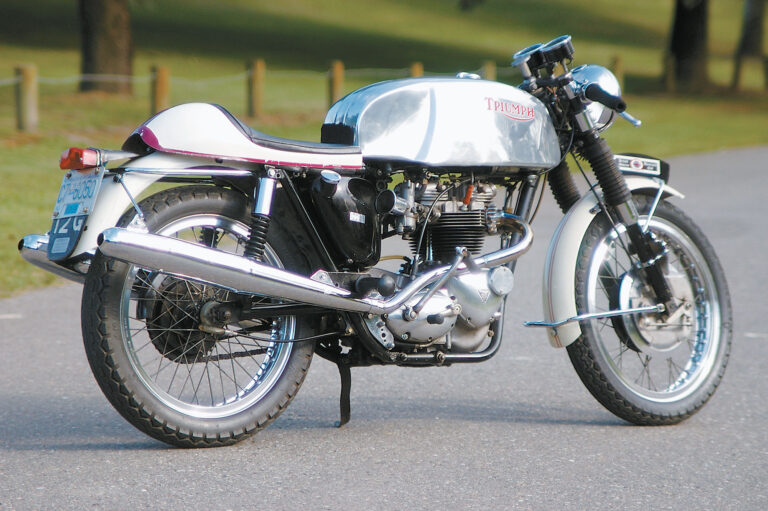
Okay, let’s get this out of the way up front: Owner David Haydon can’t be certain whether his 1969-registered Thruxton Bonneville is a genuine factory racer or merely a collection of factory tuning parts fitted by a dealer to a stock Bonnie. But there are several clues that this is a special bike.
Read David Haydon’s review of owning and riding a 1969 Triumph Thruxton Bonneville
When Haydon bought it, the engine was fitted with high-compression, 11:1 pistons — not really suitable for the street. In the valve train, Haydon discovered Triumph competition shop exhaust cam followers, specially designed with a larger radius to not only reduce friction loads on the cam lobes (rapid camshaft wear was a persistent problem with production-racing Bonnies), but to increase valve overlap with the relatively mild cams. The latter were running in needle roller bearings instead of plain, stock bearings, an old racer’s trick. Special, lighter pushrods actuated rockers that were aligned with shims and spacers rather than the stock spring-and-washer arrangement. Valves were standard size — as they were in the Thruxton racers — but Haydon noted some machining work in the ports.

Unfortunately, the engine number was no help. One of the crankcase halves had been replaced, and the number stamped on the left case is an early unit construction number, completely out of step with the rest of the bike’s specification.
Haydon settled on 1969 as the probable year of manufacture (or dealer assembly) based on the United Kingdom street registration date and the rest of the bike’s equipment. The twin-leading-shoe front brake is from 1969-70, rather than the ventilated, single-leading-shoe 8in brake fitted to the homologation batch; but it’s drilled for cooling — like 1969 factory racers. The swept-back headers, with the factory crossover and step-down diameter pipes, also were 1969-only factory race items, with the distinctive long mufflers that all Thruxtons shared. These were built from a United States-spec flat-tracker megaphone with the rear end of a Triumph Saint police muffler welded on!

The alloy gas tank and bump-stop seat are marked “RGM,” which Haydon assumes to be Triumph dealer Rose Green Motors (the tank was a 1969 factory part). Also correct for a Thruxton are the 19in rear wheel, alloy rims, extended intake stubs and cutaway oil tank. The frame had no mountings for a centerstand or sidestand, and the transmission contained a close-ratio gearset. Only the original Amal GP carbs are missing, replaced by Amal Concentrics — but such a swap was common at the time. Period pictures of Thruxtons, especially Malcolm Uphill’s 1969 second-place Barcelona bike and Isle of Man Production TT winner, show a remarkable similarity to Haydon’s Bonnie.
Thruxton: The name, the race
Opened as a Royal Air Force base in 1941, Thruxton airfield, near Andover, Hampshire, was transferred to the United States Army Air Forces on March 1, 1944. From there, the 266th Fighter Group’s P-47 Thunderbolts flew ground attack missions in support of the D-Day landings and continued strafing and ground attack roles after the beaches were taken. Later in the year, when it became possible to use French airfields, the group was transferred to Normandy.
At the end of hostilities, Thruxton became a civilian airfield (which it remains), though its potential for motorcycle racing was quickly exploited with construction of a 1.9-mile circuit. By 1951, it was sufficiently established to host a six-event motorcycle race program as part of the Festival of Britain. World Champion Geoff Duke won the 12-lap Invitational race, rather predictably. But second across the finish line was 17-year-old newcomer John Surtees, who would go on to win seven world championships.

In 1955, the Southampton & District Motorcycle Club held its first nine-hour endurance race at Thruxton. Noted BSA tuner Eddie Dow and co-rider E B Crooks placed first, riding a Gold Star 500. The next year, BSA’s famous bike took the top six places. In 1958, the race became 500 miles, and the first winners at this distance were Mike “the Bike” Hailwood and Dan Shorey on a 650 Triumph, the first of many victories. Triumph became the bike to beat.
It’s easy to underestimate the importance of endurance racing to the average British motorcyclist in the Sixties. Grand Prix racing and even the TT races were dominated by machines bearing little resemblance to road bikes and backed by huge factory support. The Thruxton 500 offered amateur racers and aspiring tuners a chance to show their stuff.

Typical of the entrants was the 1958 team sponsored by Lawtons, the Royal Enfield dealers in Southampton. With Bob McIntyre as lead rider on a 700 Constellation, the team placed second behind Hailwood and Storey with another Enfield in third.
Hailwood’s 1958 win was the first of eight outright Triumph victories; only Norton, with six wins, came close. In fact, in the 15 years of the 500-miler (the last actually run at Thruxton was in 1965), Triumphs gained 19 of 45 possible podium places. In 1969, they took five out of the first six places, including the top three.
The Thruxton Bonneville
It was Doug Hele’s arrival at Triumph in 1962 that spurred development of the Thruxton. While at Norton, Hele masterminded the 500cc “Domiracer” and the 650SS production racer. The latter won outright at Thruxton in three successive years to 1964 — but in that year the first of Hele’s hand-built, unit-construction Bonneville racing prototypes was produced at Meriden, placing second in the Thruxton race. Hele could claim a “one-two.”
In order to properly sanction the Thuxton for production racing, Triumph was obliged to make it available for sale. To produce the single batch of 52 machines at Meriden in May 1965, standard Bonnevilles were pulled from the production line, stripped and hand reassembled with special Thruxton parts. Although horsepower gains were modest — 54bhp against the stock Bonnie’s 46 — the careful assembly made dramatic gains in reliability.

In theory, any regular Joe could put down the extra 30 pounds or so over a stock Bonneville’s 357 pound sticker price (approximately $925) and order a Thruxton. In practice, however, few got beyond the dealer race teams. (In order to satisfy “production racer” rules, only dealers — not the factory — could enter their bikes in the 500-miler.)
After 1965, the picture got cloudier still. Thruxton tuning parts were available through the larger Triumph dealers — again, in theory — but few were ever traded over the counter. Hele continued to upgrade the specification, improving power, braking and reliability until 1969, perhaps the Thruxton Bonneville’s finest year. As well as the 1-2-3 finish in the 500-mile race and the second place finish in Barcelona, a Thruxton ridden by Uphill won the Isle of Man production TT at an average speed of 99.99mph, with a flying lap at more than 100mph. In recognition of this, and in a shrewd piece of marketing, Dunlop renamed its K81 tire the “TT100.”
In 1970, Triumph and Hele refocused their racing effort on the new 750cc Trident and almost identical BSA Rocket3, taking the Daytona 200 in 1971 and five consecutive Production TTs thereafter. But that’s another story for another issue of Motorcycle Classics.
2005 Triumph Thruxton 900
The new Thruxton may be the motorcycle world’s equivalent to retro musician Brian Setzer. Like Setzer, who rode the rockabilly wave in the Eighties with The Stray Cats and helped launch the swing revival of the Nineties, Triumph’s nostalgia bike hits a lot of the right notes.
But there are those who question whether Setzer is an inspired artist or merely an imitator, and the same issue has been raised about the Thruxton.

First, the good news about the bike. The new Thruxton is a hopped-up version of the modern Bonneville platform complete with a bigger engine (865cc compared to 790cc), hotter cams and carbs and megaphone-style exhausts. Revised frame geometry and longer rear shocks steepen the steering angle, and clip-on handlebars and rear-set pegs make for a more aggressive riding position. Read practically any review, and the word “fun” comes up repeatedly.
The knock is that unlike the original, the bike’s not the biggest badass on the block. With a claimed 69bhp and an estimated top speed of 110mph, it certainly won’t compete with modern superbikes.
Bottom line? The new Thruxton is as close as a normal schmo can get to a piece of Triumph history without selling a vital organ and buying a Sixties version. And that makes it pretty cool in our book. MC