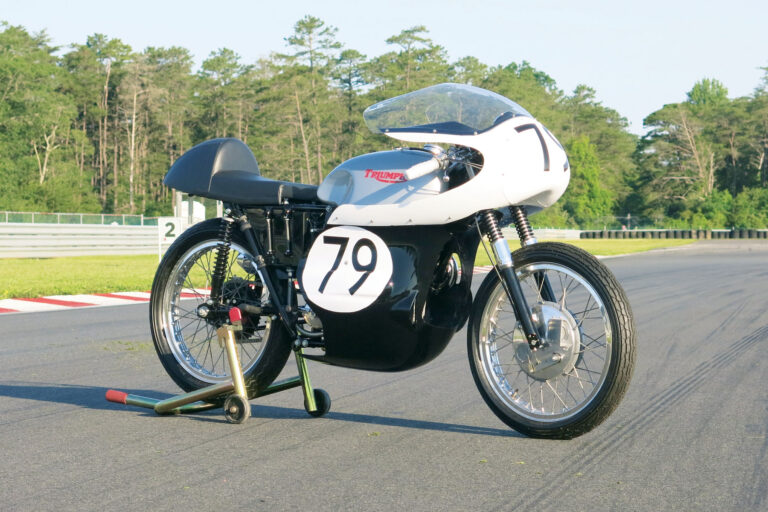
1966 Triumph T100R Factory Road Racer #44113
- Engine: Air-cooled parallel twin, OHV four-stroke, 69mm x 65.5mm bore & stroke, 490cc, CR 9.75:1, 46.5bhp at 8,500rpm (at crankshaft)
- Carburetion: 2 x Amal 10GP2, 1 3/16in
- Ignition: Lucas Energy Transfer, dual points
- Gearbox: 4-speed close ratio, chain primary drive
- Clutch: Multi-disc wet plate, aluminum hub
- Chassis: Accles & Pollock T45 carbon-manganese tubular steel, full cradle
- Suspension: Front: Modified Triumph telescopic fork, HD springs. Rear: Twin Girling coil-over shocks
- Fuel capacity: 5gal U.S. (18.9ltr)
- Wheelbase: 53.5in (1,359mm)
- Brakes: Front: Triumph 8in (203mm) single-leading shoe, ventilated. Rear: 7in (178mm) SLS
- Tires/wheels: Front: 3.00 x 19 Dunlop KR76 on Dunlop WM2 aluminum rim. Rear: 3.50 x 19 Dunlop KR73 on Dunlop WM2 aluminum rim
- Weight: 319lb (145kg) with ½ tank fuel
- Top Speed: 130mph
- Owner: Mike Iannuccilli, Las Vegas, Nevada, U.S.
Ted Rivard could barely hide his delight when he heard the news. “An old friend of yours has been found,” said the familiar voice on the telephone. “It’s Buddy Elmore’s 1966 factory road racer. The bike’s in pretty rough shape,” the caller, John Melniczuk, explained. “But the works engine and frame are, amazingly, still together. I’ve been given the job of restoring it for its new owner.”
“So, you’ve found One-One-Three!” replied the soft-spoken Rivard. Like many of us who have never forgotten the serial number of a special bike we’ve owned, Rivard has had the motor and frame number 44113 burned into his brain for 59 years. As senior mechanic at The Triumph Corporation in Baltimore from 1963 to 1973, Rivard built and rebuilt dozens of competition machines for TriCor’s star riders, including Elmore, Larry Palmgren, and scrambles legend Charlie Vincent. During the 1966 AMA racing season, he was responsible for Elmore’s road racer — one of six new T100R 500cc twins built at Triumph’s Meriden factory that year and Buddy’s winning ride in the Daytona 200 and Loudon 100-miler.
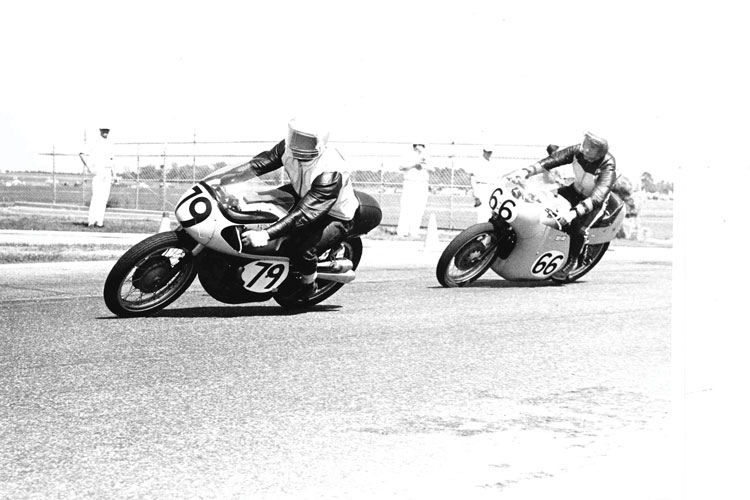
Six bikes were brought to the U.S. for Daytona and the other scheduled 1966 road-race events. Three were raced and owned by TriCor, and three by JoMo (Johnson Motors, Triumph’s western states distributor). The following year, Meriden sent over a new sextet of improved T100Rs, so the ’66-spec bikes were assigned as spares to some pro riders. By 1968, they were further disbursed. Some went to dealers sponsoring up-and-coming racers.
44113 is one of three 1966 factory T100Rs still known to exist. At one point, following its illustrious pavement career, the quick, nimble-handling Triumph was transformed into a dirt-slinging hillclimb machine. Its swinging arm had been extended. The bike was fitted with a pizza-sized rear sprocket and a paddle-tread rear tire worthy of a farm tractor. Straight exhausts replaced the megaphones. But miraculously, the bike retained its works engine and frame, the brazed, lightweight-alloy steel tubes now rusted. Engine and frame numbers matched. It still wore its rare magnesium timing cover, Lucas racing ignition housing, and twin Amal GP2 carbs. Even the stubby reversed gear lever remained.
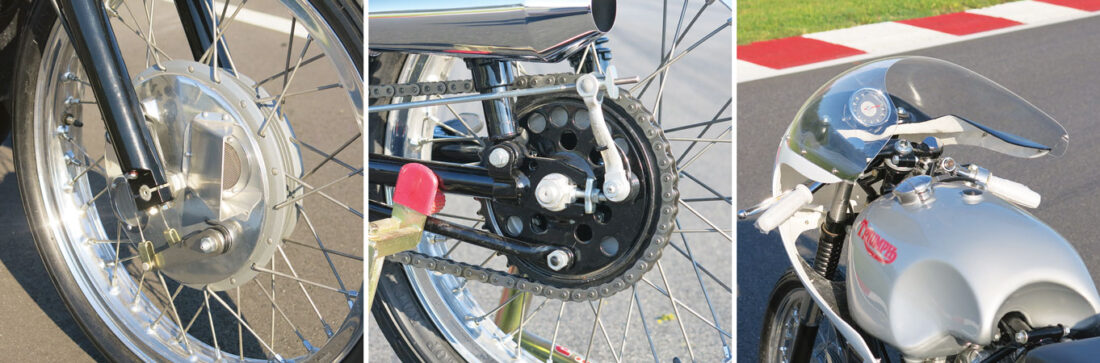
When the sad carcass arrived in Melniczuk’s [mel-ne-chuck] New Jersey shop over two years ago, he reflected on the tragic afterlife of some top-caliber AMA racebikes he’s seen. Oddball conversions were not uncommon in the era long before old racing machines became valuable art objects. Who in Britain, by comparison, would disfigure a Manx Norton for hillclimb duty? Heresy indeed.
But fortune shined on 44113 as it fell into the hands of current owner Mike Iannuccilli, collector of historic competition bikes and an ardent Triumph fan. An uncompromised restoration to Daytona-1966 spec was his vision.
Meeting 44113 at Marlboro
1966 was pivotal for Triumph’s American road race program. The company’s owner, BSA, had gotten serious about a factory effort for Daytona. In fall 1965, TriCor veteran racing boss Rod Coates and chief mechanic Cliff Guild flew to Britain to warn company management that Honda was rumored to be preparing its new 450cc, 44hp, 11,000-rpm DOHC twins for Daytona.
“What worried us was a Honda factory effort as intense as their international Grand Prix effort at the time,” recalled Doug Hele, Triumph’s former chief development engineer, in a 1994 interview with the author. There was also the perennial threat posed by the hard-charging 750cc Harley-Davidson KRTTs.
“Harry Sturgeon [BSA managing director] gave the directive to go to Daytona with a works effort,” Hele explained. “So, we had to get the job done quickly, which meant using what we had (see sidebar). We developed the six machines in five months, from October 1965 through February 1966.” As the clock ticked toward Daytona qualifying week, March 14, Hele and his small Experimental team raced to transform, within AMA rules, Triumph’s Tiger 100 roadster into a works-built winner. The short-stroke, unit-construction 500cc twin had proven itself at Watkins Glen in 1961, when Don Burnett wrung out his unfaired TriCor bike to 10,000 rpm to outpace Harley icon Carroll Resweber. The following year, Burnett won the Daytona 200, running virtually flat-out for 200 miles. U.S.-built Triumphs then finished second in the big race in 1963 and 1964.
Importantly, since 1960, the brunt of unit-500 speed knowledge had come from the American side of the pond. TriCor, JoMo, and their American dealer-tuners were driven by the AMA Class C formula pitting 500cc OHV engines against the flyin’ 750cc flatheads. At the time, the Meriden factory was preoccupied with developing its 650cc Bonneville for Britain’s popular Production racing series.
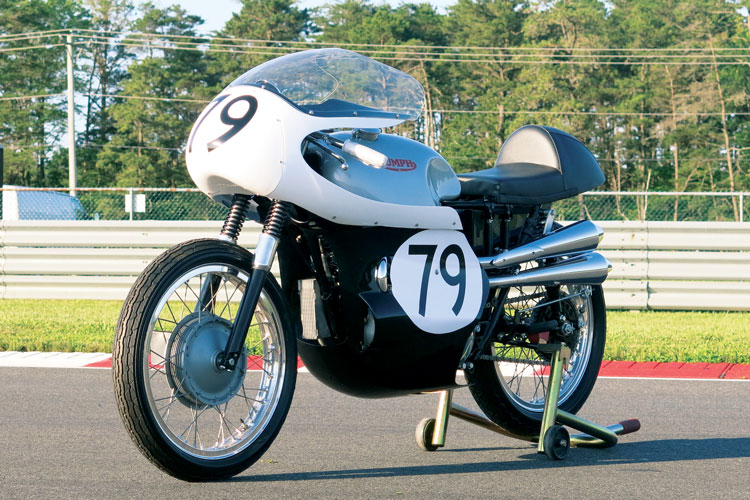
Rivard first met 44113 at Marlboro, Maryland, in February ’66. The twisty 1.7-mile road course near Baltimore was often rented by TriCor for pre-race bike setups. On this cold, wet morning, a caravan of vehicles hauling motorcycles sloshed into the track’s pit area. Coates brought Hele, who had flown in directly from Britain for this session. Rivard, Guild, and fellow mechanic Dick Bender unloaded the newly arrived T100Rs. Their slick Avon fiberglass full fairings, high-level chrome megaphones, and fat aluminum gas tanks reflected the grey sky. The group was joined by TriCor ace Gary Nixon, who brought his 1965-spec TriCor-built road racer.
“Gary’s job was to ride each machine and compare it against his TriCor-built bike,” Rivard noted. Nixon selected the fastest and best-handling new T100R for himself. He then rated the next-best machines for the other TriCor-sponsored Daytona riders, Buddy Elmore and Billy Lloyd. After the Marlboro session, the bikes were tested further at a local dragstrip. Those that Nixon nixed for TriCor use were shipped to California for JoMo Daytona riders Ted Davis, Sid Payne, and Jess Thomas. Triumph’s eastern- and western-states distributors were fierce competitors in sales and on the racetrack. No love was lost between Rod Coates and his JoMo counterpart, Pete Colman, both hard-nosed former racers.
The T100R sextet for AMA duty were numbered consecutively: 44111 through 44116. Before they were sent to America, Triumph’s development rider Percy Tait shook down each bike at a U.K. track.
Daytona tragedy and triumph
Despite Tait’s testing and Hele’s steady involvement, the 1966 factory Triumphs were far from being Daytona-ready. “We worked non-stop to get those bikes to the starting grid,” Rivard explains. It was clear to him that the factory effort had been rushed. The new twins contained troubling flaws. Some engines left Meriden with crankshaft polishing residue in their crankcases, causing main bearing failure in one bike during the Marlboro testing, according to Rivard. Blown main and connecting-rod bearings plagued the bikes through Daytona practice week and in the race. An external oil line to the exhaust tappet block, installed late in the Meriden builds, was feeding the tappets while starving the crankshaft, Hele said. TriCor’s Dick Bender devised a solution in the Daytona garage: Close off the oil line, which traded reduced cam lubrication for critical crankshaft life in the 200-miler.
Prototype aluminum tappet blocks designed for the upcoming 750cc triples’ alloy cylinders were fitted at Meriden in the race engines’ iron cylinders. The two materials’ different coefficients of thermal expansion caused the blocks to slacken in their bores, damaging the Thruxton three-inch-radius tappets. The beautiful high-level exhausts and the Avon one-piece fairing lowers made the bikes “miserable for us mechanics,” Rivard recalls. “They seemed to be assembled by people who didn’t have to work on them.” This was puzzling to Ted, given Triumph’s U.K. Production racing experience, which demanded rapid pit work.
And, by Hele’s own admission, both the mechanics and riders complained about the bikes’ fuel tanks. Made by specialist supplier Lyta, the tanks were off-the-shelf items designed for BSA Gold Star road racers. Cycle World magazine’s 1966 track test of a JoMo factory T100R described how the bulbous vessel was “about as handy as riding with an overinflated beach ball in one’s lap.” Rider Jess Thomas, who practiced on a factory T100R, told Hele, “The BSA tank gives no body or knee support.”
As the March 20 race day approached, Rivard and colleagues Bender and Guild faced ongoing mechanical mayhem. While replacement cast-iron Thruxton tappet blocks and tappets were air-freighted in from Britain to solve that problem, the new T100Rs were devouring their lower ends. The mood in the TriCor and JoMo garages darkened. Pressure mounted on the riders. Gary Nixon decided not to ride the 44114 machine he’d chosen at Marlboro, opting instead for his “old reliable” 1965 TriCor bike. He finished ninth. AMA records show that TriCor second-stringer Denny Haven took over 44114; he was out after seven laps due to a broken primary chain that grenaded the case. Lloyd’s 44115 suffered multiple pre-race failures. He managed 25 laps in the race until his ignition quit. Late-entry Payne lasted until lap 41 when 44112’s engine blew. Oklahoma Triumph dealer Davis, on the JoMo 44111, finished in 14th place, four laps down.
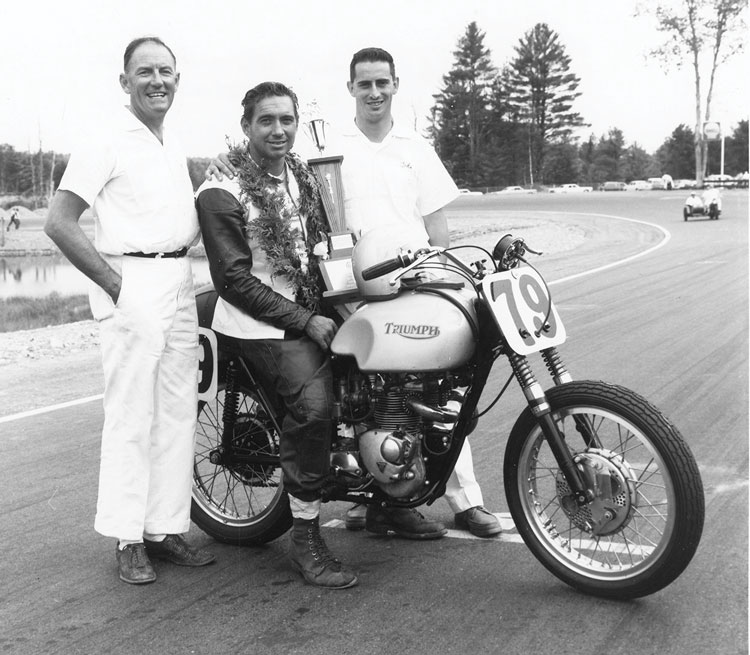
Elmore’s 44113 suffered mechanical woes all week, pushing Rivard and Bender to keep it on track. Buddy’s 122-mph qualifying speed was 12mph slower than pole-sitter Cal Rayborn’s KRTT. (Dick Hammer, on a bike built by California tuner Danny Macias, was fastest Triumph qualifier at 130.5mph.) Elmore gridded in 46th position. But eight laps into the race, the tough Texan had sped through traffic into fourth place. On lap 21, he passed Nixon to take the lead.
With Rayborn and fellow Harley veteran Roger Reiman out of the race by lap 30, it became an Elmore-versus-Nixon battle until Gary’s rear tire went flat at 130mph on the track’s high banking. Buddy crossed the checkers over one minute ahead of second-place George Roeder on his 750cc KRTT, clocking a new-record Daytona average speed: 96.582mph.
The rumored Honda threat didn’t land until 1967, when Nixon and Elmore finished 1-2 in the 200-miler.
Six Special Tigers
The six 1966 Daytona 200 works bikes were based on the production Tiger 100. Hele told the author in 1994 that the fast-paced development program’s goal was to create a lighter, better-handling, more powerful motorcycle. Horsepower was key to keeping pace with the Harleys around the banking of Daytona’s vast 3.81-mile circuit.
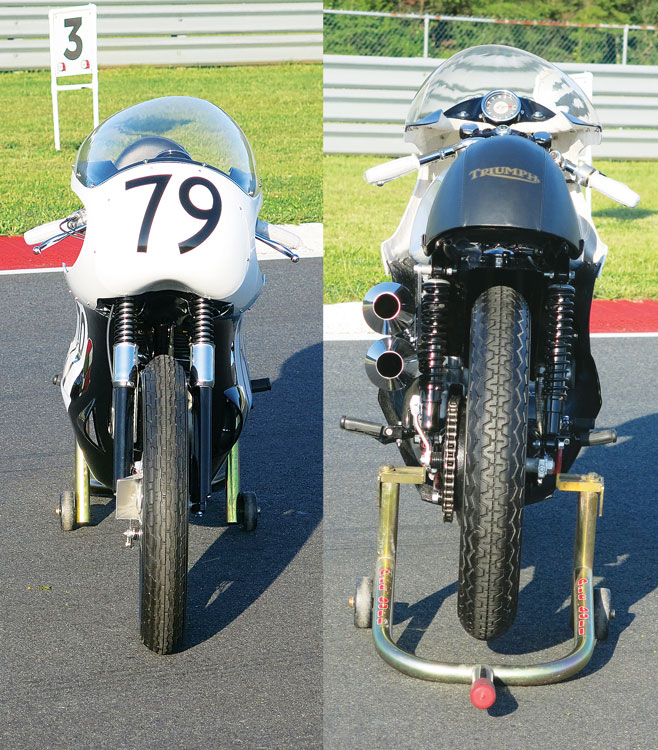
Seven pounds of chassis mass was shed by using a frame made of light, strong Accles & Pollock T45 carbon-molybdenum tubing. Steering heads were lowered 1.5 inches and reinforced there and at the swingarm pivot — a racing improvement carried over to Triumph’s 1967 500cc street bikes. Center-mount aluminum oil tanks copied from the TriCor accessory racing tank were used, as was a cast-magnesium timing cover. Dunlop aluminum wheel rims carried that company’s revolutionary triangular-profile KR-series racing tires. Stock Triumph forks, already a stout component, were upgraded with heavy-duty springs.
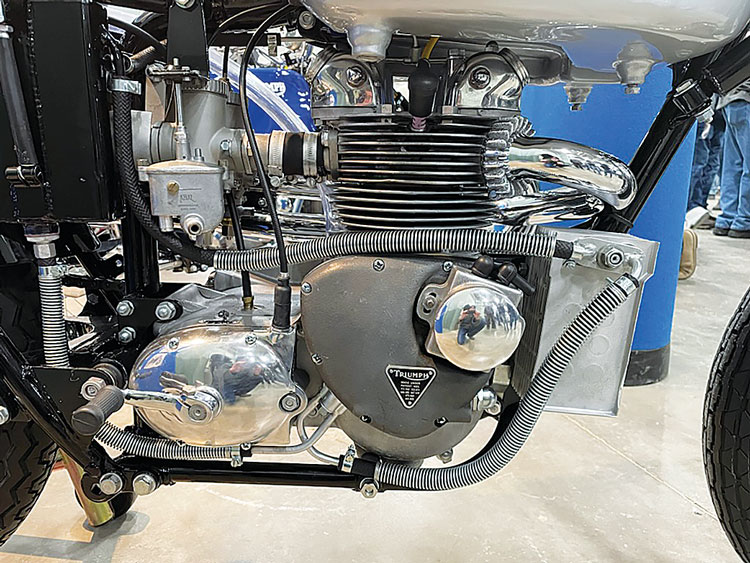
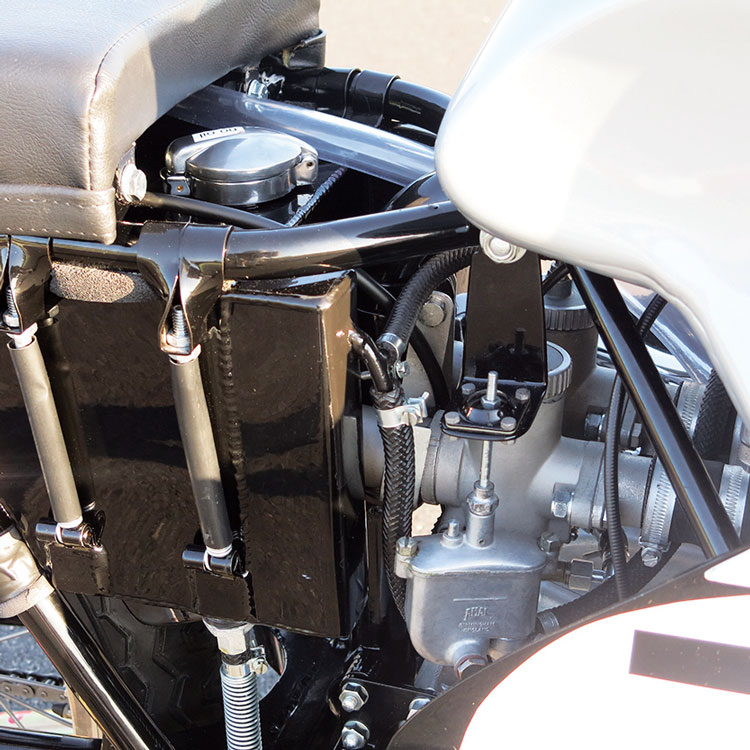
The factory race engines were bored to the .040-inch oversize allowed by the AMA. Tuning focused mainly on improved airflow, higher compression (9.75:1 versus stock 8.5:1), and reduced internal friction. A new cylinder head (also incorporated into 1967 production engines) employed steeper 39-degree included valve angle (versus 45 degrees) and larger 1.5-inch intake valves in aerospace-alloy steel. The race engines inhaled through twin 1 3/16-inch Amal 10GP2 carbs mounted on long rubber tubes, with a separate Amal “matchbox” float bowl. Valve gear and crankshafts were polished and lightened. The stock timed crankcase breather and left-side main bearing seal were eliminated, allowing crankcase pressure to vent into the primary — another mod adopted for production bikes. And the Lucas ET ignition featured a special racing contact breaker housing, its points isolated on ball bearings and driven by an Oldham coupling directly off the exhaust camshaft.
American tuners’ experience racing the unit-500 twins influenced Hele’s specs for the new 1966 T100R. For greater reliability, he followed the advice of TriCor’s Cliff Guild in fitting a Chevrolet Corvair oil cooler to help survive wide-open running in the Florida heat. Robust California-made S&W valve springs were also used. The following year’s factory T100Rs added hardened, Eutectic-coated camshafts, also advised by Guild.
Compared with a stock T100 rated output of 34hp at 7,000rpm, the ’66 T100R race bikes developed peak 46.5hp at 8,500rpm. According to Gary Nixon, they were “safe to 9,000.”
“Slant-shooter” surgery
Buddy and 44113 were a relentless combination for the remainder of the 1966 road-race schedule. On May 15 at Carlsbad, California, he crashed, breaking his collarbone. But he won a month later at twisty, hilly Loudon, with 44113 converted to what Rivard called “the Laconia set-up”: sans fairing and oil cooler, with western handlebar fitted. At Greenwood, Iowa, on August 7, Elmore placed ninth, riding in pain with a separated shoulder. Back at Carlsbad on September 18, he finished eighth.
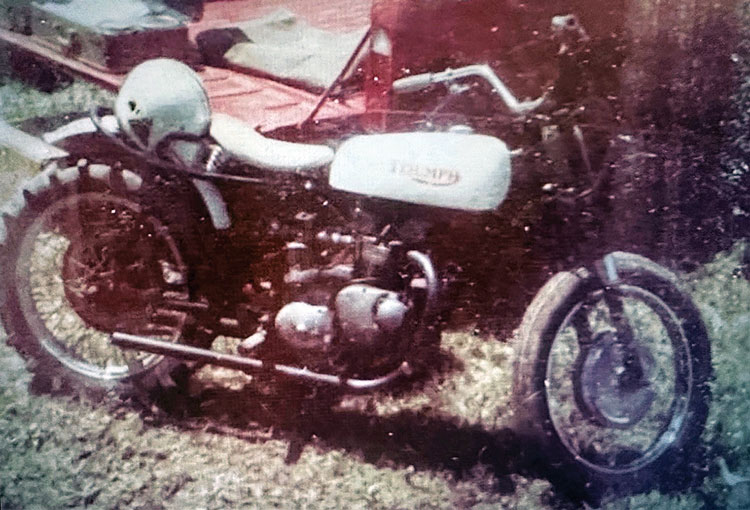
For 1967 Daytona and Loudon, 44113 was passed to TriCor-sponsored Larry Palmgren for use as a spare. According to Rivard, it remained in TriCor custody until late in the year when Coates sold the bike to Elmer Morra, a Pittsburgh-based pro racer and dealer. Morra campaigned 44113 through 1968. He and the bike finished second at the initial AMA Heidelberg (Pennsylvania) GP in September ’67. Race winner Bob Sholly recalls that he had been instructed by TriCor’s Coates to enter the event, to compare the performance of Sholly’s ’67-spec T100R to that of the ex-Elmore ’66 Daytona winner.
Morra sold 44113 to hillclimber Thomas Novack, a fellow member of Morra’s “Leap N Lynx” motorcycle club, according to Morra’s widow and son. After a brutal second life clawing up hills, the tired T100R languished in Novack’s barn until his passing. Novack’s son was clearing out his late dad’s motorcycles and contacted Kyle Ede, proprietor of Classic British Spares in California. Ede, an enthusiastic student of Triumph’s racing history, purchased 44113 in 2020 with intent to restore it. After some engine work, a change of plans led him to sell the machine to Nevada-based Iannuccilli, whose outstanding collection of important vintage race bikes in Las Vegas includes four other ex-factory Triumphs, including Nixon’s 1967 Daytona 200 winner (restored in 2017 at Big D Cycle in Dallas) and the ex-Gene Romero 1970 works Trident, still in as-last-raced condition.
Two-year restoration
Iannuccilli stipulated a dead-nuts-correct restoration of 44113, right down to the unusual red Triumph logos that Daytona ’66 pit photos reveal adorned the factory T100R tanks. For the challenging resto, he contacted John Melniczuk, one of the U.S.’s top classic Triumph experts. Melniczuk has Triumph racing history in his blood. His father’s Triumph dealership was closely allied with TriCor’s Baltimore racing operations and helped prepare Elmore’s own Triumph twin for the 1965 Daytona race.
Melniczuk credits the two-year restoration of Buddy’s T100R to “a universe of Triumph knowledge,” not the least being Rivard’s keen memory. Texas-based racing historian and AMA Pro racing tech savant Bill Milburn provided vital entry lists, period photos, and memos from former AMA Competition Director Jules Horky and TriCor’s Rod Coates related to the 1966 Daytona 200. Big D Cycle’s Keith Martin served up a ton of advice, along with rearset pegs from a batch he replicated during restoration of Nixon’s 1967 T100R.
Splitting 44113’s crankcases revealed the factory crankshaft, “beautifully polished like chrome to reduce oil drag,” Melniczuk said. His months spent disassembling, documenting, cleaning, measuring, fabricating, combing parts lists, calling sources, examining period images, hand-finishing parts, and assembling were only part of the puzzle. Hunting for 44113’s many missing rare components consumed hundreds of hours.
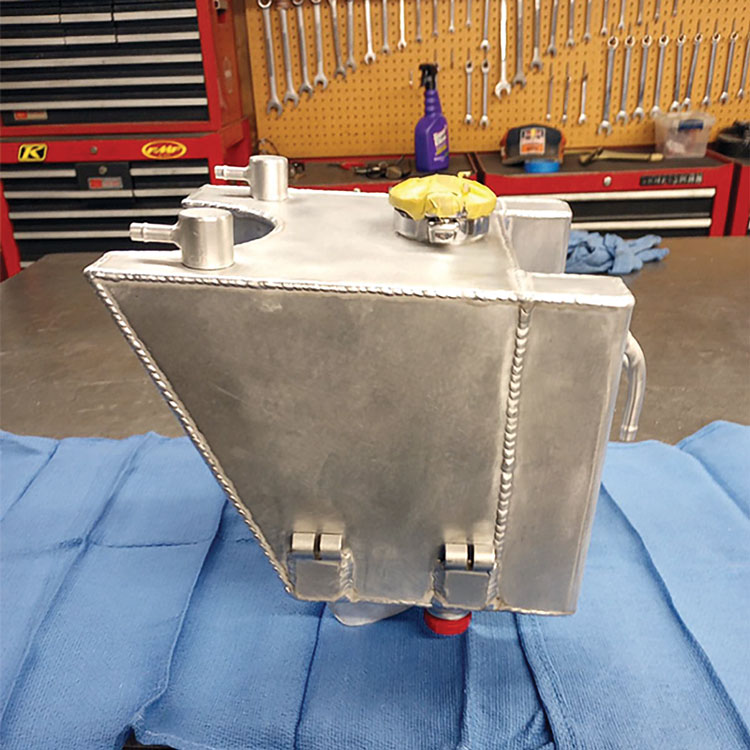
For the “beachball” fuel tank, a call to Ohio BSA expert Kerry Kubena netted a correct five-gallon Lyta Gold Star racing tank. Vintage aircraft restorer Mike Collins at Falcon Fabrications in Idaho fabbed up a new aluminum oil tank. He was aided by patterns traced from the ex-Nixon 1968 T100R, also under restoration in Melniczuk’s shop. An original Avon race fairing was found in Canada, but it lacked the correct one-piece lower section. Melniczuk shipped the fairing to fiberglass wizard Bret Edwards at Glass from the Past. Edwards crafted the new fairing lower using original photos from 1966, and from detailed images that accompanied an eBay auction of the complete 1966 Avon fairing from Denny Haven’s T100R 44114. The fairing still wore Haven’s AMA number 80. While he missed snagging that original in the auction, Edwards built an accurate replica for the Elmore bike. He also made a new seat base.
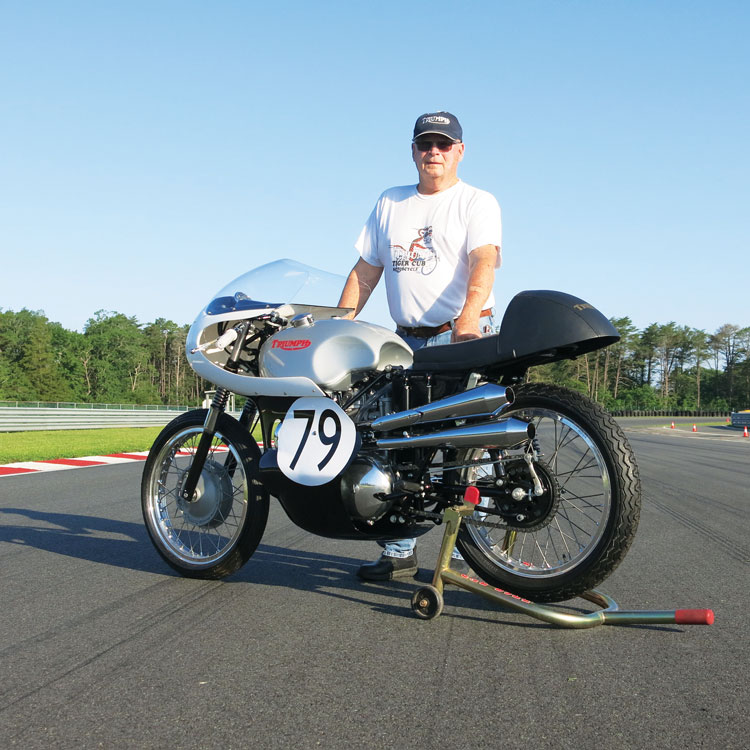
Nineteen-inch WM2 Dunlop alloy rims were found on U.K. eBay, but the seller refused to do business with an American customer. Undeterred, John contacted his friend and fellow classic Triumph expert Cliff Rushworth, owner of Ace Classics in London. With a few keyboard clicks, Rushworth bought the eBay rims and shipped them to Melniczuk. Owner Iannuccilli also intensely mined the internet. He scored a pair of correct NOS Girling shocks and steering damper and NOS Dunlop triangular road-race tires from veteran collector Joe Lachniet in Michigan. Milburn’s own parts shelves served up a Chevy Corvair oil cooler and mounting hardware, rear brake drum, front brake backing plate, and a super-scarce rocker-inspection cap, originally sourced from Pride & Clarke in London, for replication.
Florida-based Triumph zealot Jaye Strait provided the “rare as hen’s teeth” Lucas ET coils. Hard to find herringbone-rubber oil lines and Amal GP2 carb bits came from John Healy at Coventry Spares, while an NOS pair of GP2 slides were unearthed in the U.K. — for $500 each. Racing frame specialist Mike Owens at J&M Racing Products in Maryland reworked the extended swingarm to original spec and added front fairing mounts that had been cut off. He also fabbed up a pair of clip-on handlebars. Mike Morris in New Jersey turned out a set of curvaceous 1½-inch header pipes as used on TriCor and factory T100Rs.
The restoration of Elmore’s Daytona winner was gratifying for Melniczuk. It was also an education in patience. “The lesson for dedicated restorers: Don’t give up on finding what you think can’t be found,” he stressed, turning to a newly arrived, ex-Elmore Triumph dirt-tracker on his lift table. MC
Racing by the Rules
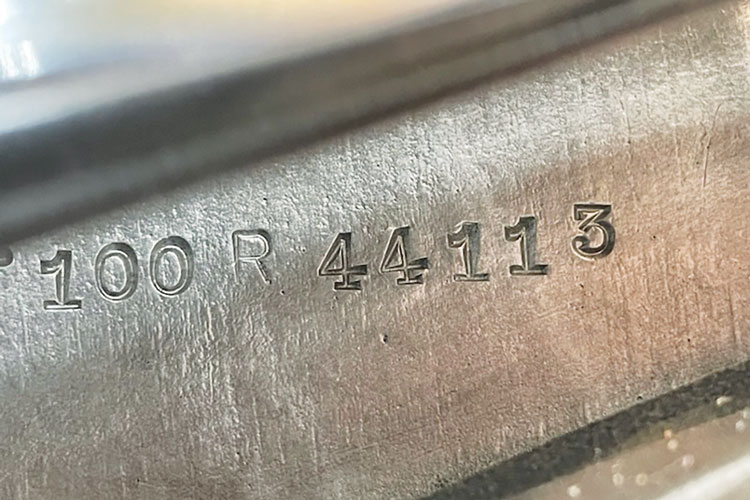
According to the 1966 AMA Rule Book, riders were permitted to enter no more than two motorcycles in an event, but were permitted to qualify and race only one. Qualifying speed determined grid position. If you brought a spare race bike, you could practice on both machines — but you had to race the engine you qualified on. Tech inspectors rigorously checked engine numbers against each entry. The AMA’s strict attention to these rules caught Dick Hammer after the 1968 Daytona 200. Hammer had qualified on a Suzuki T500, but later in the week, Triumph offered him a factory T100R that had been slated for British rider Rodney Gould, before Gould was injured in a 250cc race crash. Hammer finished the 200-miler in 7th place on the Triumph but was quickly disqualified for racing a bike on which he did not qualify.