

The Barber Vintage Motorsports Museum
What: Five levels, 80,000 square feet of exhibit space and 500-plus classic motorcycles on display at any time.
When: April 1 through Sept. 31: 10 a.m. to 6 p.m. Monday through Saturday, and noon to 6 p.m. Sunday. Oct. 1 to March 31: 10 a.m. to 5 p.m. Monday through Saturday, and noon to 5 p.m. Sunday.
Where: 6030 Barber Motorsports Parkway, Birmingham, AL, 35094; (205) 699-7275; on the web at:?www.barbermuseum.org
How to get there: 13 miles east from Birmingham International Airport on I-20. Take Exit 140 (Leeds) and follow the signs.
Keep an eye out for: New projects in the basement. The basement’s closed to the public, but you can often catch a glimpse and hear the roar of something special coming together.
More bikes: Check out our tally of 500 classic motorcycles on display at Barber during your visit listed by year and model.
For the record, there is no stairway to heaven.
You get there by taking Interstate 20 to exit 140, a few miles east of Birmingham, Ala. There, at the end of a parkway that twists through a lush pine forest, you’ll find it.
The sign outside says Barber Vintage Motorsports Museum. For motorcycle enthusiasts, it could just as easily say paradise.
Because inside this five-story, 80,000-square-foot building lies one of the world’s largest collections of motorcycles, consisting of more than 900 bikes produced by upwards of 140 manufacturers.
Of the 500 bikes on display at any given time, all but a handful could be fired up immediately and taken for a run on the 2.3-mile track at the adjacent Barber Motorsports Park.
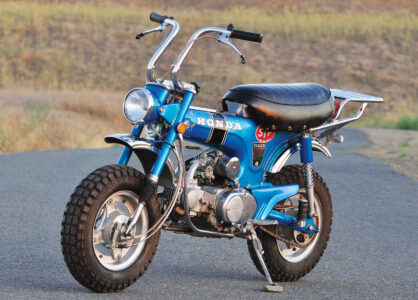
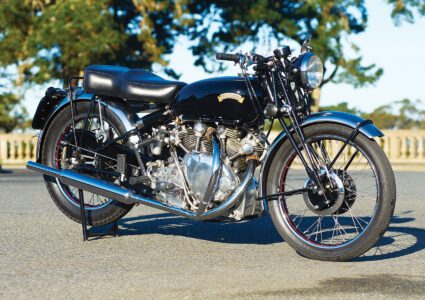
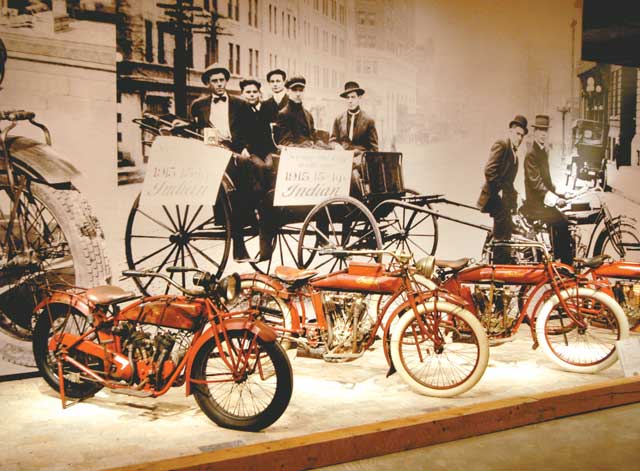
Bikes recently on display ranged from Ariel to Zundapp, from motorized bicycles that could be lifted with one arm to the 794-pound Honda Valkyrie Rune, from board-track Indians to Superbike series Ducatis.
“They’ve got bikes that I’d heard of but have never even seen pictures of,” says Jim Nicoletti, who rode to the museum from Pensacola, Fla., as part of a Harley Owners Group tour. “I can’t imagine how many millions of dollars they’ve got invested here.”
Numerous, suffice it to say. The museum boasts a state-of-the-art machine shop, restoration bay and research library among its attractions, housed in a gleaming building less than two years old.
The star attractions, however, are the bikes themselves; such as Craig Vetter’s 1980 Mystery Ship, a 1912 American, of which the museum’s operators believe there are only two in the United States, one of only three remaining Honda RC161 racers from 1961, a Rikuo, the so-called Japanese Harley, and a wall of European singles from the Fifties. The list goes on. “If Mr. Barber is going to attack something or approach something, it’s going to be the best,” says Jeff Ray, executive director.
Creating a masterpiece
Mr. Barber would be George Barber, a successful and unassuming businessman who made his fortune as the head of a family dairy operation and in real estate.
Barber caught the racing bug as a youth and drove Porsches competitively during the Sixties and early Seventies before taking over the dairy business. But his interest in racing stayed with him, and he was soon restoring cars in the downtown Birmingham warehouse where he reconditioned milk delivery trucks for his business.
A few motorcycle projects followed, and Barber started collecting bikes in the Eighties.
“You could never do the best car collection, because it’s already been done,” Ray says. “So motorcycles became the target. Plus, from a car standpoint, you can put thousands of dollars into a restoration and end up with a paint job and a set of wheels. On a motorcycle restoration, you get through and you’ve got a work of art. You can see what the designer had in mind, and you can see what the engineer had in mind. And he really liked that.”
To protect his bikes from the overspray, Bondo dust and other byproducts of the dairy’s body shop, Barber had his staff put them in crates with Plexiglas panels on the front. As more and more bikes were finished, workers were soon stacking the crates on top of each other, creating a Matchbox car effect.
Word about Barber’s growing collection and his unique setup began to circulate among motorcyclists, and the warehouse began to draw visitors.
“It was like Aladdin’s cave,” says Brian Slark, who joined Barber’s operation in 1995 and now serves as parts manager, restorer and consultant. “It was a very, very inefficient building, but it had a lot of character. It was just a hodge-podge of little rooms, and we had motorcycles and parts everywhere.”
Barber opened the collection to the public in the mid-’90s. Hours were limited to 10 a.m. to 3 p.m. on Wednesdays and Fridays.
“We’d even close for an hour at lunch,” Slark says. “We were so small and invisible that we could let people wander around. They could go in the restoration shop, they could look over your shoulder. It was just very casual.”
It was also becoming very cramped. But when Slark and his co-workers asked Barber to give them a little more work space, little did they know their request would result in the current complex.
“We said, ‘Boss, we need a larger building, and ideally we’d like a little track so we can run the bikes after we restore them,'” Slark recalls. “And as you can see, it kind of grew from there.”
Designs on success
Before workers removed 1.6 million cubic yards of dirt from the work site, before they even chain sawed their way to the area through land so rough you couldn’t ride a dirt bike through it, Barber had a vision.
His museum would be a cross between the Guggenheim and a parking garage, with plenty of open space to allow visitors to view different eras of motorcycling at one glance.
“Mr. Barber literally designed the museum on a napkin,” Slark says. “We wanted it to be mechanical. It had to be light, airy, open, and present the opportunity to walk around amongst the motorcycles. We didn’t want mirrors or a lot of flashing lights, because that detracts attention from the motorcycles.”
The resulting floor plan is open in the middle, with an elevator and circular walkway connecting the display areas. Natural light flows through floor-to-ceiling windows and illuminates such features as four “aging racks,” each a stack of 14 bikes.
Production bikes are grouped by era, while racing machines are given their own display areas. There are some special displays, such as a replica of a board track, but most areas contain nothing but motorcycles and information placards.
“We don’t show all the Harleys in one place, we don’t show all the Indians in one place, we don’t show all the Triumphs in one place,” Ray says. “What we’re trying to do is show the different types of bikes you’d see if the imagination could put you in a parking lot in a certain era. Or to take it a step further, you show the bikes you’d see if you’d take all the parking lots in the world and condense them down to one parking lot.”
Ray and Slark, who do the museum’s purchasing, are particularly interested in unrestored, original-finish motorcycles. As Ray tours the collection, bikes such as a stock 1913 Harley-Davidson Model 9-B draw his attention.
“We cherish these pieces, because they’re snapshots in time,” he says. “When you look at things like pinstriping, color and location of decals, you could get two restorers together and they’ll sit and argue all day long about what’s right and what’s wrong. But then you look at this and say, ‘That’s how it’s supposed to be.'”
Patient money
Most of the museum’s collection has been acquired in what Ray calls “the old-fashioned way.”
“We write a check.”
But Ray and Slark do not throw Barber’s cash around indiscriminately. Rather, they have adopted a “patient money” approach in which they study the market carefully, make reasonable offers and wait for another opportunity if a deal falls through.
“With our Kawasaki KZ1000R, we spent a year and a half trying to find the right example,” Ray says. “We wanted to get an original-paint bike, and we didn’t want a restoration project. We couldn’t find one, so we gave up. So I’m at the office one day, and the phone rings. A guy says, ‘I’ve got an old Kawasaki I’ve had forever and I just want to get rid of it.’ I asked him where he was located, and it was five miles from here.”
Ray wound up paying a rock-bottom price for a bike with fewer than 1,000 original miles and virtually no damage — save for a few teething marks on the rear fender, courtesy of the owner’s pit bull pup. Although the Kawasaki came from the neighborhood, the museum has acquired bikes from as far away as Australia, New Zealand and Sweden. Ray and Slark keep their eyes open for the whole spectrum of bikes, from oddities such as a 1960 DSK — a Japanese copy of the BMW R26, including a slightly revised blue-and-white, circular logo — to common, recent-model production machines such as a 1986 Honda VFR750 Interceptor.
“You have to choose what your visitors want to see and try to get it out there for them but add some things that will be of interest to them,” Ray says. “We’re in the entertainment business. You’ve got to give people what they wish to see.”
What many visitors want to see, Ray says, are bikes owned by either themselves or someone they have known.
“They love to be able to think that they made the right choice by buying a bike that’s now in a museum,” he said. “That’s their tie to it.”
Looking ahead
In 2004, without the benefit of a marketing campaign, the museum drew 50,000 visitors. Ray’s goal is to boost the annual count to 100,000.
But with or without the extra visitors, Ray says the museum will be okay from a financial standpoint.
“We’re perpetually funded. We have a funding mechanism in place with the racetrack and other items.”
The track, which is home to the Porsche Driving Experience program and hosted the AMA Superbike Championship in April, is a for-profit venture that operates separately from the museum. The museum overlooks the track and leases it for testing but does not promote it.
Slark, a walking history book whose resume includes stints as a test rider for Matchless and a marketing director for Norton Villiers in California, says Barber’s collection will do nothing but grow. He and Ray, who grew up riding dirt bikes and ran a mechanical shop before joining Barber’s crew, are filling gaps in the existing inventory while also acquiring brand-new pieces.
“I look at each decade,” Slark says. “You’ve got X number of motorcycles from 1920 to 1930, for example, and you try to make sure you’re not too American, not too British, not too Italian. You just try to round out the collection.”
Slark’s key focus this summer was to acquire bikes from the Seventies, the decade of choice among visitors. But while the collection may lack a few classics — Slark was recently pursuing a Suzuki GT750 “Water Buffalo,” for instance — it’s already a jaw-dropper.
“People usually walk out of here with a glazed look in their eye,” Slark says. “When they come here, there’s so much to see. But if you’re into motorcycles, I think there’s something here that will be of interest.”