1963 Royal Enfield Continental
Engine: 248cc OHV air-cooled single, 70mm x 64.5mm bore and stroke, 9:1 compression ratio, 20hp @ 7,500rpm
Top speed: 84mph (period test)
Carburetion: Single Amal 1-1/16in 376 Monobloc
Transmission: 4-speed (5-speed stock), chain final drive
Electrics: 6v, coil and breaker points ignition
Frame/wheelbase: Single downtube open cradle steel frame/52in (1,320mm)
Suspension: Telescopic forks front, dual shocks rear
Brakes: 7in (178mm) SLS drum front, 6in (152mm) drum rear
Tires: 3.25 x 17in front and rear
Weight (dry): 305lbs (138kg)
Seat height: 29.5in (749mm)
Fuel capacity: 4gal U.S. (15ltr)
Price then/now: £242.10s (1963)/$3,000-$6,000
One of motorcycling’s most powerful design icons first appeared on the roads of Britain in the late 1950s: the café racer. The archetype was the BSA Gold Star in Clubman trim, sporting clip-on handlebars mounted on the front fork, a paired speedometer and tachometer, skinny fenders and a swept-back header pipe.

In reality, few bikers — especially young bikers — could afford a Goldie, so they made look-alikes. They were often utilitarian machines, wrenched, chopped and welded to emulate the bikes their heroes rode on the Isle of Man or at the local track. Then came a couple of shifts that changed the nature of British motorcycling — with the unintended consequence of creating another classic café bike: the Royal Enfield 250 Continental of 1963.
Fast learners
In 1960, Britain was coming off its biggest post-World War II motorcycle sales year (1959) with 332,000 registered bikes on the road, and the future of motorcycling looked rosy. The leading edge baby boomers were turning 16 — the legal age to ride a motorcycle in Britain (it was 17 to drive a car). Then, in response to a rise in motorcycle fatalities, the Ministry of Transport dictated that new motorcycle riders would be limited to 250cc machines or less until they passed a riding test on public roads. That typically took several months, an interminable amount of time to a 16-year-old.

The move immediately raised the status of quarter-liter bikes, and with many older riders forsaking the family sidecar outfit for a small car, teens were now the biggest buyers of new bikes. This happy arrangement lasted until 1971, by which time Japanese 2-stroke 250s were capable of speeds close to the “ton,” and fatalities continued to rise. The learner limit was revised again, down to 125cc and a 12 horsepower maximum, and the minimum motorcycling age was raised to 17.
Crusader
Some manufacturers were better prepared for the boom in 250cc bikes than others: BSA had the pedestrian C15 Star; Norton had introduced the Jubilee twin in 1958; Triumph soldiered on with the 200cc Tiger Cub; and dozens of smaller makers produced 250s using the Villiers 2T 2-stroke twin. Royal Enfield was better prepared than most: In 1956 they introduced the Crusader, an all-new 250cc unit-construction 4-stroke single intended to eventually replace the aging 350 Bullet.
The new engine had its roots in traditional Enfield practice, but with some unusual variations. At its core was a typically stout one-piece iron crankshaft with equally large main bearings: a left (drive-side) ball race and right-side roller. The piston ran in a cast iron barrel with an iron cylinder head. The vertically split engine cases contained three separate compartments: one at the front for the crank assembly, a central engine oil “tank” and a rear gearbox case. Although oil was contained in the engine cases, it was a dry-sump engine. The connecting rod was fitted with a shell bearing big end, lubricated by Enfield’s idiosyncratic (and sometimes troublesome) reciprocating plunger-type oil pump, the oil fed through the crank via a replaceable felt filter.

The camshaft was on the left side of the engine, driven by a duplex chain outboard of the single-row primary chain, with bell-crank followers operating pushrods and conventional rockers. A possible advantage of this arrangement was that the electrics (a crankshaft-mounted Lucas alternator and ignition contact breaker) were both on the right side of the engine, while the timing and primary drives were on the left. The downside? The ignition contact breaker required a crossover shaft driven from the camshaft by an intermediate gear.
The primary chain drove a wet multiplate clutch attached to the 4-speed transmission’s mainshaft with the usual left-side countershaft chain drive (fully enclosed) to the rear wheel. The power unit slotted into a typical Enfield open-cradle frame, with a single downtube running from the steering head to the front of the engine. The single spine tube divided under the seat, with dual tubes wrapped around the rear and under the transmission, providing mounting points for the cast alloy centerstand. Two fully enclosed coil-spring shocks controlled the rear swingarm, with the front wheel attached to Enfield hydraulic forks. The fork legs were threaded at the top and screwed into the Enfield alloy “casquette” instrument panel, which formed the top triple clamp.

With a modest 7.3:1 compression ratio and a 7/8-inch Amal Monobloc carburetor, the Crusader made around 13 horsepower at 5,750rpm and was good for 70mph while eking 90 miles out of an Imperial gallon (about 75mpg U.S). The engine also had tuning potential, and a Sports Crusader arrived in 1959. With a new light alloy cylinder head, a larger intake valve, 8.5:1 compression, hotter cams, a 15/16-inch Monobloc carburetor and a new Burgess muffler, the Sports made 17 horsepower at 6,250rpm and was good for 78mph without a significant impact on fuel consumption. To match the extra speed, the front brake went from 6 inches to 7 inches, with new handlebars and revised footpegs for a sportier riding position. Shallower chrome fenders completed the makeover.
Super 5
For a relatively small manufacturer, Enfield certainly liked to mix up their model line. The company’s 1962 range included a new 250, the Super 5, with a 5-speed transmission and a leading-link front fork. Essentially the prototype for the Continental, the Super 5 featured a compression boost to 9.75:1 thanks to a higher piston dome. The specification included an RR56 high-duty aluminum alloy-forged connecting rod, a 1-1/16-inch Amal Monobloc and a 5-speed transmission, the first British street bike so equipped from the factory.

It was pretty quick, with 20 horsepower at 7,500rpm giving a top speed of around 84mph and crisp acceleration helped by the extra gear ratio. Gas mileage suffered, dropping to 70mpg Imperial. U.K. magazine The Motor Cycle tested the Super 5 in 1962, and enjoyed the ride, although they did find the occasional false neutral between second and third gears and the gearshift action was “a little hard.” Yet while it was fast and innovative, the Super 5 looked a little dowdy, inheriting Enfield’s partial rear wheel enclosure, plastic shrouds around the leading-link front fork and the “casquette” headlamp enclosure.
Continental
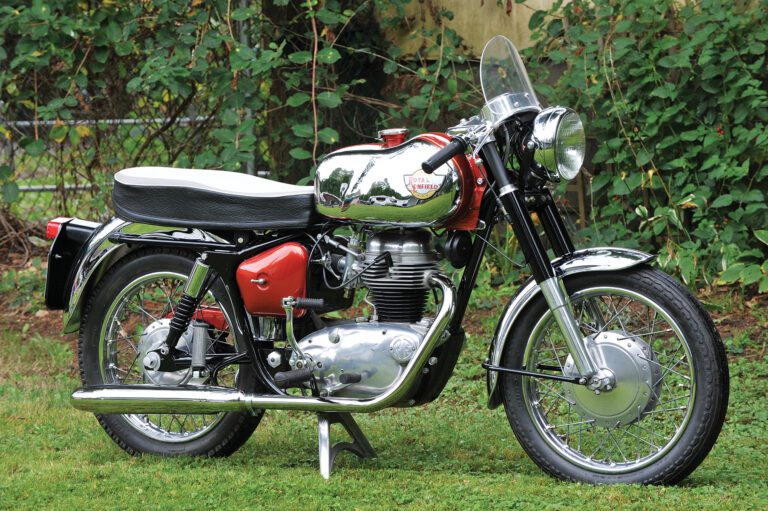
So the Super 5 had good performance, but was somewhat lacking in the cosmetic department. Home market sales manager and former RE test rider Roger Boss commissioned a prototype 250 based on the Super 5, but with a paired Smiths Chronometric tachometer and speedometer replacing the casquette. The bike also had telescopic forks, sporty chrome blade fenders, a flyscreen, a swept-back header pipe, a two-tone dual seat, and — in a clear nod to Ducati’s sporting 175 and 200cc singles — a “jelly mold” chrome-plated steel gas tank with red panels and gold pinstriping. The bike shared the Super 5’s powertrain, with compression lowered to 9:1 for 1963.

Boss showed the prototype to Wilf Green — owner of the long-time Royal Enfield dealership in Sheffield, Yorkshire, U.K., — and got an enthusiastic response. The “Continental” (another nod to its styling origins) went on sale in the U.K. for the 1963 model year, and while it was well received, it did cause some consternation in the trade. The Continental offered performance equal to or better than most British sports cars — and a 16-year-old with no previous experience could ride one away from the dealer.
Motorcycling had been getting bad press in Britain, with stories (well publicized and often media driven) of maniacal teenage motorcycle street racing. In 1961, Britain’s Daily Mirror newspaper ran a special investigation into the “suicide club” of riders who gathered at London’s Ace Cafe. For many, the goal was to set the fastest time on a short stretch of the North Circular Road between the Ace and the Neasden roundabout. Crashes — and fatalities — were inevitable. Public outrage obliged the police to take notice, and they duly raided the Ace on Friday night, Feb. 10, 1961. Twenty-one people were charged with minor offenses, and most escaped with a small fine. But the motorcycle industry was conflicted: café racers were what their market wanted, but they were also shy of attracting the wrong kind of publicity.

Instead, Royal Enfield went for broke. With its race-bike styling, “Ace” handlebars and rearset footpegs, the Continental was like crack cocaine to a red-blooded teenager. Motor Cycling tested a Continental in 1963 and found the performance and handling essentially unaltered from the Super 5 in spite of the new telescopic forks — the tangs on the alloy centerstand being the only limit to cornering. But the Continental story had one last twist.
In 1963, Royal Enfield managing director Leo Davenport surveyed U.K. dealers for input into the 1964 model range. The outcome was a new version of the Continental; the GT, or Gran Tourismo. The 250cc engine got a further power boost to 21.5 horsepower at 7,500rpm thanks to 9.5:1 compression, but it was the GT’s outrageous styling that set it apart. That included a number of race-bike features — like the open carburetor bellmouth, unshrouded rear shocks, big bore breather tube and front brake cooling discs — that were really just for show. The handlebars were clip-ons and the header pipe was aggressively swept back (obscuring the contact breaker cover in the process). With its white-painted frame topped off with a red fiberglass gas tank and 2-tone bump-stop seat, the GT certainly made a statement.
Unfortunately, the extra performance of the GT stretched the Crusader design to its limits. Engine blowups weren’t uncommon, and the 5-speed gearbox was notoriously unreliable. With the GT in the lineup for 1964, the Continental was down-specified, the flyscreen and tachometer being nixed. It was dropped from the range in 1965. The GT continued through 1966, but production ceased when Royal Enfield was sold to Norton-Villiers in 1967.
So was the GT the ultimate in factory café racers? Or a gaudy example of gilding the lily? That’s a personal preference, of course, but its outrageous styling did create both a further stirring of teenage passions and an instant classic. Sadly, that means the more conventional Continental is often overlooked.
Restoring the Enfield
The Continental shown here was restored by retired mechanic Mike Middleton. Mike heard about the bike from a family friend, and the connection led him to the town of Sechelt on British Columbia’s Sunshine Coast. The owner had died, and Mike acquired the bike from his widow.
“It was in a terrible state,” Mike says. “The transmission and clutch were missing, a lot of the outside engine parts were missing, the exhaust was missing and the seat was a mess.” But it wasn’t all bad news. “It was sitting on its wheels. The tank was just resting on the frame and the cylinder head was still on. The cylinder was intact, and I thought, ‘That’s not a bad sign. It’s not been allowed to get rusty. It’s been inside this garage all the time.'”

While Mike was somewhat daunted by the amount of work required, he was hooked. “I’m emotionally involved,” he says. “I owned one when I was 18, exactly the same model. I loved the bike. It was just the best thing in the world for an 18-year-old. Now they’re very rare.”
Surprisingly, Mike found it relatively easy to source the parts he needed for the restoration, mostly from suppliers in England, and eBay U.K. “You troll eBay over in the U.K., and you get hits,” he says. “Sometimes they’re used parts, sometimes they’re new-old-stock parts. So you just get a dialogue going with these people. ‘This is what I need. If you don’t have it, do you know anyone who does?'”
Mike also cites Alan Hitchcock at RE specialists Hitchcock’s Motorcycles in the U.K. as a major source, and while many of the parts originated in India (not surprising, as Enfields are still made there, of course), Mike was mostly happy with the quality. “Hitchcock says, ‘It must be to the original manufacturer specification, or I’m not buying it.'”
After stripping the bike down, Mike had the frame stove enameled. “It is a special black enamel, very similar to the original factory enamel,” Mike says. Next came the drivetrain. “Having owned one of these and worked with them, I know what to look for. I took it all apart and cleaned all the oilways. It didn’t have any signs of a major mechanical failure.”
Mike installed a new camshaft and piston, though the cylinder was in good condition. “There was just six thou wear, which is remarkable for all those years,” he says. “But the transmission was the problem, always, with these motorcycles. It was a 5-speed. The gears were very, very narrow, and any dumb kid on there with a big boot trying to get the gear, not feeling it gently in, he would wreck it.” So Mike followed the time-honored practice with RE unit singles and fitted a 4-speed gear cluster from a Crusader.
The most difficult part of the restoration proved to be getting the red paint and gold pinstriping on the gas tank right. Eventually, on a visit to the U.K., Mike dropped in at Hitchcock’s to talk to a former RE employee. Mike showed him photos of the tank that came with the bike.
“He said, ‘That is spot-on original, even though the chrome is bad. If you do your line to this, it’ll be original’,” Mike says. “The guy gave me the measurement in from the edge and how thick the line was.” Mike took the gas tank to Superior Electroplating in Surrey, British Columbia. They stripped the tank, cleaned it the insides, tested it for leaks and re-plated it. Mike then took it to a painter friend who applied the red paint and gold pinstripes. The same painter also finished the side panels.
Another challenge was finding the correct period 17-inch tires. Eventually an Avon rear tire showed up at Motoparts in Edmonton, Alberta, and a front tire of Oriental manufacture was sourced in Vancouver, B.C. But the biggest problem showed up after the restoration was complete when Mike went to ride it on the street: “That’s when I found I couldn’t!” he says. So he trailered the Continental to a nearby airfield to run it through its paces. “I thought, ‘Man this is just great. This is fabulous. You want to keep going forever.'”
But the Continental’s small size and semi-racing-crouch riding position was too uncomfortable for any distance. “Which is why I sold it,” Mike says. “It brought back some very happy memories of the people I used to know. I used to go over to the Isle of Man. I knew a lot of racing guys there, and we used to have a lot of fun. It was just fabulous. So yeah, it was part of my youth, and I was sad to think that I have to sell this because I couldn’t ride it.”
New owner Joel McCooey of Maple Ridge, B.C., rides the Continental now, but he still has problems with false neutrals. That didn’t stop the little Enfield from taking third place at the Crescent Beach Invitational show in Surrey, B.C., in September 2016. It’s a delightful reminder of simpler times, when a sporty 250cc 4-stroke single was a teenager’s dream. MC