
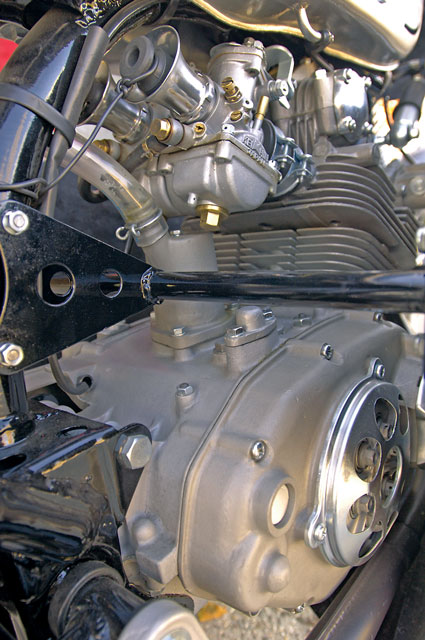

1963 Honda CR93 Benly
Claimed power: 18hp @ 12,500rpm
Top speed: 100mph
Engine: 124.8cc air-cooled DOHC parallel twin
Fuel capacity: 2.2 gal (8.4ltr)
Price then/now: $1,400 (approx.)/NA
Although it may seem like it, Honda hasn’t always been the giant manufacturer of power equipment, motorcycles and cars that it is today. Prior to World War II, founder Soichiro Honda was focused on manufacturing piston rings, and he didn’t produce his first motorcycle, the Model D, until 1949 – a long time before the development of the 1963 Honda CR93 Benly.
Yet thanks to the perseverance and determination of Soichiro Honda, by the early 1960s the company he started on little more than the proverbial wing and a prayer was the largest manufacturer of motorcycles in the world. And these weren’t just any motorcycles — they were a new breed of motorcycle that changed the rules of the game and revolutionized the industry.
Honda also had an equally dramatic impact on the world of racing. In 1954, following an unpublicized visit to the Isle of Man TT, Honda declared his intention to build race-winning motorcycles. A former racer himself (he once built a race car powered by a Curtiss-Wright V8), Honda was determined to prove his motorcycles were the equal of anyone else’s, and he knew a win at the Isle of Man TT would make his point.
Motorsports success
The company finally arrived on the Isle of Man in 1959, with a team of five riders and a stable of 125cc road racing motorcycles. Honda made history at the TT, for even though the company didn’t finish in the top three, their sixth, seventh, eighth and 11th place finishes proved Honda’s reliability and won Honda the 125cc Class Manufacturers Cup. Two years later in 1961, Honda cleaned up at the TT, with first through fifth place finishes in both the 125cc and 250cc classes.
These wins only furthered Honda’s quest for domination of motorsport. To further this goal the company looked to privateer racers, and in 1962 unleashed the CR93, a limited production 125cc race machine for sale to the public. A remarkable motorcycle that won races thanks more to its reliability than its outright power, the CR93 was only produced in 1962 and 1963, with a total of approximately 150-200 coming out of the factory.
The bike hit race tracks mainly in Europe and Japan, and any that did make it here to the U.S. were gray-market machines. Honda also put together perhaps 30 street-legal CR93s, most of which were sold in Japan. Engines in the street-friendly CR93 had lower horsepower thanks to a more restrictive exhaust (approximately 16.5 horsepower versus up to 21 on the unrestricted racers), employed a kick starter, and were fitted with a neutral switch, centrifugal ignition advance mechanism and a four coil ignition instead of the two coil setup found on the race engines. The street version was also equipped with a headlight, taillight, license plate holder, battery and side covers.
The CR93 today
Ron Mousouris, owner of the Benly Shop in Carpinteria, Calif., specializes in the restoration of 1950s and 1960s Honda motorcycles. He maintains an extensive list of contacts and routinely travels to Japan searching for rare Honda models such as the 1954 Benly J, a humble commuter bike that was never sold outside of Japan. Ron was always aware of the Honda CR93, and had encountered more than a couple of examples in his travels.
“I occasionally come across a CR93 in Japan,” Ron says, “but often they have been pieced together from parts, or else they are original but severely thrashed.” He did find a very nice example of a CR93 in Japan about 12 years ago, but the price was beyond his reach, so he moved on. Then he got a call from California-based friend and Honda CR enthusiast Randall Baselt. Randall had a pair of CR93s, and one of them had to go to make way for a new project.
“I had grown accustomed to having to search extensively in remote areas of Japan to find rare, early Hondas. Those built from 1949 to 1957 are my main interest, the Hondas that Soichiro Honda took a big gamble in making. Having said that, I’ve always loved the CR93, and I told Randall if he ever wanted to part with one of his CRs to give me a call,” Ron recalls. When Randall did call, Ron didn’t hesitate. “I’ve spent years and plenty of detective work trying to find early Hondas in Japan, and this one just snuck up on me right here in California,” Ron laughs.
Interestingly, Ron didn’t buy the Honda CR93 alone. Instead, he partnered with noted early Honda and Italian motorcycle collector Guy Webster in a 50/50 split to purchase Randall’s CR93. And while they own the bike together, the CR93 is on display in Guy’s Ojai, Calif., motorcycle museum, where once or twice a year they take it out for a track day to give the thoroughbred Honda some exercise.
Strength in design
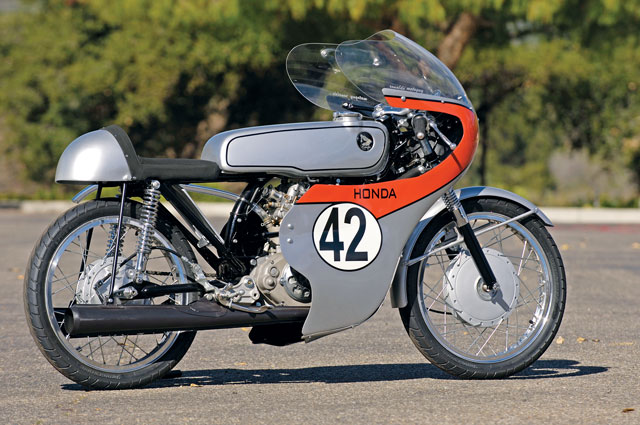
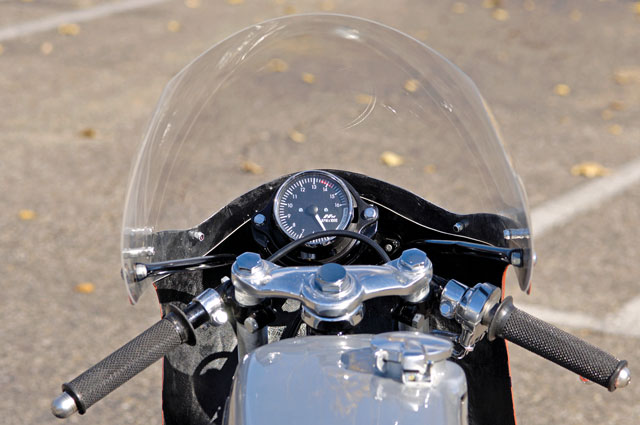
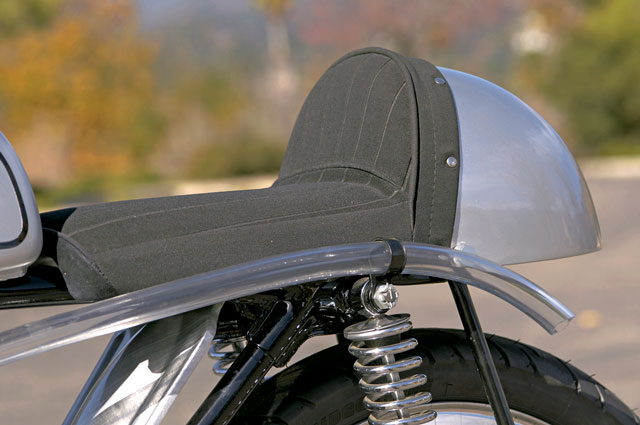
Spare in its execution, the Honda CR93 features a steel tube backbone-style frame of the type the company was well known for in the 1960s. In this layout the 125cc engine acts as a stressed member, with hydraulic forks featuring exposed springs up front and swingarm/shock absorber suspension out back. Topping off the frame is a sleek, low and long aluminum gas tank punctuated by a solo seat and rear seat hump. The front fender is also crafted of aluminum.
While the running gear may appear minimalist, the motive power for the CR93 comes from a sophisticated 125cc parallel twin engine. The CR93 logically progressed from the ground breaking Honda CB92 Benly Super Sport of 1959, and the CR93’s engine did use some of the engineering developed in the earlier machine. But where the CB92 used a single overhead cam and two valves per cylinder, the CR93 featured gear-driven double overhead cams acting on four valves per cylinder.
“The cams are gear-driven by six straight-cut gears, one on the crank, one idle gear each in the case, cylinder and head, and one on each cam,” Randall says. “The tappets are solid steel, and the valve clearance is set by filing down or welding up their stellite tops.” A helical-geared primary drive transfers power from the 180-degree crank to the five-speed gearbox, built in unit with the engine. Lubrication is via wet-sump.
According to the Honda factory service manual, this little mill could rev out to 12,500rpm and made 18.5 horsepower in race trim. The most frequently quoted output is 18 horsepower (in full race trim), but there are sources that quote output as high as 21 horsepower at a much higher 14,000rpm.
The price of admission to enter races on an over-the-counter CR93 in 1962 and 1963 wasn’t cheap. Randall says a new CR93 in the U.K. was £504, or approximately $1,411. By contrast, consider that in 1961, a CB92 Benly Super Sport was $495. “That’s not a trivial amount of money to throw at a motorcycle,” Ron says, adding, “It wasn’t the kind of bike where you’d go on a whim to your Honda dealer and buy one. You would have had to be serious about racing.”
The CR93 dominated club racing in Europe in 1962 and 1963, and remained competitive into the late 1960s and even the early 1970s. Ron and Guy’s CR93 definitely saw race use. “It came from a private owner in Japan and had been raced hard before sitting in a warehouse for many years,” Randall says. “It still had the original Dunlop racing tires, which Ron now has. It had been extensively modified, including drilling vent holes in the rear hub and drilling various parts such as the rear sprocket and even the rear brake pedal to save weight. It was brought back to factory condition during restoration.”
Riding the CR93
Both Ron and Guy have ridden their co-owned CR93, primarily at Buttonwillow Raceway Park north of Los Angeles. “This CR93 makes the most rewarding sound I have ever heard,” Ron says. “It has a slightly hostile tone to it that you just would never expect from a 125cc machine. But it’s really, really loud. It’s just deafening, even with earplugs. I will never forget the enthusiasm written all over Guy’s face as the screaming little 125cc racer lapped the track [at Buttonwillow] at 13,000rpm. That’s 216 revolutions every second!” Guy adds: “It’s about 114 decibels, and that’s about the most outrageous little 125 in the world.” According to a decibel comparison chart, that’s equivalent to attending a loud concert or standing on an airport runway.
Ron says getting the CR93 moving involves a bit of finesse, revving the engine close to 8,000rpm-9,000rpm and slipping the clutch for a smooth launch. And while the CR93 has very little torque in the lower rev range, he says it pulls really well between 10,000rpm-13,500rpm, its safe limit. “Keep in mind, this is a 125cc engine, and it doesn’t make a lot of power,” Ron adds. “But if you keep it on the boil it will pull you up to 100mph. The CR93 was a really competent, good handling and fast motorcycle that would finish the race. It was a no-compromises race bike; you could get on it and win.”
Both Ron and Guy are happy with their partnered ownership. Ron’s pleased to have the CR in Guy’s Ojai museum where other enthusiasts can appreciate it, rather than having it at his own home where that opportunity wouldn’t exist. “I get more joy out of sharing this bike with Guy than I would owning it myself,” Ron says. “We were lucky to get the bike,” Guy adds. “It’s a very valuable machine, and it’s just one of those great collector pieces because it was so limited in its production.”
Ron’s appreciation and respect for Soichiro Honda’s accomplishments runs deep, and is central to owning this rare motorcycle. “Honda built the CR93 and a few other brilliant motorcycles at a time when doing so meant great sacrifice and risk. Only a handful of these rare machines exist today to remind us of the brilliance and relentless efforts of Mr. Soichiro Honda.” MC