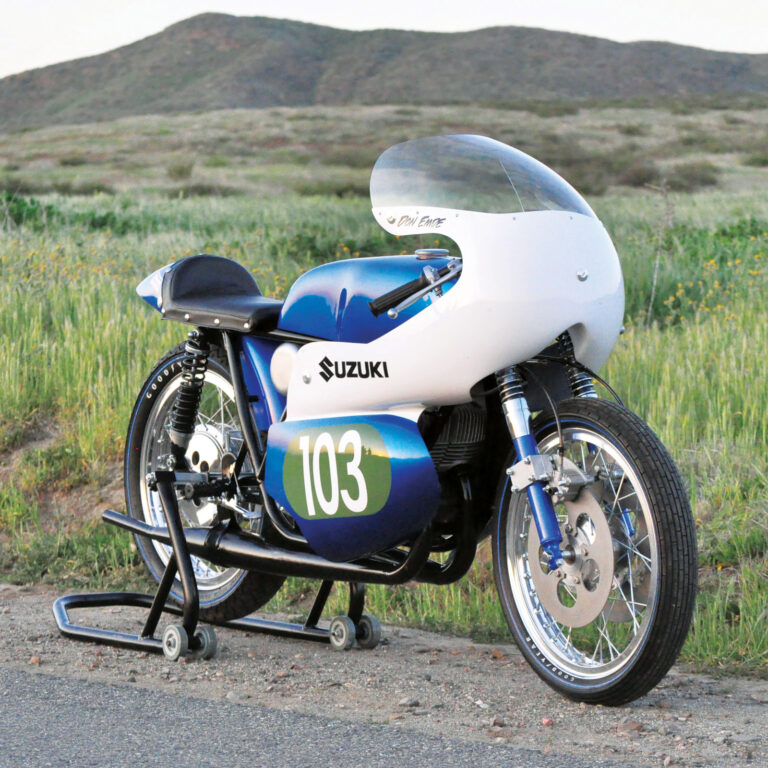
1966 Suzuki X-6 Road Racer
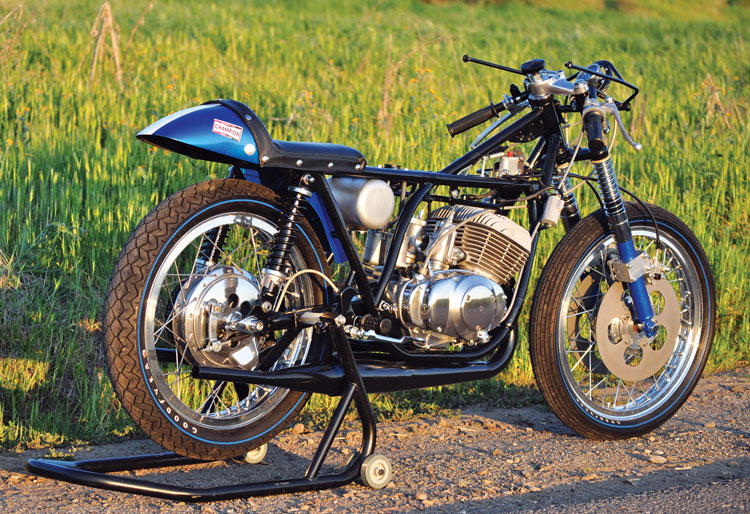
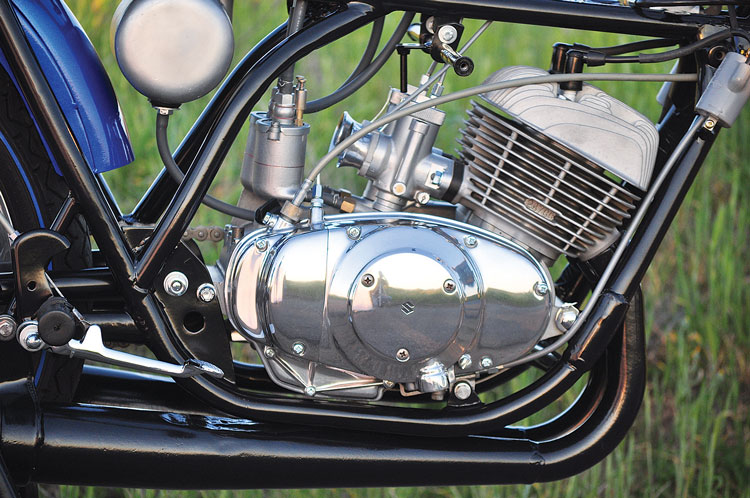
- Engine: Modified, air-cooled two cylinder, two-stroke, port induction, 247cc
- Bore and Stroke: 2.13in x 2.13in
- Top speed: 120mph (estimated)
- Carburetion: two TT10 28mm Amals, remote float bowls
- Drive train: helical gear primary drive, 5-speed transmission
- Electrics: Battery and points ignition
- Frame/wheelbase: Steel, double down tube, 50.5in
- Weight: 290lbs, est.
- Suspension: Hydraulic fork, coil-over shocks
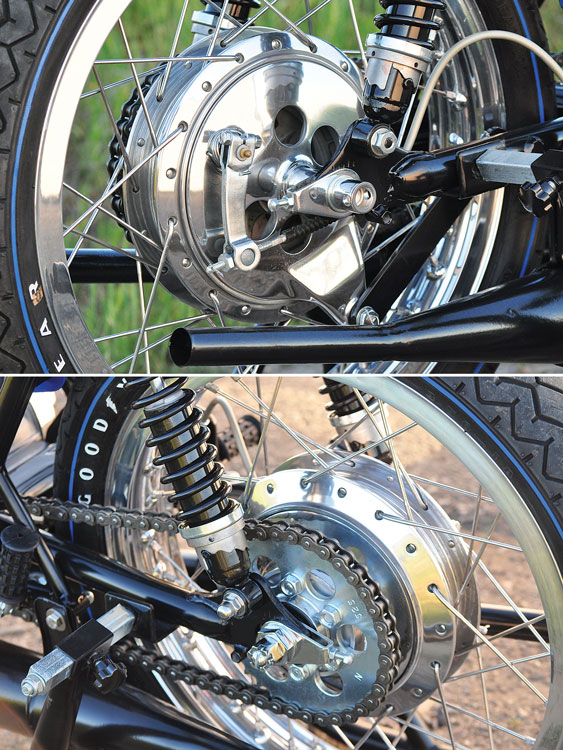
- Brakes: Twin disc front brakes, Airheart master cylinder and calipers, rear drum
- Tires: Goodyear Blue Streaks, 2.75 x18 front, 3.50×18 rear
- Seat height: 25in
Racer’s Creed: A racing motorcycle has one purpose — to win races. Beyond that, everything else about the bike is incidental. Race bikes aren’t judged on their looks, and for that matter, a bike’s silhouette, regardless of how sleek or stylish it might be, is not enough to win a race. Rider comfort isn’t a prime factor, either, and the bike doesn’t necessarily have to be rock-solid reliable.
Simply, a race bike needs only to finish the race; like migratory salmon instinctively swimming upstream to perpetuate the species, race bikes need only survive to the finish line. As the saying goes, “To finish first, you must first finish.”
This oh-so-beautiful 1967 Suzuki X-6 road racer is a prime example. It began life in a blaze of glory, only to be retired a couple years later for reasons that we’ll address elsewhere in this narrative. For the time being, just know that this piece of racing history was restored and is now owned by Kent Riches, with a lot of help from his friends. If you’re familiar with Kent’s name, it’s probably because you were involved with motorcycle road racing one time or another the past 40 or so years; Kent owned and operated Air-Tech Streamlining, a successful accessories company that was headquartered in Vista, California, where it specialized in producing race fairings, bubble windscreens, and other related fiberglass go-fast components that come in handy for winning road races. Kent recently sold the business and is now retired.
As you can imagine, the sale of Air-Tech Streamlining allowed Kent time to restore the aging Suzuki to its former glory, right down to the striking blue and white livery that it wore back in 1967 and ’68 as a full-fledged race bike. The recent restoration paid off, because last March the bike won the Trailblazers’ Best of Show award, presented by Motorcycle Classics magazine, at the annual Trailblazers Bike Show. The bike show typically includes some rather historic motorcycles, plus it serves as a warmup to the Trailblazers’ evening banquet that honors inductees into the Trailblazers Hall of Fame. In addition, the banquet includes presentation of several other special awards before capping the evening with the BIG ONE — The Dick Hammer Award, presented annually to a deserving Trailblazer member for his or her “outstanding racing career, continued service to the motorcycle industry, help in preserving the history of the sport, supporting a lasting commitment to The Trailblazers,” and most of all for “exhibiting drive, determination, and desire that the late Dick Hammer always displayed during his hard-charging flat track, TT, and road racing career.”
For the time being, though, let’s focus on Kent’s blue and white Suzuki that won the Best of Show trophy sponsored by this magazine. The bike is actually one of a reported four racers originally built by U.S. Suzuki prior to the AMA’s 1966 racing season. Those racers were based on the incredible X-6 Hustler roadster introduced to America that same year. Suzuki’s squad of race bikes were hand built for AMA Experts Dick Mann, Dan Haaby, and Dick Hammer. A fourth bike was earmarked for Sportsman/Novice racer Walt Fulton III, whose father was an active and key member of America’s booming motorcycle industry. But when Daytona Speed Week got underway in early March, 1966, only young Fulton was in a position to lead the charge; the three Expert riders’ Suzukis suffered mechanical problems that sidelined them from competing in the upcoming Daytona Lightweight 100-miler for 250cc bikes.
But Fulton managed to open fire in the Lightweight Sportsmen race, which he won after a brief skirmish with Jim Deehan on a Yamaha TD-1. The race was held on Daytona Speedway’s abbreviated course that bypassed the torrid 31-degree banking. Regardless of which track hosted the racers, the Sportsman race proved to be a cakewalk for Fulton on his slippery-fast Suzuki.
Next, and that same week, Fulton set his sights on Daytona’s 76-mile Novice Race, which was run on the famous banked racecourse. Although Fulton’s was the only Suzuki in the 75-bike field, his qualifying time placed him on the front row for the start. Pause now as the starter prepares to wave the green flag for the 76-mile Novice 250cc race, and at about that same time, Fulton’s brand-new Suzuki engine begins to cough and sputter. Something’s definitely wrong with the modified (enlarged transfer ports, higher compression, etc.) twin-cylinder two-stroke engine. A track steward directs Fulton to push his bike to the sidelines where Suzuki mechanics feverishly search for the problem; a malfunctioning spark plug, which they quickly replace, and “tally ho!” — young Fulton is off to the races! — in last place.
We can only imagine what Fulton mumbled to himself before putting his head down to charge and catch the large, yet disappearing, pack of Novice racers aboard their Yamahas, Aermacchis, Bultacos, and other assorted 250cc bikes that the sole Suzuki had to catch, which young Master Fulton did in masterful style. Among his first thoughts were how effortlessly the Suzuki accelerated out of the corners, enabling him to pick off one bike at a time, or in clusters. Cycle magazine’s race report pretty much summed up the race, too: “Walt Fulton III held every position (in a field of 75 bikes) at some time during the 76-mile Novice Championship race, but when it was all over, he and his Suzuki were in everybody’s favorite spot: Number 1.” Fulton overtook 30 riders on the first lap alone, picking off 23 bikes the following lap, eventually displacing the remainder of his 74 competitors to finish in first place. Class dismissed….
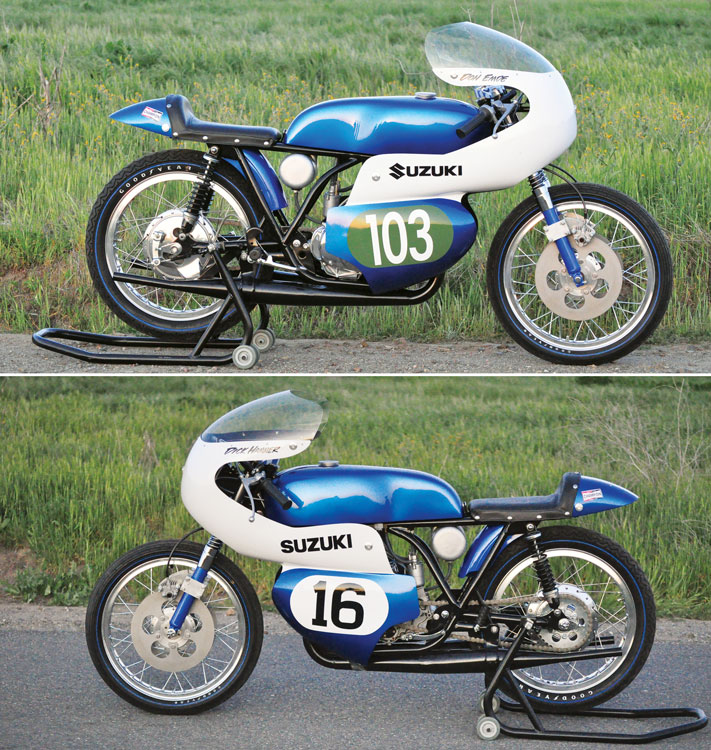
Suzuki returned to Daytona the following year, again with their X-6 special, but with no Walt Fulton, who had signed to race for Harley-Davidson that year. Regardless, this time the Suzuki’s ignition gremlins appeared tamed, although Hammer’s Suzuki (bike number 16 that’s featured in this article) never posted a complete qualifying lap, so he started the Amateur Expert 100-mile race (250cc bikes) from the back row. And, as Walt Fulton did in 1966, Hammer put the hammer down as he laid waste to the field rather quickly, moving from 80th to 9th place by the end of the fifth lap. Two laps later he was 5th, and by lap 17, Hammer was dicing with Gary Nixon and Bobby Winters — both on Yamahas — for the lead. Nixon and Hammer eventually pulled away to grapple for first place until… misfortune struck Hammer’s Suzuki. The left foot peg and brake pedal broke then separated completely from the bike, ending any chance for the win. Hammer nailed down a solid second-place finish, but that only confirmed once again that a bike’s good looks aren’t enough to win races.
New kid in town
By the end of 1967, Suzuki offered its TR250, a production racer that was based on the 1966 X-6 package so successfully ridden by Fulton and Hammer. The TR250 also had what became known as the Square Barrel engine due to the cylinder fins’ cubed configuration, unlike the stock X-6’s rounded cooling fin configuration.
And about that same time, Suzuki was making inroads with another racer, its TR500, a bike powered by Suzuki’s 500cc twin-cylinder Titan two-stroke, to compete in AMA Grand National road races open to bikes with engines up to 750cc. Consequently, the 250cc program became secondary in terms of spending resources from U.S. Suzuki’s limited racing budget; Suzuki pivoted to the bigger two-stroke program. As the 1968 AMA racing season approached, Fred Moxely, the man in charge of U.S. Suzuki’s racing program, elected to sell the original X-6 racers, one of which was sold to Floyd Emde’s Suzuki dealership in San Diego, California.
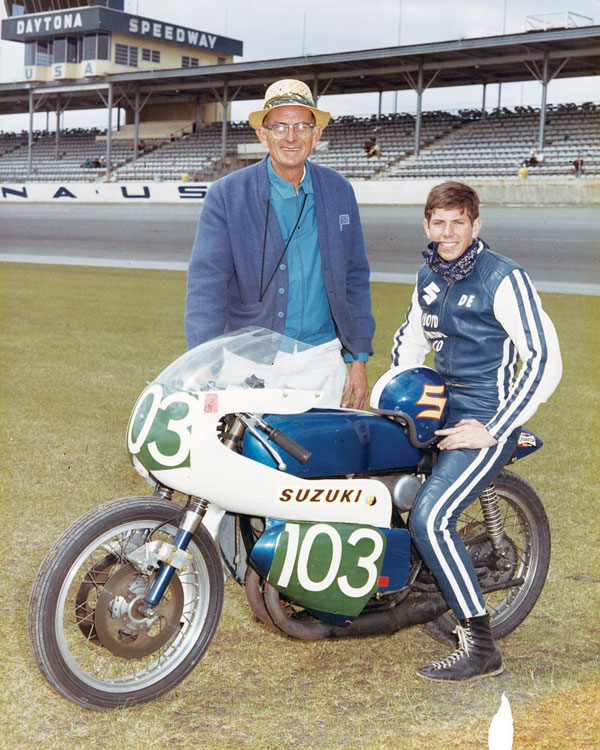
Floyd, a past winner of the Daytona 200 (1948, Indian, on the beach course), was supporting a similar X-6 flat-track program at Ascot Raceway with his middle son Don in the saddle, so it seemed logical to offer one of the X-6 road racers for Don to race in 1968. Emde, in turn, was looking to expand his road racing skills, so it made sense for U.S. Suzuki to help him into the saddle. Moxely got to the point, asking Floyd if he wanted to buy one of the four X-6 250s for 17-year-old Don to campaign in the AMA Sportsman division. They settled on bike number 16 — Hammer’s bike. Although nobody knew it at the time, and as you shall see, in a manner of speaking, Dick Hammer and Don Emde became joined at the hip thanks to this particular Suzuki X-6.
Bike 16, er, 103…
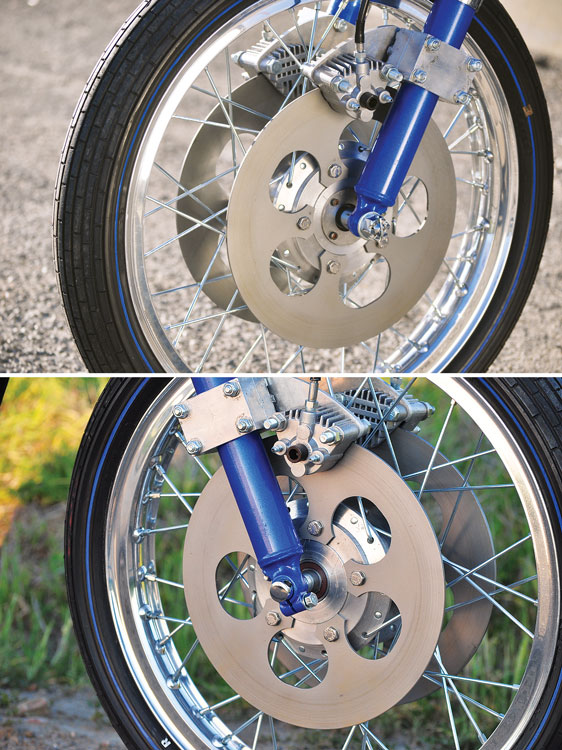
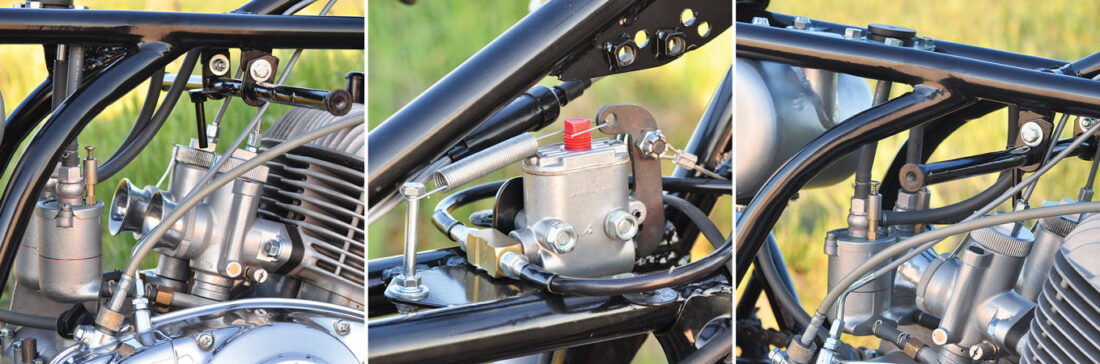
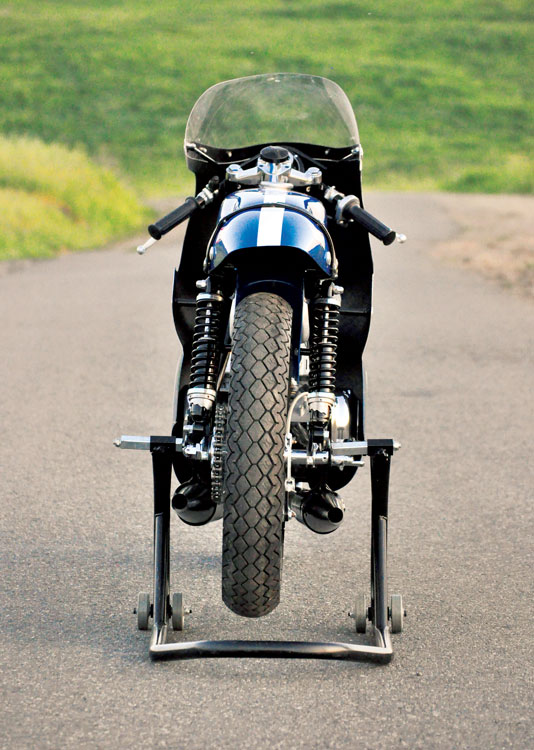
The three Suzuki X-6 race bikes that had been reserved for the Expert riders included hydraulic front dual-disc brakes, a rarity among motorcycle racers at the time (Fulton’s bike had mechanical drum brakes). Although nobody has officially stepped forward to explain exactly who developed the Suzukis’ front dual disc brake system, their design and components suggest they originated from Al Gunter’s groundbreaking designs. Gunter was among the top TT and flat track racers of his time, and he was especially a torrent of speed when sliding on Ascot’s half-mile, hard-packed, oval. And he always rode a BSA.
Gunter’s disc brake systems included various bits and pieces that had been explored and successfully developed by Franklin B. Airheart, a prolific engineer within the automotive and motorcycle communities who held many patents that impacted disc brake development during the 1960s. Most of the R&D took place under fire on racetracks. Among Airheart’s advanced concepts was the disc brake caliper, what initially became known as the “actuator” that allowed the small brake pads to “float” fractions of an inch adjacent the brake’s fast-spinning rotor. When the rider decided to slow down or stop completely, he squeezed the brake lever. That put into motion a rather simple sequence: pressure initiated by squeezing the brake lever forced hydraulic fluid from the master cylinder into small “brake lines” where hydraulic pressure forced, or squeezed, the caliper’s brake pads against the rotor’s flat, rotating, surface. The whole sequence was enough to create controlled friction that helped slow or stop the bike. Simple, yet ingenious in many ways.
While the Gunter/Airheart hybrid disc brake helped lay the groundwork for disc brakes, there were other players with their own motorcycle disc brake assemblies, too. For instance, Tom Heyster’s BSA had what appeared to be twin front disc brakes for his 1966 Daytona 200 entry, and Howard Barnes was always tinkering with his own disc brake concepts that sometimes included components developed by other innovators.
Indeed, our featured Suzuki has its Airheart master cylinder safely located on the frame’s stout backbone tube beneath the fiberglass gas tank. The brake lever on the right clip-on activates a typical steel brake cable, routed to the hydraulic master cylinder which then pumps brake fluid to the calipers. The payoff is surprisingly good braking performance.
But we need to stop here for a moment; those disc brakes are placing us ahead of this Suzuki’s restoration, so let’s pause to catch up with the past when Don Emde raced the ex-Hammer X-6 that he essentially inherited from Hammer.
Young Emde had just turned 17 when Floyd saddled him up and onto the Suzuki, but only after placing the proper AMA race number on its fairing sides. Off came Hammer’s 16, in its place was 103, Emde’s AMA Sportsman number. The young rider showed promise, too, putting his new Suzy racer in first place to lead the pack at the 1968 Daytona Sportsman race when… the bike’s ignition stopped igniting, forcing bike and rider to a halt. Years later, Walt Fulton recalled that his Suzuki tuner back in 1966, Tony Nicosia (who later went on to establish himself as a top-gun drag racer), had discovered that those early X-6 ignition systems had an Achilles Tendon of sorts (Walt doesn’t recall exactly what it was), and that Nicosia had a fix that he applied to Fulton’s bike. For whatever reasons, the other Suzuki tuners must have failed to fully implement that same fix, resulting in their bikes’ unreliability.
By summer of ’68, Emde temporarily swapped his number 103 for “71” to compete in an international race in Canada. By that time, Emde had logged a fair number of Southern California club races on tracks that he’d come to know especially well during his next two years of competition. That pivotal year, he joined a contingent of other SoCal club racers to venture to Canada’s Westwood Raceway for their first “International” racing adventure. As Emde recently pointed out, “Steve McLaughlin and a group of other AFM racers told me they were entering an international race at Westwood, a track right across the Canadian border north of Seattle. It was an ‘International’ race, and the Canadians invited Americans to join in. A small group of us went there to race and see what it was all about,” he recalled. The FIM sanction required the American riders to apply for FIM race numbers, to which Emde was assigned the number 71.
So, the SoCal contingent loaded their vans and pickup trucks before caravanning north through California’s long and hot Central Valley, then into Oregon and Washington, finally crossing the Canadian border, where the sunshine boys were greeted with classic Pacific Northwest “rainshine.”
Recalled Emde, “It was pouring rain during my race… and I crashed. After tearing away the damaged fairing, I remounted and finished third behind two Canadians on production TR250 Suzukis.” Not bad for a young racer who had little or no experience racing in the rain, and whose bike was, in a manner of speaking, old and dated compared to the TR250 production racers and their square barrel engines.
Grooming for the future
Don competed in several more AFM (American Federation of Motorcyclists) and ACA (American Cyclists Association) road races in Southern California, and as he gained experience, a certain tuner and sponsor had been monitoring his progress. Mel Dinesen, who owned a Yamaha dealership in Bakersfield, was also known for his tuning skills that helped aspiring young racers grow into successful racers, the most recent being Ron Pierce who, after a dominating 1967 season, joined Yamaha International’s factory USA team. And as the 1968 SoCal racing season concluded, Dinesen invited Don Emde, with Floyd’s blessing, to trade his Suzuki for Dinesen’s Yamaha the following season. In addition, Don agreed to ride all of Dinesen’s stable of race bikes, the end goal to compete throughout 1969 for the AFM Number 1 plate.
The following year put Don in the saddle four, sometimes five, times at every AFM race meet. It was enough to earn the coveted No. 1 plate, plus he and Dinesen won the AMA Amateur Expert 250cc 100-mile Talladega race, beating his friend and mentor Cal Rayborn and Gary Nixon to the finish line. Emde’s success also caught the eye of BSA’s U.S. team that led to a factory-sponsored ride. Perhaps the most notable “investment” came in 1972 when Dinesen signed Don to race the Daytona 200, which Don won, making Floyd and Don Emde the only father and son to win America’s signature motorcycle road race.
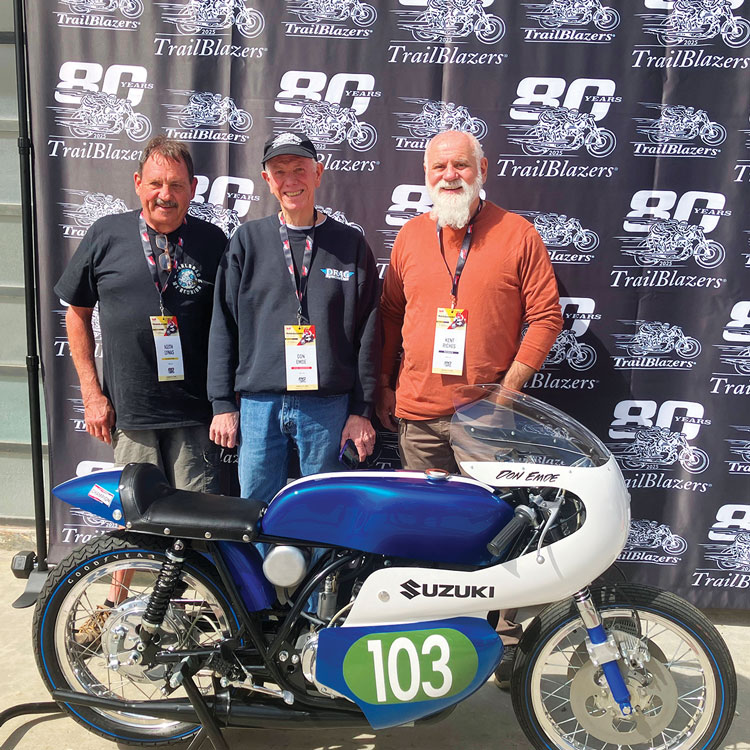
Now let’s get back to that reference about Dick Hammer and Don Emde becoming joined at the hip. The Dick Hammer Award originated at the Del Mar races in 2000 when three Trailblazers (Skip Van Leeuwen, Tom Cates, and Jim Feuling) led a movement to present Hammer with a special award that recognized his level of “Drive, Determination, and Desire” in everything he pursued in life. The award became an annual presentation, and ever since Hammer’s passing from his 10-year battle with cancer, it’s especially meaningful to Trailblazers members. Don Emde, who has served as Trailblazers’ president for more than a decade now, was presented the award at the 80th annual banquet, March 15, 2025. And it was at the banquet that Don Emde was reunited with his and Hammer’s quarter-liter Suzuki racer, which brings us full circle to Kent Riches’ shop for the impending restoration. Check that, it brings us to Keith Lynas’ shop, because that’s where the bike was housed for a majority of the past 40 or so years that Kent has owned it!
“I bought the bike from Floyd in 1989 or ’90, I can’t recall exactly,” confessed Kent. At the time he had no room to store the racer, but to the rescue came Kent’s good friend Keith Lynas, volunteering vacant floorspace in his shop. What are friends for, right? And Kent and Keith have been friends for many years. Keith is an ex-motocrosser who, a few years ago, stepped forward to help rescue what was left of the Ossa brand after the Spanish company cried “no más!” before closing its doors for good. Long story short, Keith has done what he can to help keep the Ossa brand active on American off-road trails and MX tracks.
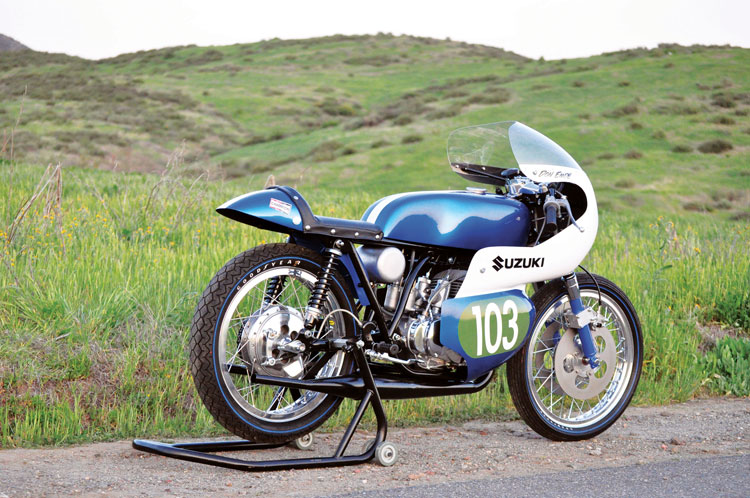
Let’s get back to the Suzuki. It was pretty much a rolling chassis; “there was no engine,” said Keith, and Kent made it clear that the bike’s original fiberglass was rather busted up (Don’s 1968 Westwood race, perhaps?).
“There was just enough of the fairing left that I could piece something together,” said Kent, who, as former owner of Air-Tech, is familiar with that versatile composite. He pointed out, too, that he called on a number of his friends and contacts in the industry for help. First in line was Keith who, as a Trailblazers board of directors member, had learned during the first week of February 2025 that Don Emde would be receiving the upcoming Dick Hammer Award at the banquet, scheduled for March 15, prompting a rather desperate phone call to Kent. In so many words Keith told Kent, “We’ve only a few weeks to finish the bike!” It was time to turn and burn the midnight oil as only racers can do, and after finishing the restoration, Keith reasoned rather clearly that Don’s award “was the stimulus to finish it [bike].”
Long story short
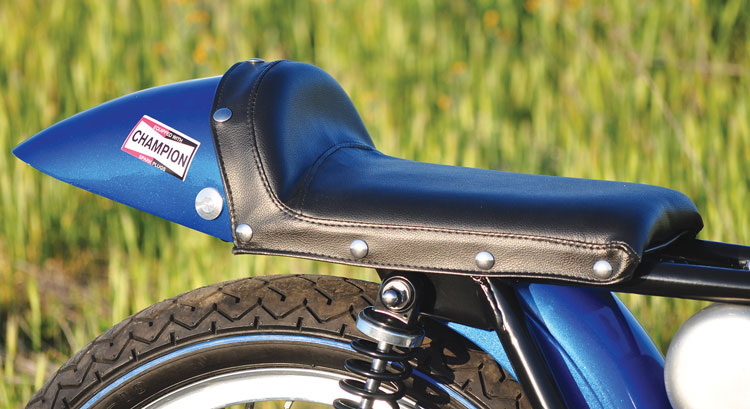
They made the deadline, but only after some heroics by their friends and contacts within the motorcycle community. For instance, Shawn Kilian made haste to apply powder coating to the frame and other bits and pieces. “He knocked things out real fast!” confirmed Kent. “My long-time race partner Randy Nelson helped me piece things back together — just like our old racing days!” he added. And when Kent wasn’t rubbing and scrubbing old parts, he shuttled the finished fiberglass and other parts needing paint to his painter friend Pete Finlan (aka Hot Dog) at Hot Dog Kustoms in Temecula, California, where the rich blue and white fairing helped give the finished bike its soul.
Clearly, and like many bike restorers, Kent has a laundry list of helpers, among them Robert Sanchez of Sanchez Plating in Escondido, California, who had parts in and out of the chroming vat just long enough to stew to that bright and familiar shine we love on older bikes.
As noted, the bike needed an engine, and by chance, Keith had a stock X-6 engine that he donated, along with the Amal carburetors and their remote float bowls. (There was no engine in the roller that Floyd delivered… although the deal included “boxes of various Suzuki parts”).
Finally, Keith recalled that one of the last things to do was lace new spokes to the new wheels. He squared that away practically moments before they rolled the finished racer onto Kent’s pickup truck for the ride to the Trailblazers Banquet that’s held annually in Carson, California. The rolling chassis that rolled into Kent’s and Keith’s lives back in ’89 or ’90 was now a bona fide and rolling racer that looked as fresh as the day it rocked and rolled on the race track back in the ’60s.
All that remained was to reunite Don Emde with the bike that he and Dick Hammer had raced so many years ago. The reunion transpired as entries for the bike show began rolling into the mezzanine, at which point Don caught his first glimpse of the old Suzuki. He recalled: “It really impressed me when they rolled it in. I was totally surprised!”
Perhaps it was fitting that the old Suzuki, now looking fresh and proper, rolled onto the showroom floor in the nick of time. The restoration wasn’t necessarily a race to the finish, but for Kent, Keith, and their friends, it was a race to finish the bike in time. Maybe there should be a new Racer’s Creed that we classic bike enthusiasts can abide by: “If you keep the restoration throttle wide open long enough and hard enough, your classic old racer can, once again, look as fresh and sparkling as it did during its glory days.” MC
(Author and Photographer’s creed: My thanks and gratitude to Keith, Kent, Don, and Walt for sharing their insight about this race bike. And a king-size thanks to my good friend and brother, Alan, and to our brother from another mother, John Lassak, for helping Kent and me during our photo session that carried us into the early evening. With their help in moving the bike for various photo angles, I successfully finished my race against the setting sun.) — DG