Yamaha XZ550R Vision
Years produced: 1982-1983
Power: 64hp @ 9,500rpm
Top speed: 113mph (period test)
Engine: 552cc (80mm x 55mm) liquid-cooled, DOHC 70-degree V-twin
Transmission: 5-speed, shaft final drive
Weight/MPG: 462lb curb, half-tank fuel/57mpg (period test)
Price then/now: $3,099 (1982)/$1,000-$3,300
In the late 1970s, every Asian bike maker built air-cooled, inline 4-cylinder bikes — lots of them, from 350cc to 1,100cc. They were the sliced white bread of their day. The problem? They all tasted alike. The Big Four found themselves in a standing-quarter-mile shoot-out every year.
So why not try something different? Kawasaki and Suzuki pretty much stayed the course with their UJMs, while Honda and Yamaha tried new ideas. Among the options considered was a 90-degree V-twin, employed to such success by Italian manufacturers. But packaging an L-twin wasn’t easy. Why not try a narrow-angle twin — in spite of their association with heavyweight cruisers?
Honda came first with the 80-degree transverse CX500. Yamaha fired back with the 75-degree Virago 750 and XVR920; then in 1982 came the revolutionary 70-degree V-twin XZ550R Vision.
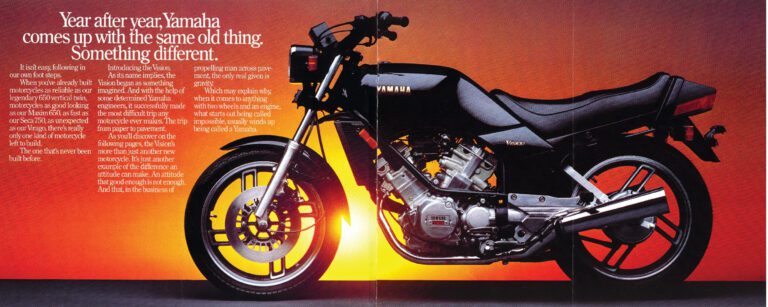
The Vision was all new in concept and execution: Its liquid-cooled, 552cc dual overhead camshaft 8-valve engine was well oversquare at 80mm bore by 50mm stroke, fed by a pair of honking 36mm Mikuni carburetors. To ensure adequate fueling at low revs, the Mikunis featured accelerator pumps, and the cylinder heads included Yamaha’s YICS induction control system, to improve “swirl” in the combustion chambers and promote more efficient combustion. And to negate the primary vibration inherent in high-revving, narrow vee engines, a single counterbalance shaft was added forward of the crank.
The Vision’s drivetrain created a uniquely new look, suspended from (and forming an integral part of) its triangulated steel tube frame. Absent was any pretense of cooling fins, just clean alloy cases and smooth cylinders. Inside was a plain bearing, single crankpin bottom end connected to a pair of 10.5:1 pistons, driving the four overhead cams by left-and-right spur gears and HyVo chains. Drive to the 5-speed transmission and shaft final drive was by straight-cut gears. Running on distinctive 18-inch alloy wheels with 90/90 and 110/90 tires, the Vision used a telescopic fork at the front with a single disc brake, while the drum-brake rear wheel hung on Yamaha’s “Monocross” swingarm with a single spring/damper unit adjustable for preload.
Cycle magazine took the Vision to the drag strip, recording 13.0 seconds at 100mph, which compared well with its contemporaries in the 4-cylinder class. So the Vision was a competent, innovative and sprightly motorcycle. What could possibly go wrong? Testers who rode the Vision praised its performance and lack of vibration while admiring its nimble steering. But the engine was not quite ready for prime time, with a noticeable flat spot in the carburetion at around 4,000rpm, and an idle speed that could vary by 1,000rpm. (A dealer reset partially cured Cycle‘s test bike). And while ground clearance was excellent, the Vision’s thrift-store suspension gave vague handling. The rear shock could be adjusted for preload, but the front fork had no adjustment at all. Braking with the single front disc was “meekly adequate” Cycle said. And what was a putative sport bike doing with a power-robbing shaft drive? But it was probably the Vision’s eye-watering price that limited its appeal: Yamaha’s own XJ550 4-cylinder cost $300 less than the Vision’s $3,099 MSRP.
Yamaha responded to critics in 1983 with an extra front brake disc, a wider front tire at 100/90, an air-adjustable front fork, a rear shock with a rebound damping adjuster, and a modified intake to fix the carburetor glitch. And to mollify critics of the sterile engine appearance, a handlebar fairing was added. All this pushed the price up to $3,299 for 1983. Sales stayed low, and 1982 models were soon heavily discounted.
Cycle perhaps summed up the Vision best: “It’s convenient to think of the Vision as the Japanese manufacturers’ last great attempt to build an all-purpose, versatile, mid-displacement motorcycle. [But] the mid-displacement class was breaking apart, forming two specialized rivers: cruisers, the major artery; sport bikes, a smaller tributary. The Vision, left in the middle, fell into the void.” MC
Contenders

1978-1982 Honda CX 500
Years produced: 1978-1982
Power: 48hp @ 9,000rpm (claimed)
Top Speed: 108mph (period test)
Engine: 497cc (78mm x 52mm) liquid-cooled, OHV, 4-valve transverse twin
Transmision: 5-speed, shaft final drive
Weight/MPG: 481lb (wet)/43mpg (avg., period test)
Price then/now: $1,898 (1978)/$800-$1,800
If you had been a motorcycle courier in Britain in the 1980s, chances were better than even your mount would be a CX500. Riders loved the maintenance-free shaft drive, the easily adjustable valves, tubeless tires, (mostly) bulletproof reliability — and leg-warming heat blowing from the radiator in London’s winters!
Designer Soichiro Irimajiri of CBX fame drew up a revolutionary but logical alternative to the UJM: a 500cc transverse, 80-degree V-twin with eight pushrod-operated valves, CV carbs, five gears and shaft drive. The drivetrain was an integral part of the backbone chassis, which ran on Comstar composite wheels with a single front disc and rear drum. The result was a bike that worked, Cycle magazine said. “It’s comfortable, inexpensive, peaceful, fast and capable, and it handles very well both on the Interstate and in the mountains.” But it wasn’t without issues. Cycle World‘s long-term tester broke its timing chain tensioner, a common problem with the 1978s, and the subject of a recall. Other known problems: alternator stator and water pump seals — both engine-out repairs. That said, Cycle Guide concluded, “Honda certainly has done an enviable job of breaking out of the old four-cylinder routine.”

1980-1989 Moto Guzzi V50 Monza
Years produced: 1978-1982
Power: 48hp @ 9,000rpm (claimed)
Top Speed: 108mph (period test)
Engine: 497cc (78mm x 52mm) liquid-cooled, OHV, 4-valve transverse twin
Transmission: 5-speed, shaft final drive
Weigth/MPG: 481lb (wet)/43mpg (avg., period test)
Price then/now$1,898 (1978)/$800-$1,800$1,898 (1978)/$800-$1,800
If 4-cylinder UJMs were the Wonder Bread of motorcycles, Guzzi’s 500 Monza was the focaccia. Conceived by Alejandro de Tomaso when he bought MG and Benelli around 1973, the “small block” Guzzi engine was compromised from the start by de Tomaso’s frugality, insisting on using leftover components from the failed Benelli/Guzzi 254 engine, fitted with cheaper-to-make Heron cylinder heads.
Down on power in this class, the Monza was a second slower than the Vision in the standing quarter; but was also considerably lighter, which benefited its handling: “amazingly stable,” said Cycle magazine, “The Guzzi tracks through corners as if it were laser guided.” And while the forward riding position was a stretch in town, Cycle’s tester found it worked well at 70mph-plus speeds. Stopping was by triple discs operated by Guzzi’s linked braking system, the pedal operating one front caliper and the rear brake. From 1981, Monzas were fitted with mechanical contact breakers replacing an unreliable Bosch electronic module.
The Monza wasn’t a big seller in the U.S. In comparos, it lagged on power, performance and price. But “Italian machines have strong, loyal, articulate, even vociferous partisans,” for whom “the strengths of European engineering still outweigh the quirks,” Cycle wrote. The small-block lives on, developed into today’s Guzzi V7 and V9 engines!