In the heart of Texas, just north of downtown Dallas, a revival is blending art and craftsmanship with a passion for motorcycles. The Haas Moto Museum & Sculpture Gallery, named after the late Bobby Haas, is once again one of the top motorcycle museums in the country, after a period of uncertainty. If you’ve not heard of or visited the museum, it can be described as a place for lovers of mechanical art, but it also serves as a reminder that it’s never too late to fall in love with motorcycles.
Bobby Haas didn’t grow up working on bikes or racing them around the neighborhood. In fact, motorcycles weren’t even on his radar for most of his life. Haas was a Harvard-trained lawyer and a powerhouse in the high-stakes world of Wall Street during the 1980s, where he made his fortune through leveraged buyouts. But, that life ultimately left Haas unfulfilled. At age 47, Bobby shifted away from finance and picked up a camera for the first time. He found a strong interest in wildlife photography, and his work was featured in National Geographic and several coffee table books, earning him recognition in the field.
In his early 60s, Haas discovered motorcycles, first through the purchase of a utilitarian Ural sidecar rig in 2014, followed by a 1962 Matchless G3L he bought on eBay. That marked what would become an all-consuming passion.
Stacey Mayfield partnered with Bobby in 2016 as museum co-founder & director and, over the next few years, Bobby and Stacey began acquiring motorcycles with a collector’s eye — but not for performance or brand prestige — the interest was always about the beauty. Lines. Shape. Story. The motorcycles were seen as sculptures as much as machines. The collection grew from a handful of bikes to over 200 motorcycles, which were originally displayed across two locations in Dallas’s Design District. They treated the bikes as both artifacts and art.
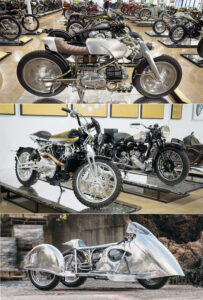
From the beginning, one thing that differentiated the Haas collection was its emphasis on custom motorcycles. Bobby developed personal relationships with many of the world’s top builders. Some machines were purchased; others were commissioned and collaboratively built with Haas’s funding. By the time the museum formally opened in 2018, it housed the largest known private collection of custom motorcycles in the world.
Uncertain future
The trajectory of the museum changed when Bobby passed away unexpectedly in September 2021. His death left a void not only in the halls of the museum but in the global motorcycling community.
In the hauntingly prescient 2020 documentary Leaving Tracks, which chronicled Haas’s life and the creation of the museum, Bobby made an announcement that three years after his death, a core group of the custom bikes would be returned to the builders he had formed close relationships with.
That idea became increasingly real with the closure of two other major U.S. motorcycle museums in 2024 — The Moto Talbott Collection in Carmel, California, and the Lone Star Motorcycle Museum in Vanderpool, Texas — both of which shut down and sold off their collections. But the Haas Museum took a different path.
A new home
In 2024, under the leadership of museum director Stacey Mayfield, the museum secured new financial backing and a long-term plan for sustainability. The collection found a new home, closed its two Design District locations, moved its over 230 motorcycles to a new site approximately 13 miles north, and officially reopened in November 2024.
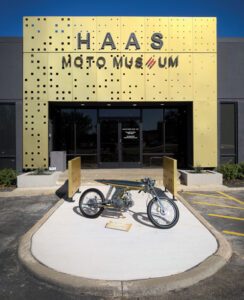
The new location, at 4301 N. Beltwood Parkway in Dallas, offers significantly more space — enough to house the full collection under one roof with room to grow. It includes a large, professional-grade restoration and build shop, a sculpture gallery, and space for event hosting, thanks to an expanded parking lot and soon-to-open beer garden. Most importantly, it carries forward what Bobby was building.
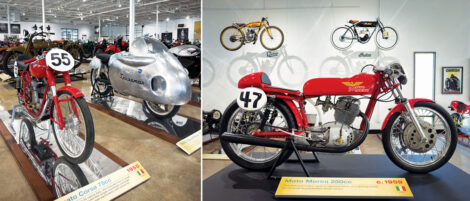
What hasn’t changed is the museum’s guiding belief that motorcycles are art, and that every motorcycle has a story worth telling. The collection remains around 230 machines strong, and future acquisitions are in the works.
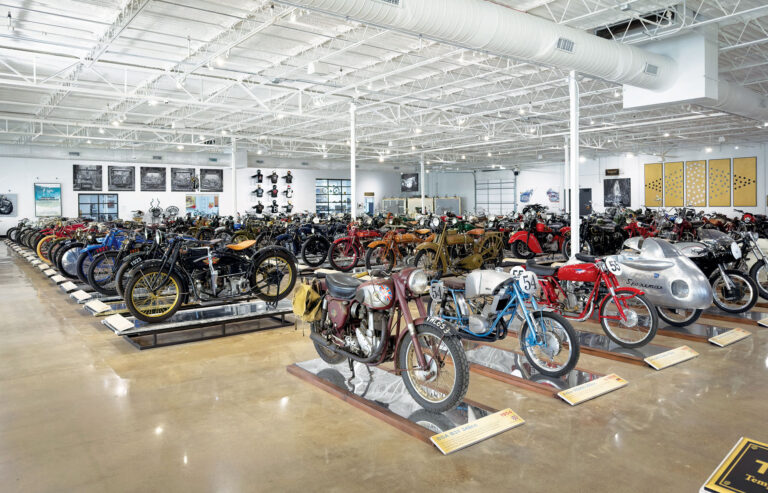
The motorcycles are thoughtfully displayed with ample spacing and excellent lighting — no jumbled rows or dim corners. The Haas Museum’s exhibition layout allows visitors to view intricate fabrication details, capture clean photographs, and, above all, appreciate the art behind each machine.
The space is divided into several themed sections:
- History Hall – Roughly 70 motorcycles arranged in chronological order, starting from the late 1800s, presenting an impressive overview of motorcycling history.
- The Race Track – A high-octane lineup of competition machines, from road racers to drag bikes and land speed monsters.
- Sidecar Alcove – A three-wheeled tribute that includes important machines like Mister Fahrenheit, the sculptural, streamlined land speed sidecar built by Craig Rodsmith.
- The Custom Shop – Arguably the crown jewel of the museum, this section showcases the finest in modern custom builds. Though Bobby’s will suggested the customs would be returned to their builders, many artists have since donated, loaned, or sold their bikes back to the museum in tribute.
Beyond the bikes themselves, it’s about the stories they carry. Stacey put together a beautifully designed book that features each motorcycle, with captions based on the detailed placards Bobby originally wrote for the exhibits. (The book is available at the museum or from the Motorcycle Classics Store — see page 60.)
In addition to the motorcycles, the Haas features a rotating collection of motorcycle-themed sculptures and paintings, adding an extra dimension to the space. Few museums integrate fine art and mechanical beauty as seamlessly as the Haas does.
The Rodsmith connection
One of the most powerful personal stories tied to the Haas Museum is that of Craig Rodsmith, a master metalworker and custom bike builder known for his stunning bare-metal finishes and experimental design.
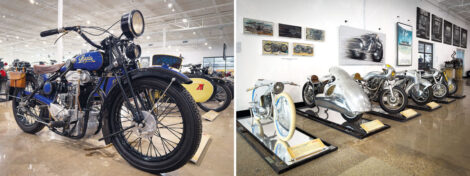
Craig and Bobby were close collaborators and friends. Their partnership culminated in the creation of Mister Fahrenheit; the Moto Guzzi-powered land speed sidecar designed to race at Bonneville. That story is told in the documentary Racing Mister Fahrenheit, available on Prime Video.
Rodsmith is now a permanent part of the Haas team, serving as the museum’s in-house custom builder. He’s already completed his first project in the new facility’s shop, proving that the museum isn’t just a time capsule, but a living, evolving tribute to motorcycle culture.
Looking ahead
The museum’s comeback is a personal commitment for the people behind it. As Stacey reflects, “My goal for this labor of love is to honor the past, focus on the present, and embrace the exciting future of the museum. Bobby remains our guiding light, and the team and I have no intention of letting that dim. Sparky, Nancy, Brent, and now Craig each bring unique talents, and I’m endlessly grateful to work alongside them. We’re a family and they’re a part of the legacy I’ll continue to carry forward.” That future includes continued participation in major motorcycle events like the Distinguished Gentlemen’s Ride and Bonneville Speed Week, as well as growing the museum’s online presence to reach a broader audience.
If you’re anywhere in the North Texas area, or you’re just looking for a good reason to plan a trip, the Haas Moto Museum should be on your list. Yes, with over 230 motorcycles on display, it will take some time to study and appreciate the nature of each motorcycle, its qualities, and why it’s on display. It’s not a museum to rush through. It’s a museum, several galleries, and overall a bit of a love letter to motorcycles and the people who build, ride, and cherish them. MC