Moto Guzzi 850 Le Mans Mk1
Years produced: 1976-78
Total production: 6,817
Claimed power: 71-80hp @ 7,3000rpm
Top speed: 133.5mph (1977 test)
Engine type: Overhead-valve, air-cooled V-twin
Weight (dry): 196kg (431lb)
Price then: $3,679 (1977)
Price now: $7,500-$10,500
MPG: 35-55
Bikes are getting bigger. That’s not news of course, but in an age when many cruisers have the displacement of a Honda Civic, it’s tough to remember that street 750s were once called Superbikes.
It’s a tough call as to who built the first Superbike, but when Honda jumped on board in 1969 with the Honda CB750 Four, it became the gold standard. You could argue Laverda, Norton, Royal Enfield and Triumph were there first, but by 1972 Kawasaki, Suzuki, Ducati, Moto-Guzzi, MV Agusta and BMW all had three-quarter-liter offerings.
It’s said, Kawasaki had its own SOHC 750 on the drawing board, but decided instead to leapfrog its rival, creating the DOHC 900cc Kawasaki Z1 and the new benchmark capacity.
Norton, Ducati, BMW and Guzzi all produced pumped-up versions of their existing engines: 850 Commando, 860GT, 900SS, BMW R90S and 850T, respectively, all intended to stem the trans-Pacific tide. In some cases, these became classics, viewed by many as the ultimate expression of European motorcycle tradition. And that’s how the sleek and sinuous Moto Guzzi 750 V7 Sport became the Moto Guzzi 850 Le Mans.
Pushing the envelope
Guzzi’s V7 of 1971 combined Giulio Cesare Carcano’s remarkable transverse V-twin with a sleek new frame by Lino Tonti, which required that the belt-driven generator be replaced by a pan-type alternator at the front of the engine. The result was a marriage of brilliance. The V7 Special and Sport were swift and diminutive lightweights in the 750 class. With the 900cc imperative, the engine gained a longer stroke with plated barrels replacing the V7’s iron liners for 844cc, creating the touring 850T.
The Le Mans borrowed the 850T’s engine, but with high-compression pistons running in the chrome-lined alloy barrels, larger valves, new camshaft and two 36mm “pumper” Dell’Orto carbs. Brembo callipers gripped the twin drilled cast iron front brake discs, one of which was linked to the rear disc through the brake pedal (the system also used on the triple-disc 850T3).
What was different about the Le Mans was its styling. The clip-on bars, rearset footrests and humped seat all made it a worthy successor to the V7 Sport. At 71hp and 124mph (when introduced in 1976) it may not have been as quick as the Kawi, but it would see off the Beemer and be just behind the Duc. Deservedly popular in its day and still very usable in modern highway conditions, the Moto Guzzi 850 Le Mans Mk1 is a true classic that has justifiably acquired cult status.
The Tonti-framed Le Mans ran to 1991 and five Mark series, with capacity upped to 1,000cc for the MkIV. And of course, the name lives on in today’s backbone-framed V11 Le Mans.
Going for the Guzzi
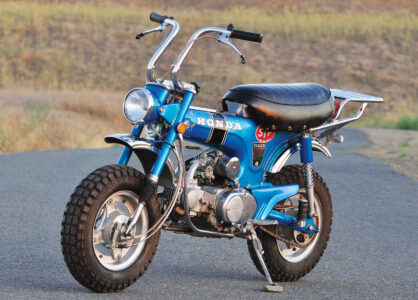
The story of how Alan Comfort acquired his 1976 Moto Guzzi 850 Le Mans Mk1 turns on the chance acquisition of a tiny Honda, and the selling power of eBay. A death in the neighborhood around his east Vancouver home resulted in a house clearance sale. In the basement, under nearly 30 years of concrete dust and wood shavings, was a 1973 CT70, Honda’s offroad, open-frame tiddler. Unaware of the CT70’s fanatical following, Alan made the family an offer.
“I scraped the dust off the odometer and saw 67 miles recorded,” he says. “I probably could have bought it for $50, but I offered them $500.
“After I’d paid up, they produced the original bill of sale and laughed. It was for $373.”
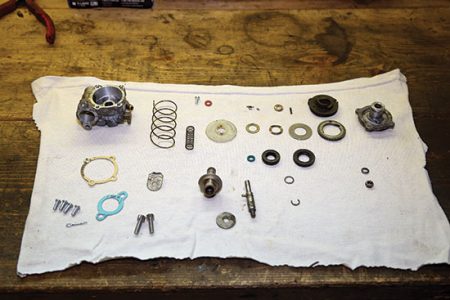
Alan had the last laugh, though. Some research revealed how much a CT70 was worth to one of the little dirt bike’s army of fans. After its fuel system had been reconditioned, the diminutive Honda burbled back into life. A little cosmetic work, and the CT70 looked as good as new. Alan listed it on eBay. It fetched $2,750!
Guzzimania
“I remember ogling Guzzis when they were first sold in North America in the 1960s,” Alan says. “I was riding a ’50 Harley Panhead at the time. I even made lithographs of Guzzis when I was in art school. I’ve been lusting after one ever since.”
Guzzis were off-limits for some time while Alan did the family thing, and when he got back into bikes a few years ago they were still expensive. “They were always just out of reach, a little more than I wanted to pay,” he says.
Alan’s good fortune with the CT70 convinced him it was time to get serious, so he put his BMW R65L daily driver on the market and went shopping for a Le Mans. He found one advertised in a local auto trader magazine.
“There was a long period of negotiation,” Alan says, “not about price, but about whether the bike was going to a good home. It wasn’t until I told him about my lusting and lithographs that he agreed to even show it to me.”
Alan expressed some concern over the bike’s serial number, which was outside the published range for a genuine Le Mans. Imitations of Guzzi’s top sportster are sometimes fabricated out of 850Ts and other mundane Mandello machinery. Negotiations suffered a downturn, but another two months of back-and-forth finally saw money change hands. Though he’s now determined it is a genuine Le Mans, Alan says, “I didn’t care, really, because it had all the right stuff.”
Life with Le Mans
So what’s the Le Mans like to ride? “I haven’t stopped smiling. It’s fabulous,” Alan says. “You couldn’t ask for a better bike. It goes well and stops well. And the sound it makes is like Luciano Pavarotti on full song.”
Alan says the Le Mans is long-legged, with a “sweet spot” at around 90mph. It’s very stable at speed and relatively easy to ride in stop-go traffic. It can stay with most bikes in the twisties, “but the rider gets a real workout,” Alan notes. He even likes the oft-maligned linked braking system.
“It’s a good feature 99 percent of the time,” he says. “The 1 percent when you’re stopping downhill on a loose surface can be a bit frightening.”
Aesthetically, there’s no question the Le Mans is a hit. “Long, narrow and low with pleasing lines, it has just the right amount of upsweep on the exhaust and curves on the tank. It’s a small bike by today’s standards; when riding beside modern sportbikes with large section tires, it looks like a 250. But mostly, it’s Italian and red,” Alan says. ‘Nuff said. MC
Read more about the motorcycle mentioned in this article:
• Honda CB750 Four: A Classic for the Masses
• 1973 Kawasaki Z1: King of the Road
• BMW R90S