Honda CX500
Claimed power: 48hp @ 9,000rpm
Top speed: 106mph (period test)
Engine type: 497cc overhead valve, liquid-cooled v-twin
Weight (dry): 441lbs
MPG: 45-55
Price then: $2,398 (1979)
Price now: $700 – $1,700
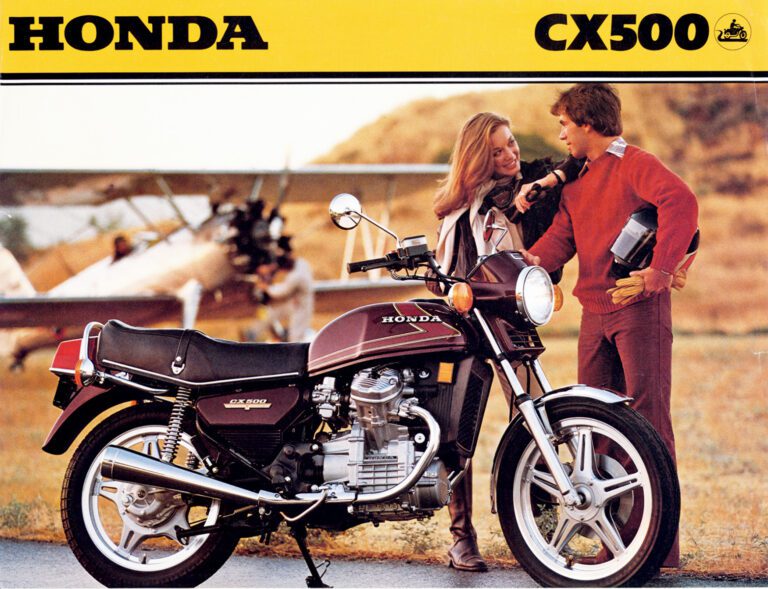
“First into the Future!” Coming from anyone else, those words would just be more tired huckstering. But coming as they did from Honda’s ad men announcing the new-for-1978 Honda CX500, they demanded at least a bit of attention.
In today’s world of massive, 1,800cc cruisers and 150-plus horsepower sportbikes, it’s easy to forget that middleweights once ruled the road. While there were plenty of big bikes around in the late Seventies, the middle ground of 400cc to 650cc machines was a hotly contested category where Japan’s Big Four pitched their wares to mostly newer, younger riders. By 1977, Yamaha offered four mid-sized machines in two- and four-stroke guise, Suzuki had no less than seven, Kawasaki six and Honda four.
The beefiest of Honda’s middleweights was the CB550 Four. A smooth, capable machine based on the Honda CB750 introduced in 1969, it was decidedly old-school and hardly the machine to entice a new generation of riders. Enter the Honda CX500.
Moving forward
Keen to preserve its reputation as a pioneer in motorcycle design, a reputation garnered most notably by the CB750 and the water-cooled, horizontally-opposed GL1000 introduced in 1975, Honda assigned the task of designing a new middleweight to Shoichiro Irimajiri, the man responsible for the Honda GL1000 and, later, the legendary six-cylinder Honda CBX.
Working from a clean sheet, Irimajiri and his team came up with a machine that drew almost nothing from the past and instead looked to the future of motorcycle design. What they came up with was unlike anything ever built by Honda: a water-cooled, shaft-driven V-twin. Water-cooling was hardly new, but it had never been applied to a V-twin. The same with shaft drive, but so far Honda had only used it on the massive GL1000. Yet Honda had never produced a V-twin, and this was to be a twin like no other.
To begin with, while everyone was singing the praise of overhead-cam engines, the 48hp CX500 made do with simple pushrods. This kept the engine height low and dispensed with the complexity of running separate cam chains to each cylinder. To make things interesting, Irimajiri twisted the heads 22 degrees inboard to pull the carbs in closer to the middle of the bike and out of the rider’s way. This had the benefit of splaying the exhaust pipes out for a stronger visual statement of power.
To help lower the center of gravity, the counter-rotating (to fight the longitudinally-mounted engine’s twist under power) five-speed transmission was located just below and to the right of the engine. All of this was hung as a stressed unit from a spine frame, supported by standard telescopic forks at front and adjustable shocks at rear. Importantly, the CX500 was the first production bike equipped with tubeless tires.
Goes better than it looks
Response from the press was mixed. With its huge 4.9gal tank and big cylinders hanging out in the wind, testers found themselves less than excited about Honda’s revolutionary twin. In a February 1978 review Cycle Guide editors said, “Our first look at the machine was quite a letdown,” while Cycle World singled out the CX’s engine, saying it “looks like an air compressor.”
But once they climbed on board, criticism turned to praise for the bike’s smooth suspension and excellent handling. “We must consider the CX500’s handling as excellent,” Cycle Guide said, while Cycle’s May 1978 issue praised it for its excellent ground clearance and responsiveness, calling the bike’s steering “wonderfully neutral and light, it seems almost to sense your desire to make slight course corrections.”
Buyers were a bit skeptical at first, and early problems with the cam chain tensioner and alternator probably didn’t help fire CX500 sales. But Honda stuck to the model, and as time ticked on the CX500 built a loyal following of owners, many using the twin as a long-haul touring machine or daily commuter.
In 1979 the Honda CX500 lineup was expanded to three with the addition of the Custom and Deluxe models, which proved so popular the standard model illustrated here was dropped in 1980. 1981 saw the addition of the Silver Wing and Silver Wing Interstate, featuring a rear-mounted accessory box on the former and a full factory-made fairing on the latter, while 1982 saw the introduction of the baddest CX500 of them all, the 82hp CX500T turbo.
The CX’s last hurrah came with the uprated 650cc CX650 in 1983 (a 97hp turbo was also offered), after which it was dropped to make way for Honda’s new line of liquid-cooled V4s, which were yet another in a string of pioneering motorcycles from Honda.
Overall, the CX500 was a good seller for Honda, and a well-earned reputation for being bulletproof means the CX survival rate is high, so there are still plenty of good examples out there. Almost all bikes will have had the timing chain tensioner fixed (three punch marks in a triangle next to the engine’s serial number confirm the fix was done), and aside from that, the biggest issues are dirty cooling systems and improperly adjusted valves, which had a tendency to go out of spec quickly, especially on early models.
Middlweight rivals to the Honda CX500
1978 Yamaha XS500

– 38hp, 110mph
– 498cc
– Air-cooled
– 5-speed
– Dual disc front, single disc rear
– 423lb (dry)
– 40-50mpg
– $800-$1,800
Unlike its bigger brother, the legendary Yamaha XS650, the two-cylinder XS500 (first introduced in 1973 as the Yamaha TX500) never really caught on.
Why? For starters, it developed a reputation as being wildly unreliable, with reports of a balancer and cam chain arrangement that needed constant attention, and heat dissipation issues that caused valves to burn up and cylinder heads to crack.
The vertical twin’s performance didn’t make many hearts flutter when it was introduced, either, as the bike posted below-average quarter-mile speeds in its class and reviewers noted problems with drive-train backlash and dodgy throttle response on early models.
On the plus side, the bike boasts many of the features that made classics of the XS650 and the three-cylinder XS750. Its combination of a 180-degree crank with a vibration damper, electric start and twin carbs makes for a smooth and easy ride, and its styling lines are clean and were quite fashionable in the day. It’s still a handsome bike today.
Yamaha logged the complaints about the 500, made refinements and continued to produce it until 1979. A surprisingly high survival rate suggests they weren’t nearly as unreliable as many believed, as nice examples surface regularly.
1980 Moto Guzzi V50 Monza

– 48hp, 109mph
– 490cc
– Air-cooled
– 5-speed
– Dual disc front, single disc rear
– 353lb (dry)
– 45-55mpg
– $2,000-$4,000
Based on the V50 that Moto Guzzi introduced in 1977 as a down-sized option to its successful 850cc V-twins, the sporty Moto Guzzi V50 Monza was an attempt to inject some excitement into a bike the U.S. market simply didn’t find attractive.
Where the standard V50 was somewhat austere and devoid of any gee-whiz factor, the Monza had the go-fast styling of its celebrated big brother, the LeMans. Its 490cc V-twin pumped out a respectable 48hp (the same as Honda’s CX), and like most Italian sport bikes it was endowed with excellent handling, something you couldn’t say about all its Japanese competitors.
An aggressive seating position and excellent high-speed manners inspired frequent runs up to the bike’s claimed top speed of 109mph, while Guzzi’s controversial linked brake system (the left front and rear calipers are linked to the foot pedal; the hand lever operates the right front caliper) with triple discs was more than adequate to bring the bike’s modest bulk to a quick stop.
Unfortunately, the Monza’s reputation for quirkiness — coupled with a sticker price north of $3,000 — helped guarantee success for bikes like the CX500, which offered the added promise of Japanese reliability for almost a grand less. Low production and slow sales mean survivors are few and far between, but they are out there, and most are still in good shape thanks to enthusiastic owners.
Read more about the other motorcycles mentioned in this article:
• Honda CB750 Four: A Classic for the Masses
• Honda Gold Wing GL1000
• 1981 Honda CBX
• Yamaha XS650
• Yamaha TX500
• Moto Guzzi V50 Monza