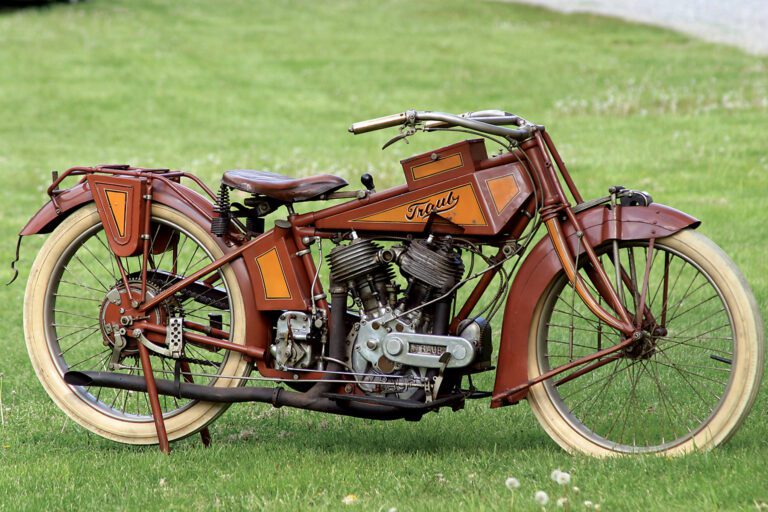
Found hidden in a bricked-up wall in a Chicago suburb 40 years ago, the 1916 Traub motorcycle is still a mystery today.
Pulled from its dark, secretive hiding place of 50 years, this Traub is the only example ever found. Since its discovery, the Traub has provoked more questions than it has provided answers. But one thing is for sure; this is a unique, one-of-a-kind classic American motorcycle. And with all attempts to reveal its true identity leading only to frustrating dead ends, at this time we have to be content with the hard facts that have been collected by its current owner, Dale Walksler.

As the man who owns the world famous Wheels Through Time classic motorcycle museum in Maggie Valley, N.C., Walksler has been riding, working on and collecting rare and classic American motorcycles for nearly 40 years. And in all his years around American classics, he has never seen anything quite like the Traub.
Hidden Origins
Found in 1968, the Traub was bought in 1972 by Bud Ekins, famous as Steve McQueen‘s stuntman. Ekins later sold the Traub to collector Richard Morris, who then sold it to Walksler in the mid-1990s. The Traub is now one of the “crown jewels” in Walksler’s collection of 240 classic American motorcycles. And believe it or not, it actually gets ridden on a fairly regular basis: Dale has even had the engine apart to cure a knocking noise that turned out to be a worn out connecting rod bushing.

Ask him about the components inside the engine, and he’ll tell you with great enthusiasm that “everything inside the engine is just magnificent. The pistons are handmade, and they have gap-less cast iron rings. The engineering and machining are simply years ahead of their time.” During the reassembly process, the only parts Dale had to fabricate were the base gaskets. The bike doesn’t use any other gasket anywhere in the engine, as it is so perfectly machined. This is one significant indicator that this was not a mass-production machine.

While the majority of the components on the bike are handmade, it is the “off-the-shelf” parts that have enabled Walksler to determine an approximate date of 1916 for the Traub. Equipped as it is with a Schebler carburetor, a Bosch magneto, a Troxel Jumbo seat and period wheel rims, the bike’s creator left some concrete clues behind as to the age of the machine.
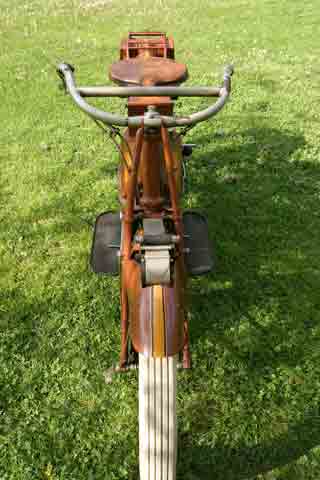
The rest of the bike is unique. For example, a close inspection of the rear brake reveals a dual-acting system with a single cam responsible for pushing an internal set of expanding shoes, while pulling an external set of contracting shoes. As far as Dale knows, this single-cam/twin-brake system has never been used on any other American motorcycle.

Stepping around the left side of the bike, the careful observer will notice two clutch levers. There is a conventional foot-operated mechanism, and also a hand lever that sits alongside the fuel tank on the left-hand side. The lever gate for the shifter is also unique, operating what could have been the first three-speed gearbox on an American motorcycle. Even more, the tranny also features two separate neutral positions, which are marked on the shift mechanism with a zero. These are found between first and second gear, and between second and third gear.
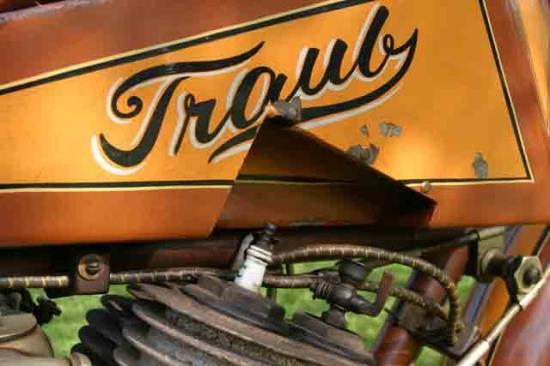
Power is provided by a beautifully crafted 78ci V-twin engine with a 4in stroke and a 3 7/16in bore, yielding an engine capacity of 1,278cc, which was large for the time. The majority of big displacement motorcycle engines from the Traub’s era were around 1,000cc (61ci). Using a side-valve arrangement, the top of the cylinders feature a gas primer valve, although Dale notes this is not really an unusual feature. What is unusual, however, is the adjustable crankcase breather and the engine fasteners, which are unique to the Traub and whoever built it.

As one of the highlights of any tour through the Wheels Through Time Museum, the Traub is enjoyed by thousands of people every year, some of whom are lucky enough to hear it run and see it riding around the museum grounds.
Shrouded in mystery, the Traub motorcycle was without a doubt many, many years ahead of its time. With its wonderful innovations, intricate machining and impressive attention to detail, you may never see an American motorcycle this rare again.

With no photographs, no documentation, nor anyone claiming to have any knowledge of its origin, it appears for now that the mystery of the Traub motorcycle will remain. Maybe someday the full story behind this unique motorcycle will be unearthed, but in the mean time it serves as an interesting chapter in the history of American motorcycle design. MC