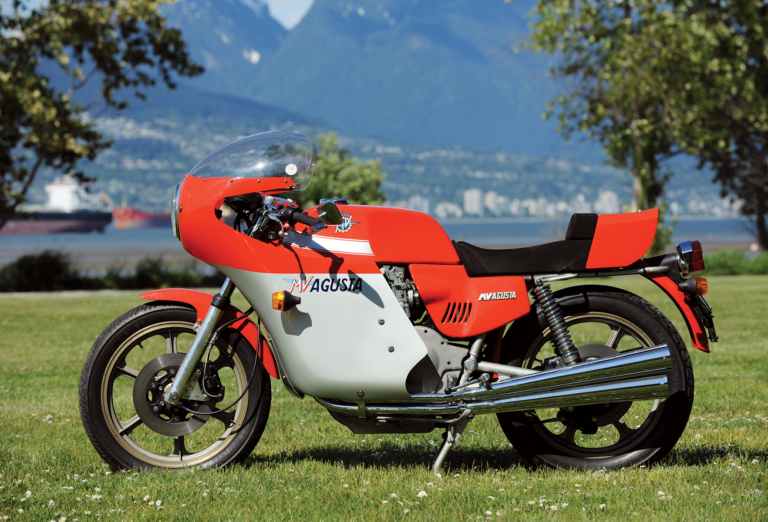
1977 MV Agusta 850SS

Claimed power: 85hp @ 9,500rpm
Top speed: 140mph (est.)
Engine: 837cc air-cooled DOHC inline four, 69mm x 56mm bore and stroke, 9.5:1 compression ratio
Weight (dry): 517lb (235kg)
Fuel capacity: 6.3gal (24ltr)
Price then/now: $6,400 (approx.)/$40,000-$70,000
It is unlikely that MV Agusta’s run of 17 consecutive Grand Prix world championships will ever be equaled, let alone beaten. From 1958 to 1974, the bright red “fire engines” of Meccanica Verghera Agusta dominated the premier 500cc class.
No other manufacturer came close. That is, until the Japanese factories extended their supremacy of the smaller capacity classes into the big leagues. Not to take anything away from Count Domenico Agusta’s magnificent machines, but they did make good at the right time.

At the end of the 1957 season, MV’s three most serious competitors — Gilera, Moto Guzzi and FB Mondial — all closed their race departments, and Norton had pulled out in 1956. That gave MV the pick of the best riders of the era: John Surtees, Mike Hailwood, Giacomo Agostini, Gary Hocking and Phil Read. With no factory-based competition, MV repeatedly swept the field in 350cc and 500cc racing right through the 1960s.
MV four beginnings
The road that led to the 850SS started with Ing. Piero Remor, who arrived at MV Agusta in late 1949 with an impressive resume. In 1923, he and Carlo Gianini had designed a 4-cylinder, air-cooled single overhead camshaft motorcycle engine. Gilera acquired the rights, developing it into the famous “Rondine” double overhead cam, liquid-cooled, supercharged racer of the 1930s.
Following the post-war ban on superchargers in GP racing, Remor, now working at Gilera, redesigned the Rondine, creating the classic normally aspirated, air-cooled double overhead cam four that brought Gilera six 500cc World Championship titles between 1950-1957.

Enter MV Agusta. Banned from producing aircraft (its main business until 1945) following World War II, the Agusta company had turned to motorcycles. Count Domenico, son of the company founder and a motorcycle enthusiast, chose racing to promote Agusta motorcycles.
Before 1950, only the big Italian bike makers — Gilera, Moto Guzzi and Benelli — had tackled international competition in the larger capacity classes, but Il Conto was nothing if not ambitious. When he lured Remor away from Gilera in 1949, there was little doubt of his intentions. MV’s first four, looking much like the Gilera, appeared in early 1950. Yet while the engine’s common ancestry was apparent, the rest of the bike was new and unconventional.
The MV four was shaft-driven, its transmission laid out longitudinally behind the engine and driven by bevel gears. Equally unconventional was the torsion bar springing front and rear, the girder-style front end using molybdenum steel blades, and the rear controlled by a pair of swingarms. That year the company acquired the services of 1949 500cc world champion Les Graham and Remor’s former chief mechanic from Gilera, Arturo Magni. A street version of the four, the R19GT, was shown at the Milan show in December 1950. It never went into production, and it would be 15 years before MV proposed another road-going four.

Continuing track development saw the 500’s unconventional suspension and drivetrain abandoned, with the 1952 MV four featuring chain final drive with telescopic fork front and swingarm rear suspension. This same basic formula would win 10 500cc world championships by 1966.
In 1956, Count Domenico signed 21-year-old John Surtees, who quickly earned the name figlio del vento, “son of the wind.” The result was MV’s first world championship in the senior class. Gilera’s parting shot in 500cc racing yielded a World Championship for Libero Liberati in 1957; from then on, MV Agusta would rack up 17 consecutive World 500cc titles.
MV continued with essentially the same 8-valve double overhead cam four until 1966, by which time the design was looking decidedly old. Combustion chamber technology had moved on, and the “hemi” head was replaced by a modern 4-valve arrangement on the 1967 500 triple. A new 500 four with 16 valves appeared in 1973, winning MV’s final two 500cc championships for Phil Read.
MV’s street four
It’s said the imperious yet paranoid Count feared a competitor would obtain one of his race bikes, replicate or improve on it, and challenge Agusta on the track. For this reason, he ordered the destruction of all retired race bikes, and this may also explain why the R19GT was never built. But with the retirement of the otto valvole in 1966, Agusta finally agreed to a street version. Even so, the street version would be 600cc, electric start and shaft final drive, with the idea that it could never be competitively raced.

The first street version retained most of the 8-valve racer’s key features, like its gear-driven overhead cams, but with changes like separate cylinders and a revised crankshaft carrier to simplify manufacture. Starting and charging was by a belt-driven Bosch Dynastart positioned under the rear of the engine. Sadly, the elegant and purposeful engine was strangled to just 50 horsepower, yet the bike weighed close to 500 pounds, so performance was less than sparkling.
The 600 was also burdened with brutally ugly bodywork, with a bizarre rectangular headlight nacelle and humped gas tank. Yet it featured a race-style, cable-operated Campagnolo dual-disc front brake setup. Just 127 production 600s were built over seven years, and they remain an acquired taste.
The 750S and 750GT
By 1970, the reluctant Count was forced to concede that what MV fans wanted was a sports version. However, he insisted the shaft drive be retained, and the 750S was the result. The extra capacity came from a bore increase to 65mm from the 600’s 58mm, while four 24mm Dell’Ortos replaced the 600’s two similar instruments; the Campagnolo disc was ditched in favor of a four-leading-shoe double-drum Grimeca.

The big change was in the styling, which was considerably sportier. The clip-on bars, sleek tank, four-into-four pipes, velocity stacks and humped seat all echoed the 8-valve racer. Power was quoted as 66 horsepower at 8,000rpm.
Sadly, the Count died suddenly during 1971, with control of operations passing to his brother Corrado, who had little interest in motorcycles. Regardless, the 750GT appeared for 1972, essentially a restyled 750S with touring bodywork and handlebars. It wasn’t a wild success either, with just 50 made in 1972-1974.
1974 brought major revisions. A new 750S appeared, distinguished at first glance by its Scarab dual-disc front brakes. Revised cam timing, larger valves and intake ports, and 27mm Dell’Ortos gave 69 horsepower at 8,500rpm. From 1970-1974, around 560 750Ss in all variants were built.
The U.S. market
Now under government-sponsored EFIM ownership and managed by former Ducati boss Fredmano Spairani, MV was persuaded that a large market for their premium-priced and exotic bikes existed in the U.S. The resulting MV America of 1975-1976 boasted a slightly larger 67mm bore for 790cc; with 9.5:1 compression it made 75 horsepower at 7,500rpm.
EPM cast alloy wheels were an option to spoked Borrani rims, and the gearshift was now on the left, courtesy of a cross-shaft behind the engine cases. A new, squared-off gas tank was mated to angular side panels and a suede-covered seat with a small glove box on the bump-stop. To meet U.S. noise regulations the four 26mm Dell’Ortos breathed through a new airbox, and the engine exhausted into matte black Lafranconi mufflers. The original four-into-four chrome pipes remained an option and were often included in the crate with the bike.

Like many other European makers, though, MV discovered that there was no pot of gold awaiting them in the U.S. market. The oil crisis and a weak economy conspired to limit sales of the America, and fewer than 500 are thought to have been produced.
MV’s day in the sun was coming to an end: The dominance of Japanese 500cc 2-strokes in GP and the Yamaha TZ in Formula 750 left no room for a bespoke Italian maker in perpetual financial crisis to go racing successfully. And without the cachet of racing success — the cornerstone of the company’s business model — the appearance of the MV 850SS in 1977 represented a last gasp.
Essentially a big-bore 750 America, the 850SS displaced 837cc thanks to a 69mm bore. With revised cams (using an America intake cam for the exhaust), 27mm Dell’Ortos and nominal 9.5:1 compression, the 850SS produced a very respectable 85 horsepower at 9,500rpm, with some reports claiming as much as 95 horsepower.
Most details were as per the America, though Brembo calipers replaced the Scarabs at the front, and the rear drum also went in favor of a Brembo disc. In fact, the 27 — or 35, or 42, depending on the source — 850SSs built were really modified Americas, many no doubt retrofits from MV’s stock of unsold 750s. While the company struggled on until 1980, the factory closed in 1977, and no further street models were made.
Dale Baston’s MV Agusta 850SS
Vancouver, British Columbia, Canada, collector and restorer Dale Baston had an 850SS on his shopping list for quite a while. “I had a hankering for one for a number of years,” Baston says, explaining simply, “MV Agusta; the mystique. I read a lot about them before I bought it.”
Baston’s MV is one of the 16 or so 850SSs imported into the U.S. by distributor Garville Corporation. At least, it was an 850 when sold by the Livermore, Calif., dealer: Apparently, some 850SSs were conversions from 750 Americas, carried out by distributors under advice from MV. As 850SS serial numbers were in the same sequence as the America, it’s impossible to tell if it left the factory as a 750 or 850.
Baston found his 850SS in San Jose, Calif. The prior owner had been trying to sell the bike by auction, but had a high reserve — more than Baston wanted to pay. The lure was strong, though, and after an abortive attempt to buy a different 850 from an unscrupulous eBay seller, Baston ponied up for the San Jose bike.

Up to that time, however, Baston had never actually ridden an 850. “I thought it might be more than I could handle,” Baston says. “There were quite a few adverse comments in the contemporary road tests — twitchy handling at high speed, for example. The clutch was said to be hopeless in traffic, way too heavy, all sorts of things. None of which have proved to be a problem at all.”
Baston thinks tire choice is likely critical to handling, an opinion backed up by MV user forums. His other concern was weight. “It is heavy,” he says, noting its claimed 517-pound dry weight, “but the only problem I have with it is when I’m pushing it around. I have to be careful it doesn’t get off center. But riding it, it’s not a problem.”
Power delivery is, Baston says, “quite stunning. All the contemporary road tests managed to get very close to 140mph. It’s got more power than I’ll ever use. It’s quite delightful to ride. I haven’t found any faults at all with it really — other than it draws a lot of attention.”

Since this bike is a rider, Baston has made minor modifications to suit his preferences. Changes include adding a voltmeter (essential on an Italian bike from this era!), moving the ignition switch from its almost inaccessible location under the fuel tank to the dashboard, replacing the black Aprilia headlight with a chrome Lucas unit from an early 1970s Triumph, replacing the flaky starter button with a more robust item and replacing the flexible brake hose from the master cylinder with steel line. He’s also removed the redundant drum brake cable mounting lug from the rear frame tubes and added a prop for the lift-up seat. “Purists will see the things I’ve changed on it,” he says, yet he’s tried not to detract from its originality.
His only complaint about the 850SS so far is the small size of the seat hump glove box, into which he can just squeeze a pair of Rukka rain pants. Overall, though, he’s delighted with the bike. “Some people might consider it a folly, but not me.” MC
Here’s one way a collector got his hands on an MV Agusta: He built one. Read more in Want an MV Agusta? Why Not Make One?