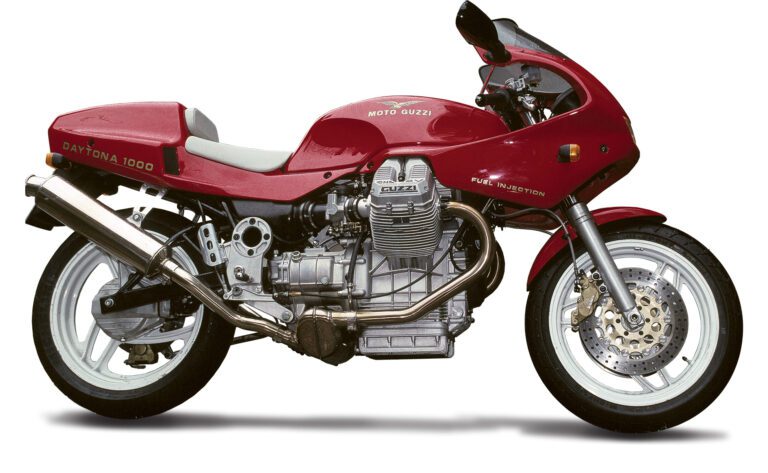
MG Daytona 1000
Claimed power: 95hp @ 8,000rpm
Top speed: 145mph
Engine: 992cc air-cooled high-cam 8-valve 90-degree V-twin
Weight: 451lb (dry)
Price then/now: $14,195/$10,000-$12,500
After his team of
modified Moto Guzzis won the 1984 and 1985 U.S. Endurance Championship and the
1987 Pro Twins series, U.S. Moto Guzzi guru Dr. John Wittner was made an offer
he couldn’t refuse. Summoned to Italy
by Guzzi godfather Alejandro de Tomaso, Wittner, a former dentist turned
endurance racer, was asked to help develop a new world-beating superbike. Guzzi
revealed a prototype at the 1989 Milan show and
named it for the famous Florida
circuit (where they won the 250-mile endurance race in 1985), but in typical
Italian fashion it took until late 1991 for the Daytona to go into production.
Although the hot rod
Daytona engine was based around the classic “big block” air-cooled Moto Guzzi
transverse V-twin, in the end it retained only the crankshaft and crankcases of
the standard engine. Using the 78mm stroke of the 948cc Le Mans 1000 combined with new plated alloy
cylinders with a 90mm bore, it displaced 992cc. A bright red sport fairing
melded into the gas tank just above the Daytona’s all-new cylinder heads,
grandly marked “OHC 4V” for overhead camshaft 4-valve. In truth, the cams were
carried high in the cylinder heads, not on top, so the engine could also be
considered a high-cam design overhead valve.
From the crankshaft,
a reduction geartrain drove a pair of toothed belts, each spinning a single
camshaft in each cylinder head, which in turn opened four valves via short
pushrods operating rocker shafts. Fueling was by Weber-Marelli electronic
injection, and the exhaust system was in stainless steel. The engine drove a
revised version of the 5-speed transmission used on most Guzzi twins through a
beefed-up clutch (with 10 springs versus eight) and a driveshaft to the rear
wheel.
The powertrain hung
from a new spine frame based on Dr. John’s race bike design, constructed from
1.5mm chrome-moly tubing with a cantilevered rear swingarm and a fully
adjustable Koni (later WP) monoshock under the seat. Marzocchi supplied the
“conventional” three-way adjustable fork, and Brembo four-pot calipers with
300mm dual discs (two-pot/260mm rear) provided stopping power. Cast alloy
17-inch wheels ran on 120-section front and 160-section rear tires.
With a claimed 95
horsepower available at 8,000rpm, the Daytona was the most powerful road-going
Guzzi to date, returning a top speed of 145mph. “The result is excellent
rideability, with big-time low-end and midrange power available whenever you
open the throttle,” Cycle World said of the big twin in 1993. On the
road, they found that being long and low in Guzzi tradition gave the Daytona
reassuring stability at high speeds: “The Daytona proved unflappable, with
well-damped suspension, plenty of cornering clearance, premium tires and a
relatively flickable yet very stable nature.”
Those same
characteristics, though, meant it was less nimble than some lighter and more
compact motorcycles of the time. “The Daytona is less track-ready, more of a
traditionalist’s GT-class machine,” Cycle World said, adding, “The
Daytona shines by excelling everywhere and not doing anything wrong. Its
suspension offers a good balance of compliance and control … though the bike
does turn more readily to the right at slower speeds thanks to the engine’s
pull-to-the-right flywheel effect.” They were impressed by the absence of driveshaft-induced
handling quirks, noting that “mid-corner throttle changes have almost no
consequence whatsoever on the chassis. If anything whacking open the throttle
while leaned over makes the rear end squat slightly, just like a chain-drive
bike.”
But Daytonas aren’t
without their issues. The timing gears are noisy and have been known to fail as
have timing belts, which must be replaced regularly as failure — from the belts
or the gears — can result in serious engine damage. Further, harnessing the
Daytona’s prodigious torque means a heavy clutch pull plus extra strain on the
transmission; it doesn’t help that there is no cush drive in the driveline.
Gearbox oil should be changed regularly to help keep the gearbox happy, and the
magnetic drain plug checked for metal fragments. The Daytona’s bevel drive case
is unvented and blown oil seals are not unknown.
Overrall, though, Cycle
World concluded that the Daytona was “a polished and thoroughly updated
version of a machine many had left for dead … there is no more charismatic
motorcycle on the market today,” and 20 years later, that statement still rings
true. Limited production (there were just barely more than 1,000 built from
1992-1995) means finding one requires patience, but the rewards are clearly
worth the wait.
Contenders: Sport V-Twin Rivals to the Daytona 1000
Ducati 900SS

Claimed power: 73hp @ 8,000rpm
Top speed: 129mph
Engine: 904cc air-cooled SOHC desmodromic 90-degree L-twin
Weight: 414lb (dry)
Price then/now: $7,900/$3,000-$7,000
Also exuding
charisma in 1992 was the new Ducati 900SS. Derived from the liquid-cooled 907
i.e. Paso engine, the 900SS engine instead used air/oil cooling, 38mm Mikuni CV
carbs and a 6-speed transmission. The 904cc 2-valve desmo engine was slung
beneath a strengthened version of the F1 Sport steel tube ladder frame, forming
a stressed member.
Elegantly simple,
the 900’s cantilevered swingarm pivoted in the engine cases and worked a
preload- and rebound-adjustable Showa shock running under the seat. A three-way
adjustable Showa upside-down fork controlled the front end, and the 900SS ran
on three-spoke cast alloy wheels fitted with dual 320mm Brembo four-pot front
disc brakes and a single 245mm two-pot rear disc brake.
Period tests praised
the Ducati for its looks, handling and visceral V-twin character. While it was
outclassed by contemporary Japanese multis on the strip and the track, it
scored high on roll-on acceleration, street-ability and, surprisingly, comfort.
“Absolutely
wonderful … one of the five best-handling bikes I’ve ever ridden,” Cycle
magazine’s tester said — though they also noted an electrical issue that
extinguished all the dashboard idiot lights! Ducati got the powertrain and
chassis right in the 900SS, but that old bugbear of unreliable electrics
remained. And with a valve-check/adjustment interval of just 3,000 miles, a
900SS could be an attention whore as well as a seductive mistress.
But what a mistress
it was — and still is.
Buell RS1200

Claimed power: 70hp @ 6,000rpm
Top speed: 125mph
Engine: 1,203cc air-cooled OHV 45-degree V-twin
Weight: 461lb (wet)
Price then/now: $15,995/$8,000-$12,500
Was the Buell RS1200 a
match made in heaven … or hell? Harley-Davidson’s 200-pound Sportster lump
powering a diminutive sport bike? Erik Buell was the one man who could make
that unlikely combination work. Essentially Buell’s 1985 RR1200 Battletwin
without its wind-cheating bodywork, the RS1200 combined a more-or-less stock
1,203cc H-D Evo XL engine with Buell’s Uniplanar mounting system to isolate the
steel-tube frame from the 45-degree V-twin’s jackhammer vibration. That was
only the beginning, as the RS bristled with innovations like an upside-down
Marzocchi fork with Buell’s own electronic anti-dive system, a rear monoshock
mounted under the engine, Buell-designed alloy wheels, and the clever if
clunky-looking combined bum-stop/passenger backrest.
At just 460 pounds
with a 55.5-inch wheelbase and 25-degree rake, the RS1200 steered quickly yet
confidently, though reviewers said the rear suspension lacked sufficient
damping. The brakes were powerful, with precise control at the front, but were
race-bike-weedy at the rear: Stoppies were the RS1200’s specialty! But the
Buell’s biggest selling point — and its Achilles’ heel — was the engine. The
reason for the RS1200’s brief bodywork, anathema to Buell’s aerodynamic
sensibilities, was to show off the Harley engine. But with just 70 crankshaft
horsepower at best and only four gears in the tranny, the RS1200 was always
going to be a minority taste. Sadly, so were the Buells that followed it.