1949 Vindian
Claimed power: 45hp @ 5,300rpm
Top speed: 105mph (est.)
Engine: 998cc air-cooled 50-degree V-twin, 84mm x 90mm bore and stroke, 6.8:1 compression ratio
Weight (dry/est): 550lb (250kg)
Fuel capacity/MPG: 4.5gal (17ltr)/35-40mpg
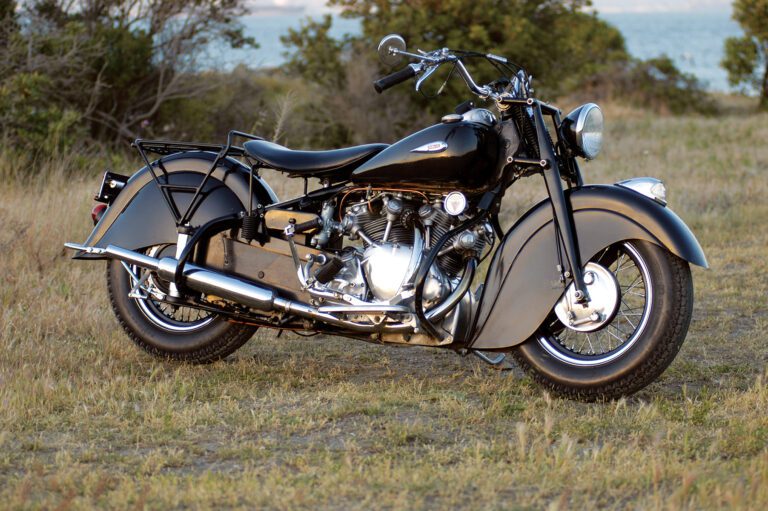
What would you get if you married the fastest motorcycle available in the late 1940s with the most iconic cruiser of that time? The answer is the bike you see here — the Vindian.
It’s the frame and cycle parts of an Indian Chief, with a 1,000cc Vincent V-twin engine bolted under the tank. But would it have sold enough to knock Harley-Davidson off the top of the sales charts in the 1950s? Would it have sold well enough to save Indian? We’ll never know for sure, but the builder of the bike on these pages is convinced it could have.
Tough times
By 1948, Indian Motocycle Company was in trouble. To bolster revenues, Indian had become the U.S. distributor for Vincent, Norton, AJS, Royal Enfield and Matchless motorcycles. Ironically, Indian was spending a huge amount of cash on the development of its new “Dyna-Torque” line, designed to compete with the British bikes. Meanwhile, the full-fendered heavyweight Indian Chief, with its outdated 80-cubic-inch (1,311cc), 42-degree V-twin sidevalve engine and 1930s streamlined styling, was losing sales to Harley-Davidson’s new OHV “Knucklehead” series. Dealers were crying out for a new Chief. How to update the image?
In 1948 Philip Vincent, owner of the British motorcycle company bearing his name, visited the U.S. seeking to kickstart sales of the Vincent brand. The brass at Indian appreciated that Vincent’s 998cc, 50-degree V-twin engine with constant mesh 4-speed transmission offered an answer to the Chief’s aging problems. As compared to the Chief’s current engine, the Vincent offered higher power output and a more compact design. A power unit transplant would provide a machine with significantly higher top speed than the Harley. Handling and braking would be adequate, and for a rider who wanted even more, perhaps Vincent could offer an Americanized version of its complete motorcycle, outfitted with tasseled seat and cowhorn bars? The British factory would be happy to build 50 more engines a week for Indian.
The original Vindian is ancient history now, and like much history, there are multiple stories of how it came to be. According to most accounts, Vincent received a 1948 Chief rolling chassis from Indian, shipped from the U.S. to the U.K. with no engine or transmission, and immediately began installing the Vincent twin engine in the frame. Other accounts say that Indian sent a complete bike, which was road-tested before work began.

Everybody agrees that a hybrid was created by replacing Indian’s 42-degree sidevalve V-twin engine with Vincent’s 50-degree OHV unit. How much work did it take? Here the accounts diverge again, with company boss Philip Vincent claiming that the Vincent engine’s low-profile design suited the Indian frame admirably and fit in easily, while Vincent designer Phil Irving was quoted saying “installation was fairly simple.” Irving admitted that the swap called for much welding and grinding, as well as the removal of the frame tube behind the engine. The factory also relocated the upper frame between the gas tanks and modified the gas tank bottoms to clear the cylinder heads. A new exhaust system was also fabricated. It’s easy to imagine the factory mechanics spending late hours with hacksaws, grinders and welding gear, desperate to fit the modern Vincent powertrain into the heavy Indian frame.

With the Vincent engine successfully installed, the Vincent lads headed off for their high-speed test track, a bumpy back road near the hamlet of Six Mile Bottom in Cambridgeshire. There the bounding, bouncing Vindian was wrestled up to the “ton” and beyond. Again, accounts vary; top speed, according to the stopwatch, was between 104-108mph. Not bad. All agree that hauling the 500-plus-pound motorcycle down to a stop again using the standard Indian single-leading-shoe drum brakes was a daunting task.
Meet Dennis Magri
Dennis Magri’s love affair with Vincent motorcycles is enduring. He can’t remember where he bought his first Rapide, but he vividly remembers the second, bought from a Butterfield & Butterfield’s auction in 1978, when seven Vincents hidden in chicken sheds by “Crazy” George Disteel hit the block. Dennis paid $1,100 for a complete but dirty red Rapide. “I only had $800 in cash in my pocket,” Dennis remembers, “but they let me write a check, and I took it home!”

Dennis’ career with things mechanical began as a boy in San Francisco with lawn mower engines, mini bikes, small motorcycles and an old Willys Jeep, all acquired while he was in high school. Classes in auto shop, machine shop, drafting and science paved the way. He remembers one day, after riding his Honda 90 around, a neighbor opened up his garage and said “Forget that little stuff — here’s a real motorcycle!” The bike was an Indian Scout, and it began Dennis’ love affair with Indian.
Later, as an Air Force technician, Dennis kept top-secret aircraft flying. With the training came an increased knowledge of all things mechanical, and he later established Magri Motorcycles in San Francisco, an independent shop specializing in British motorcycle repair. With his wrenching abilities and his touring experience aboard Vincents and Indians, Dennis’ background made him a natural to build this bike.
Beginning the project
Dennis muses that Vincent factory engineers, facing a deadline, had to do everything fast. The original Vindian took three weeks to build. When Dennis decided to build the Vindian many years ago, he decided to do it right. Phase 1 was the mock-up. With no pressing deadlines, he could spend a day and a night wondering how to design or revise the smallest part.

His original plan was to use a rigid frame from a 1930s Chief, but Dennis couldn’t bear to cut up an original frame. Along came a heavily modified 1940s Chief plunger frame for a couple hundred bucks. Dennis had no qualms cutting that one up, and better yet, it was the same type used for the original Vindian.
The engine he used is based on a set of crankcases bought in Santa Rosa, Calif., years ago for a few hundred dollars, and was assembled using Dennis’ substantial collection of used Vincent parts. The standard Vincent uses the engine as a part the frame: Everything bolts to it. The original Vindian ignored this concept, perhaps because of time constraints, and the engine was simply bolted into the Indian frame.
In 1997, Australian enthusiast Peter Arundel built a fully functioning Vindian replica, copying the original design. It is thanks to him that we know the procedure was not as simple as Philip Vincent stated. After quite some time studying the original assembly, Dennis decided to modify it to fit the spirit of Vincent.
Guided by the principle “function follows form,” he removed the Indian frame’s lower cradle. Following Vincent practice, the engine now acts as part of the frame, with frame pickup points at the cylinder heads and rear of the engine. The result is a much cleaner installation than the original Vindian, with the advantages of the Vincent design — lower weight, greater rigidity and easier access for service. Plus, the engine sits 2 inches lower, lowering the center of gravity for improved handling.

Further, removing the frame tubes meant that the footboards, gear and brake levers could be mounted on the engine, just as they do on the Vincent. The twistgrip throttle control is mounted on the right bar. Indian used a twistgrip throttle on the left bar, with another twistgrip on the right for spark advance. Vincent chose not to duplicate this system, possibly because it would make the bike more difficult to ride. Dennis followed suit.
The beauty of Vincent’s original engine and frame design, and the Magri Vindian version, is the ease of maintenance. The engine drops down easily for top end work, although, as Dennis points out, that’s the only reason to pull the engine. Valve adjustment is handled through the large hex-head covers, and virtually anything less than a full engine overhaul can be carried out with the engine in the frame.
Simplifying maintenance was another guiding factor in Dennis’ approach. Little things help a lot, like slotting the front brake cable abutment so cables can be removed without removing the cable ends. Dennis also machined the rear wheel spindle with a relief so it can be drifted out from an angle, without removing the muffler. The hardware has been standardized to three basic sizes for most chassis parts. Fasteners are captive wherever possible. Dennis added an oiler inside the chain guard to extend chain life, and he used a prewar, quickly detachable type rear wheel rather than the bolted sprocket used on the 1940s Chief; both front and rear wheels are interchangeable (an Indian feature). The 5.10in x 16in tires are wide enough for today’s often-potholed roads.
Time to ride
Dennis tells me the starting procedure: Nudge the engine over compression a couple times, using the valve lifter lever as you press on the kickstart, to find the long interval between compression strokes (since it’s a V-twin). Leave the throttle alone, and commit to a good kick with plenty of follow-through. Boom! It starts the first time, and I’m grateful. The kickstart lever is pure Vincent. Electric starter conversions are available for Vincents, though Dennis chose not to use one here. He’s proud that he can still kickstart his bikes.

I’ve spent some time in the saddle of Chiefs, and always enjoyed Indian’s unique controls, but this bike is more conventional, with Dennis’ own design of foot pedals on the right for gear changing (push forward for low, backward for high), and the rear brake on the left side.
I pull in the ultra-light clutch lever, tread on the front gear pedal and chug away. The original servo-type Vincent clutch is fitted and, although they’re known to be grabby, Dennis has his adjusted nicely. It’s easy to use. The Vindian’s a lot quicker to change gears than a Chief, where you have to “feel” the gear lever in place by hand before opening the throttle. Thanks to the wide handlebars, the riding position is classic Indian — high, wide and handsome — but the rumble is not. A yank on the throttle brings rapid movement. After a pause for a gear change I open the throttle again, and soon we’re doing 60mph — in second gear! I don’t know if I’ve ever done 60 in second on any Indian before. But while it’s covering ground quickly, the bike feels completely unhurried. The “telltale” on the speedo reveals that Dennis has had this bike up to 85mph recently, and he says there’s plenty left. Even with the added weight of the Indian accoutrements, the bike should easily top the ton. When Vincent testers rode an original Indian Chief they found maximum speed when warm was 85mph; as soon as the sidevalve cylinders and heads heated up, top speed dropped to 80.

The noise of the engine is evident, and you can feel it pulling strong, almost like a big Moto Guzzi twin — long-legged, wanting to go fast. Hitting a bump, the plunger suspension deflects through an inch of travel and the springs of the seat take care of the rest. It’s comfortable, and I can see why Dennis likes to put miles on this bike. Ignition and lights are controlled from the Indian dash panel, which also features a Miller ammeter, a reminder of the Vincent’s original electrical system components. The charging system, though, is modern, with an Alton 12-volt alternator in place of the original generator. This allows Dennis to use a modern H4 halogen headlight, a must for riding at night.
The brakes are as good as you’d expect for single-leading-shoe drums. They are quite capable of handling stopping chores at low speeds but unlikely to hold up to repeated high-speed stops, and definitely not as powerful as Vincent’s own dual front drums. Still, they work as well as the opposition’s did — Harley didn’t change to hydraulic brakes until 1957, but even then, drums were retained. I was not able to take the bike for an extended high-speed test, but Dennis reports the bike is comfortable for hours. He’s taken it everywhere, including “America’s Loneliest Road,” US 50 through Nevada and Utah.
Vincent and Indians woes
In 1949, the Vindian appeared headed for success. But the deal was doomed. The British currency was devalued in September 1949, making British motorcycles cheaper in the U.S. Worse, John Brockhouse, who had brokered Indian’s distributorship of Vincent and other English brands and was bankrolling the Indian-Vincent deal, pulled the financing until Vincent could prove it was in suitable financial condition to increase production. Of course, financial struggles were the whole reason for Vincent to clutch at the Indian deal to begin with. Vincent was forced into receivership, the British equivalent of Chapter 11 bankruptcy, though motorcycle production continued. According to Philip Vincent, the loss of the Vindian dream was a cloud with a silver lining, because even though Indian and, later, Brockhouse’s reorganized Indian Sales Corporation would not be building Vindians, it did import complete Vincent motorcycles for sale in its showrooms, buoying the sales of the Vincent brand.

Could the Vindian have kept Indian alive? Perhaps. But the Vincent engine demands more commitment from the rider and more skilled maintenance compared to the sidevalve Indian. It’s difficult to see Indian Chief riders — or mechanics — falling in love with the Vincent hybrid (with the exception of Mr. Magri, of course!), and emotions are important in motorcycling. It is the loyalty of Harley-Davidson dealers, their mechanics and, above all, their customers that has kept Harley alive during tough times.

What is certain is that designer Phil Irving, who had drawn up the Vincent V-twin engine, left on the next boat after bankruptcy was declared, returning to his native Australia. Vincent lost a vital creative spark. It struggled for the next decade, with motorcycle production ending in 1955.

And the original Vindian? What happened to it after it was shipped back to Springfield, without the Vincent engine? Look on the Internet and you might find a picture of a Vindian with a Black Shadow engine parked at the races at Laconia in 1951. Apparently, it was built by an Indian employee, perhaps using the Vincent-modified rolling chassis mated to a salvaged Vincent engine, or if not, certainly influenced by it. So, if you ever see a strange-looking Indian in the back of a chicken shed, make sure you take a closer look. MC