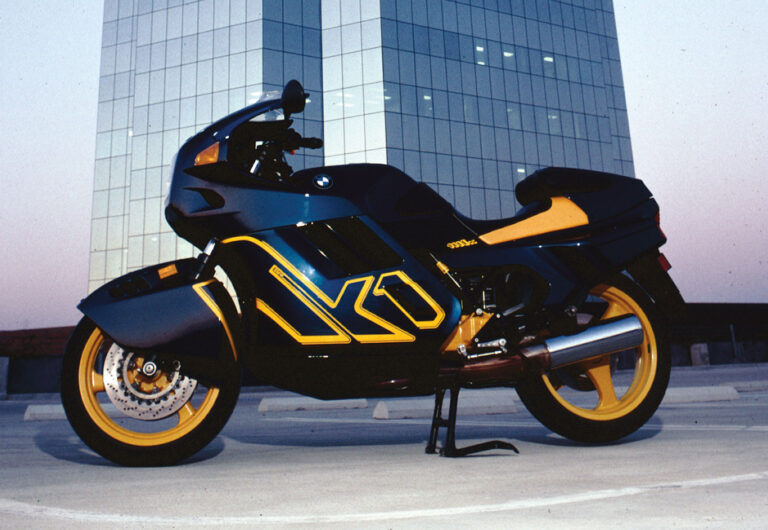
BMW K1
Years produced: 1989-1993
Total production: 6,921
Claimed power: 95hp @ 8,000rpm
Top speed: 143mph (period test)
Engine type: 987cc DOHC, liquid- cooled inline four
Transmission: 5-speed/shaft final drive
Weight: 618lb (wet)
Price then: $12,990 (1990)
Price now: $4,500-$8,500
MPG: 45-55
When BMW introduced the radical sport-touring 4-cylinder BMW K1 in 1988, the Bavarian firm was already under attack from BMW traditionalists who felt the company was suffering an identity crisis, turning away from a time-honored line of horizontally opposed, air-cooled touring twins in favor of increasingly, well, un-BMW-like machines.
The break with tradition started in 1982, when BMW announced the inline 4-cylinder BMW K100. Featuring double-overhead cams, liquid cooling and Bosch electronic fuel injection, the K100’s 987cc mill was — in a further break from the norm — laid down on its side. It was unlike any BMW before; apart from the blue and white roundel on its tank, the only traditional BMW aspect of the K100 was its shaft-driven rear wheel.
Why BMW made this break is easy to understand. As the 1970s drew to a close, 4-cylinder motorcycles were clearly becoming the order of the day. BMW, which had coaxed as much performance as it could from its air-cooled twins, knew it needed a clean-burning, modern platform; the K100 was its path to the future. That it didn’t pick a horizontally opposed flat four is almost certainly due to the fact Honda had beat them to the punch with the Honda GL1000 in 1975.
Although sales of the new model were modest at first, buyers warmed up to the idea of a multi-cylinder BMW and a 3-cylinder variant, the BMW K75 (which had been planned along with the K100 from the beginning), was introduced two years later.
Although changes to the K100 over the next few years were few, BMW knew it needed to update the K100 to wring more power out of the bike, which at a claimed 90hp was starting to lag behind the competition’s liter bikes. BMW decided to address that point with the K1, but few expected the fully faired über rad BMW presented at its September 1988 press launch.
A BMW Superbike?
Although based on the standard K100, the BMW K1 was in fact a very different animal. While the general layout was the same (liquid-cooled inline four, disc brakes front and rear, fuel injection) the K1 received a new 4-valve cylinder head good for another 10 horsepower and 10 foot-pounds of torque (74ft/lb versus the K100’s 64ft/lb). It also got an improved version of the K100’s Bosch fuel injection, which supposedly accounted for much of the engine’s improved performance. BMW could have made the engine more powerful yet, but continued its voluntary adherence to a 100 horsepower maximum for motorcycles in Germany. By the time the K1 was U.S. emissions compliant it was down to 95 horsepower, still the most powerful BMW made to that time.
Four-piston Brembo calipers replaced the K100’s twin units up front, and a thicker rear rotor aided heat dissipation. U.S. K1s also received the K100’s optional ABS system, first offered in 1988, standard. The K1 also received BMW’s new Paralever system, announced for the R80GS and R100GS the year before. Using a double-jointed driveshaft/swingarm with the rear hub linked by the shock at the top and the Paralever at the bottom, the system canceled out the rise and fall from acceleration and deceleration familiar to shaft-driven bikes.
The K1’s frame looked much like the K100’s, but was in fact substantially strengthened, with larger diameter tubing and slightly revised geometry — along with a longer wheelbase — to improve stability in fast sweepers. This was, after all, a bike designed for the autobahn, and with a top speed in excess of 140mph, all day runs at 100mph-plus were a snap. Testers mostly praised the K1’s performance and were impressed by its high-speed aplomb, with more than a few testers claiming to hit an indicated 150mph; not bad for a 600-plus-pound bike with “only” 95 horses to push it around.
Much of that high-speed calm was thanks to the K1’s controversial bodywork. This was to be the company’s flagship, a technological tour de force that nobody would confuse with anything BMW — or anyone else — had ever made before. From its wind-tunnel tested fairing including an almost completely enveloped front wheel (giving a drag coefficient of 0.34, the lowest of any production motorcycle then made) to its bold (or lurid, as some saw it) ketchup or blue and yellow paint schemes with screaming yellow graphics, the BMW K1 demanded attention.
Unfortunately, not all the attention was positive. While some considered the bodywork cutting edge, more thought it was just plain weird. And while performance was good, the K1’s solid-mounted engine was faulted for mid-range buzziness. Worse yet, at speeds below 50mph many testers found the heat pouring from under the K1’s bodywork unbearable. Although BMW eventually offered an optional under-body blanket to minimize the heat question, it was always an issue.
At almost 13 grand it was also expensive, and for that kind of money the well-heeled cyclist expected more power and more refinement, especially from BMW. Panel fit and finish on early models was often poor, and while performance was good, a Honda CBR600 was just as fast, lighter and stopped shorter. And it was much, much cheaper.
While it’s doubtful BMW expected the K1 would top the sales charts, sales were still disappointing; production stopped with the 1993 model after 6,921 units. But the K1 was a success in helping shift public perception of BMW from a builder of staid tourers for old men to a manufacturer of modern, high-speed sportbikes. The K1 helped BMW change its persona forever, and it remains one of their most memorable machines. MC
New school sports-touring rivals to the BMW K1
1988 Ducati Paso 906

- 80hp @ 8,000rpm/ 137mph
- Water-cooled, SOHC V-twin
- 6-speed
- Dual disc front, single disc rear
- 518lb (wet)
- 40-50mpg
- $2,500-$4,000
Although certainly the least radical of our featured trio, the 1988 Ducati Paso 906 was still revolutionary in its own way, a high-speed sport-touring machine with technology and styling that, Ducati hoped, pointed the way to the future.
Although based on the 750 Paso introduced in 1986, the 906’s V-twin (which was actually a 904cc) borrowed heavily from Ducati’s 8-valve 851, including the latter’s meatier crankcases, 6-speed gearbox (the “6” in 906) and liquid cooling. Although the changes didn’t result in impressive horsepower gains (depending on whose dyno you used, the 906 was only 2 to 10hp up on the 750), they did, along with very slight suspension tweaks, result in a significantly refined bike.
While the 906’s handling was still considered heavy, it was praised for quick steering and excellent stability, with precise control under any road condition.
Comfort was highly rated, too, thanks to a riding posture — inspired, it’s said, by the Yamaha FJ1200 — cited as ergonomically superior by reviewers.
But for all its positive attributes, the 906 never lived up to expectations, and was replaced in 1990 by the 907 I.E.
Although somewhat unloved even today, the Ducati Paso 906 is strong, fairly reliable and relatively cheap, making it an interesting and stylish alternative to Japanese liter bikes of the time.
1993 Yamaha GTS1000
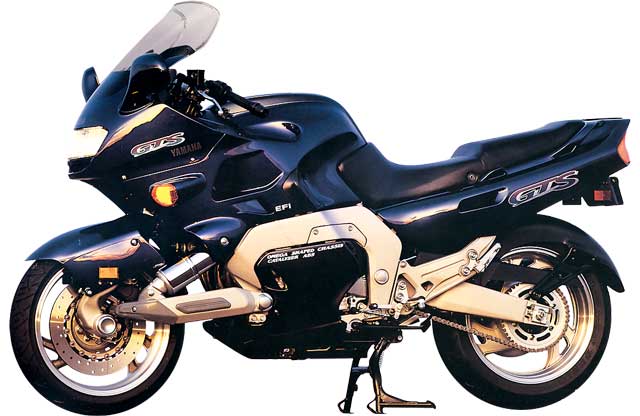
- 96.7hp @ 7,500rpm/ 139mph
- Water-cooled, DOHC inline four
- 5-speed
- Single disc, front and rear
- 641lb (wet)
- 30-40mpg
- $2,500-$5,500
If the riding public thought BMW’s K1 was wild, they clearly weren’t ready for the revolutionary Yamaha GTS1000. Featuring James Parker’s RADD (Rationally Advanced Design Development) single-sided swingarm front suspension, the GTS1000 was supposed to herald a new future for motorcycle design and highlight Yamaha’s capacity to take new ideas into production.
The GTS’ swingarm addressed the inherent limitations of hydraulic forks, namely flex under braking and the attendant “stiction” that occurs as forks bend and compress at the same time. Parker’s system also meant anti-dive geometry could be dialed in, keeping caster angle and wheelbase changes in check and all but eliminating bump steer. This made the GTS extremely stable under hard braking, particularly in bumpy corners.
Power came from an FZR1000-sourced 5-valve inline four equipped with fuel injection instead of a bank of carbs, and tuned to provide better low-speed and mid-range power. Like the BMW K1, ABS was standard.
While a competent motorcycle (Rider magazine named it their “Bike of The Year” for 1993), it was also expensive, heavy, and, well, just plain too weird for most people. Sales were feeble, with fewer than 500 sold in the U.S. in 1993. U.S. sales continued for 1994, and for a few more years overseas.
Quirky yet innovative, the Yamaha GTS is an excellent sport-tourer, highly prized by owners today, and relatively cheap — if you can find one.