1930 Henderson KJ
Engine: 79.4ci (1,301cc) air-cooled IOE F-head inline four, 2-11/16in x 3-1/2in bore and stroke, 4.4:1 compression ratio, 40hp at 4,000rpm (claimed)
Top speed: 100mph (claimed)
Carburetion: Single Schebler
Transmission: 3-speed handshift, chain final drive
Electrics: 6v, magneto ignition
Frame/wheelbase: Dual downtube cradle frame/58in (1,473mm)
Suspension: Trailing link double leg springer forks front, rigid rear
Brakes: Drum front, contracting band rear
Tires: 4 x 19in front and rear
Weight (dry): 440lb (200kg)
Fuel capacity: 4gal (15ltr)
Price then/now: $435/$20,000-$60,000

“Motorcycle racing in this country, according to a well-known sports writer, is kept alive and supported principally by the county speed cops. When the A.M.A or some other organization sponsors a motorcycle race, a trick riding contest or a hill climb, the experienced officer-riders are on the spot.” — The Blue Book of Sports, 1931
At that time, a high percentage of those motorcycle officers would have been riding Hendersons. In the 1920s and 1930s, the Henderson, a sturdy, quiet and fast machine (by the standards of the day) was a top choice of police departments all over the U.S., and there weren’t many cars on the road that could outrun one. In recent years, Hendersons have shone on the Cannonball coast to-coast rally for vintage motorcycles, frequently winning and placing high in the points rankings, underscoring the fact that a Henderson is one of the most user-friendly and reliable bikes of its era.

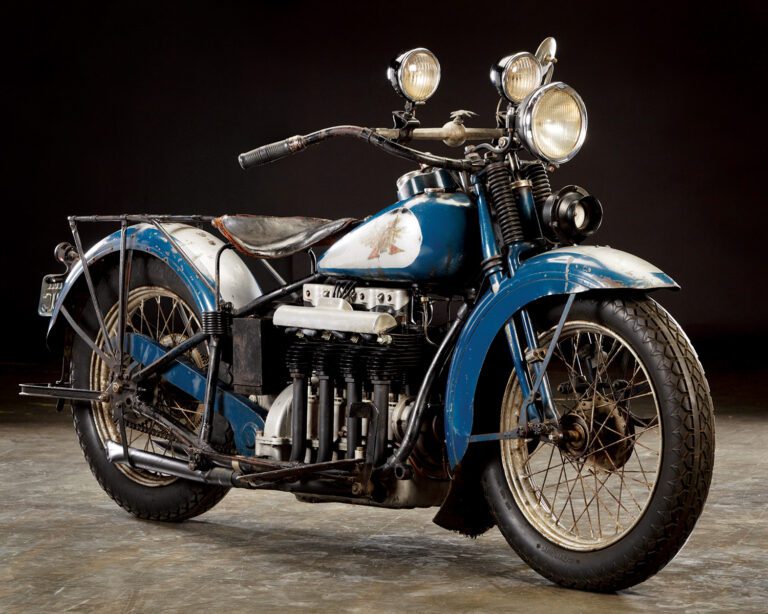
This original 1930 Henderson KJ — unrestored, running, and in amazingly good shape for an 87-year-old machine — probably started out as a police bike. The decals are consistent with motorcycles manufactured for traffic cops, and among its accessories is a “hand control” speedometer, with two hands, one of them red. Lacking radar, the motor cop would match speed with the boat-tailed Auburn or Duesenberg that was burning up the road, hit the button, and the red hand on the bike’s speedometer would set at the maximum speed. The cop would then pull the offender over and write down the indicated speed on the ticket.
The KJ Streamline
William Henderson designed the inline four motorcycle bearing his name, running the Henderson Motorcycle Company with his brother Tom from its beginning in 1912 until 1917, when the company was purchased by Ignaz Schwinn — the same Schwinn that built the bicycle you had when you were 10 years old. Schwinn reworked the original Henderson design to make it more attractive to police departments, a major source of revenue for motorcycle factories at the time. The redesign, with a sidevalve top end instead of the original inlet-over-exhaust design, was more reliable, but much heavier. Disappointed with Schwinn’s development of the Henderson, William left to start another motorcycle company, Ace, but the new Henderson was embraced by motor police and the company prospered through the 1920s.

Henderson, like many other American motorcycle factories, also had a big export business. Large-displacement motorcycles were mostly an American product, and enthusiasts in Europe, South Africa, Canada and Australia looking for bigger machines imported them from the United States. In 1928, Schwinn hired Arthur Constantine as new chief engineer. Constantine, who had previously worked for Harley-Davidson, began working on a new version of the Henderson, which was then getting a little long in the tooth. In an interview with Ted Hodgdon, the author of Motorcycling’s Golden Age of the Fours, Constantine explained that he wanted a lower and more central riding position, more horsepower and smoother running, as well as greater reliability. The result was the KJ “Streamline” model. Produced from 1929 until 1931, the KJ sold for $435 (about $6,000 in 2017 dollars) and was claimed to be capable of reaching 100mph.
The KJ’s 79.4-cubic-inch (1,301cc) engine had four inline cylinders like its predecessors, but was improved with a five-bearing crankshaft, increased fin area, and a new valve cage design with overhead inlet valves. Inlet over exhaust valves might be thought to be a retreat from the prior sidevalve valve design, but it worked with a newly designed intake manifold to enable down-draft carburetion, of a sort: The carburetor is a side-draft, but the intake manifold feeds the fuel/air mixture downward into the cylinders.
The engine developed 40 horsepower at 4,000rpm, compared to the 30 horsepower made by a contemporary Harley VL sidevalve (base price $340). Not only was the Henderson more powerful, but it produced its power quietly, with minimal vibration, unlike the noisier and vibration-prone Harley. The Henderson’s 3-speed handshift transmission could be ordered with a reverse gear, a handy option for the commercial sidecar outfits that were then common inner city delivery vehicles.

Cycle parts on the KJ included wide fenders, 19-inch “safety” (drop center) rims, 4 x 19-inch tires, a larger front drum brake, and a redesigned front fork, all melded into a new streamlined look. The instrument panel on top of the tank boasted a speedometer, an ammeter and an oil gauge. The standard color was dark blue, although maroon and green were available on special order. Shortly after the advent of the KJ in April 1929, Henderson announced the KL, with more horsepower and a top speed of 110mph.
Although the KJ and the KL were selling well, there were dark clouds on the horizon. The October 1929 stock market crash and its aftereffects were eating the American economy. At the same time, the British Commonwealth exponentially increased tariffs, killing the Henderson’s major overseas markets. And while the Henderson was a better police bike than its competitors, it was also more expensive, a factor that belt-tightening municipalities had to consider.
On top of all of that, Ignaz Schwinn was getting old. He liked motorcycles, but his sons, poised to take over the company when Ignaz retired, did not. In the summer of 1931, Schwinn called the Henderson (and sister company Excelsior) department heads together for a meeting, and with no warning told them, “Gentlemen, today we stop.” Despite a full order book, Schwinn decided to pare back to his core business, bicycle manufacture, in order to better survive the developing economic depression. By September 1931, the Henderson factory had shut down.
Paul Woelbing’s Henderson
Henderson built a lot of bikes over the years. Riders who liked their Hendersons hung on to them, while other riders, looking for inexpensive and reliable transportation, bought retired Henderson police bikes, like this KJ. Although not built in the numbers of, say, Harley-Davidsons, Hendersons are not exactly rare, and our feature bike is only unusual for its unrestored good condition. At some point in its history, this KJ was bought by two brothers in the Bronx who ran a window replacement business. For some reason, they parked the Henderson in a semitrailer they owned, and then started throwing scrap glass into the truck. When a collector located it, the KJ was in the back of the old semitrailer, covered with broken glass. This collector extricated the bike (very, very carefully) and cleaned it up, but otherwise left it as it was. Some years later, needing to raise college funds for his daughter, he sold the bike to Paul Woelbing.

Paul, of Franklin, Wisconsin, comes from a long line of bikers, including a grandmother who owned a Harley single. “I still have her black leather jacket,” Paul says. His father had a 1948 Cushman and, for something different, a 1937 Harley-Davidson Flathead. However, Paul didn’t get really excited over a motorcycle until he drove by a Harley dealer and saw a turquoise and cream Sportster. “My folks bought it for me as a surprise.” Scientists are still working on cloning Paul’s parents.
After four months riding around on the 1992 Sportster, Paul got Bigger Bike-Itis and ended up with a 1992 Harley Springer. He also started collecting vintage bikes. “I found a 1948 Indian Chief, and that was just the beginning.” Paul explains that his parents collect 18th century furniture, and he grew up appreciating antique patina, one of the things that endeared him to this KJ. “The Henderson is a cool bike. I learned the value of an original finish from my parents. The vintage patina really speaks to me.”
When the bike was first delivered it was dusk, but Paul was excited, and wanted to go for a ride. The rear light was burned out, the headlight wasn’t working and Hendersons don’t have a brake light, so Paul taped a flashlight to the handlebars and asked a friend to ride behind him to be the brake light for both. The Henderson ran, but sounded a little ragged. The brakes were worn to scraps of fiber around the rivets and Paul had to drag his feet at stops. The wheels were sound, which is unusual, as many Hendersons that have surfaced have wheels that are rusted out and have to be replaced. He decided that if he was going to ride the bike, it might be a good idea to improve the engine and running gear. He asked Ken Preston, a well-known old-bike mechanic, to sort out the engine and the brakes.

In the meantime, Paul called Henderson expert Dick Winger and described the bike to him. Winger told him that the decals and the bar on the handlebars with extra lights were consistent with police use. Other accessories that came with the bike were a fork lock (bike theft was a problem then, just as it is now) and a Klaxon horn for that great “ah-oo-gah” sound.
Paul rode the bike on a regular basis for a couple of years, mostly on short local trips around his neighborhood, “an ice cream getter,” he says, noting the Henderson “has a very unique sound,” likening it to a Massey Ferguson tractor. He finally decided to pretty much park the bike in favor of riding the twins from his collection. At the moment, the KJ sits in Paul’s office at work.
Paul says the Henderson has lots of power for an oldster, and that it is very easy to start. However, when you first get going, the clutch sticks. “You have to duck walk it to get moving, it kind of needs a running start. But once it gets going, the clutch isn’t a problem.”

One of the issues riding a bike this old is maintenance. “Most vintage bikes don’t have oil filters, so I change the oil frequently, every 500 miles,” Paul says. “Henderson fours have a large crankcase that looks somewhat like a small automobile engine. The oil lubricates the transmission and engine. My brother flies World War II vintage airplanes, so from a source he uses I purchased a barrel of AeroShell 80 weight oil, which I believe translates into SAE 40 weight car/bike oil. I also always add Marvel Mystery Oil to the gas to help lubricate the valves on any vintage motorcycle, regardless of the brand.”

Like almost all bikes of this vintage, Hendersons don’t have positive lubrication to the overhead valves, which need to be greased at regular intervals. “At the same time I change the crankcase oil, I remove the top cover and use a popsicle stick to grease the valve train.” One chore that once had to be done on a regular basis — decarbonizing the cylinders — is now rarely necessary. Present-day oils do not have the amount of carbon that 1930s oil did. By the end of a year’s riding, or possibly sooner, depending on the amount of dust on local roads, the cylinders, pistons and valves would be coated with carbon, and performance would suffer. Contemporary rider’s manuals have elaborate instructions for removing carbon from the top end.
Despite the fact that the Henderson has no rear suspension, it is a surprisingly good handler. “I never pushed it past its limits. The fastest I ever rode it is 55mph. The front end is a little light, and I don’t completely trust the brakes,” Paul says. MC
Riding and Maintaining a Henderson Today
Well-known American vintage bike enthusiast and restoration expert Matt Olsenhas extensive experience riding and repairing Henderson KJs. He points out that KJs have many features that make them safe, reliable bikes. “A KJ has a front brake, wheels with drop center rims, and a comfortable riding position. The problem with most Hendersons is poor maintenance over the last 80 years. The first and second owners probably took care of the bike, but by the fifth owner, who knows.” Matt says that the key to a trouble-free Henderson is to have the engine properly rebuilt.
The brakes, which have been a sticking point on Paul&’s bike, can be made to work. “You glue on a new brake lining — there are several different shops around the U.S. who can do this — and match the brake drum to the lining. The key is parallel contact, all the way around. The back brake is a band brake, on the outside of the drum. After 80 years, the drum gets worn out, and is full of hills and valleys. The fix is to weld on a new sleeve, and fit the band to the drum. With a good brake lining, you can lock up the rear wheel,” Matt says. “A Henderson, despite its long wheelbase, is surprisingly nimble and agile. They handle very well for their age.”