
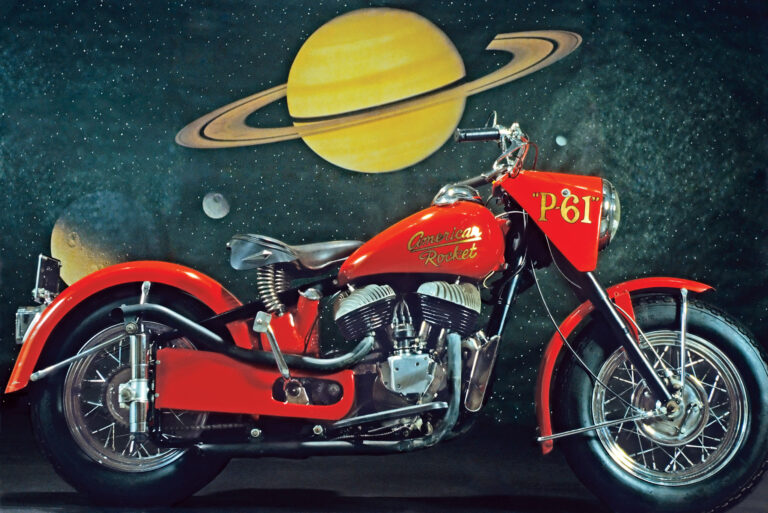
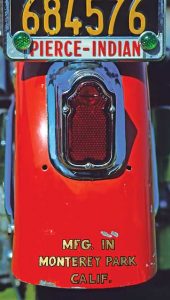
Sammy Pierce was perhaps the greatest enthusiast of Indian motorcycles. After the Springfield, Mass., factory closed in 1953, “Mr. Indian” kept the flame alive. And thanks to his devotion to the brand during the Fifties and Sixties, he inspired well-known restorers like Bob Stark and Micah McCloskey to keep the flame burning. And along the way, he designed his own motorcycle – the P-61 American Rocket.
West Samuel Cecil Pierce was born March 23, 1913, and grew up in the Kansas City, Mo., area. A motorcycle nut and tinkerer from an early age, his lifelong love affair with Indians began in the late 1920s as a teenager, when he started riding cross-country on a 1926 Scout. This was no easy feat, as most roads, especially in the West, were unpaved and service stations were few.

When the Depression hit, Sammy turned to his motorcycle for a living, performing stunts and racing at county fairs. Along the way he acquired an expertise for sheet metal, designing and fabricating custom cars. But bikes were his passion, and in 1945, after a stint in the Navy during World War II, he swung a deal to become the California distributor for Norton.
Beginnings of the Rocket
At some point, perhaps when Sammy was still in the Navy, he started designing his own motorcycle — the American Rocket — possibly as an exercise in improving what was then available. By the early 1950s, his efforts had garnered enough attention to rate a story in the May 1952 issue of Cycle magazine. As he explained to Cycle‘s editors: “The 10 years I’ve spent on the construction of the Rocket were experimental, trial and error years, during which I built each bearing and joint over and over again. Maybe my solutions to all the problems aren’t perfect — only time will tell — but they’re the best I could do.”
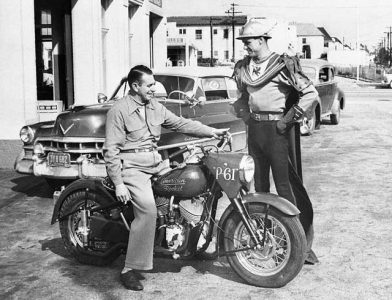
As he explained at the time, Sammy considered several approaches for his bike. He rejected the idea of building a standard single-throw V-twin: “Why should anyone buy your machine if it’s just like all the others?” He also dismissed the idea of building everything from scratch: “Suddenly, you realize that you have spent many dollars more than the average guy can ever afford.” The approach he settled on was taking easily available parts and combining them in a novel way. Turning to his beloved Indian, he used an Army-surplus Indian 841 tank and frame along with a case and cylinders from an Indian Chief as the foundation for his bike.
The Chief cylinders were cut down from 80ci to give 61ci (hence the P-61 designation) by shaving both ends and using a sleeve for a Mercury car engine. His modified crank assembly was supported on two sets of bearings (one plain, one ball, the theory being if one gave out the other would carry the load), with connecting rods from a Ford shaved to fit and pistons from a Mercury. All of this was supposed to make the engine lighter, stronger and more powerful, although it’s unlikely it did.

The engine assembly was bolted to a skid plate, which was bolted to the frame. The engine could be removed by simply pulling out the skid plate’s cross bolts. Pierce claimed the Rocket’s rubber mounted engine (using modified car engine mounts) was the first practical vibration isolator for a motorcycle ever built. The forks were from an Ariel, and the foot shift assembly was improvised by Pierce using Indian parts. The brakes were Indian, reinforced by Pierce, and the horn was from an Olds 88. “You can blast anyone off the road,” he boasted.

Two Rockets were built — a show bike that was used for publicity, and a test bike. Machinist Dick Renninger, a friend of Pierce’s, was enlisted to ride the test bike, and Pierce told him to do what he could to make it break down. Renninger cheerfully complied, and improvements resulting from Renninger’s testing were added to the test bike. “Sam never had any plans,” Glenn Pierce, Sammy’s son, says. “He could see what something was going to be before he built it. He never had a blueprint — it was all trial and error.”
Gunning for Indian?
So what was Sammy hoping for with the Rocket? Louis Fisher, the Rocket’s current owner, thinks Sammy was trying to get Indian to buy his design as competition for Harley’s K Model and the British overheads. Or maybe he just wanted to show Indian what could be done with a little R&D. Either way, Indian wasn’t interested, and it’s possible that Sammy didn’t know how badly the company was doing at the time. In the late Forties and early Fifties, Indian was working hard to hide its problems. After a change of ownership, the company had staked its future on a line of lightweights, which were rushed into production without adequate testing. This proved to be a disaster: Indian was taken over by a British organization, Brockhouse, and ceased building bikes in 1953.

Sammy tried to get other investors interested in producing the Rocket, but finally admitted failure. “Father was, at heart, a pragmatist,” Glenn says. “At a certain point he cut his losses. He moved to Merced [Calif.] and got on with his life.” Sammy went on to own several British motorcycle dealerships, selling Triumph, Ariel, Norton and Sunbeam motorcycles. He also had an Indian dealership for a short time, but despite his love of the brand, he sold it to his friend Ed Kretz (winner of the first Daytona 200 in 1937). His last enterprise was American Indian, where he assembled his own “Super Scouts” from NOS parts, adding a bit of his own flair with special body work and performance upgrades. He sold American Indian in 1971 and in his last years Sammy was the curator of Steve McQueen’s extensive motorcycle collection. He died March 27, 1982, shortly after McQueen died from cancer.
The trail of the rocket
Louis Fisher remembers going into Sammy’s shop in Monrovia in Southern California in the 1960s and seeing the American Rocket show bike next to Sammy’s Indian special, the “Harley Eater,” and Burt Munro’s streamliner, with the streamlining off. “One day in the early Seventies, they were all gone — Sam sold all three of the bikes about the same time,” Louis says. No one knows what happened to the American Rocket test bike.

The Rocket show bike eventually surfaced, repainted, at a central California antique meet. It disappeared again, but 15 years ago Louis started thinking about finding it. He had no luck until one day his friend Dean Hensley showed him photos of someone’s midget car collection. “I saw it — the Rocket — in the background of one of the photos,” Louis remembers. He drove to the address given to him, an old peach orchard, and there was the Rocket, under a tarp in front of a barn — and it was for sale.
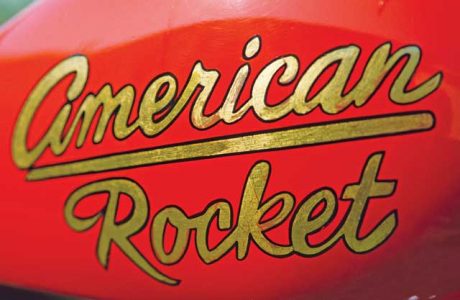
Louis bought the bike and took it to Dan Reese, a former employee of Sammy’s who now runs Indian Motorcycles of West Point, Calif., to get it running. Louis doesn’t ride it much, saying he just wants to keep the Rocket as a piece of American history. “It was a legitimate motorcycle,” Louis explains. “The size was right, it handled well; it was a fast sports bike. It would have given Harley a good run until Indian could develop an overhead [valve engine].”
Though the Rocket never made it into production, at least this bike remains today as a testimony to one man’s passion for the Indian brand and his desire to build the ultimate motorcycle, the American Rocket.


