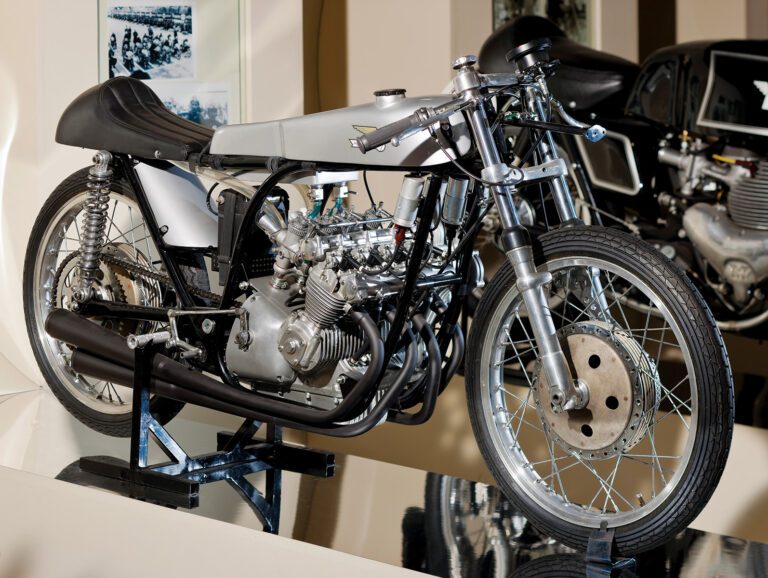
Engine: 125cc air-cooled DOHC 4 valves per cylinder inline four, 34.5mm x 34mm bore and stroke, 12:1 compression ratio, 23hp @ 15,000rpm
Top speed: 125mph
Carburetion:Four 12mm Dell’Orto (originally; 16mm now fitted), twin floats/one per pair of carburetors
Transmission: 8-speed, chain final drive
Electrics:6v battery, coil and breaker point ignition x 4
Frame: Dual downtube cradle steel
Suspension: 32mm Ceriani telescopic fork front, dual shocks w/adjustable preload rear
Brakes:Oldani TLS drum front, SLS drum rear
Tires: 2.5 x 18in front and rear
Weight (dry/minus fairing): 187lb (85kg)

One of the most intriguing chapters in the history of multi-cylinder Grand Prix racing is Ducati’s 125cc 4-cylinder. First sketched out on paper by Fabio Taglioni in the 1950s, then half-heartedly developed to a semi-prototype stage in 1958, the project was revived in 1965.
It underwent a year of testing and development, but was never raced. After being sent around the motorcycle show circuit it mysteriously disappeared. In 1989 the engine was discovered in Latvia and later the frame uncovered in Yugoslavia. In 2000 the machine was restored back to original condition and it now resides in the Morbidelli Museum in Pesaro, Italy.
What were the circumstances that led to its creation? What made it so special in Ducati’s history but so quickly forgotten? Was it a potential world beater?

A pure racer
There are several fascinating aspects to the 125cc 4-cylinder. The most significant is that it was designed purely for racing and bore no resemblance to any production Ducati. This showed Ducati’s clear intent to break away from production-based racing, which had set it on a path to worldwide sales success, and chase Grand Prix glory. Ducati was hoping to up the stakes with a clean-sheet design.
Ducati’s timing with its original foray into building a 125cc multi couldn’t have been worse. To begin with, Fiat’s introduction of the affordable Fiat 500 car was crippling domestic motorcycle sales, then, at the end of 1957 Italian Grand Prix powerhouses Gilera, Moto Guzzi and Mondial announced they would withdraw from world championship racing, altering the face of Italian competition. Although Ducati achieved GP wins with its 125cc single in 1958, with Ducati riders finishing second and third in the championship and the factory second in the constructors’ championship, the 125cc 4-cylinder project was dropped, and Ducati went into a kind of domestic hibernation while it concentrated on selling existing models into new export markets.

So instead of Ducati being the first manufacturer to enter a 4-cylinder 4-stroke into the 125cc Grand Prix class, that honor fell to Honda, with the RC146 in 1963. The Japanese giant began a period where multi-cylinder 4-strokes competed against 2-strokes from both Japan and Europe. It could so easily have been a little Italian company that started this revolution instead of the evolving giant that was Honda.
Fast forward to the mid-1960s. Spain’s Mototrans, a Ducati affiliate, had become one of Spain’s “big three” motorcycle manufacturers, joining Montesa and Bultaco. Cashed-up Mototrans urged Ducati to build a 125cc multi-cylinder to replace Ducati’s existing twin, which used a three-camshaft design with desmodromic valve operation. The twin had first seen the light of day in 1958 and had been raced by Mototrans throughout the 1960s. The relationship was so close that Ducati had sent several of its factory riders over to race those twins in Spain to ensure championship results.
The theory that created the birth of an amazing prototype was that a higher-revving multi-cylinder could produce more than the 24 horsepower at 15,000rpm of the twin. Unlike Ducati’s original 4-cylinder strategy, the intention this time was to race the new bike in the Spanish domestic championship with the goal of knocking Bultaco’s new TSS 2-stroke off the podium. If it worked there, then maybe the project could be brought across to the world Grand Prix championship.
And so, Fabio Taglioni dusted off his original plans and reworked the design into a little gem of a racer. Sadly, it had one major flaw.

A close look
Before we reveal its Achilles’ heel, let’s examine the 125 in detail. At 12.6 inches (320mm), the across-the-frame 4-cylinder was barely wider than Ducati’s earlier twin. It weighed just 187 pounds (85 kilograms) without its fairing, about the same as Ducati’s 125cc desmo single-cylinder GP racer of the late-1950s.
The compact engine design meant there wasn’t enough room to fit Taglioni’s preferred desmo valve operation inside the new racer. Instead, the double overhead cam heads ran four valves per cylinder – the first time Taglioni had publicly produced an engine so equipped – operated by conventional springs. The 16-valve engine had a barely over-square bore and stroke of 34.5mm by 34mm, encouraging high revs. A further indication of the engine’s compactness was the fact that special, very small 8mm spark plugs had to be manufactured to light the fire owing to the lack of room upstairs.

The cams were driven by a series of gears that ran up the left side of the engine behind an elegant Y-shaped cowling, and the cylinders were inclined forward 40 degrees, with deep fins on the front to aid air cooling. A squish-band, a compression ratio of 12:1 (high for the day) and forged pistons helped balance reliability with performance. Safe peak revs were 17,000rpm, with peak power arriving at 14,000rpm. This was later increased to 15,000rpm.
Taglioni’s 125cc four wasn’t some cobbled-together prototype, but a beautifully assembled miniature marvel featuring exquisite castings and a general design flair that is breathtaking, even by today’s standards of technology. It obviously wasn’t some “laboratory racer,” a machine thrown together using a mix of existing and experimental parts. It was in fact a completely new race bike with production-line quality in its execution.
Yet despite its incredible design, its main flaw was that for all its sophistication – which in the end equals cost – it wasn’t any more powerful than Ducati’s existing twin-cylinder. Another issue was ignition. Initially, it had four ignition coils mounted on the front downtubes of the cradle frame, as can be seen in the restored version. The coils were powered by a battery mounted behind the engine, and four condensers were fitted to the outside of the points plate cover at the bottom of the Y-shaped cam-drive cowling. A more compact Marelli system running just two coils was tried later, but getting a reliable spark at high revs was an ongoing challenge.
Carburetion was via a bank of four tiny 12mm Dell-Ortos, with two specially made oblong float chambers fitted between each pair of carburetors. The wet-sump engine ran an 8-speed gearbox, with geared primary drive to the multi-plate clutch. Sturdy 32mm Ceriani front forks, Oldani brakes and 18-inch wheels were typical period GP cycle parts.

On track
Legendary Ducati tester and tuner Franco Farne undertook the 125’s first testing at Modena in early 1965, and the bike’s potential looked encouraging. However, it needed more power. To be competitive in the 125cc world championship in 1965, it would have had to exceed the 31 horsepower of that season’s world 125cc champion, Hugh Anderson, riding a 2-stroke twin-cylinder Suzuki. The Ducati, although some 5 kilos lighter, was down on the Suzuki by a whopping 7 horsepower. Yet even after a year of development, including trying 2-valve heads instead of 4-valve heads, no significant power increase was found and any thoughts of transferring the project over to the world championship were soon forgotten. The project was shelved and never even raced in the Spanish championship. After making the rounds of Europe’s motorcycle shows, the 125 four disappeared.

However, in 1989, Giancarlo Morbidelli, the owner and founder of Morbidelli motorcycles, recovered the missing pieces, locating the engine in Latvia and the frame in Yugoslavia. His company had a huge interest in 125cc GP history, having won the 125cc world championship in 1975, 1976 and 1977, hence his interest in this unique piece of Ducati history. Once in Morbidelli’s possession, the Ducati was painstakingly restored back to its original specification.
This little chapter in Ducati’s history is actually retold in the Morbidelli museum, not in Ducati’s. It shows the effort an inspirational engineer, with a small team of like-minded followers and the backing of Mototrans, one of Ducati’s major corporate partners of the period, was prepared to expend on a project that promised the world – but quickly hit a dead end. MC
Inside the Morbidelli Museum

Giancarlo Morbidelli’s life story is a classic rags-to-riches saga worthy of Hollywood, an archetype of the breed of self-made men from humble backgrounds who turned provincial Italy into the mainstay of the country’s economy in the 1960s and 1970s.
Morbidelli was born in 1934 into a family of farmers, and started work at age 16 as an apprentice fitter in a factory making woodworking machinery for the furniture industry, one of the two engineering specialties of his hometown of Pesaro, on the Adriatic Coast just south of Rimini. The other? Motorcycles.
Morbidelli started his own woodworking company in the late 1950s, but applying his innate technical brilliance to tune locally built Benelli and Motobi bikes to a succession of race victories was his relief from the punishing days spent building Morbidelli Woodworking Machines into the industry world leader it would become by the 1980s.
Like many a race fan, Giancarlo’s ambition was to go racing with a bike bearing his own name. Yet even for someone with his resources, the results of his efforts were awesome – especially given the modest nature of his homespun team. All the Morbidelli GP racers, from the first Italian title-winning rotary-valve 50cc tiddler built in 1969, were constructed from top to bottom in a corner of their patron’s Pesaro woodworking machinery factory, even down to the wooden patterns to make the engine castings. An accomplished, self-taught engineer, Giancarlo did much of the design work himself. Rotary-valve Morbidelli motorcycles contested every GP class from 50 to 500cc at various times between 1969 and 1982, winning six Riders World Championships under the Morbidelli or customer Morbidelli Benelli Armi banners.

In 1994, Morbidelli displayed his prototype design for the ultimate sport touring bike, the water-cooled, four-cam, 32-valve, 847cc Morbidelli V8. Sadly, only a prototype and three production bikes were ever built before the project came to a stop in 1998, after Morbidelli sold his woodworking business. The new owners had no interest in motorcycles.
Although retired, Morbidelli’s continuing passion for motorcycles pushed him to open the Morbidelli Museum in the former Morbidelli factory in Pesaro, Italy. In 1999 he opened the doors to the public, displaying his rapidly growing collection of historic motorcycles, most of them restored by Morbidelli and his team. Although Italian sport and racing machinery takes pride of place – there’s an incredible presentation of Morbidelli race bikes in a special side alcove – the 400-strong collection represents bikes from around the world, including special prototypes and other one-offs.
The museum is generally open on Saturday afternoons from 3 p.m. to 7 p.m., and you can arrange an after-hours visit through the museum website at museomorbidelli.it – Alan Cathcart, with Richard Backus