- Claimed power: 26hp @ 9,500rpm
- Top speed: 93mph (period test)
- Engine: 247cc air-cooled high-cam 4-stroke single, 68mm x 68mm bore and stroke, 8:1 compression ratio
- Weight (dry): 255lb (116kg), period test
- Fuel capacity: 2gal (7.6ltr)
- Price then: $784 (1962)
Around 1927, a group of motorcycle clubmen in Camberley, Surrey, England, decided they would organize an off-road motorcycle trial outside the approval of the sport’s ruling body, the Auto-Cycle Union. Until then, the goal of a motorcycle trial was to keep your feet up and stay upright: a prod on the ground from the rider’s boot earned penalties — just as it does in motorcycle trials to this day.
The Camberley clubmen set up a course across the roughest ground they could find, but without the usual “observed” sections and all riders set off together. Although it wasn’t intended to be a race, the resulting melee was described by one observer as “a rare old scramble.” A new sport was born!
Motocross proved especially popular in post-World War II Europe. The inaugural Moto Cross des Nations was run in 1947, but with the AMA sanctioning off-road racing in 1959, the sport took off in the U.S. as well. With Harley-Davidson’s acquisition of Aermacchi in 1960, they inherited a sporty 250cc machine somewhat suited to off-road competition. Importers Cosmopolitan Motors of Philadelphia and New Jersey’s Berliner Corporation went shopping for alternative offerings and found the sporting Parilla 175 and the SOHC Ducati 250.
With help from Giuseppi Salmaggi, Giovanni Parrilla had developed a unique 4-stroke engine, which was employed in the 1952 175cc Fox. The single-lobe, chain-driven camshaft was positioned just below the cylinder head and drove the overhead valves via pushrods and rockers. Included valve angle was 90 degrees. This high-cam arrangement offered most of the advantages of both overhead valve and overhead cam engines: valve clearances were screw adjustable, while the ultra-short, lightweight pushrods minimized inertia and resonance — two major issues in high-revving OHV engines.
The built-up crankshaft was supported in the oil-bearing crankcase by a timing side ball bearing, a roller on the primary side and a caged roller big end. A helical gear primary drove the 4-speed gearbox in unit with the engine, making for a compact and lightweight unit. The new engine quickly demonstrated its power and reliability in the Motogiro d’Italia: In 1957, Giuseppe Rottigni was first home in the 175cc class on a Parilla. The 175cc proved rugged and tunable and formed the basis of Parilla’s street and race bikes for the next 15 years.
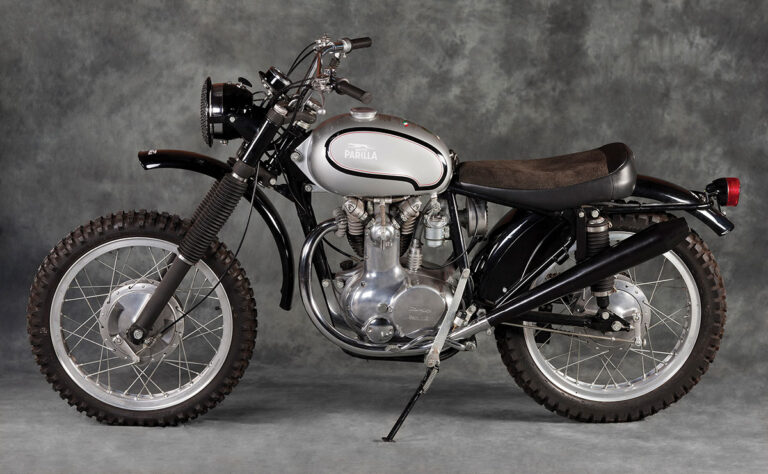
Taking note of this success, Cosmopolitan began importing Parilla motorcycles mostly in 250cc form. The models introduced into the U.S. were the 250cc Tourist street bike, the Trailmaster enduro and the Wildcat scrambler, with optional street lighting and the “X-1” racing cam. Cosmopolitan claimed 26 horsepower and a weight of 226 pounds (Cycle World noted 255 pounds in its July 1962 test) even with its iron cylinder, giving it an impressive power to weight ratio. Equipment on the magazine’s test bike included flywheel magneto and coil ignition, Dell’Orto TT-style remote float carburetor and 10,000rpm tachometer.
Cycle World noted that the new-for-1962 aluminum alloy front fork offered adjustable damping, which the testers found “very convenient.” In their off-road test, they found the brakes gave “smooth stopping under all conditions,” and the Wildcat “scored very well” in its ergonomics with the handlebars and footpegs at “just the right distance,” while the suede-finished seat gave “unsurpassed grip on one’s hindside.”
“This is a 250 with bags of power as long as it is kept turning briskly,” they wrote, “And it hauls along through the rough at a very exciting pace. Its handling at high speed over bad surfaces is very good.”
Its weakness was in sand, where it got “badly bogged down … but get it out where the engine can be cranked on tight, and it will really fly.”
Overall, Cycle World concluded, the Wildcat was “One of the most versatile 250cc machines around,” noting also that “this very same bike with the simple addition of clip-on-type handlebars and another exhaust system is being raced with a large degree of success in road races all over the country.” MC
Contenders: Two more small-displacement scramblers

1964-1969 Triumph Mountain Cub
- Claimed power: 14.5hp (16hp 1966-on) @ 6,500rpm
- Top speed: 70mph
- Engine: 199cc cc air-cooled OHV 4-stroke single, 63mm x 64mm bore and stroke
- Weight (wet): 250lb
- Fuel capacity: 3gal
- Price then/now: $650/$2,500-$4,500
It was Johnson Motors’ sales manager Don Brown who proposed that Triumph build a bike for the California market, with the Trials Cub’s wide-ratio gearbox and running gear, and the 1964 Sports Cub’s more powerful 14.5 horsepower engine. The result was the T20M Mountain Cub with Dunlop Trials tires, aluminum fenders and 7.5 inches of ground clearance. JoMo sold every one they could get!
Cycle World tested a Triumph Mountain Cub in 1964, calling it the trail bike they’d been asking for, “A real motorcycle, slightly undersized, properly equipped and geared.” Though heavier than its Asian competitors, the Mountain Cub scored on comfort and hill climbing ability, pulling strong where the smaller Japanese bikes ran out of steam.
The Triumph Tiger Cub range evolved in 1966 into the T20B “Bantam Cub” with the Cub engine in a BSA Bantam frame, a result of Cub production moving from Meriden to BSA’s Small Heath plant. It was not a great success, in spite of claimed handling improvements. The Super Cub with better brakes lasted until production ended around 1969.
1963-1966 Ducati 250 Scrambler

- Claimed power: 30hp @ 8,700rpm
- Top speed: N/A
- Engine: 249cc air-cooled SOHC 4-stroke single, 74mm x 57.8mm bore and stroke, 9.2:1 compression
- Weight (dry): 242lb
- Fuel capacity/MPG: 3gal/68mpg
- Price then/now: $739/$2,000-$4,000
Meanwhile, over at Berliner, the 250cc Ducati Scrambler arrived with 30 horsepower, thanks to its gear driven single overhead cam engine and 9.2:1 compression. With a 5-speed transmission, it claimed a weight of just 242 pounds, including a new stronger front fork for 1966.
Cycle magazine tested the 250 Scrambler in 1966, noting that it came with three different rear sprockets, an additional countershaft sprocket, a complete set of extra cables, a pair of struts to replace the rear shocks for flat-tracking, extra roto caps for the valves, and a set of tools. Cycle called it “A complete competition package that is also rideable on the street … a machine that the average enthusiast can afford and can win on with a limited budget.” However, riding it on the street required attaching the optional muffler which was, wrote Cycle, “essential” but compromised the power output. A speedometer was also optional.
“If your plans include … only occasional runs on the dirt,” wrote Cycle, “it might be wise to choose another Ducati more suited to street riding,” concluding, “it’s an extremely rugged bike, both in appearance and performance, and will prove a favorite with 4-stroke lovers.”