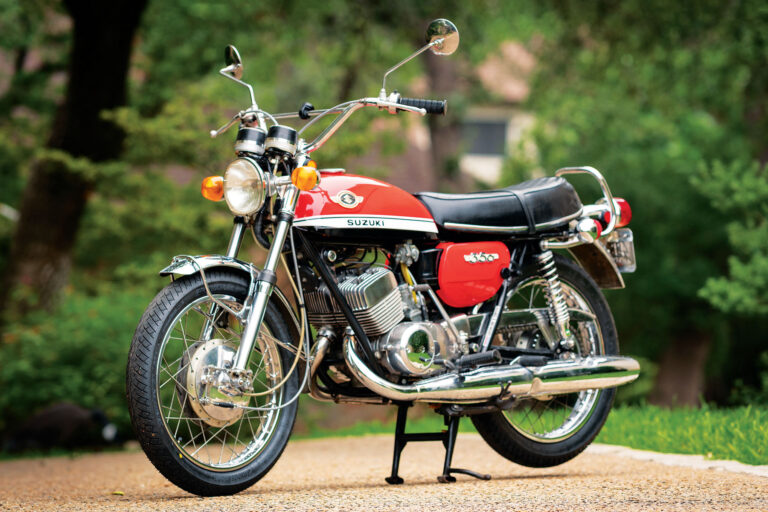
1970 Suzuki T350-II Rebel
- Engine: 315cc air-cooled piston-port two-stroke parallel twin, 61 x 54mm bore and stroke, 6.94:1 compression ratio, 40hp @ 7,500rpm (claimed), 29lb-ft @ 6,500rpm (claimed)
- Carburetion: Twin 32mm Mikuni VM32 SH
- Transmission: 6-speed constant-mesh, left foot shift (1-down/5-up), wet multi-plate clutch
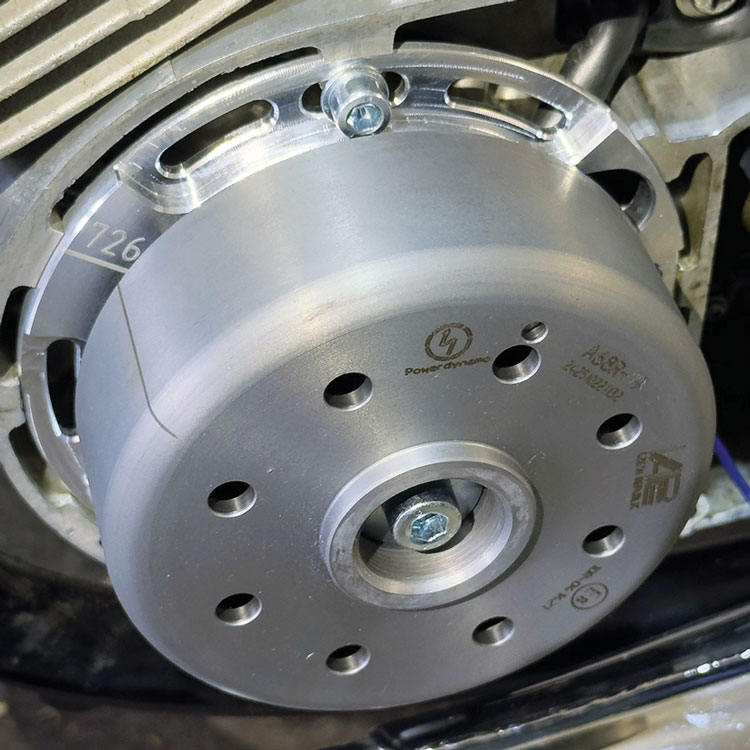
- Ignition: VAPE Electronic (Stock: Points, Condenser, coils)
- Wheelbase: 50.8in (1,290mm)
- Suspension: Telescopic 34mm hydraulically dampened forks front; twin hydraulically dampened spring-coil shocks rear; multi-disk friction steering damper
- Brakes: 8in TLS drum front, 8in SLS drum rear
- Tires: 3.00 x 18in front, 3.25 x 18in rear
- Weight (dry): 312lb (142kg) (claimed)
- Fuel capacity: 2.8gal (10.4ltr)
- Top speed: 105-110mph (claimed)
- Price then/now: $759 / $4,000-$8,000
When I bought my first motorcycle, a 1969 Norton 750 Commando S, I was a high school kid who wanted lots of torque and an exhaust that rumbled rather than shrieked. That was more than a half-century ago, and from the very beginning, I was never tempted by anything other than large-displacement four-strokes.
I spent my motorcycling life astride British and Italian singles and twins — machines with character, quirks, and a certain charm only an owner learns to love. The smallest bikes I owned were 500cc singles.
After 52 years of riding, I finally realized I’d missed something: two-strokes. Those small, smoky, noisy, inelegant “stinkwheels” I’d shunned since the Nixon administration turned out to be grin-inducing, heart-lifting fun. I’m a slow learner, but better late than never.
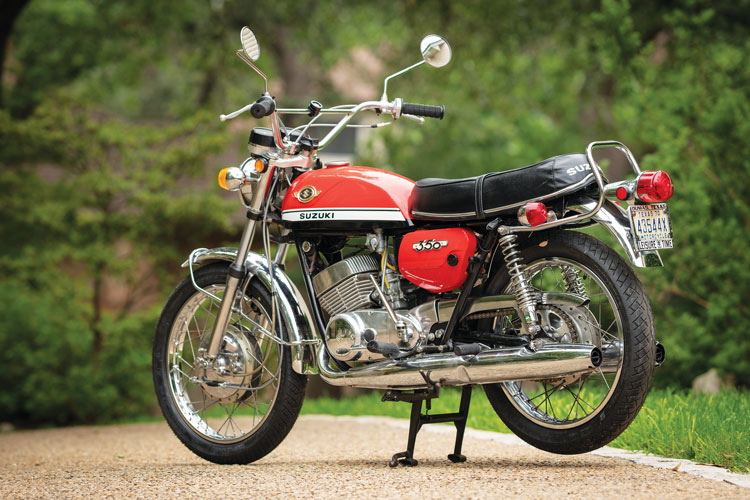
This is the story of the motorcycle that broke down my prejudices — a red 1970 Suzuki T350-II “Rebel” — and the event that took me from pleasant Saturday rambles to committing to a five-day, 1,000-mile adventure. It’s about discovering a new kind of riding, and how a small bike can deliver a very big experience.
Discovering the world of two-strokes
The shift started in 2024, when I signed up for the Small Bike Big Adventure (SBBA), a multi-day event for vintage motorcycles with a very specific formula: no machines larger than 350cc, and all had to be manufactured before 1973. Having never taken a shine to smaller motorcycles, this was already outside my comfort zone. Until then, my “adventures” were pretty much limited to solo rides of less than 150 miles.
The SBBA was different. It promised five days of riding in South Dakota, thousands of miles from home, on roads I’d never seen, on a bike I didn’t own. It was a challenge that forces you to reconsider what you think you know about riding.
For that ride, I borrowed a Honda CL77 Scrambler from my friend Hollis. The 305cc twin was dependable, easy to live with, and met the event requirements — but it didn’t quicken the pulse. Things changed when Hollis handed me the key to his little blue Suzuki X-6 Hustler, a 250cc two-stroke twin.
That half-day ride was a revelation. The Hustler’s revvy little motor and six gears gave it a lively, eager character I’d never experienced. It was fast, smooth, nimble, and, yes, a bit smoky. For the first time, I understood the appeal of a well-tuned two-stroke and realized I’d been neglecting an entire world of motorcycling joy. I left South Dakota with two resolutions: on the next SBBA I’d ride my own bike, and it would be a two-stroke, preferably a 350.
The hunt for the right bike
By the end of 2024, I had my eyes peeled for something suitable. In December, opportunity appeared on the auction site Bring a Trailer: a bright red 1970 Suzuki T350-II “Rebel.” It had clean lines, attractive styling, and a modest 8,059 miles on the odometer. I hadn’t specifically been hunting a T350, but when I saw the listing, it spoke to me. At $4,400, I placed the winning bid.
In one of those small-world moments, I learned that the seller was a good friend of someone I’d met at the 2024 SBBA. The bike was shipped from Illinois to Texas for $750 and rolled into my driveway in early January 2025. With only two previous owners, the Rebel was well-preserved, still wearing its original 55-year-old red-stripe tires. T350s aren’t rare — Suzuki sold tens of thousands of them between 1969 and 1972 — but they don’t surface often. For me, it was the right bike at the right time.
Suzuki and the two-stroke legacy
Buying the T350 pulled me into Suzuki’s history, one that’s deeply entwined with two-stroke technology. In 1961, East German factory MZ rider Ernst Degner defected and joined Suzuki, bringing with him cutting-edge two-stroke know-how developed by famed engineer Walter Kaaden. With Degner in the saddle, Suzuki won its first World Championship in 1962 in the 50cc class. From there, Suzuki became a two-stroke powerhouse, racking up titles throughout the 1960s, including a string of 50cc and 125cc championships.
At the Isle of Man TT, Suzuki also left its mark, with Mitsuo Itoh becoming the first and only Japanese rider to win there, taking the 50cc TT in 1963. Suzuki’s racing successes translated into production machine sales, a classic case of “win on Sunday, sell on Monday.”
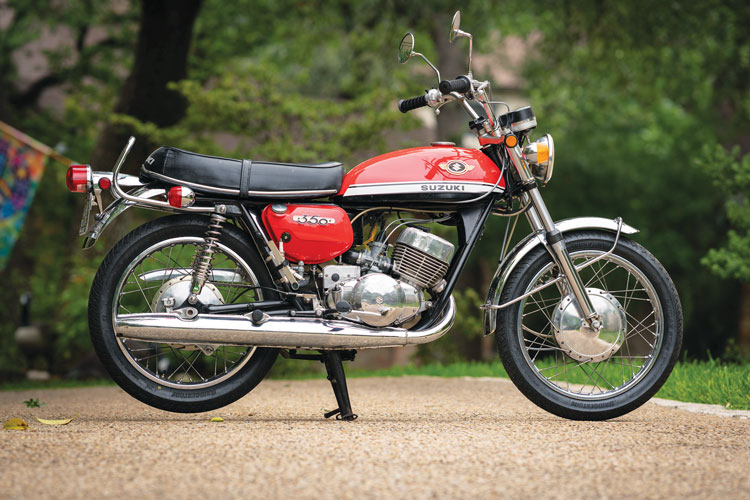
The T350 debuted at the 1968 Tokyo Motor Show, slotting neatly between Suzuki’s T250 and T500. Styled with rounded, painted tanks inspired by Montesas and Bultacos, it broke away from Suzuki’s earlier chrome-heavy look. Technological advances included oil injection through the “Posi-Force” system, which eliminated the hassle of premix, and a left-side kickstarter that could start the bike while in gear with the clutch pulled in. Most impressive of all was the six-speed gearbox — Suzuki pioneered the introduction of this exotic feature into production motorcycles.
At only 315cc, the T350 was essentially a bored-out T250. Period tests clocked 1/4-mile runs in under 15 seconds and 0-60mph in about six — performance close to bigger four-strokes such as Honda’s CB450 or Triumph’s 500 twin. Built from 1969 through 1972, the T350 evolved through a handful of cosmetic and mechanical updates before giving way to the GT380. Estimates suggest between 50,000 and 60,000 T350s were sold worldwide, most going to North America, Europe, and Australia.
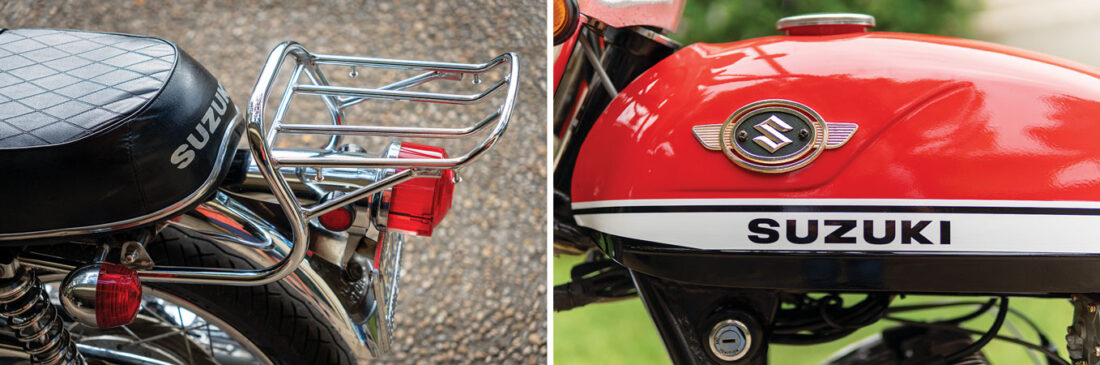
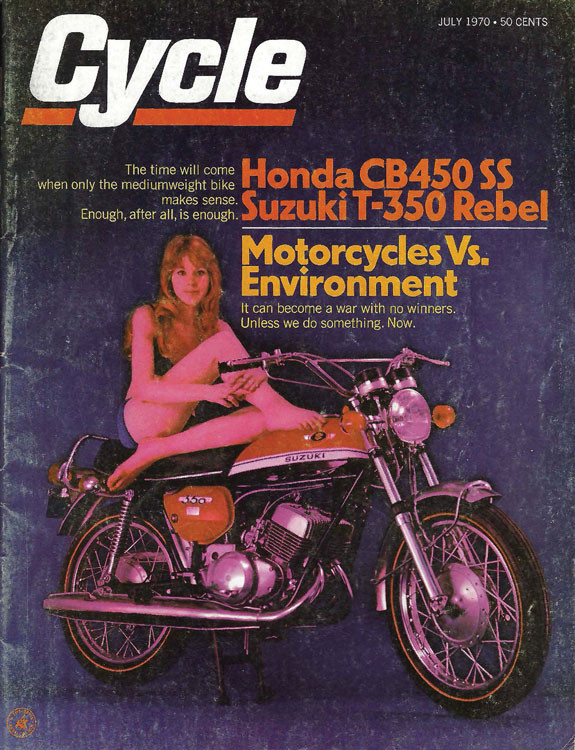
The July 1970 issue of Cycle magazine featured a T350 Rebel on the cover that looked just like mine. About the motorcycle, the editors said “What we motorcyclists need is a weapon with the agility of a lynx and the evasive capabilities of Willie Sutton. The Suzuki T350-II Rebel is such a weapon.”
An identical T350 also graced the cover of the August 1970 issue of Cycle Guide magazine. Again, the editors were enthusiastic about the machine stating: “In just about all the performance areas, the Rebel responded with agility and ability meeting or exceeding that of its peers.”
Wrenching toward reliability
As pretty as my T350 was, it needed more than polish to handle 1,000 miles of Arkansas and Missouri roads. Getting it SBBA-ready became a project of its own.
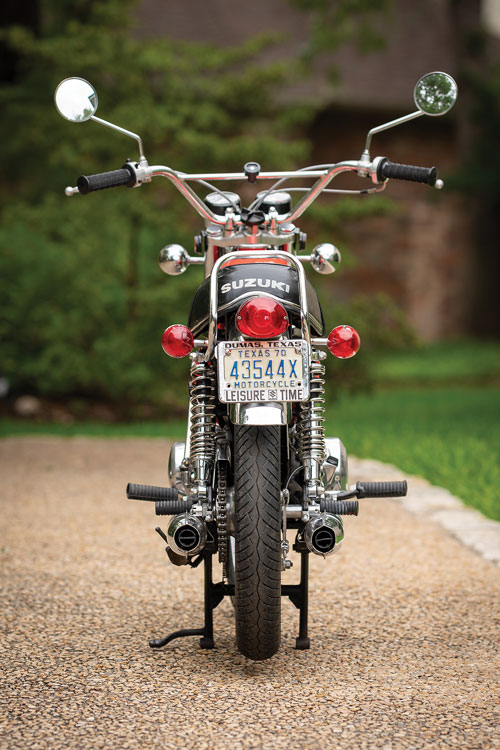
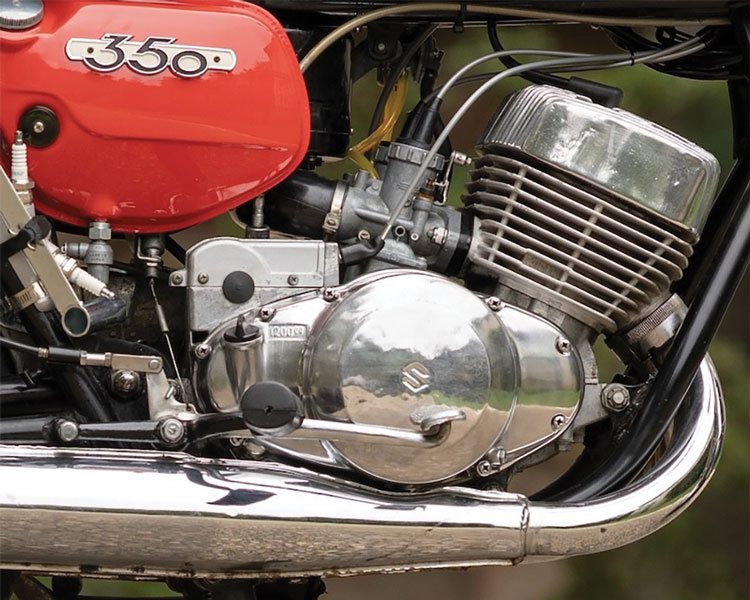
First came reliability upgrades. A modern VAPE ignition and charging system replaced the old ignition points and alternator, ensuring stronger spark and consistent timing. The greater charging output also meant I could run lights without worrying about draining the battery.
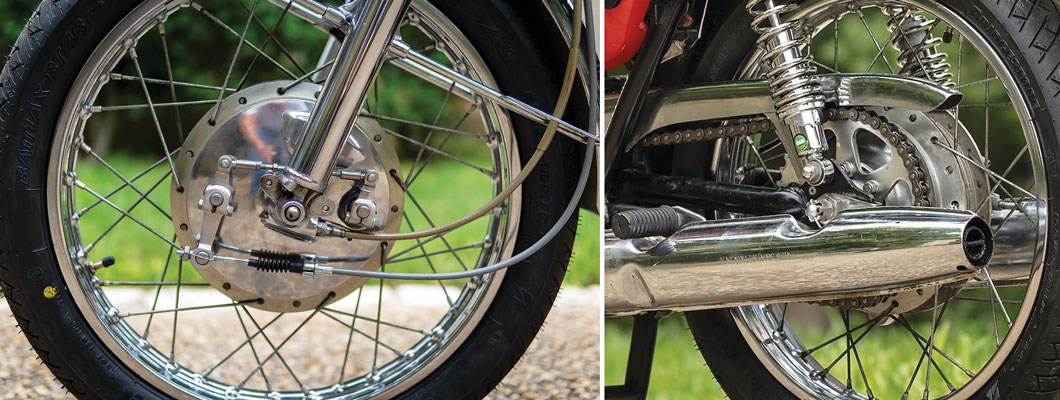
Next came tires: I installed new Bridgestone BT46s, fresh tubes and rim strips, turning the bike from a polite antique into a roadworthy partner. The fork legs showed evidence of a hard life — both were bent with pitted chrome. I sent the tubes to Frank’s Forks (née Forking by Frank), a venerable outfit that fabricated a perfect set of new tubes. With new seals and O-rings installed and 20 weight oil, the front end felt tight and leak-free.
The pre-ride prep checklist grew to include:
- New clutch, throttle, oil pump and front brake cables
- New Cush-drive rubbers
- A new Motobatt MB5U 12-volt battery (7Ah)
- Ethanol-resistant yellow Tygon® fuel lines fitted with in-line sintered-metal filters.
- Non-resistor NGK B8HS plugs gapped at 18 thou.
- A factory accessory package rack on the rear for light luggage.
- New IKON rear shocks with springs matched to my weight.
- A new DID 525 chain and JT sprockets (15/41). Stock ratio was 14/38, but repro 38-tooth rears weren’t available; the final ratios differ by less than one percent — effectively stock.
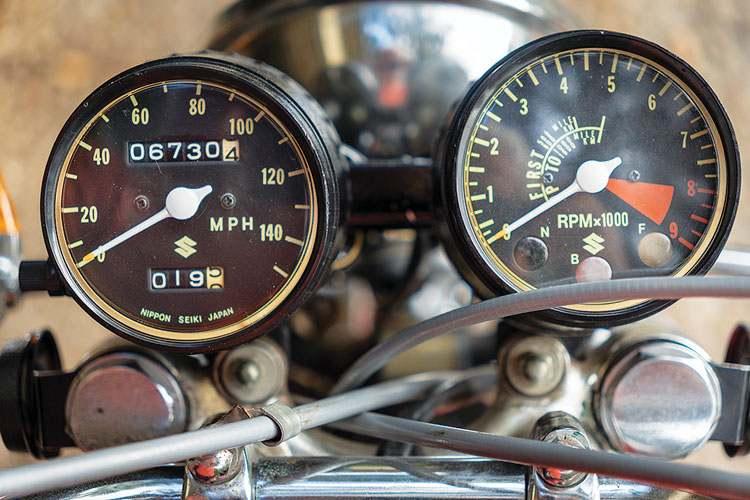
- 1972 Suzuki T350J instruments swapped in for one very practical reason: the ’70 speedometer lacks a trip odometer; the ’72 gauge has one. On a small-tank two-stroke, a trip meter saves push-of-shame miles.
The carb flanges were slightly bowed from over-tightening, creating an air leak, and the float levels were off; once trued and set, idle stabilized and midrange cleaned up. A minor fuel tank seep at a tank-badge screw prompted me to coat the interior with Caswell Novolac phenol-epoxy sealer. Lastly, I replaced the stock vacuum petcock with a Pingel manual tap to stop off-engine fuel seepage.
Parts availability for the T350 is better than you might think. eBay remains the best bazaar for NOS bits; the oddball pieces — the uniquely shaped air filter and sealed-beam headlight, for instance — take more patience. To complete the period look, I registered the Suzuki as an antique motorcycle in Texas (no annual inspection, five-year renewal), bolted on a 1970 Texas plate found online, and framed it with a period-correct chrome surround from a Suzuki dealer in Dumas, Texas.
For luggage, I packed light: a Cortech Super 2.0 18L magnetic tank bag carried rain pants, sunglasses, a phone power pack, spare plugs, and odds-and-ends. When the wrenches stopped clinking, the tally for shipping, spares, repairs, and upgrades came to just under $4,000 — nearly the price of the bike again. What I rolled out of the garage, though, was a ready companion, not a fragile relic.
The 2025 SBBA
The 2025 edition of SBBA ran August 23-30 in the Ozarks, with headquarters in Harrison, Arkansas, about 15 miles from the Missouri border and 35 from Branson. A Holiday Inn and a Hampton Inn shared a parking lot that instantly turned into the heart of the event. In the evenings it felt like a vintage-bike field hospital crossed with a cookout: fairings off, carb bowls on benches, jokes in thick air.
Roughly 50 riders came from all over the U.S. The daily plan was simple. We’d ride five days and cover a touch over 1,000 miles. Each loop started and ended in Harrison, so there was no trundling gear from motel to motel. The organizers drew routes that kept our small bikes off high-speed highways and funneled us onto rolling farm roads with 25-55mph limits. Gravel appeared each day in measured doses — three categories, from easy mandatory stretches to optional sections with bigger rocks and ruts. High-water alternates were mapped in case an Ozarks cloudburst filled the low crossings. One day was canceled due to rain; some riders explored Eureka Springs, while a handful of hard cases, including veteran racer Dave Roper, simply went out and got wet.
Adventure implies risk, and SBBA acknowledges that up front. Two riding mechanics, Jonesy and Andrew, rode the full routes every day, performing roadside triage on balky bikes. Back at the hotel, they wrenched into the evening hours. Sag vehicles hovered where they were needed to retrieve the truly stricken. Communication was modern and efficient. A WhatsApp group handled route notes, lunch rendezvous, and “does anyone have a Dell’Orto jet?” requests.
If you’ve never ridden the Ozarks on a small motorcycle, picture a mix of rolling green hills and farmland, stitched together by roads that seem built for small bikes. Traffic was light and the posted speeds matched our bikes’ happy zones. Harrison, population 13,000, was perfectly sized — big enough for fuel, food, and parts, and small enough that two traffic lights stood between you and the good riding.
Each morning after the daily riders’ briefing, I’d check my oil level and tire pressures, check my chain slack/need for lube, fuel up, reset the trip meter, and hit the road. The group would fan out along the day’s loop — small packs forming and dissolving as pace and scenery dictated. Lunch stops had an old-friends-at-a-homecoming feel, even among people who’d met two days earlier.
How the T350 performed
How did the Suzuki fare? Surprisingly well. On paper, the T350 is a modest motorcycle. On the road, it’s a small miracle of proportion and personality. At about 325 pounds dry, it’s easy to manage and the engine was much torquier and less peaky than I expected. It has an impressive amount of grunt for a small bike.
For a rider six feet tall, the cockpit is a little cramped. Once out of town, I usually relocated my clodhoppers to the passenger pegs for more legroom. The saddle was more comfortable than it looked, and I never ended a day cursing it.
Fuel range concerned me before the event, but it wasn’t a problem. The Rebel consistently returned 45-50 mpg, and the longest gap between gas stops on our routes was about 80 miles, so I had no range anxiety. Another stroke of luck was that every rural gas station we used sold non-ethanol premium, a gift for our old carburetors.
The six-speed gearbox made the T350 feel alive. Shifts were light and positive. I spent most of my days between 3,500 and 4,500rpm, with the engine spinning at about 4,000rpm at 60mph in 6th gear — half its 8,000-rpm redline. On longer climbs I’d drop one or two gears and let the Suzuki hum. The little twin’s willingness to hold a rhythm felt almost musical.
The Rebel’s twin-leading-shoe front brake outperformed many of the other single-leading-shoe setups, but it was still a good idea to plan one’s stops in advance. The suspension did its part and delivered honest control without beating me up on occasional washboard dirt sections or patched asphalt.
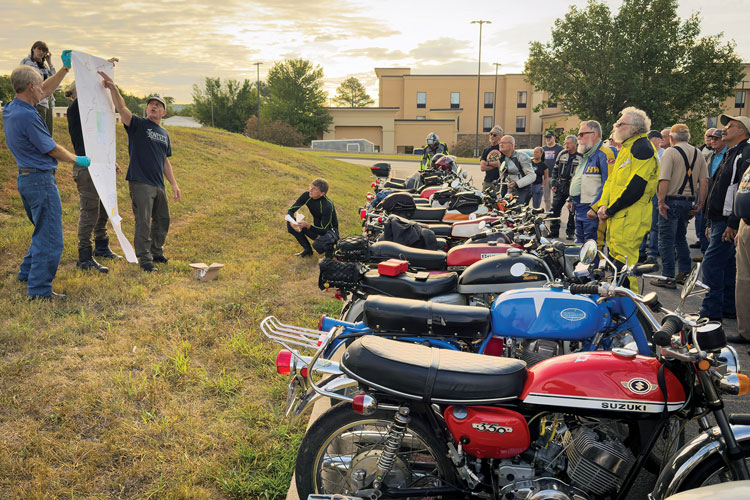
The Suzuki smoked a little on first start-up each day, then settled down without leaving a blue fog behind me. I topped the oil-injection tank once during the week and never needed to touch the plugs. It started easily hot or cold — something I can’t say for every big four-stroke I’ve owned.
In the hotel parking lot, another rider walked over and introduced himself with a grin: “You’re the guy who outbid me on that red T350 on Bring a Trailer.” To soften the blow, I told him I’d spent another four grand getting the bike to this point, which made him feel better and made me realize that while auctions end at a number, builds don’t.
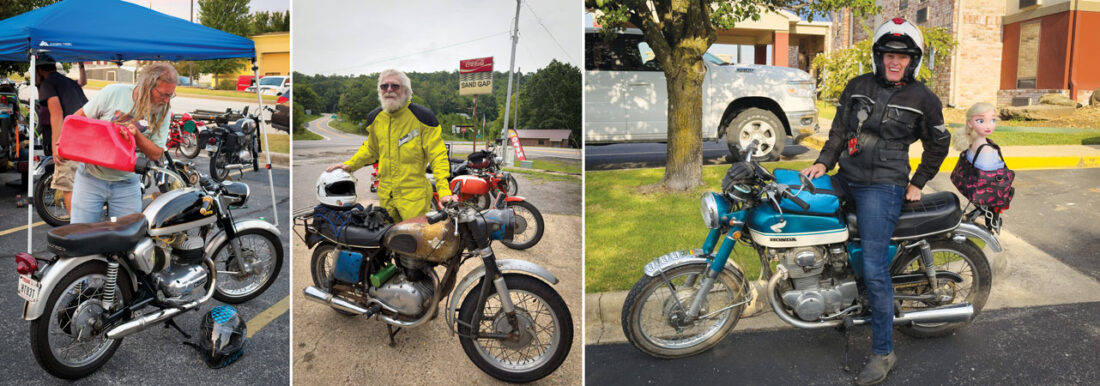
Although I had plenty more in reserve, my top speed for the week was around 65mph; most days averaged 40-45 mph once you factored in photo stops, fuel, and the welcome habit of standing around talking with new friends. That’s exactly the pace these bikes were made for: slow enough to enjoy the scenery, quick enough to keep the engine singing.
Rebel teachings
I came to SBBA looking for an adventure and maybe a good story. I left with a new definition of motorcycling. For most of my life, I’d limited myself to large-displacement four-strokes. I loved them — and still do — but they became a habit, and habits can turn into blinders. A five-day ride on a 315cc two-stroke twin peeled those blinders back.
Small bikes change the way you ride. You carry momentum. You read the road more closely. You use the gearbox as an instrument. You measure progress by smiles rather than speedometer digits. The world smelled like cut hay and hot oil and creek water. The engine didn’t so much dominate the experience as soundtrack it.
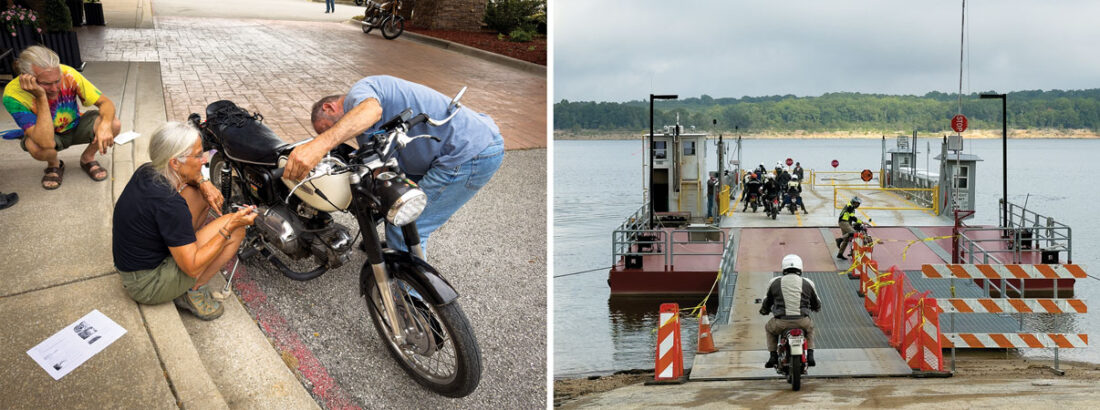
Committing to SBBA also forced me into good habits. Paying a $300 sag fee up front and having a hard start date meant finishing the prep work on schedule. Knowing I’d ride 1,000 miles in five days guided each decision — do it once, do it right. After getting the bike sorted out, fighting with stuck parts, tweaking the carbs, and finally taking it on the road, I ended up feeling more connected to it than I expected.
The people are the other half of the equation. SBBA attracts riders who cherish old machines but don’t worship them so much they won’t ride them. Evenings in the parking lot reminded me why group events matter — advice freely shared, spare parts passed across tailgates, and friendships renewed or begun. The WhatsApp chatter carried jokes and problem-solving in equal measure. I came home with a longer contact list and a shorter list of assumptions.
New friends and new horizons
The best part of SBBA lives in the spaces between the rides. It’s the group of riders gathered around a misbehaving carb in the evening light. It’s two mechanics who somehow always arrive exactly where they’re needed. It’s a hotel parking lot that turns into a university where everyone teaches and everyone learns. It’s a stranger at a gas pump who becomes a friend by the end of the day. I renewed old friendships and made new ones, all orbiting the shared love of classic motorcycles and the stories they carry.
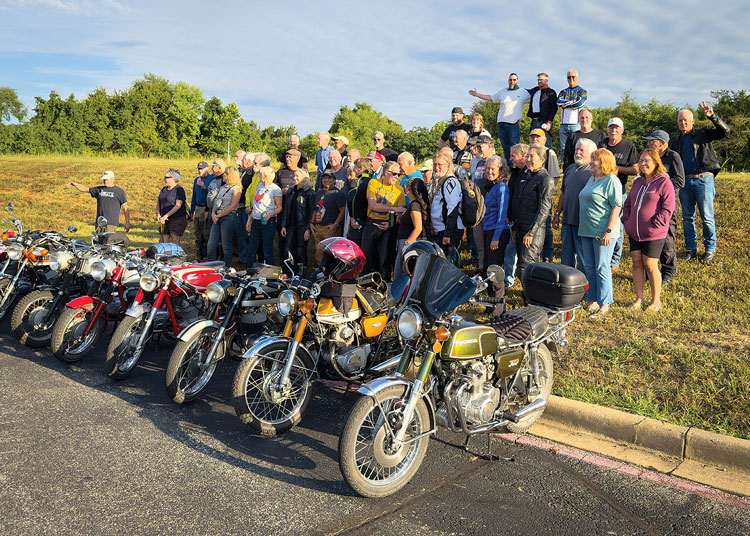
The SBBA event set a chain of good things in motion. It opened me to a new kind of riding on a new kind of bike. It revealed a blind spot I didn’t know I had. I’d been limiting myself by defining motorcycling in terms of engine size and cylinder count. It pushed me to commit to buying a bike I didn’t yet own, to prepare it without shortcuts, and then to show up on a date circled in ink. It taught me that choosing the right machine, prepping it properly, and keeping it running for a week is a recipe for satisfaction.
The 2025 Small Bike Big Adventure broadened my horizons. The experience tied me closer to a machine, but it also deepened friendships old and new.
Big bikes will always live in my garage. But next to them now sits a bright red Rebel, a little two-stroke that taught an old dog a new smile. MC
Small Bike Big Adventure: Riding Light, Riding Far
The Small Bike Big Adventure (SBBA) ride is the creation of Todd Wallis and Ben Foster, born from Todd’s original “Puchs on Pikes” idea — an ambitious plan to ride small two-stroke Puchs up Pikes Peak in Colorado. That ride never happened, but the concept evolved into what has become a celebrated series of SBBA events.
The premise is simple: machines no larger than 350cc, built no later than 1972. Why so small and so old? For one thing, they’re easier to troubleshoot when problems arise. They’re also lighter, nimbler, and frankly, more fun. With horsepower capped at around forty, riders are less likely to get in over their heads. Instead, the pace encourages soaking up scenery rather than fixating on the next apex.
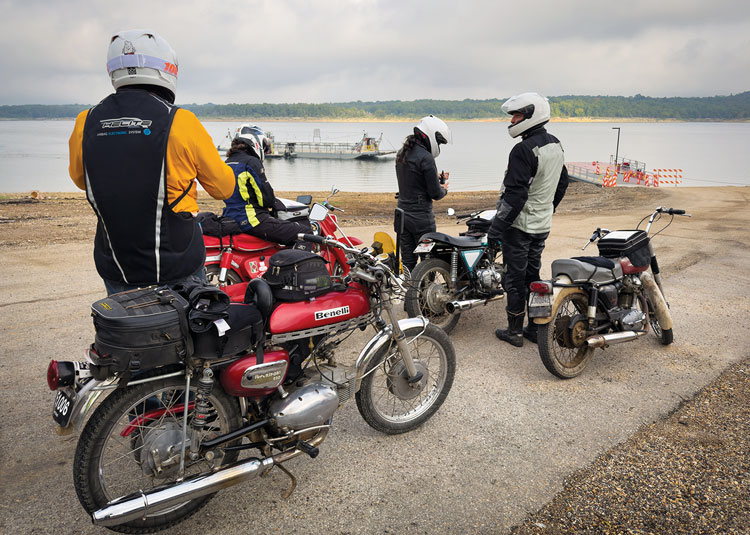
The range of bikes is as diverse as the riders. European four-strokes like Aermacchi, Ducati, Benelli, Motobi, Velocette, BMW, Horex, Riverside, and Husqvarna shared the road with Japanese two-strokes from Yamaha, Suzuki, and Bridgestone. Add to that European two-strokes like Puch, MZ, and Bultaco, plus Japanese four-strokes from Honda, and the result is a rolling museum of quirky, charismatic classics.
SBBA follows the model of other “Motogiro-type” events, celebrating small, older machines with character. Many riders are veterans of the Motogiro d’Italia, the Moto Melee, and the Motogiro di California. As Foster and Wallis point out, older machines have quirks that make them interesting, while modern bikes, if they break down, can be nearly impossible to fix by the roadside.
The first four SBBA rides took place in Colorado, home turf for the organizers. The fifth edition in 2024 headed north to South Dakota, while the sixth, in 2025, explored the Ozarks. The 2026 edition will be held in Wisconsin from August 31 – September 4. Details can be found here: SBBA website.
The ride has also drawn the attention of Motorcycle Classics. The 2024 event was featured in “2024 Small Bike, Big Adventure.” Founding editor Richard Backus has taken part himself, writing about the 2023 edition and joining the Ozarks run in 2025.
With a growing following and a clear passion for celebrating small classics, the Small Bike Big Adventure has become a reminder that you don’t need big horsepower to have a big ride.