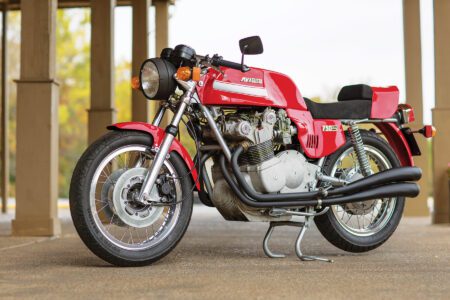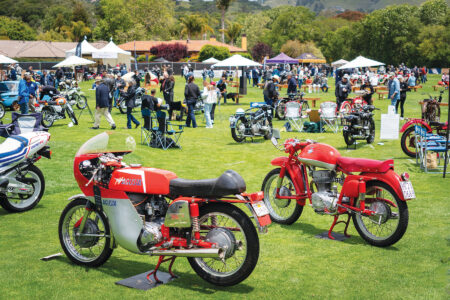
When I told my friends back home in Texas that I’d just been looking at rare and exotic vehicles on a golf course near Monterey Bay, they assumed I’d been to the Pebble Beach Concours d’Elegance. I thought they knew me better than that. Why pay almost five hundred bucks to look at a bunch of old cars when I can go to the Quail MotoFest, pay less than a hundred bucks, and see some of the most beautiful and significant motorcycles ever built?
Like the Pebble Beach event, the Quail MotoFest was held on a lush golf course near Monterey Bay, but it’s an entirely different sort of event — it’s smaller, less crowded, more relaxed, and exclusively focused on motorcycles.
The Quail MotoFest is a rebranding of the event formerly known as The Quail Motorcycle Gathering, and it’s one of two annual motorcycle-focused shindigs hosted by The Peninsula Signature Events. The other is the 100-mile Quail Ride through the hills surrounding Monterey Bay, which features laps of Laguna Seca. It takes place on Friday, the day before the MotoFest, includes lunch and dinner, and is open to modern and vintage motorcycles. The Ride is limited to 100 riders and includes a ticket to the MotoFest held the following day.
Gordon McCall, the director of motorsports for The Peninsula Signature Events organization, is a lifelong motorcycle enthusiast, and it’s his passion and vision that have sustained and grown these two events over the years.
Bikes and camaraderie
The 15th edition of the MotoFest took place on Saturday, May 17, 2025, at the Quail Lodge & Golf Club in Carmel Valley, California. Traditionally held on the first Saturday in May, the 2025 event was moved two weeks later in the hopes of avoiding the wet weather that deluged the 2024 edition.
More than a mere bike show, the MotoFest is intended to be a celebration of motorcycle culture and community. Each year, there are thousands of avid attendees and hundreds of beautiful motorcycles on display. The 2025 event also included vendor tents, food, a beer garden, live music, and discussions with motorcycle luminaries Troy Lee, Wayne Rainey, Steve Baker, Fujio Yoshimura, and others.
The “Legend of the Sport” chosen for the 2025 event was renowned
motorsports protective apparel designer and artist Troy Lee. During the chat session hosted by Gordon McCall, Troy reflected on his many years of work in motorsports and was joined on stage by AMA Hall of Famers Wayne Rainey and Steve Baker. Wayne is a motorsports legend who won the Daytona 200 in 1987 and was a three-time FIM 500cc World Champion (1990, 1991, and 1992). In 1977, Steve campaigned his Yamaha YZR 750 successfully to become the first American to win the Formula 750 World Championship.
Legends on the lawn
The bike show is the centerpiece of the event and includes 10 traditional motorcycle groups: American, British, Italian, Japanese, Other European, plus Antique (pre-1936), Choppers, Competition (On Road and Off Road), and Custom/Modified.
Of the 152 bikes registered for the event, 105 signed up to be judged. There were two entries in the American class, 20 bikes in the competition classes, 13 in the Custom/Modified class, and seven Choppers. The Antique, Italian, Japanese, and Other European classes had 6, 11, 15, and 7 entries, respectively. There were only four bikes in the British class this year (down from 26 three years ago!). Time will tell if this is a trend or a blip.
Each of the traditional classes was judged to select first- and second-place awards, except for Choppers and the Competition classes, which each had a single winner. There were also several special awards, resulting in a total of 26 awards presented.
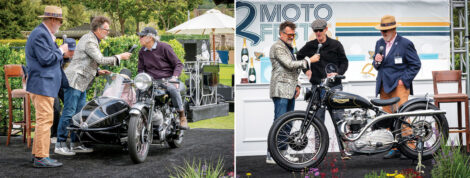
Somer Hooker, Chief Judge at the event, provided guidance for the team of 40-odd judges (the hyphen is important here). About the 2025 edition of the Quail MotoFest, he commented: “Over the years, we’ve added highly successful classes such as ‘Custom/Modified’ bikes as well as ‘Choppers,’ a uniquely American icon. In addition to the 10 traditional classes, the annual featured categories add interest. After the monsoon that hit the event in 2024, this year the weather was perfect, the participants brought quality machines, and the crowds showed up.”
As Somer noted, one thing about the Quail event that keeps it fresh and exciting is the addition of special classes each year. In 2025, the three special classes were: “Italian Innovation by Bimota,” “Tribute to Yoshimura,” and “Celebration of 45 Years of the BMW GS.”
The Bimota display featured 19 examples of the relatively rare Italian marque on the lawn, including some historically significant machines. Named after the three founders of the company (Valerio Bianchi, Giuseppe Morri, and Massimo Tamburini), Bimota was launched in Rimini in 1973 with the goal of creating beautiful, fast, good-handling motorcycles. Their approach was to build exceptional chassis around existing engines from manufacturers such as Honda, Ducati, Suzuki, Kawasaki, and Yamaha. Model names indicated the source of the engine (HB, DB, SB, KB, and YB, respectively).
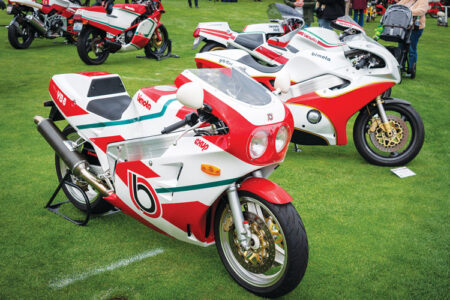
In addition to making street bikes, the company was focused from the beginning on competition. In fact, the first-ever World Superbike race at Donington Park in April 1988 was won on a Yamaha-powered Bimota by Davide Tardozzi, the current team manager of the factory Ducati MotoGP team. He won a total of five races on the bike during the inaugural season.
Bimota was one of the first motorcycle companies to pioneer the use of race bike technology on their street bikes. Their creations incorporated things like electronic fuel injection, aluminum twin-spar beam frames, upside-down forks, floating brake discs, four-piston brake calipers, composite wheels, digital instruments, and full-enclosure bodywork designed for aerodynamic efficiency.
Two exceptional Bimotas at the Quail highlighted the company’s competition heritage. One was Virginio Ferrari’s YB4R model that brought Bimota its first world title in 1987, when he won the TT F1 World Championship. This bike, owned by Robert Steinbugler, is currently in the Bimota Spirit collection and won the award for the special Bimota class. Another Bimota on the lawn, a 1981 KB1-A, had been raced by Graziano Rossi, father of nine-time World Roadracing Champion Valentino Rossi.
Kawasaki’s acquisition of 49.9% of Bimota in 2019 provided the financial resources for Bimota to return to competition in the World Superbike series while building high-end road bikes based on Kawasaki’s engines. The Quail exhibit also included examples of the latest Bimota street bike technology, such as the Oro Nero and the radical-looking Tesi model that incorporates hub-center steering.
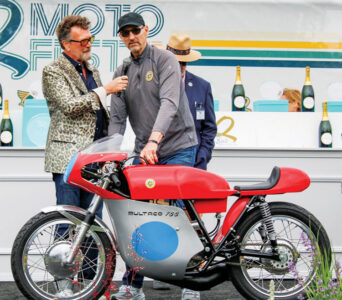
The “Tribute to Yoshimura” recognized and honored the legacy of Hideo “Pops” Yoshimura and his family’s contributions to motorcycle racing and developing trick aftermarket parts. On display was Yoshimura’s famed first race bike, a Honda CB72, built by Pops that took the victory in the 1964 Suzuka 18-Hour Endurance Race. The bike, now owned by John Barrett, took the award for this class.
Also at the event was the Yoshimura-built 2024 FIM Endurance World Championship Suzuki GSX-R1000, which was shipped to the show from Japan. There was also the one-of-a-kind Yamaha R7, a collaborative masterpiece built by the Yoshimura team and painted by motorsports artist and this year’s Legend of the Sport Troy Lee. Pops’ son, Fujio Yoshimura, was at the event to represent the still-thriving Yoshimura company, and it was a treat to hear him talk about the history of his father’s famous tuning business.
The “Celebration of 45 Years of BMW GS” recognized the motorcycle that essentially created and defined the Adventure Bike category. There were several noteworthy examples of the model on display, and Robb Talbott’s high-mileage 1981 R80 G/S took the award for this special class.
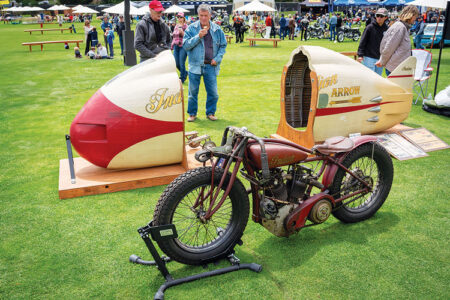
There were six special awards, which went to machines that were deemed to be exceptional in one way or another. “Best of Show” went to Clyde Crouch for his 1937 Indian Arrow, which also won the “Best American” class. The bike was built by dealer Hap Alzina to challenge Ernst Henne’s 1936 land speed record of 279.503 km/h (173.675mph) set in a streamlined BMW. It turned out the Arrow was not very aerodynamic, was somewhat unstable, and the Indian actually went faster without the egg-shaped shell. Not a complete success, but a fascinating story nonetheless.
The “Spirit of the Quail Award” went to Michael Szymanski for his custom/modified 1983 Yamaha XV920 Midnight Virago. This was the first custom bike built by Michael — he taught himself how to engrave, weld, paint, etc., and his efforts were duly rewarded. His partner, the actress Juno Temple (best known for her role as Keeley Jones in Ted Lasso), was on-site and lent a splash of celebrity sparkle to the event.
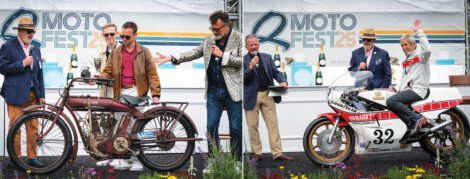
The “Hagerty HVA/Preservation Award” was given to Russell Harmon for his 1913 Indian Single Speed Twin. This bike had belonged to Russell’s great-grandfather, and prior to entering the show, it hadn’t run for more than 20 years. Miraculously, it started up after changing the oil and adding fresh gasoline. It was recognized for its unrestored, completely original condition.
The “Why We Ride Award” was given to Brian Wismann for his 2024 Lightfighter LFR V3. The winner of this award is chosen by children 12 years old and under who are inspired to pursue motorcycle-related careers by the award winner. It’s interesting that they chose an all-electric race bike. Who needs noise and fumes to have fun?
The “AMA Motorcycle Hall of Fame Heritage Award” was presented to Steve Baker for his 1978 Yamaha YZR 750. This award honors individuals who have demonstrated exceptional dedication and impact on the AMA and the motorcycling world, and Steve, America’s first motorcycle road racing World Champion, was a deserving recipient.
The “Arlen Ness Memorial Award” was given to Corey Mauck for his 2025 Aero Precision Metal Works chopper, “The Medusa.” His creation bristled with intricate metalwork and design details. It really was a stunning piece of rolling art.
As in previous years, Paul “The Vintagent” d’Orléans emceed the awards presentation ceremony and did an excellent job of keeping the banter with owners lively and informative. Paul is an enthusiastic supporter of the annual event and noted: “The vibe was, as always, excellent; relaxed and friendly. It’s about the most pleasant motorcycle gathering imaginable, and it’s a wonder more folks don’t make the effort — tickets were affordable, and there were so many super cool bikes to see, most of which had great stories if you chatted with their owners. In the case of race bikes, that included some of the legends who rode them to glory.”
MotoFest magic lives on
What makes the Quail event unique and keeps it vibrant year after year? The Quail Lodge and Golf Course is a perfect venue for the event. The lawns are lovely, and there’s plenty of room for the bikes and attendees. There were food trucks, a beer garden, free ice cream, a children’s play area, and live music all day. Various vendors and local lifestyle brands had display booths.
It remains the premier outdoor motorcycle-only concours in the U.S. The mix of bikes and people changes from year to year. Each year, there are new featured categories, guaranteeing the variety and depth of the entries displayed. The collection of restored, preserved, and custom/modified machines represents some of the rarest and finest motorcycles in the country.
Gordon McCall shared his thoughts about this year’s edition of the event: “The newly revamped Quail MotoFest was an incredible success. The Bimota Class was over the top with help from Bimota Spirit, the Tribute to the famed Yoshimura brand was spectacular, with Fujio Yoshimura coming from Japan and his son Yusaku bringing an iconic lineup of race bikes from their vault. As a longtime GSA owner/rider, a nod to the 45th Anniversary of the GS was very appropriate. Our Legend of the Sport is always a highlight, and Troy Lee was a perfect choice this year. Our longtime supporter Yamaha, under Bob Starr’s direction, is always appreciated, and when he showed up with Steve Baker and his famed YZR500 and TZ750 Flat Tracker… well, that was amazing. So was Brad Lackey and his Dick Mann-built BSA B50MX, and it’s great to have dear friend Wayne Rainey on hand.”

The atmosphere is relaxed and friendly, with none of the snootiness that can be experienced at some of the high-end automobile concours. The event provides a rare opportunity to hear from remarkable and legendary figures in motorcycle culture and history. It’s also a giant reunion for many attendees and offers the chance to reconnect with old friends and make new ones. Like the Barber Vintage Festival, The One Show, The Handbuilt Show, AMA Vintage Motorcycle Days, and other moto-centric events, the Quail MotoFest allows attendees to share and celebrate motorcycle culture with fellow fanatics. For me, attending the Quail MotoFest was a relaxing act of escapism. I enjoyed being immersed in motorcycle culture, surrounded by like-minded souls, and not thinking about the outside world for a brief period.
Gordon summed it up well: “It’s about more than the bikes — it’s about the people, the stories, and the passion of the motorcycling community. The love for two wheels is as strong as ever.”
Looking ahead to the 2026 MotoFest, details about the 2026 Quail Ride and Quail MotoFest, including the date, who will be the Legend of the Sport, and which special machines will be featured, have yet to be announced. Keep an eye on their website for updates. MC
Inside the Competition Class
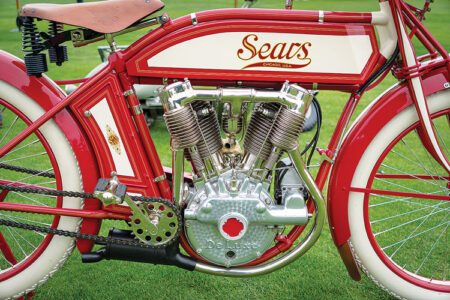
“We have a really eclectic group of bikes this year,” said Gordon McCall, Quail director of motorsports. There were GS BMWs plastered with stickers from all the countries they had gone through. One had gone around the world. There were motorcycles that were over 100 years old, including a 1913 Sears, and the owner demonstrated how to start it. There was a single speed Indian from ’13 as well. OrangeCat Racing, a top competitor in MotoAmerica AMA National road racing, brought a 2024 electric motorcycle that has been doing well in track competition.
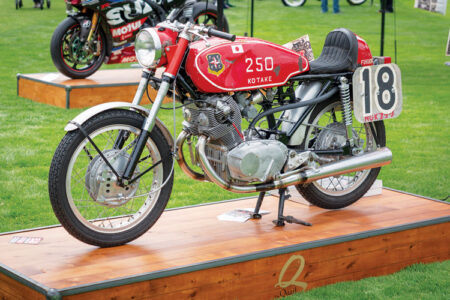
Some of the more interesting bikes, however, were entered in the competition class. Just about every racer on the field had an interesting story behind it. Yoshimura has been a top name in competition engine building and exhaust system production since the 1960s. Everyone has to start somewhere, and Fujio “Pops” Yoshimura got his start prepping small-displacement motorcycles for local racing. His first purpose-built racer was a 1964 CB72 Honda, raced by three American servicemen stationed at a nearby base. It took part in the inaugural 18-hour endurance race at Suzuka. One of the G.I.s bought it from Yoshimura and brought it back to the U.S., intending to continue racing — only to learn that his base commander had banned servicemen from racing. He stashed the bike in his basement, where it stayed until the present owner, Dr. John Barrett, bought it. He researched its history and reached out to the Yoshimura company, which was very excited to learn it had been found. Yoshimura’s son and grandson came from Japan for the MotoFest, where the CB72 Honda, cleaned and polished, but very original, was prominently displayed.
Racing is often a story of what-ifs and broken dreams. As Phil Irving said, “They only count the winners at the finish.” Thad Wolfe, an early 1980s AMA Superbike racer, and John Richards collaborated to convert a pre-War Indian Scout into a road racer. “We brought it to Daytona in 2013 or 2014,” said Thad. “All the Wrecking Crew — the post-War team that won numerous races for Indian — were there. We wanted to win. I was leading the race when the Indian broke down. I just brought the bike back, put it together more or less, and it hasn’t run since.” Entered in the Competition class at Quail, it somehow looked mournful out there on the field, as if it wanted another chance.
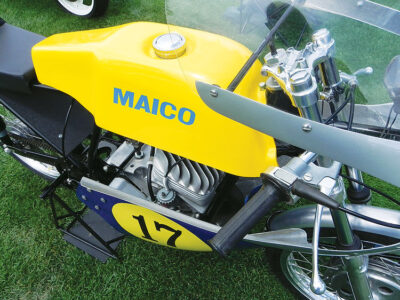
Racing can also be a story of phoenixes rising from the ashes. Jacklyn Lucas and Steve Poggi are a married couple who help each other with each other’s hobbies. Steve frames Jacklyn’s watercolors, and Jacklyn helps Steve with his Bultaco and other European motorcycle restorations. Maico is a German manufacturer of innovative and fast two-stroke motorcycles. Between 1972 and 1973, the company made a splash in Grand Prix road racing, winning three races in the 125cc class. Perhaps best known for their motocross bikes, Maico built 164 road racers during this time.
At least one of the 164 lightweights survived. “When it arrived at our house, it was a box of rusty parts,” says Jacklyn. The pair agreed to title the little bike in Jacklyn’s name, and little by little, missing parts were found, rust and corrosion were scrubbed off, parts were reconditioned and replated. “I watched the metamorphosis from rusty parts to shiny yellow racer. It transformed like a Monarch butterfly in a chrysalis.” Steve and Jacklyn proudly displayed the newly refurbished 1972 Maico R125 at Quail, along with another recent restoration, a bright red 1969 Bultaco TSS, which won the prize for Best Competition Motorcycle.
Lastly, racing can spark technological progress. Wind tunnels were invented in the 1870s, but experimenters had to build their own, and most wind tunnels were used to design aircraft. In the 1930s, Nazi Germany was trying to get around the restrictions imposed by the Treaty of Versailles to test new war machinery, and hit on the idea of experimenting with streamlining, ostensibly to assist with record-breaking speed attempts on motorcycles. Photographs of one such effort in 1937 (with German Army officers pushing the bike off the start line) reached the Indian Motorcycle distributor in California, Hap Alzina. He persuaded the Indian company to give him an overhead valve racing engine used to power a 1924 board tracker. The frame was from a Sport Scout, the forks from a 1920 racing machine, and the tank from a 101 Scout. An aircraft engineer designed the totally enclosed body, which looked something like a goldfish. Problem was that the stresses on aircraft are not the same as the stresses on a land speed racer, and testing the streamlining in a wind tunnel would have added large costs to the project. In 1938, the Depression still gripped America.
Veteran racer Freddie Ludlow was hired to pilot the beast, and a crew trundled off to Bonneville Salt Flats. The streamlining enclosure was made of aircraft fabric over wooden stringers and formers, and made in two pieces, fore and aft, which were bolted together by the rider, who then handed the wrench out to the crew via a little door. “To call this a death trap is not an overstatement,” says present owner Clyde Crouch.
The motorcycle ran well, but with the enclosure was difficult to control at speed. On its third run, it went into a tankslapper at 145mph, tearing the handlebars from Ludlow’s hands. Luckily, both Ludlow and the motorcycle were OK. The Indian team gave up at that point and ran the bike sans fairing. However, future race teams, both automobile and motorcycle, learned from this failure, and, despite the costs, and when possible, tested their streamlining designs in wind tunnels before they were built and hauled off to rare and remote courses like Bonneville Salt Flats.
All these stories, and more, were out on the field at the Quail MotoFest.
—Margie Siegal