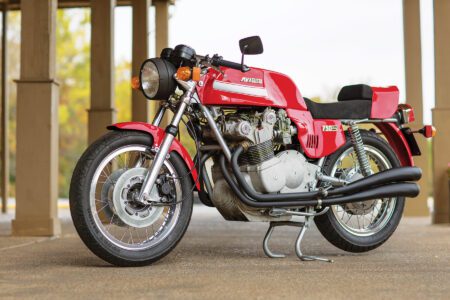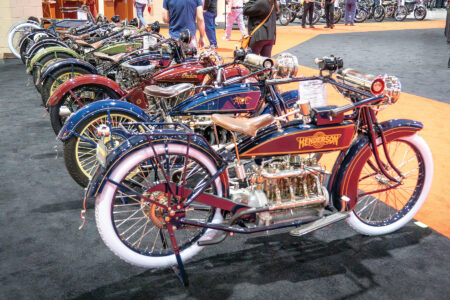
In all fairness, the two words that best describe my relationship to Mecum Auctions are “embedded” and “invested.” A rare combo, as I am both paid by Mecum to write catalog and magazine stories and deliver live commentary on their YouTube feed, and I am an interested party, meaning I cannot stop myself from buying motorcycles.
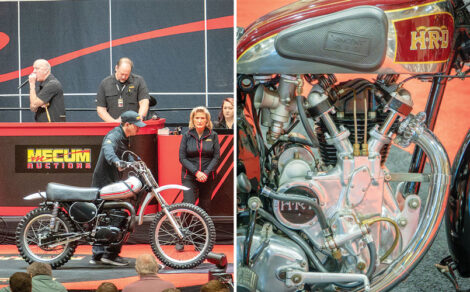
Especially when they’re cheap; eye-popping cheap, so cheap my inner moto-catlady, the one it physically pains to see a good bike go to an uncaring home, involuntarily raises her hand to “rescue” them. It’s the least I can do, because motorcycles have done so much for me. If that sounds self-serving or delusional, note that I did immediately forward two (of the five motorcycles I won) to friends. One of whom happened to be sitting beside me when a 1961 Matchless G12CS in gorgeous original paint came across the block, that I knew would sell for peanuts ($2,750 with fees), because the previous 14 Matchless and AJS singles and twins had set the pattern over the previous two days — buy now, ride tomorrow. My seat-mate also works for Mecum and was concerned about the complications of being both a buyer and seller, so he had no bidder paddle. I had no such compunctions, so I circulated amidst 600 other potential bidders, feeling like Dr. Strangelove as I forced down my bidding hand, again and again.
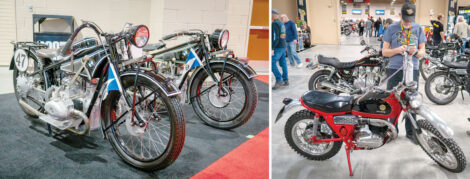
Before we dive into the details, here’s what you need to know: It’s a great time to buy a motorcycle or five, especially if you’ve always wanted a particular model. Because the price of everything is down, way down. If you’re a seller, well, you have my sympathy — my collection has plummeted in value as well. And still, I keep buying, because… an immaculate 1974 Bultaco Matador Six Days enduro with 168 miles on the clock, a full tool roll and manual in the tank box, plus a Bultaco fanny pack (as rare an accessory as a Heuer stopwatch), for $4,500. Full disclosure #2, I will likely put the Bultaco on Bring a Trailer, hoping to recompense my Mecum madness, but only after writing up a road test comparison with my equally immaculate, low-mile 1974 MZ ETS250 ISDT that I bought from the Moto Talbott Museum sale two months back. I was vindicated in paying $6,000 for Talbott’s machine, as an identical ultra-low-mileage ISDT MZ (albeit missing its essential tank top toolbox) sold for $4,950 at Mecum. Having recently paid nearly $1,000 for Corinna Mantlo to replicate my own missing leather toolbox, in retrospect, my savage lowball offer to Talbott was actually on the money. I won’t tell you how much he paid for the museum-worthy MZ a few years back, but it was a whole lot more than that. Like I said, a great time to buy, but a painful time to sell.
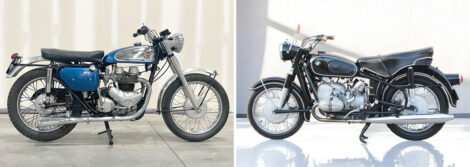
The Las Vegas auction is the bellwether event for motorcycle prices around the world, but that’s not saying much, as the old bike market everywhere else is dead, dead, dead. That’s why savvy Europeans bring fancy restorations to Vegas to sell; even in this crap seller’s market, at least motorcycles still sell in the U.S., unlike elsewhere. Let’s dig in on a few indicator machines sold (or not) at Mecum this year, pre-selected before the auction as indicator species, presented in no particular order but the date sold.
Lot F183 — 1967 Honda CL450 D Kit Scrambler
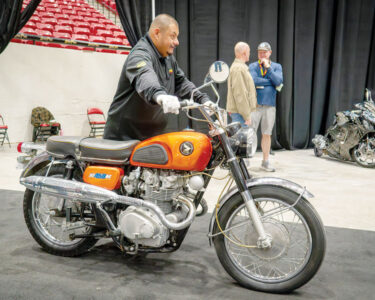
If you needed any proof that rare factory kits bolted on mass-produced models raise the value of a machine by several times, this is it. We’ve had a long run of Golden Dragon-equipped Honda CB350 and CL350s selling for crazy money, and that trend shows no signs of cooling off: two examples this year sold for $44,000 and $49,500. By contrast, this Black Bomber with D Kit Scrambler bodywork sold for merely $27,500, which seems a lot to pay for a pair of upswept pipes, a braced handlebar, trimmed chrome fenders, and a pair of checkered flag stickers. This D Kit just planted its flag as the Ultimate Scrambler; regardless, it had nearly 9,000 miles on the odometer. Scramblers, enduros, and ISDT replicas have suffered in value generally this year, whether British, Japanese, or German (see my notes above), unless of course it’s a 1960s Honda with a body kit. Why? Rare, I suppose, and, in fact, I’d never seen one before.
Lot F299 — 1969 Triumph T120 Bonneville
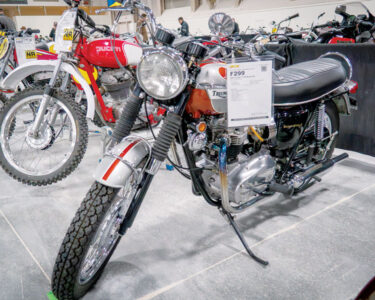
As the end of the line for classic Triumphs, the late 1960s T120R Bonneville has always had a strong demand because they’re beautiful and a lot of fun to ride. This 1969 example was fully restored and immaculate, showing about 500 miles on the clock, and unusual in its Olympic Flame / Silver Sheen paint job, which accounted for the strong sale at $11,000. Prices for Bonnevilles were all over the map, but good ones hovered around $11,000-12,000, with the top price this year for a ’61 pre-unit at $18,700. Four Bonnies sold at around the $2,000 mark, which is when I get itchy, as that’s what I paid for them in the 1990s. Six T120s sold around $6,000-7,000, and eight sold for $10,000 and up. So, Bonnie prices are holding, but there are bargains to be had if you want a rider.
Lot F333 — 1958 Harley-Davidson Arlen Ness Custom
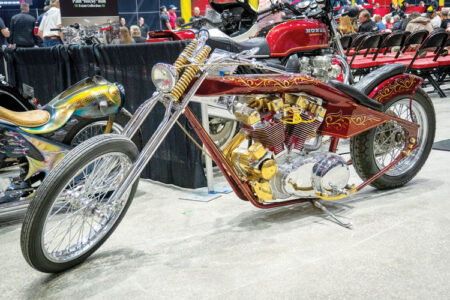
I had hoped to use this early Ness Digger as an indicator for “historic custom” values, but it failed to sell at an (asterisk) $35,000 bid. The question mark on that bid is due to the perfectly legal habit of auction houses to place phantom bids up to the reserve price, which only the auction house and the seller know. Setting that aside, this is a very early, one-owner Arlen Ness custom in the Digger style he invented, inspired by drag bikes, presented with totally elaborate finishes. The cases, rocker boxes, and exhausts were gold-plated and gun-engraved, and the paint job a multi-hand extravaganza: art by Horst, gold leaf by George, and paint by Ness, according to the fuel-tank-cum frame tube. Diggers might not be your thing, but they do have a place in the history of motorcycles, especially when built by Arlen Ness himself, one of the most successful customizers in history. There is a near-identical Ness Digger in the Oakland Museum, in case you’re curious: their curators know what matters.
Lot F214 — 1993 Honda CBR900RR
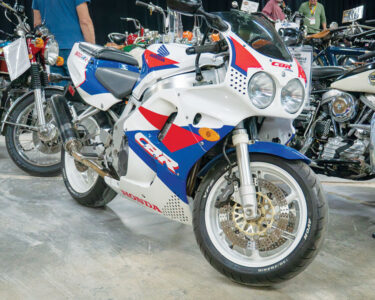
It’s a Honda, so you know you can hop on this bike and ride it anywhere, right? But 1990s and 2000s sport bikes in general are in the doldrums, with this machine fetching the best price of any of the eight Honda 900/1000s at Mecum: $8,800. Presented in beautiful original condition, the CBR900RR was the king of the hill in 1993, with 122hp and superb handling from its aluminum spar frame and triple floating disc brakes. Track it or daily it, this Honda could be relied on to do it all, if you’re cool with clip-ons and rearsets. $9,000 is a respectable price for a used sport bike that has not yet reached its apex of value as a collectible. Interestingly, only the Honda RC30 has achieved true collector status, and while none were available this year, last year, one would set you back around $50,000. And in the heady days of 2019, that figure was more like $120,000 for a low-mileage machine.
Lot S91 — 1965 BMW R69S
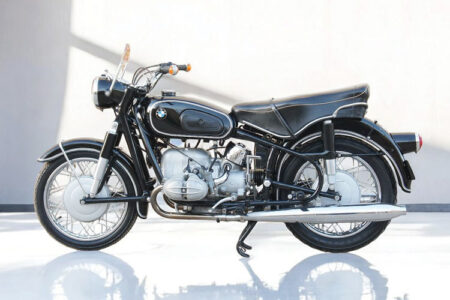
This looked like a nicely restored R69S, all shiny and correct, but not in my favorite configuration, with its small fuel tank and extra-grande Denfeld dual seat. A seat should not be larger than a gas tank, amirite? But that didn’t stop a buyer from dropping $14,300 for this beauty. Five R69Ss were offered this year, and four sold between $12,000-16,000. That’s definitely down for Teutonic sports bikes, which held their $25,000 value far longer than their British rivals, but have now joined the rabble scratching their heads wondering where their value has gone. Only a first-year 1955 R69 failed to sell, and it had all the groovy farkles: Pagusa saddle with R68-style bum pad, Avon fairing, Craven panniers, and very cool Schorsch Meier sports mufflers: bids fell short at $17,000, but that was more than any other Earles fork BMW fetched. Top price for a BMW? $209,000 for a second-year 1924 R32 in spectacular restored condition.
Lot S92 — 1957 Mondial GP Dustbin
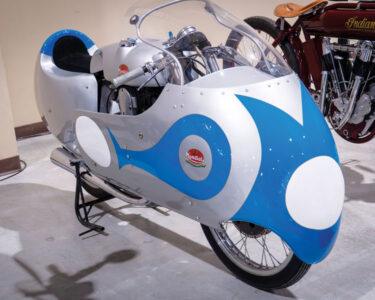
If you wanted a dictionary definition of Rolling Art, this Mondial is it. A very well-documented and genuine 125cc DOHC factory racer, it was originally raced by either Sammy Miller or Cecil Stanford in the 1957 125cc World Championship (4th and 6th, respectively). The history of this bike is well known; it was cut loose from the Mondial factory to Piero Nerini, then was sold to John Beale, and Guy Webster, then to the Moto Talbott Museum. The missing aluminum dustbin bodywork was re-created by the very artisan who had built the original in 1957, using the only existing original fairings as a pattern. An eye-poppingly beautiful and very historic machine, bidding stopped at $50,000, and it’s still available if you need the ultimate eye candy. Strangely, a sister machine without its fairing, a 1956 factory Mondial 250cc Bialbero DOHC racer, did find a new home at $110,000.
Lot S155 — 1968 CB750 Pre-production
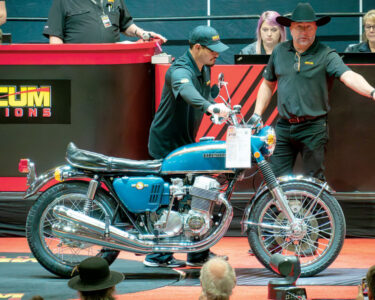
Rumors swirled before the auction that this machine would top one million dollars — cue Dr. Evil — but, when asked, I reminded the interested that this was a pre-production model, and, yes, had many unique features, but I would not call it a prototype. Honda destroyed those and probably would have done the same to this one, but it escaped its fate to be restored later. The bike is a stunner, with meticulous attention to the hundred little details that differ from the production model, like pumper carbs, unusual push-pull cables, Honda logo cast on the case, etc. etc. — all of which you can geek out over at CB750Prototype.com. This machine was sent by Honda to their super-dealer and race sponsor Bob Hansen in 1968, months before four other pre-production models were famously sent to a Las Vegas dealer’s convention in January 1969. So, this is the first CB750 to reach American shores, which accounts for its eventual $313,500 sale price. That compares favorably with another pre-production CB750 sent to the U.K. in 1968, which fetched $263,750 back in 2018. This bike won Best of Show at a very rainy Quail Motorcycle Gathering in 2024, and I was impressed that its owner braved the wet to roll his unique bike across the grass to collect his trophy; I thanked him for sharing this historic machine during the ceremony because it really is a special bike.
Lot S211 — Vesco Triumph T100R
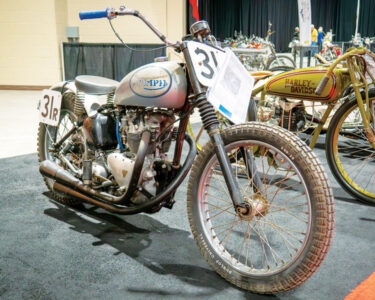
If you don’t know the name Don Vesco, under what rock do you live? He still holds the World Land Speed Record in a car (458mph in 2001), used to hold it on a bike (318mph in 1978), and was the first winner of the U.S. Grand Prix, held at Daytona in 1963. In short, a proper legend, and this was his first flat track/TT/drag bike, a 1955 Triumph T100R racer. The bike itself is rare enough, as T100Rs generally got used up long ago, and factory-supplied R models were always rare. Amazingly, or rather sentimentally, this machine is in as last raced condition, with a wonderful patina, Don Vesco’s original race numbers, and a set of flat track pipes on the right side that really set off the fine-pitch aluminum finning of the second-generation T100 models. Twin carbs, one gallon oil tank, tacho driven from the hole where the generator used to sit, etc., and no front brake. I thought it a very reasonable buy at $24,200, given it simply oozed history.
Lot S232 — 2004 Honda RC174 Replica George Beale
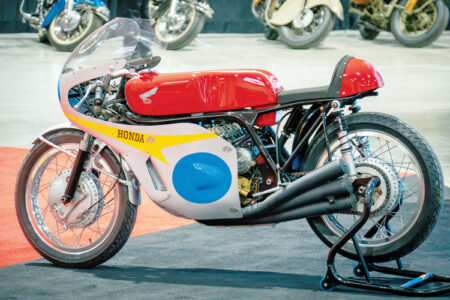
This is as good a time as any to talk about replicas. In 2004, George Beale built 10 replicas of the 1967 factory Honda RC174 six-cylinder DOHC 297cc Grand Prix bike. The original, which took Mike Hailwood to the 350cc World Championship, apparently no longer exists, but several examples of the RC166 250cc six are out there, including at Team Obsolete, with another in Germany, and surely one at the Honda Museum in Japan. Replicating the 297cc version, which was simply over bored to fit the 350cc GP rules, was not exactly a piece of cake, but enough parts and drawings exist to make such a project feasible. George Beale liked making replicas of super-rare GP bikes, but this was his masterpiece, being fiercely complex (4 valves per cylinder x 6 plus cams, buckets, shims, etc.), and certainly ambitious. God bless George; he never tried to pass off his replicas as anything other than that and still fetched $250,000-300,000 for each 1:1 scale model he built. Sadly, the same transparency cannot be said of many other replicators, especially those building early American racing motorcycles and Crockers, which always seem to have “provenance.” The Crocker story is especially problematic, and woe betide anyone plunking down big change for a V-twin… the real story is coming, and I understand a certain insurance company is investing in carbon dating technology to sort the wheat from the chaff. By contrast, the Brough Superior Club has a system in place for replica SS100s, real examples of which fetch Crocker money. SS100 repros, whether using a new engine or frame or both, are given particular identifying numbers, and have held steady values at around 50-75% of a genuine machine, depending on what was replaced — the more new, the less value. That still works out to $250,000-400,000, but at least nobody feels burned because they know what they’re getting.
Lot S310 — 1971 Husqvarna 400 Cross
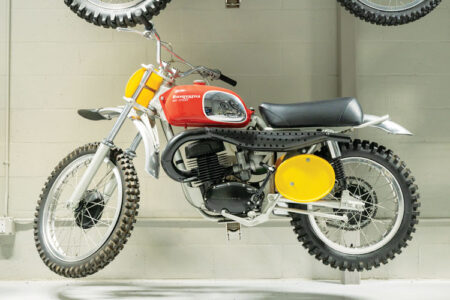
I don’t know if motocrossers are on a downward trend, but this one surprised me: a beautifully restored 1971 Husky 400, the king of the hill in its era, and a movie superstar thanks to On Any Sunday. But, there were no fewer than 37 Husqvarna dirt bikes on offer this year, so last year’s identical model 400 Cross (with only 13 Huskies on sale) fetched the same price — $5,500 — but for an unrestored bike. That’s hardly a trend, and, at a guess, I’d say the 2026 Husqvarna market saturation only dipped the sale price by around $1,000 on average, compared to 2025. Interestingly, an ex-Steve McQueen Husky 360C Sportsman failed to sell, as did a 1966 250cc factory racer. Where is the love? Or, are there simply too many good Husqvarnas out there?
That’s a question lingering on many enthusiasts’ minds. I personally know a dozen collectors with more than 500 machines languishing in warehouses, barns, and museum inventory, and most of these guys (yes, always men) are old. Mecum’s EJ Cole auction of 2015 was the starting gun of the great sell-off, and the flood of warehoused collections being released shows no sign of abating. Mecum insiders admitted they turned away hundreds of motorcycles for 2026; they were full up and had already stretched the auction an extra day, starting things off on a Tuesday this year. Simple laws of supply and demand suggest we will see a further drop in prices for motorcycles with little following among younger collectors: British singles and twins, antique motorcycles, high-production anything. The lens of generational interest in motorcycles constantly shifts forward in time, and at the moment, rare 1970s and ’80s machines have the buzz. But nostalgia doesn’t explain everything about the collector market. And then there’s the economy and general political instability/fear of continued war, which is killing the European market, and remains the X factor for the U.S. market. My advice? Buy the bikes you want, and enjoy them, because you never know what’s around the bend. MC