
French design details
Your idea about sharing short stories about collectors’ favorite motorcycle is difficult to choose. Asking your parents which one of your siblings is their favorite?
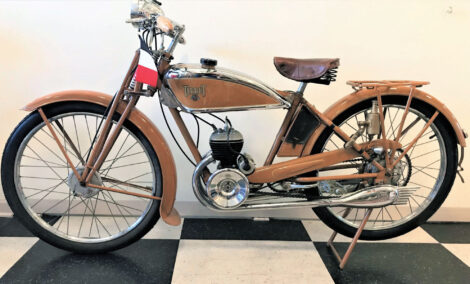
I like all of mine, or I would not have chosen to keep them in our TV room/Vintage Motorcycle Den. However, one of my favorites is our 1935 Terrot MT-100 Grande Luxe. It is a twin exhaust 100cc single two-stroke with an exposed flywheel and wood hand grips. Today, we would call it a moped as it uses direct drive. It is always in gear. Instead of a kick-start lever, it has bicycle pedals. To start, the rider pulls in the clutch and pedals away, eventually releasing the clutch and the motor comes to life. The right side hand grip is the throttle.
I found this at a swap meet in Italy in 2012. It had a badly rusted and dented tank, but I was enamored with the twin “ray gun” exhaust tips and the pre-war general styling. I was able to find a slightly dented replacement tank on French eBay. When I brought the tank to a silver smith to remove the dents, he said he could not get his tools into the top of the tank to “pop” the dents flat. I suggested that he cut out the bottom of the tank to get access, which he did. A friend in Italy found the period correct Terrot tank transfer. The saddle and toolbox are the original 91-year-old leather. The headlight, which runs off the rear wheel friction generator, was another eBay find from the same collector who I got the tank from.
Burt Richmond, Illinois
Thanks for sharing one of your favorites, Burt. Elaborate, the twin-port engine that prompted designers to go with a dual exhaust, in chrome plating, along with the chrome plated flywheel. Quite detailed for a 100cc “moped,” as you call it. — Ed.
The contributions of Rob Iannucci
Racing Motorcycles: Authentic pure passion. Some just gnaw atcha, others get bone deep.
As a cycle crazed kid, Iannucci was a word I never heard before (along with Burt Munro). As I grew old over 50 years along with my bikes, I heard so many motorcycle stories that it seemed all bikers had the same tales, until I became aware of Rob Iannucci, Dave Roper — Team Obsolete.
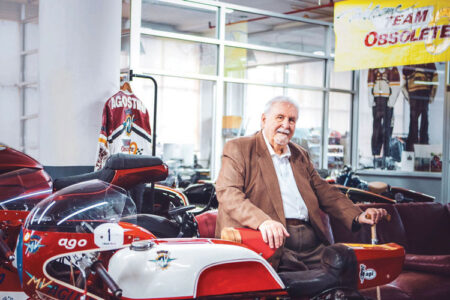
Iannucci wanted nothing more than to obtain, restore, prepare, and run the old bikes as they were built to race. And because of that, Dave Roper became the most winning classic bike rider of all time. While they were having fun and success, they created the classic bike, vintage, race scene we now know and love.
His checkered flag has waved, but his obsession lives on with Team Obsolete, in the machines and the vintage/classic scene he brought to life. Take a well-deserved parade lap Mr. Iannucci, and may your bikes always run at speed.
Dave Rorty via email
We feel lucky to have had John Lawless write a fine story about Team Obsolete, which included an interview with Rob Iannucci and photos of some of his best road racers for our November/December 2025 issue. The forming of AHRMA was spearheaded by Iannucci’s passion for vintage road racing, and that was 40 years ago. — Ed.
Life with fiberglass fuel tanks
Great article about gas tank restoration. I agree, success is in the obsessive execution of all the steps of cleaning, abrading the rust, etching, neutralizing, rinsing, and especially drying.
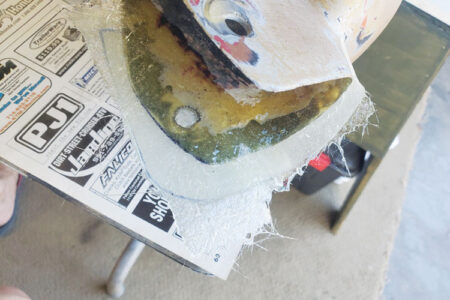
I need advice now on the restoration of a Montesa Cota 49 fiberglass tank, the elegant one-piece tank and seat. Previous owners left gas to decay in the tank, which also saturated the interior with oily residue. This led to spalling and continual clogging of the fuel filter.
Is there a way to inflate a diaphragm of sorts into the tank and adhere it? I’m hoping to not have to cut the bottom of the tank away to install a new secondary tank inside the original.
Thanks for any advice.
Bob Wills, New York
I’m working an early Bultaco Sherpa S. As we get into the fuel tank part of the project, I’ll see what approach we take and this may prompt a How-To for the magazine. — Ed.
Retro comparisons
I’m a relatively new subscriber of your magazine, first year, but just renewed for three more. I currently ride a 2021 Kawasaki W800. As with most W800s, I purchased it as a leftover. Here in Canada, they are even rarer, and I’m told that they only import 50 a year from Japan. 42,000km, 26,000 miles, in three summers of riding. Short summers, and I still work full time, or it would be closer to 60,000.
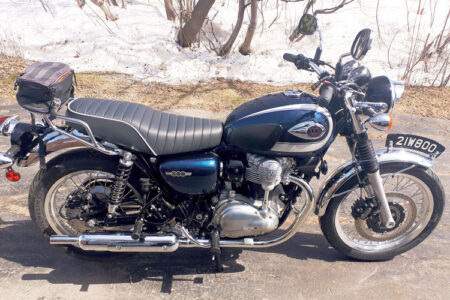
I would like to see stories that compare original bikes to their so-called modern classics; the W800 compared to the W1, the W2, and W650. Compare Royal Enfields, Bonnies, Honda CBs to their modern retros.
Well, enjoy your coffee and the rest of the day.
David Chesson via email
While the Motorcycle Classics On The Radar department typically compares bikes contemporary to each other, this seems like a good reason to bend our rules a bit and compare the new retro version with the original machine. — Ed.
Honda Nighthawk prices, then and now
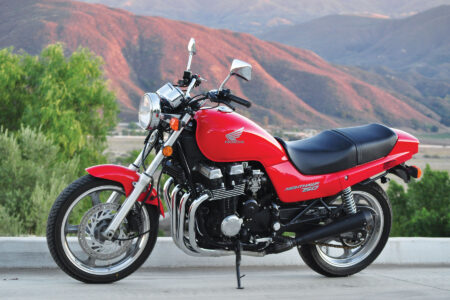
I just received my May/June 2026 issue of Motorcycle Classics in the mail today. The article on the 2003 Honda 750 Nighthawk caught my eye right away because I used to have a 1993 750 Nighthawk. Except for colors, they were the same bike for many years. But in the spec sheet in the article, it showed the then/now price as being $3,998/$3,998. I don’t know where Mr. Gingerelli got his info on the prices, but I have many years of Cycle World‘s buyers guides, and I looked at 2003, and it showed the new price at $5,799. I bought my ’93 as a new leftover in 1995 and I paid $5,299 for it.
Mike Giebler, Kansas
The Nighthawk was first sold in 1991 for $3,995, but MSRP crept up to $5,799 by 2003. — Ed.
Show us your classic motorcycles and projects, give us content feedback, share a story, or make a suggestion for future issues. We love hearing from our readers!
Send your letters to 1503 SW 42nd St, Topeka, KS 66609, or email us at Editor@MotorcycleClassics.com. Please note that unless you specify otherwise, we may consider your correspondence for publication in Motorcycle Classics. Supply your contact information if you need a quick response. Keep the letters coming!


