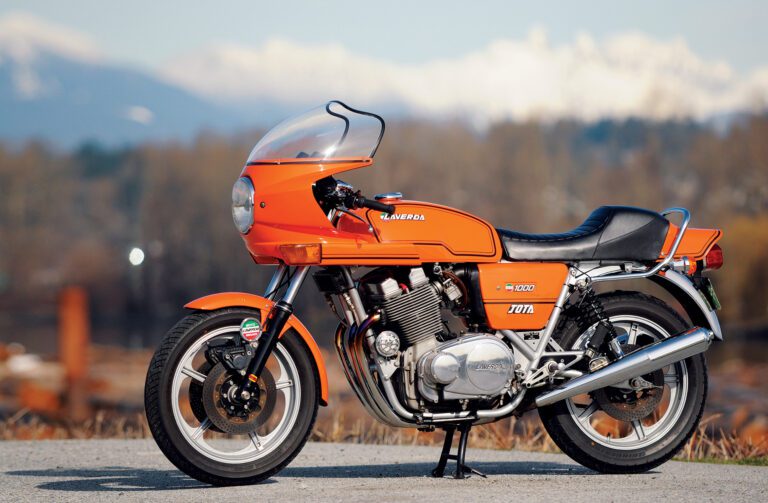
Laverda Jota 1000
- Years produced: 1976-1981
- Number produced: NA (Approx. 7,100 triples total)
- Claimed power: 90hp @ 7,500rpm
- Top speed: 146mph (period test)
- Engine type: 981cc DOHC air-cooled inline triple
- Weight: (dry) 234kg (515lb)
- Price then: $5,950 (1981)
- Price now: $4,500-$10,000
- MPG: 35-45
I’m standing outside the Fox and Fiddle pub on the Langley By-Pass in Surrey, British Columbia, Canada, with Steve Gurry and his 1981 Laverda Jota 1000, its orange paint a fireball in the evening sunshine. It’s the loudest bike in the parking lot — and he hasn’t even started the engine.

Then he thumbs the 1,000cc triple’s starter. The tarmac shudders as the beast comes alive with a bellow, its raucous beat echoes off the pub wall and stray gusts of exhaust beat at my face. It has the seething, restrained menace of an offensive lineman just before the snap.
Steve climbs aboard, slips it in gear and idles the Jota toward the highway entrance, the engine thrumming its rhythmic beat. He pulls out on the street, checks traffic and cranks the throttle wide, ramming open the pumper jets in the three big Dell’Orto carbs. With a snarl like a top fuel dragster, the Jota rips away, firing two rooster tails of raw gas high into the air. It’s pure theater.
Laverda and the Jota
Every successful bike maker has a standout model, the ne plus ultra, the one where everything comes together perfectly, producing a classic bike that exemplifies the brand. For Triumph it was the Bonneville, for Moto Guzzi the Le Mans and for Indian the Chief. For Laverda, it was the Jota.
Not for the first time in motorcycling history, the Laverda Jota is the result of an enterprising salesman telling the factory what it should build. In the 1950s, it was U.S. distributor Bill Johnson who persuaded Triumph to build the Bonneville; Joe Berliner asked Ducati for a police bike and got the Apollo; and it was U.K. Laverda distributors Slater Brothers who came up with the idea for the Jota.

Production of the Laverda 750 twin was barely underway in 1969 when the factory announced intentions to produce a 1,000cc triple, promising to show a prototype at that year’s Milan show. General manager Massimo Laverda claimed the new machine would be both lighter and narrower than the new Honda CB750 (471 pounds and 22 inches). These were ambitious targets, but the only one Laverda missed on was the timing. Though the company showed a 1,000cc triple at Milan, it was a single overhead cam design clearly based on the twin, and it was soon abandoned. The final prototype, shown in Milan in 1971, was an all new inline 3-cylinder engine with chain-driven double overhead cams, a new duplex-cradle frame and a Laverda twin-leading-shoe front brake.

Production of the 1000 eventually got underway in early 1973, still with the drum brake, though for 1974 a revised version, the Laverda 1000 3C with dual Brembo disc brakes at the front (a few early 3Cs wore a single disc), was announced. In a prescient move, higher performance camshafts, designated “4C” became an available option. Even in stock form, though, the 3C was the bike to beat, with a tested top speed of 133mph.
For 1975, the 1000’s specification was revised again, this time with Laverda’s own cast wheels replacing the wire spoke Borrani rims, and with a third brake disc added for the rear wheel to create the 1000 3CL (L for lega, meaning alloy). The rest of the Jota story comes from across the English Channel.
The English connection
In April 2003, I was riding through rural Herefordshire, England, when a familiar red, white and green roundel on the front of an unremarkable industrial building caught my eye. “Slater Laverda,” said the sign. Of course, I had to stop and go in. Behind the counter was the friendly and self-effacing Richard Slater: the Richard Slater, now gray-haired, but still full of energy. It was around 1970 that Richard and his brother, Roger, became the U.K. importers for Laverda.

Richard showed me around his parts inventory and the restored bikes he had for sale, and also invited me to look up Roger, who lives in the U.S., when I returned home. Our acquaintance was renewed when both Slater brothers appeared at the inaugural North American Laverda Owners’ get together at Willow Springs in 2005.
Roger Slater’s race development skills were honed on Egli-framed Vincents, which he built under license, so when the first 3C arrived at their premises back in the mid-Seventies, Roger Slater recognized its potential. By 1975, Slater Brothers were offering a triple fitted with factory optional 10:1 pistons and 4C race cams. Slaters fitted fork yokes from the SFC750 endurance racing twins to give a shorter rake; and added an exhaust system designed in cooperation with Ariel Square Four specialist Tim Healey. The bike, called the 3CE (E for England) was essentially the basis for the Jota.
In 1976, Massimo Laverda agreed to supply a factory-built 3CE exclusively for sale in the U.K. Whether it was Massimo or Slater Brothers who came up with the name Jota seems unclear. Lamborghini had used the name for its high-performance Miura Jota, but it’s also said that music buff Roger Slater found the name in a musical dictionary. Supporting the former notion, enthusiasts say that if Ducati is the Ferrari of motorcycles, then Laverda is the Lamborghini; either way, the name stuck.

The 1976 Jota was a sensation. Making around 90hp, it was the first production motorcycle trapped at more than 140mph. Slaters entered a Jota in the Avon Production series of races in the U.K. with Peter Davies as rider. Davies went on to win the series outright in both 1976 and 1978, and Jotas claimed the championship four times in total, with more victories in 1979 and 1980.
By 1977, Jotas equipped with a left-side shifter and a Harris exhaust system were being sold in the U.S. by Lance Weill of Rickey Racer in Pomona, Calif. With the introduction of the 1200 in 1978, all of the triples adopted the same frame with more forward-leaning rear shocks and Marzocchi forks. Engine reliability problems surfaced in 1979 and were principally associated with crankshaft bearing and cylinder head changes. These were quickly resolved in 1980, and for 1981, the Jota received a major makeover with a new, more powerful alternator that required fitting the ignition pickups on the left end of the crankshaft instead of the right. U.S. models got softer cams and lower compression pistons, too.

1981 marked the end of the line for the “real” Jota. Early triples featured a 360-degree crankshaft, with the outer cylinders rising and falling together, and the center 180 degrees off. While the “180” engines had a distinct sound and feel, they were faulted for vibration. Although some Jotas were sold in 1982 with the 180-degree engine, these were left-over 1981 models, for in 1982 the factory switched to a new crankshaft with a smoother, 120-degree firing interval. For 1982 the factory offered a “Jota 120” styled like the original, but that was replaced by the RGA Jota, basically a stripped down RGS and with none of the character of the “original” Jota.
Steve Gurry’s Laverda Jota
The motorcycle that breached the peace at the Fox and Fiddle is a 1981 model with the later Nippon Denso alternator and left-side ignition pickup. A speedometer marked in kilometers means it’s probably a Canadian model, although that could be misleading. Either way, it would have originally had 8.0:1 compression pistons and touring A12 camshafts. Though the compression is still stock, Steve has installed new camshafts with a more sporting profile, as supplied by North American Laverda parts guru Wolfgang Haerter as well as less restrictive Campbell reproduction mufflers.
What is astonishing about Laverdas in general, and the late 180-degree triples in particular, is how durable they are. Though meticulous about maintenance, Steve rides his Jota hard; yet in spite of covering at least 60,000 miles, the engine is oil-tight and burns negligible amounts of oil. It’s never been apart except for routine maintenance and top-end upgrades.
A look at the outside of the engine offers some clues to the robustness inside: heavily finned and ribbed sandcast engine cases; solid webbed and gusseted frame; sturdy cycle parts and top-quality components from Bosch, Brembo, Marzocchi and Nippon Denso. With its own foundry, Laverda was able to make many of the major components it used — such as the engine cases and frame, metal bodywork and more — as well as casting its own wheels.
Though not restored as such, Steve has carried out an engine-out repaint with the result that his Laverda Jota looks better than new.
Riding the Jota
Laverda triples seem to like lots of fuel, and starting the Jota requires choke most of the time, sometimes even when the engine is warm. The throttle should stay closed, though: Too much air will stifle the engine, and vigorous use of the throttle will work the carburetors’ pumper jets, flooding the cylinders.

The next challenge is the clutch, which requires Popeye-sized forearms to operate. The triples got a hydraulic clutch in 1981, but while the action is smoother, the effort required is still considerable. And while the original 3C weighed a relatively modest 470 pounds, later models like Steve’s Jota scale more than 515 pounds dry. With a kickstand that is almost impossible to deploy from the 32-inch seat perch, mounting and dismounting the Jota can be a challenge for shorter people. It’s always best to park the Jota on its center stand, which is both rugged and adjustable.
The engine’s considerable torque right off idle makes takeoffs easy, however, and once rolling the brute seems to lose its bulk and weight. The riding position is aggressive, though the patented adjustable handlebars allow for a number of options. In spite of its 1-2-3-miss firing order (the 180 engine has been likened to a 4-cylinder engine that’s only firing on three), power delivery is surprisingly smooth, though vibration does become obtrusive at high revs, say above 6,000rpm. What’s most impressive, though, is the loping, locomotive-like torque that propels the bike along at highway speeds.
But it’s on fast sweepers that the big Laverda really wakes up. The relatively relaxed steering geometry mean some effort is required to change direction, but once heeled over, the Jota is rock steady, holding its line solidly in spite of pavement ripples. A series of fast turns is huge fun on the Jota: big engine braking aids the setup, firm pressure on the bars initiates predictable counter-steering, and accelerating through with the engine spinning between 4,000 and 5,000rpm elicits a resonant boom from the airbox and a roar from the exhaust: an Italian concerto!
Owning one
Keeping a Jota on the road is relatively straightforward, although a strict maintenance schedule is essential. There’s no spin-on oil filter to change, but the oil must be refreshed every 1,500 miles. However, changing the sump oil screen requires removing the exhaust headers, but this is a fairly quick job. The cam chain and primary chain are both adjustable from outside the engine (follow the instructions in Tim Parker’s excellent Laverda Twin and Triple Repair and Tune-up Guide, but should be replaced at 20,000-mile intervals.

Valves are a simple shim-and-bucket design and use Honda shims, but they need to be checked for clearance every 6,000 miles with the engine cold; and the camshafts have to be removed to replace any shims.
Laverda 180-degree triples are huge fun to ride, and much more rewarding in both visceral and acoustic feedback than a typical modern motorcycling appliance. By modern standards, the handling feels heavy and slow, and the Jota’s estimated 90hp (less for the later low-compression models) is unimpressive compared to a contemporary sport bike.
In many ways, they’re the antithesis of the traditional lithe, lightweight Italian motorcycle, yet much more usable in that real world we’re all so familiar with. Solidly built, desirable, immensely durable, and with excellent parts backup, Laverdas are likely to become even more collectable in the future. MC
The softer Jota: Jarama
Incredibly, as I’m setting up for our photo shoot another Laverda arrives. It’s ridden by Laverda enthusiast Jim Bush, who’s just acquired a 1977 Laverda Jarama, and seeing us, he has to stop.
The Jarama, named for the race circuit outside Madrid, Spain, was essentially a Laverda 1000 3CL (the L meaning Laverda cast wheels) modified to suit the U.S. market with a left-side shifter (most European 3CLs were sold with right-side shift), reflectors and a quieter exhaust. Though never reaching the acclaim of the Jota, the Jarama’s more conservative riding position and softer engine tune make it a very practical “daily driver.” And its mellow green color provides a tasteful backdrop to the screaming orange of the Jota.
Not entirely successful, some Jaramas were shipped from the U.S. to Slater Brothers in England, where they were sold at a discount or, in some instances, converted to Jota specs to speed up sales. These became known by insiders as “Jarotas.”
Resources
• The International Laverda Owners Club
Parts
• Columbia Car & Cycle: Wolfgang Haerter
• Slater Laverda
Read more about the motorcycles mentioned in this article:
• Honda CB750 Four: A Classic for the Masses
• Laverda 1000 3C